


AI Robot Cleaners Leave the Lab for China's Living Rooms

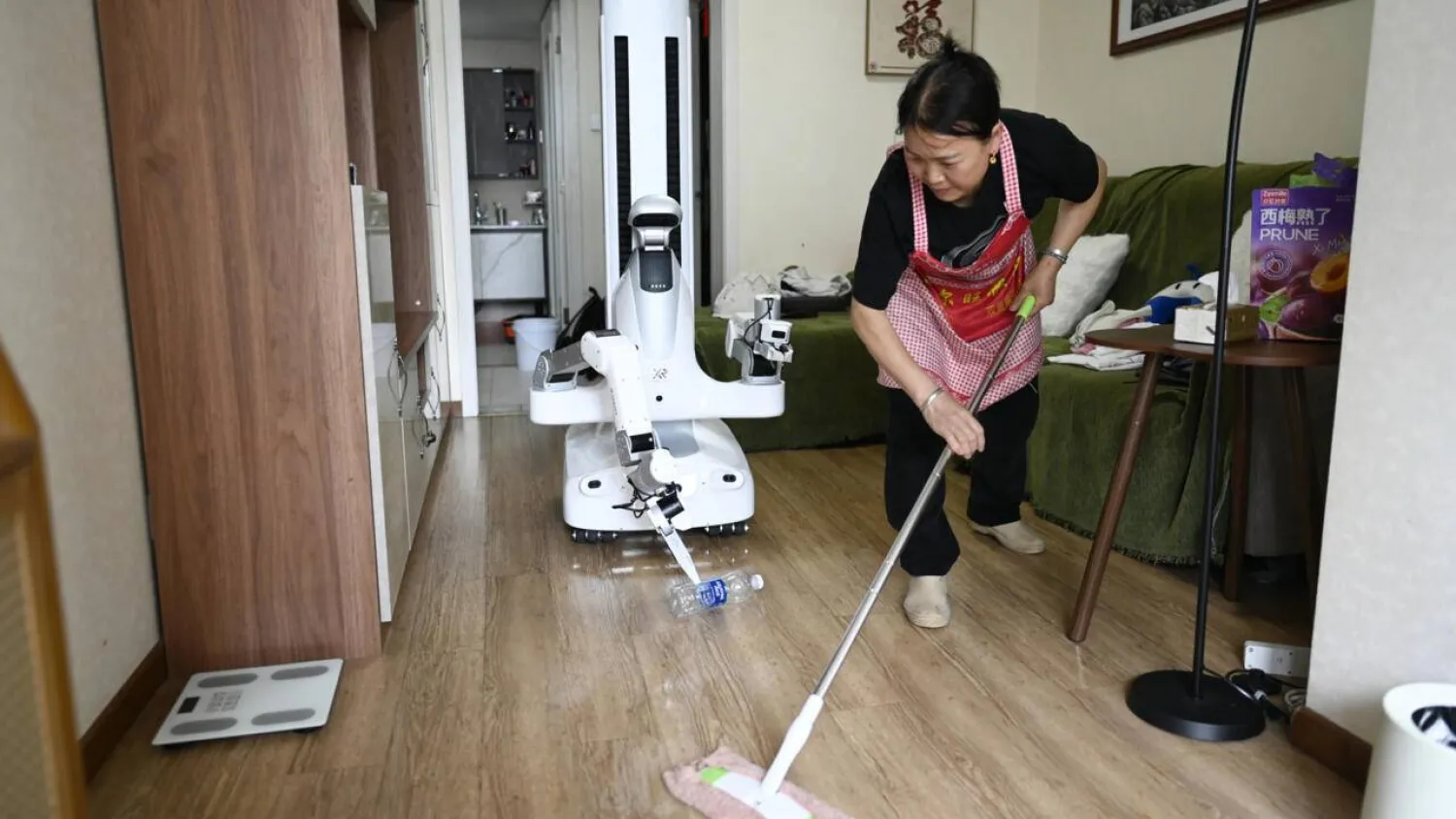
The service is a baby step towards a future in which robots increasingly take over manual labor from humans. WANG Zhao / AFP
TT

AI Robot Cleaners Leave the Lab for China's Living Rooms

The service is a baby step towards a future in which robots increasingly take over manual labor from humans. WANG Zhao / AFP

Beijing cleaner Lin Meiqiong found her work a little easier the day she was paired with an unlikely new colleague -- a tall, wheeled robot with AI-powered tidying skills.

The 56-year-old and her white-and-silver partner, fitted with cameras and two mechanical claws, are part of a new human-robot cleaning service offered by Chinese household help platform 58.com.

It's a baby step towards a future espoused by tech evangelists in which robots increasingly take over manual labor from humans -- though at the moment, such services are largely a data-gathering exercise for companies and a novelty for curious customers.

"It's definitely different," Lin told AFP in between cleaning the kitchen and wiping down windows.

"I used to have to do everything myself," she said. "It's reduced the workload a bit."

The cleaning service, a collaboration between 58.com and Chinese robotics company X Square, costs 149 yuan ($22) for three hours and is available in Beijing and tech hub Shenzhen.

Helped into the apartment by an X Square engineer, the AI-operated Quanta X1 Pro robot uses its cameras to identify areas it could spruce up.

As Lin scrubbed the floor on her knees, it picked up rubbish and folded clothes strewn across a sofa.

Grasping a pair of dark grey trousers, it raised its upper body to stretch the fabric taut, before laying it flat and arranging it into neat halves.

The process took several minutes and resembled a child learning to fold clothes for the first time.

Future iterations of the robot will respond to voice commands and even be able to chat, said the engineer, Hu Bowen.

- 'Better than a lab' -

Around 200 households have booked the service since it was rolled out in March.

Tan Pei, who works in advertising and booked the robot to clean her Beijing flat, said she had chosen the service because she was interested to "see what it could do".

"Even though it's not that perfect, there are still parts of it that surprised me," such as folding a pair of trousers "quite well", she said.

China's robots have wowed audiences with fluid dancing and set-piece martial arts displays onstage, but their application and performance in real-life settings remains limited.

For companies like X Square, the logic of launching an imperfect service lies in data collection for so-called embodied artificial intelligence.

Unlike large language models trained on vast quantities of internet content, robots lack comparable real-world datasets.

"We don't have a robot internet yet," Christoforos Mavrogiannis from the University of Michigan told AFP.

"It is much more informative to put the robot out there and study what happens than staying forever in the lab."

X Square engineer Hu said he sends his robots to work in a "completely unfamiliar environment".

"That is very challenging, but this unfamiliar data is also very helpful for the robot's growth."

As investment into embodied AI booms, similar trials in China include robots directing traffic in cities like Hangzhou or working on factory floors.

On the domestic help front, firm GigaAI also plans to deploy 100 humanoid robots into households in central Wuhan this autumn for free home-service trials.

Investors have poured more than 57.7 billion yuan ($8.5 billion) into China's embodied AI industry so far this year, already soaring past the total for last year as a whole, according to business database ITjuzi.

- 'Very elementary stage' -

But a myriad of hurdles stand in the way of widespread deployment.

As the Quanta X1 Pro's clothes folding demonstrated, robots still can't match human dexterity.

"Even though many companies are working on building better hands and building autonomy for hands, we don't have that yet," the University of Michigan's Mavrogiannis said.

There are multiple regulatory issues even once the physical capability is there.

Privacy will become a big issue, as robots would have access to huge amounts of personal data.

"We don't know where that data is going, where it's located... who is looking at that information," said Valeria Alessandra Macalupu Chira from Queensland University of Technology.

The safety of clients and their homes is another unresolved issue.

"I think we are still at a very elementary stage," said Yang Jianfei from Singapore's Nanyang Technological University.

Robots currently require supervision by humans who can activate emergency stop functions, he noted, and there are not yet recognized industry-wide safety standards.

Experts agree broad adoption seems a long way off.

Asked whether she thought robots would revolutionize her industry, cleaner Lin did not seem too concerned.

"Compared with people, it's obviously still not quite there," she said. "After all, it's a robot."



World Bank: Saudi Arabia Presents Global Model for Responsible AI Innovation in Digital Learning

The Saudi flag. File/Asharq Al-Awsat
TT

World Bank: Saudi Arabia Presents Global Model for Responsible AI Innovation in Digital Learning

The Saudi flag. File/Asharq Al-Awsat

The World Bank has documented Saudi Arabia's experience in utilizing AI in learning, affirming that the AI Sandbox for Digital Learning (AISB) initiative represents a pioneering national model for countries seeking to advance responsible innovation and improve the quality of digital learning, SPA reported.

This came in a study published by the World Bank titled: "AI Sandbox for Digital Learning in Saudi Arabia: Driving Socio-Economic Impact through AI Innovation in Digital Learning." The study reviewed the Saudi experience as an integrated model that combines practical experimentation, capacity building, governance, and the orchestration of an innovation ecosystem within a single national platform led by the National eLearning Centre (NeLC).

The study highlighted that the initiative actively contributes to enhancing digital learning quality, developing human capabilities, and boosting national workforce readiness. Furthermore, it enabled institutions and innovators to develop and test AI solutions within real-world, secure learning environments, directly aligning with the objectives of Saudi Vision 2030 and maximizing the socio-economic impact of innovation in learning.

The study also noted that the Saudi experience transcends the mere testing of technologies; it provides an environment that fosters the generation of evidence-based knowledge, strengthens partnerships, and accelerates the adoption of responsible innovation. Consequently, this helps build a sustainable ecosystem for AI in digital learning.

The World Bank concluded that the Saudi experience has laid a solid foundation to build upon, positioning Saudi Arabia to serve as a regional and international reference point for responsible, evidence-informed innovation.

The AISB, led by NeLC, is implemented within an integrated national ecosystem in partnership with several government institutions.


South Korea's SK Hynix to Invest $64 Billion in Memory Chip Plants

FILE PHOTO: The SK Hynix logo appears in this illustration taken August 25, 2025. REUTERS/Dado Ruvic/File Photo
TT

South Korea's SK Hynix to Invest $64 Billion in Memory Chip Plants

FILE PHOTO: The SK Hynix logo appears in this illustration taken August 25, 2025. REUTERS/Dado Ruvic/File Photo

SK Hynix said it would invest 100 trillion won ($64.38 billion) to build new chip plants, including one for NAND flash memory, as part of a massive South Korean investment drive aimed at spreading returns from the AI boom beyond Seoul.

The projects in the central city of Cheongju outlined on Thursday are included in a broader $2.1 trillion plan unveiled by the chipmaker and its local rival Samsung Electronics this week that also included a new chip cluster in the southwest and existing projects.

The huge capacity buildout by the South Korean chipmakers is a major political win for the country's President Lee Jae Myung, who wants the AI windfall to help revive economies beyond ⁠the Seoul metropolitan area, ⁠though it is stoking fears of a painful reckoning if AI spending cools.

At an event on Thursday attended by Lee, SK Hynix CEO Kwak Noh-jung said the company would spend 80 trillion won to build a new factory for NAND memory chip production by 2029 and 20 trillion won for a chip packaging plant by late 2027 in Cheongju.

The plan to invest 100 trillion won in Cheongju was announced on Monday, but details of the investment were not provided at the time, Reuters reported.

South Korea is hoping the investments will ⁠double the country's memory chip production capacity within five years. Samsung and SK Hynix are the world's largest manufacturers of memory chips alongside US rival Micron.

The investments come as demand from AI hyperscalers has caused a global shortage of all types of memory chips. Prices for both NAND flash memory, a storage chip that retains data even when a device is turned off, and DRAM have soared to historical highs.

SK Hynix shares ended down 15% and Samsung shares closed 9% lower on Thursday, hit by a global selloff in chipmakers as Meta Platforms' plan to sell computing power raised questions over excess AI computing capacity.

Michael Burry, the investor whose successful bets against the US housing market in 2008 were recounted in the movie "The Big Short," expressed caution about the massive South Korean investment plan in a subscriber-only Substack ⁠newsletter on Tuesday, the Wall ⁠Street Journal reported.

The investment drive set off alarm bells for Burry over whether the massive sums of money being poured into AI could ever generate appropriate returns, according to the report, which added that he had made more bearish bets against AI-related stocks.

"I see that as the beginning of the end," he told subscribers.

At the SK Hynix event, Kwak expressed confidence in AI-driven demand for chips.

"While demand for NAND has been increasing and is expected to continue growing in the future, NAND supply is constrained," he said.

SK Hynix said it planned to start construction of the new Cheongju NAND factory, known as M17, next year.

In April, SK Hynix broke ground on the P&T7 fab at Cheongju, a dedicated advanced packaging facility for AI memory, including high-bandwidth memory.

However, the company cautioned in a filing this week that the long-term investment plans could change depending on global chip demand and spending by major customers.

Factors such as delays in selecting and securing construction sites could also cause it to postpone plans, it added.


Microsoft Partners with Singapore's Lightstorm to Build India-Southeast Asia Undersea Cable

FILED - 30 January 2026, Bavaria, Munich: FILE PHOTO - The Microsoft logo can be seen on the Microsoft Germany headquarters building in Munich. Photo: Sven Hoppe/dpa
TT

Microsoft Partners with Singapore's Lightstorm to Build India-Southeast Asia Undersea Cable

FILED - 30 January 2026, Bavaria, Munich: FILE PHOTO - The Microsoft logo can be seen on the Microsoft Germany headquarters building in Munich. Photo: Sven Hoppe/dpa

A consortium including Microsoft and telecom startup Lightstorm plans to build a new undersea cable linking India with Malaysia and Singapore as technology firms compete to expand AI and cloud infrastructure in India, one of the world's fastest-growing data markets.

The consortium, whose other members include Tata Communications , Singapore Telecommunications, Singapore's ASEAN Cableship and Japan's NEC Corporation, will construct the I-2SEA cable to support AI, cloud and hyperscale workloads, Reuters quoted the companies as saying on Thursday.

They did not provide additional details including the investment ⁠size.

The network will ⁠span 3,600 km and have landing stations in Machilipatnam in the southern Indian state of Andhra Pradesh, where Meta and Alphabet have announced data centers.

The cable is expected to be operational in the fourth quarter of 2029, Lightstorm Group CEO and Managing ⁠Director Amajit Gupta told Reuters in an interview.

The I Squared-backed company currently connects 19 AI and cloud zones across India through terrestrial fiber cable networks, with the new network expected to bring this number up to 29, Gupta said.

India's operational data center capacity could double from the current 1.4 gigawatts by 2027, based on projects under construction, and increase five-fold by 2030 if planned projects are fast-tracked, Macquarie Equity Research ⁠said in ⁠a report last October.

Undersea cables carry roughly 95% of the world's internet traffic. India currently has 17 active submarine cables with a maximum potential capacity of 960 terabits per second, and at least 10 more have been publicly announced, according to TeleGeography, a telecommunications research firm.

Separately, Lightstorm plans to list in India in mid-2027, Gupta said, without disclosing any other details. The company was seeking a valuation of up to $1.5 billion in March, according to a media report.