


Nvidia’s Huang Says Society Needs ‘New Social Norms’ in the Age of AI

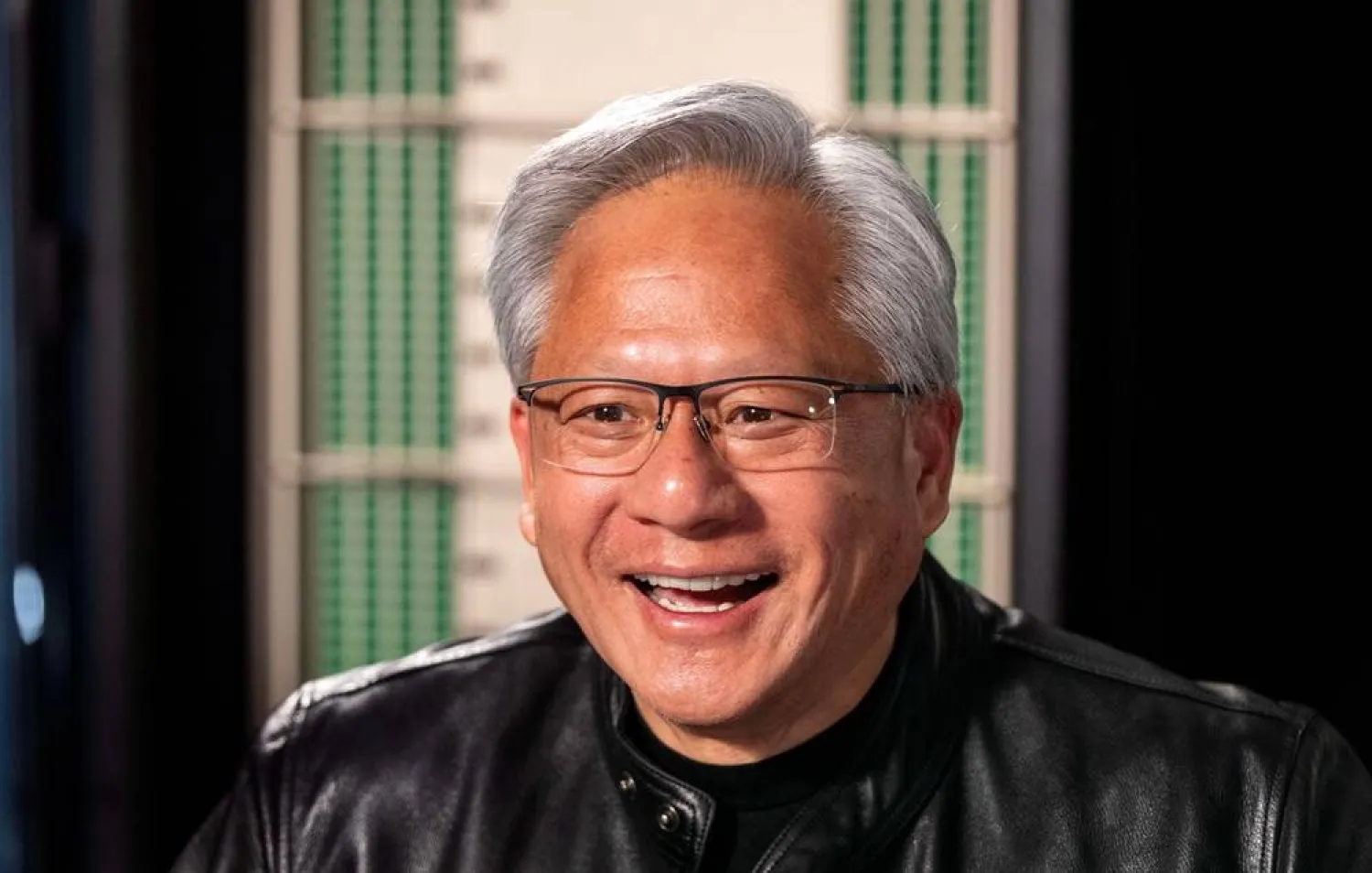
 Jensen Huang, president and CEO of Nvidia, laughs during an interview before a groundbreaking ceremony for an expansion of Coherent's manufacturing facility on Tuesday, June 16, 2026, in Sherman, Texas. (AP)
Jensen Huang, president and CEO of Nvidia, laughs during an interview before a groundbreaking ceremony for an expansion of Coherent's manufacturing facility on Tuesday, June 16, 2026, in Sherman, Texas. (AP)
TT

Nvidia’s Huang Says Society Needs ‘New Social Norms’ in the Age of AI

 Jensen Huang, president and CEO of Nvidia, laughs during an interview before a groundbreaking ceremony for an expansion of Coherent's manufacturing facility on Tuesday, June 16, 2026, in Sherman, Texas. (AP)
Jensen Huang, president and CEO of Nvidia, laughs during an interview before a groundbreaking ceremony for an expansion of Coherent's manufacturing facility on Tuesday, June 16, 2026, in Sherman, Texas. (AP)

Nvidia CEO Jensen Huang — whose work helped propel artificial intelligence — stressed in an Associated Press interview Tuesday that society needs to change with the advent of AI, arguing that a fuller embrace of the technology would improve people's lives.

Huang has been optimistic about AI’s potential to rapidly transform society, creating faster economic growth and more scientific breakthroughs. But as the head of a computer chip company now developing AI systems, he and others are confronting a public increasingly concerned about the potential harm the technology might bring. Huang has felt obligated to respond to critics who warn of job losses and threats to humanity itself.

"We need to create new social norms," Huang said in an interview. "I would advocate that everybody use AI. Just go engage it."

Huang made his case as AI has emerged as a political flashpoint, with objections to plans to build more data centers and fears that the speed with which it’s being adopted could spur the layoffs of workers who might not have a safety net.

Such questions have threatened public support of the technology at a time when a race has kicked off with China, a contest Huang believes can best be won by a US that is open to competing globally in AI.

His close relationship with President Donald Trump also has been a source of criticism among Democrats, even as he emphasized that the computing power created by AI is vital to adding the factory jobs that have been promised for decades without much enduring success.

It was an argument delivered by a 63-year-old man who has watched the technology develop and described himself as "boring" because his own life revolves mainly around work and his family.

Huang said the ability of AI to design a website, analyze complex documents, guide advanced research or even plan a kitchen remodeling has helped to close the technological divide in America. People can now do advanced work on computers without having to know how to program or write software, he added.

Huang contended that there is a need for some government regulation and safety standards for AI, stressing that national security also needed to be a priority for the technology that has been powering stock market gains and US economic growth in recent years.

Huang said society will adapt to AI just as it did to automobiles. He said cars were once portrayed as killing children, but the world changed its norms by having sidewalks and crosswalks and stopping kids from playing in the streets.

Huang skeptical of what government ownership of AI companies would achieve

With a market capitalization of roughly $5 trillion, Nvidia has soared in valuation in recent years to become the world’s most valuable company. AI modeling companies OpenAI and Anthropic are potentially set to also clear the $1 trillion mark once their stocks are publicly traded.

That explosive surge in wealth concentrated in AI companies has prompted renewed worries about economic inequality.

Trump has tried to defuse those concerns, recently musing about the prospect that the US government could own some shares in AI firms, so any windfalls would be more broadly shared with the public. That idea has also been advanced by Sen. Bernie Sanders, I-Vt., and even OpenAI CEO Sam Altman.

Huang expressed skepticism about the idea, saying he expects the country will already benefit broadly from AI advancements.

"I’m not exactly sure what they’re trying to achieve," he said regarding government ownership. "I haven’t had a dialogue with them about that. But just remember that these are American companies. Their success benefits the stock price, of which many Americans are investors in. It generates taxes, which helps many Americans. It creates a lot of jobs."

He noted that AI companies could also lead to higher profits for energy, construction and hardware technology firms.

"Americans have a stake in American companies already, naturally, in a whole lot of different ways," Huang said.

Huang says national security needs to be a priority on AI

The Trump administration has recently reversed course from using a light touch on regulating AI to taking a heavier hand.

It placed export controls on the AI company Anthropic’s latest models, leading the company on Friday to shutter all public access to those models over security concerns. Trump, a Republican, also signed an order to have new AI models voluntarily screened by the government before their release.

Huang said the government was properly focused on national security issues, but it was important to provide clear guidance.

"National security should always be the top concern of all technologies," Huang said. "But having said that, you know, you have to be very specific about the risk that you’re concerned about, before setting up policies for export controls."

During the Biden administration, Nvidia pushed back against export controls that were designed to restrict its ability to sell chips to China, rejecting the administration’s premise that a ban would preserve an American edge on AI. Huang had warned that the export controls might limit America’s ability to develop the world’s AI ecosystem, as China would respond with its own advanced chips.

Huang says energy is key problem for America’s AI development

Huang stressed that the US is vulnerable because of its deficient energy supply. The data centers performing the computations used in AI are creating a huge demand for electricity, which could be a strain on the power grid.

Some data centers will be constructed with their own electricity sources, but Huang said the US is starting from a disadvantage on energy. And without more energy, it can be harder to play to American strengths in its AI infrastructure, models and computer chip development.

"The United States is woefully behind in energy production," Huang said. "We just suffocated energy production for too long."

Huang complimented Trump on his approach to generating more energy in the US. The president has aggressively supported the use of oil, coal and natural gas, but he has scorned the use of solar and wind power.

The Nvidia CEO was not commenting on Trump's opposition to climate-friendlier energy sources. But the gap he identified goes to some of the fears that US households have about AI increasing their utility bills.

Huang was speaking Tuesday in Sherman, Texas, at an expansion of the Coherent factory to develop a laser for transmitting data among chips, which could cut power use by AI systems by up to 50%.

Trump’s fondness for Huang started at a Mar-a-Lago dinner

Trump, not known for technological expertise, quickly developed a friendship with Huang. The president has called him "smart" and "amazing," insisting that Huang accompany him on foreign trips. Most recently, Trump had Air Force One pick up the leather-jacketed CEO in Alaska while en route to his state visit to China.

Their relationship started last year with an invitation to dinner at Mar-a-Lago, Trump’s home and private club in Florida. Huang was in the area to receive the Edison Achievement Award for his AI work.

"He says drop by for dinner, and so I did," Huang said. He went with his wife, Lori.

"He was incredibly engaging, incredibly charismatic, conversational, asked a lot of questions," Huang recalled. "From the moment that I met him, the only thing that he’s ever talked to me about is creating more jobs, reindustrializing the United States, protecting national security, winning."

He added that Trump "calls me in the middle of the night and wants to talk about one of these topics."

But his proximity to Trump has also led to criticism from Democratic lawmakers. Sen. Elizabeth Warren, D-Mass., objected to Huang not testifying before a Senate committee even as "he has time to attend a $1 million-a-head dinner at Mar-a-Lago."

Huang said he wants the US president and other officials — regardless of party — to succeed. "We could differ with politics, but we should want him to succeed," he said. "Because when President Trump succeeds, our country succeeds."



TikTok Reaches $400 Million Settlement with US Justice Department over Children's Privacy

FILED - 24 August 2022, North Rhine-Westphalia, Cologne: The logo of Tik Tok is seen at Gamescom. Photo: Rolf Vennenbernd/dpa
TT

TikTok Reaches $400 Million Settlement with US Justice Department over Children's Privacy

FILED - 24 August 2022, North Rhine-Westphalia, Cologne: The logo of Tik Tok is seen at Gamescom. Photo: Rolf Vennenbernd/dpa

TikTok has reached a $400 million settlement with the US Department of Justice, ending a 2024 lawsuit alleging the company violated federal children's privacy laws.

The DOJ said Friday that TikTok will pay $300 million immediately and another $100 million after an order vacates an earlier consent decree against its predecessor company, Musical.ly.

“This settlement is a major victory for American children and parents,” said US Associate Attorney General Stanley E. Woodward Jr. in a statement. “The Department’s priority is ensuring that children are protected online and that companies entrusted with their personal information meet their legal obligations. This resolution secures a substantial recovery while reinforcing the protections that families expect and deserve.”

Since the DOJ's lawsuit in 2024, TikTok has undergone major changes, most notably in the ownership structure of its US arm. In January, the social video platform company signed agreements with major investors including Oracle, Silver Lake and MGX to form the new TikTok US joint venture.

Representatives for TikTok did not immediately respond to a message for comment Friday.

The latest lawsuit focused on allegations that TikTok and its China-based parent company ByteDance violated a federal law that requires kid-oriented apps and websites to get parental consent before collecting personal information of children under 13. It also says the companies failed to honor requests from parents who wanted their children’s accounts deleted, and chose not to delete accounts even when the firms knew they belonged to kids under 13.

The settlement comes as social media companies face an avalanche of lawsuits over children's safety and privacy and a growing number of countries are banning young kids and teens from social media apps. Instagram's parent company, Meta Platforms, is currently on trial in federal court in Oakland, California, over allegations it violated the 1998 Children’s Online Privacy Protection Act, or COPPA, along with various state statutes.


How AI Is Changing Event Discovery, Booking

Nadeem Bakhsh, chief executive and co-founder of webook.com (Company handout)
TT

How AI Is Changing Event Discovery, Booking

Nadeem Bakhsh, chief executive and co-founder of webook.com (Company handout)

A night out can start with a simple question: “What should we do tonight?”

That is where traditional search can struggle. It works best when users already know the event, date, or location they want. Booking platforms are now using artificial intelligence to tackle the opposite problem: first understanding vague intent, then turning it into options that can actually be booked.

Nadeem Bakhsh, chief executive and co-founder of webook.com, says the platform’s AI booking agent was not built because existing search tools were failing. It was designed to add another layer of discovery for users who do not yet know exactly what they want.

Speaking to Asharq Al-Awsat, Bakhsh said search and filters remain effective when users have a clear target. Open-ended questions, however, require the system to understand context before it can surface the right option.

From keywords to intent

In its first version, the agent uses natural language processing in Arabic and English and can handle informal requests that include location, preferences, group type or booking criteria.

Users do not need to know an event’s name or phrase their request like a search query, Bakhsh said. They can simply ask for a family activity, a nearby experience or something available in the evening.

The system then interprets the request, identifies the relevant details and matches them with options in the platform’s live catalog.

If key information is missing, the agent is designed to ask for clarification rather than produce a generic list that may not fit the user’s needs.

That makes accuracy central to the experience. The more discovery shifts from explicit search to conversation, the greater the risk that a question will be misunderstood or misinterpreted.

When the agent gets it wrong

Bakhsh acknowledges that mistakes are part of using AI systems.

The agent, he said, “should not pretend to know.” If a request is unclear or incomplete, it should ask for more information rather than force an unreliable recommendation.

The official booking page remains the final authority on availability, prices, fees and event terms. If information changes or tickets sell out before a purchase is completed, the details shown in the official booking flow take precedence over anything said earlier in the conversation.

When the agent cannot verify information, Bakhsh said, it should direct the user to official event details or human support.

A correction from the user may also help improve the next response, but Bakhsh does not present that as a guarantee that the same mistake will not happen again.

Recommendation or advertising?

Trust becomes a commercial issue when the agent is not only finding events, but ranking and recommending them.

Bakhsh said the system is meant to match user intent with options that are genuinely available to book, not present paid advertising as personal advice.

Recommendations are based on criteria supplied by the user, including location, timing, group type and activity preference, as well as live availability.

Any paid or sponsored placement, he said, should be clearly labeled so users can distinguish an organic recommendation from commercial content.

“Trust depends on making that distinction clear,” Bakhsh said.

One journey, several channels

The experience becomes more complicated when the conversation starts outside the booking platform itself, on services such as X, Instagram or WhatsApp.

Bakhsh said the agent uses information users choose to provide, such as location, timing, group type, interests and booking criteria, to make suggestions more relevant.

Public interactions remain limited to discovery. Once greater privacy is required, the conversation moves to a private channel and then into webook.com’s secure booking environment.

Card details and other sensitive personal information should not be requested through public posts, comments or direct messages on social media, he said.

Personal data remains subject to the platform’s privacy policy and to legal and regulatory retention requirements.

Bakhsh also said data is not treated as freely transferable from one channel to another. Any personalization depends on the permissions granted by the user and the purpose for which the data was collected.

What webook.com builds — and what it does not

The agent is not built entirely with in-house technology.

Bakhsh said webook.com develops and operates the core product layer and orchestration system. That includes understanding booking intent, linking it to the catalog, applying product logic, generating recommendations and directing users into the secure booking flow.

External infrastructure is used when needed for language-model processing, cloud services and access to channels such as X, Instagram and WhatsApp.

Those providers supply infrastructure or distribution channels, Bakhsh said, but they do not own the event inventory, booking logic or customer journey.

The company does not disclose vendor architecture or security-sensitive implementation details.

Bakhsh also stressed that the agent remains in beta and can make mistakes. Users should verify event details and final booking information on the official page before completing a transaction.

Discovery ends where the transaction begins

One of the main safeguards in the system is the separation between conversation and payment.

The agent may respond to a general request in a public space, but when privacy becomes necessary, it moves the interaction into a private channel and then directs the user to an official, identity-linked booking flow.

It does not request card details or sensitive information through social media posts, comments, or direct messages.

Bakhsh said this structure helps limit the impact of prompt manipulation, impersonation, fraudulent accounts, and fake booking links.

The conversational layer can help users find an event, but it cannot bypass the inventory, account, pricing, or payment controls on the official platform.

The agent does not set the price

Once a user moves from discovery to purchase, the agent’s role stops at a clear boundary.

Options come from the live catalog, but the official booking page remains the authoritative transaction interface.

Before confirming, users see current availability, the final price, booking fees and event-specific terms, including cancellation and refund policies.

The agent cannot change those terms or guarantee that a ticket will still be available while a user waits.

Age restrictions and accessibility requirements are shown only when they appear in the official event details. If the information is unclear, the system is not supposed to guess.

AI, in other words, changes how users reach an option. It does not change the contractual terms or controls governing the purchase.

Bakhsh also links the agent to a broader framework called TruFan, while drawing a distinction between the two.

The AI agent operates at the start of the journey, turning natural-language requests into bookable options.

TruFan addresses a different stage: integrity and access to high-demand events, by helping identify genuine, verified fans and giving them priority.


Apple Paid 40% of its Global Taxes to Ireland in Last Fiscal Year

FILE PHOTO: An Apple logo and a computer motherboard appear in this illustration taken August 25, 2025. REUTERS/Dado Ruvic/Illustration/File Photo
TT

Apple Paid 40% of its Global Taxes to Ireland in Last Fiscal Year

FILE PHOTO: An Apple logo and a computer motherboard appear in this illustration taken August 25, 2025. REUTERS/Dado Ruvic/Illustration/File Photo

Apple paid Ireland $17.1billion in taxes last year, representing around 40% of its worldwide total, according to a company filing that detailed the iPhone maker's global tax liabilities country-by-country.

Apple said the amount paid to Ireland was "significantly higher" than income taxes accrued as it included €13 billion ($15.18 billion) in back taxes that it was ordered to pay Ireland by European Union's top court in 2024, Reuters reported.

Ireland fought the EU back-tax bill alongside Apple for eight years, seeking to defend its position as the location of choice for US multinationals in Europe - and the billions of euros in direct and indirect taxes they bring in each year.

In 2016, the European Commission's competition chief at the time, Margrethe Vestager, accused Ireland of having granted Apple illegal tax benefits, unfairly diverting investment away from other countries.

Apple paid $43.2 billion in income taxes worldwide in the fiscal year that ended in September 2025.