


Norway Imposes Near Ban on AI in Elementary School

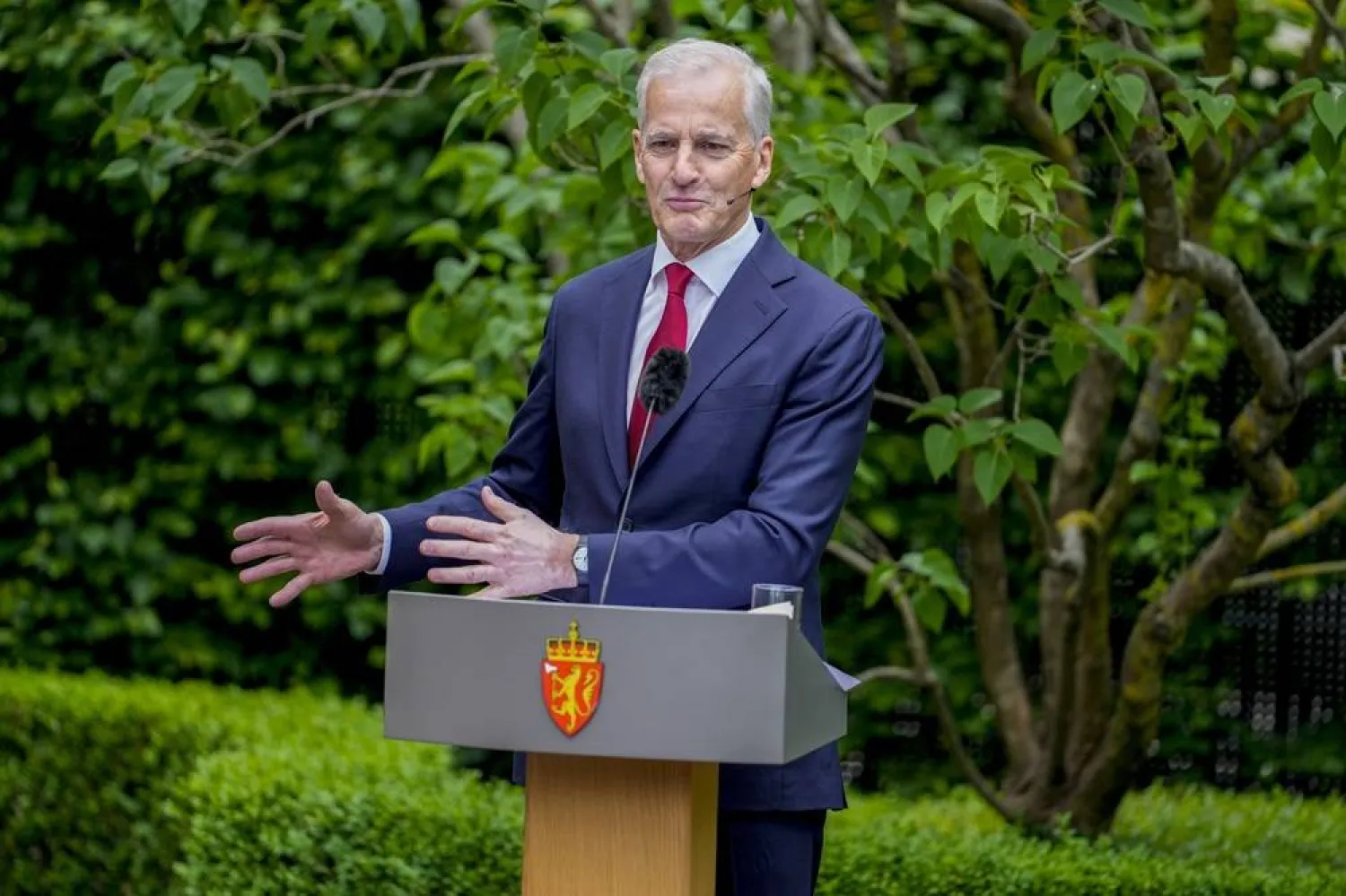
Norway's Prime Minister Jonas Gahr Store of the Labour Party speaks during the semi-annual summary press conference at the government's representative facilities in Parkveien, Oslo, Norway, 19 June 2026. (EPA)
TT

Norway Imposes Near Ban on AI in Elementary School

Norway's Prime Minister Jonas Gahr Store of the Labour Party speaks during the semi-annual summary press conference at the government's representative facilities in Parkveien, Oslo, Norway, 19 June 2026. (EPA)

Norway is imposing ‌a near ban on the use of generative AI tools by elementary school pupils while also restricting their use in the education of older children to prevent a negative impact on learning, the country's prime minister said on Friday.

Facing a broad decline in education test scores, the government in 2024 banned smartphones from schools and has given teachers back more powers to enforce discipline in the classroom.

Using AI increases the ‌risk that young ‌children skip important steps in their ‌education, ⁠Prime Minister Jonas ⁠Gahr Stoere told a press conference on Friday.

"The most important thing in school is that our children learn to read, write and do mathematics," Stoere said, adding that the new standards will be imposed from the new school year beginning in late August.

Pupils ⁠from first through seventh grade, aged 6 ‌to 13, should as a ‌general rule not be using AI, while those in ‌lower secondary school, aged 14 to 16, can ‌cautiously adopt tools under teachers' supervision, the government said.

In upper secondary education, from ages 17 to 19, students should learn to use AI appropriately so that they are ‌prepared for further education and work, it added.

Norway began adopting computers in classrooms in ⁠the ⁠1990s and tablets after the introduction of the iPad from 2010 onwards, reducing the reliance on books and handwriting.

But in a related statement on Friday, the government also said it will propose legislation to fund the use of more books in classrooms, reversing the trend towards computer tablets.

The Norwegian government in April also announced plans to ban children from using social media until they turn 16, following a trend pioneered by Australia and some other nations to reduce young people's use of electronic devices.



Saudi Communications Minister Discusses Expanding AI, Quantum Computing Partnerships in France

Saudi Minister of Communications and Information Technology Abdullah Alswaha meets with Electronic Arts Chairman and CEO Andrew Wilson in Paris. (SPA)
TT

Saudi Communications Minister Discusses Expanding AI, Quantum Computing Partnerships in France

Saudi Minister of Communications and Information Technology Abdullah Alswaha meets with Electronic Arts Chairman and CEO Andrew Wilson in Paris. (SPA)

Saudi Minister of Communications and Information Technology Abdullah Alswaha held a series of meetings during his visit to France with senior executives from leading global companies in artificial intelligence (AI), digital content and digital entertainment, gaming, and quantum computing.

The meetings aimed to expand high-impact partnerships, facilitate knowledge transfer, develop national capabilities, and strengthen the Kingdom of Saudi Arabia’s position as a global hub for artificial intelligence, electronic gaming, and emerging and advanced technologies, reported the Saudi Press Agency on Monday.

Alswaha discussed with Ubisoft CEO and Co-Founder Yves Guillemot, Sony Group CEO Hiroki Totoki, Riot Games CEO Dylan Jadeja, and Electronic Arts Chairman and CEO Andrew Wilson the use of AI in developing the gaming, entertainment, and content industries, as well as developing Saudi talent and empowering developers and content creators in the Kingdom to build globally competitive experiences and intellectual properties.

Saudi Minister of Communications and Information Technology Abdullah Alswaha meets with Sony Group CEO Hiroki Totoki in Paris. (SPA)

He discussed with Thales Group Chairman and CEO Patrice Caine the security of artificial intelligence applications, data protection, knowledge transfer, and the development of national capabilities in advanced technologies, building on the partnership between the group and the Kingdom spanning more than five decades.

Alswaha visited the headquarters of Pasqal in Paris, where he toured its laboratories and reviewed its advanced quantum computing technologies, in the presence of CEO Dr. Wasiq Bokhari and Chairman of the Board of Pasqal Arabia Prince Abdulaziz bin Turki bin Talal.

He discussed expanding the presence of quantum computing technologies in the Kingdom, integrating them with artificial intelligence, and developing national capabilities and talent.

In the field of advanced artificial intelligence, he discussed with Advanced Machine Intelligence Co-Founder Laurent Solly the future of the next generation of artificial intelligence models and their capabilities in understanding, prediction, and planning, as well as their applications in robotics, automation, and industry, in addition to enabling Saudi researchers and developers to build new applications and technologies.

The visit builds on the Kingdom's efforts to forge effective international partnerships, attract high-quality technologies and investments, and empower national talent to lead opportunities created by the intelligent era, supporting the objectives of Saudi Vision 2030.


Alibaba Shares Slide after $10.2 Billion AI Share Sale Offered at Sharp Discount

FILE PHOTO: An Alibaba logo is displayed at the company's booth at China International Fair for Trade in Services (CIFTIS) in Beijing, China, September 10, 2025. REUTERS/Maxim Shemetov/File Photo
TT

Alibaba Shares Slide after $10.2 Billion AI Share Sale Offered at Sharp Discount

FILE PHOTO: An Alibaba logo is displayed at the company's booth at China International Fair for Trade in Services (CIFTIS) in Beijing, China, September 10, 2025. REUTERS/Maxim Shemetov/File Photo

China's Alibaba shares slumped in Hong Kong trade on Monday after it launched a $10.2 billion share sale at a steep discount to fund its AI ambitions, with investors focused on stock dilution and execution risks.

The e-commerce and cloud computing giant said it would sell HK$80 billion ($10.2 billion) of new shares at HK$112.70 each, an 8.4% discount to Friday's close, to fund chips, AI infrastructure and models.

AI has become Alibaba's biggest driver of revenue growth at a time when e-commerce growth is stagnating, and its Qwen AI models are some of the most popular in China. Even so, some investors have reservations about how successful it will be.

"Alibaba's DNA is in e-commerce, not advanced tech," said Yang Tingwu, vice general manager of asset manager Tongheng Investment.

"No matter how much it invests in AI hardware, it will likely be outmaneuvered by competitors in tech innovation."

Its Hong Kong shares fell as much as 10.5% but pared losses in the afternoon to trade in line with the discount offered.

The sale of 710 million ordinary shares is equivalent to 3.6% of enlarged total shares outstanding.

It drew strong demand, attracting $28 billion of orders, including $6 billion from long-only and sovereign investors, three people with knowledge of ⁠the matter said.

About ⁠40% of the book will go to long-only and sovereign investors, including major sovereign wealth funds in Europe, Asia and the Middle East, two of the people said.

Investors included the Qatar Investment Authority (QIA), Norway's Norges wealth fund and Hillhouse, according to one person.

Alibaba, Hillhouse, QIA and Norges did not immediately respond to Reuters requests for comment.

Alibaba chairman Joe Tsai bought 720,000 Hong Kong shares at an average price of HK$112 apiece, for about HK$80 million in aggregate, while Eddie Wu, the group's chief executive, bought 350,000 Hong Kong shares at an average price of HK$111.6 per share, totaling HK$40 million, according to the group's stock exchange disclosures later on Monday.

As the US and China vie for tech supremacy, investment in AI and related infrastructure such as data centers ⁠has reached dizzying heights.

The biggest Chinese AI names are, however, investing only a fraction of what their US counterparts are spending. Most fundraising globally is also conducted via heavy debt issuance — a trend that has begun to test the limits of investor demand. Japan's SoftBank on Monday announced it would issue $6.3 billion in bonds to retail investors — its biggest debt offering to date.

Alibaba's stock sale is the largest-ever follow-on offering of new shares by a Hong Kong-listed company and the third-largest globally this year after offerings of nearly $85 billion from Alphabet and $20 billion from Intel.

"Alibaba's placement — landing alongside massive capital raises by Alphabet and Intel in the US — proves that American and Chinese tech giants are operating off the exact same strategic playbook," said Winston Ma, an adjunct professor at NYU School of Law and former head of North America for sovereign wealth fund China Investment Corp.

"The global sovereign investors aren't blind to US-China tech friction — they are compartmentalizing it," Ma said, adding that they were more comfortable with compliance issues when investing in Chinese commercial cloud and open-weight AI plays over restricted semiconductor hardware.

Capital Group, one of the world's largest active investment managers, estimates that AI-related capital expenditure by the biggest US hyperscalers — Microsoft, Amazon, Alphabet, ⁠Meta and Oracle — reached $791 billion as of ⁠July 31. That compares with $118 billion for China's ByteDance, Alibaba, Tencent and Baidu.

Part of the reason for the more subdued Chinese spending has been a lack of access to Nvidia's most advanced AI chips due to US export controls. That in turn has pushed Chinese firms to develop more efficient AI models and infrastructure that require less computing power and capital.

The share placement comes a week after Alibaba reported quarterly net profit that tumbled 75% from a year earlier, primarily due to AI-related spending.

Underscoring how AI has leapt to become a key priority, Alibaba this year separated its AI operations from its cloud business, with the new unit to be led by CEO Eddie Wu.

In addition to positioning itself as a key AI partner for companies operating in China, it is preparing a listing of its chipmaking arm T-Head and developing AI agents linking services across its sprawling ecosystem, including shopping, food delivery, travel and entertainment.

Separately, Alibaba has helped train a large language model that Apple will sell in the Chinese market, sources have said.

At earnings, Alibaba said it had committed nearly half of its three-year capital expenditure plan of 380 billion yuan ($56.5 billion), but that AI computing investments have a "high certainty" of returns.

Wu said such investments are expected to break even within three years, possibly even 2.5 years, as margins improve and proprietary chips replace third-party hardware.


Taiwan Indicts Nine Over Alleged Illegal Export of AI Servers to China

People walk past a Taiwanese flag in New Taipei City on January 13, 2024. (AFP)
TT

Taiwan Indicts Nine Over Alleged Illegal Export of AI Servers to China

People walk past a Taiwanese flag in New Taipei City on January 13, 2024. (AFP)

Taiwan prosecutors said on Monday they indicted nine people, including employees of Nvidia and Super Micro, accused of illegal export of artificial intelligence servers to China.

Semiconductor powerhouse Taiwan is the world's largest producer of advanced chips used in AI applications. Prosecutors this year investigated the suspected ‌illegal export of ‌servers equipped with Nvidia ‌chips ⁠subject to US export ⁠controls.

Washington has imposed curbs since 2022 making it illegal for such semiconductors to be exported or sold in China.

In a statement, the prosecutors in the northern ⁠port city of Keelung said the ‌defendants, whose ‌full names they did not state, were "fully ‌aware" that both Nvidia and ‌Super Micro have "rigorous internal control procedures" regarding exports.

However, the defendants "colluded with one another at various levels for enormous profit, ‌illegally exporting high-end servers, increasing corporate compliance costs, and severely damaging our ⁠nation's ⁠international image", they added.

Neither Nvidia nor Super Micro immediately responded to requests for comment.

Taiwan has tightened export controls in recent years to keep advanced technology and know-how from reaching China, which claims the democratically governed island as its own territory despite the strong objections of the island's government.