


SK Hynix Overtakes Samsung to Become South Korea’s Most Valuable Company

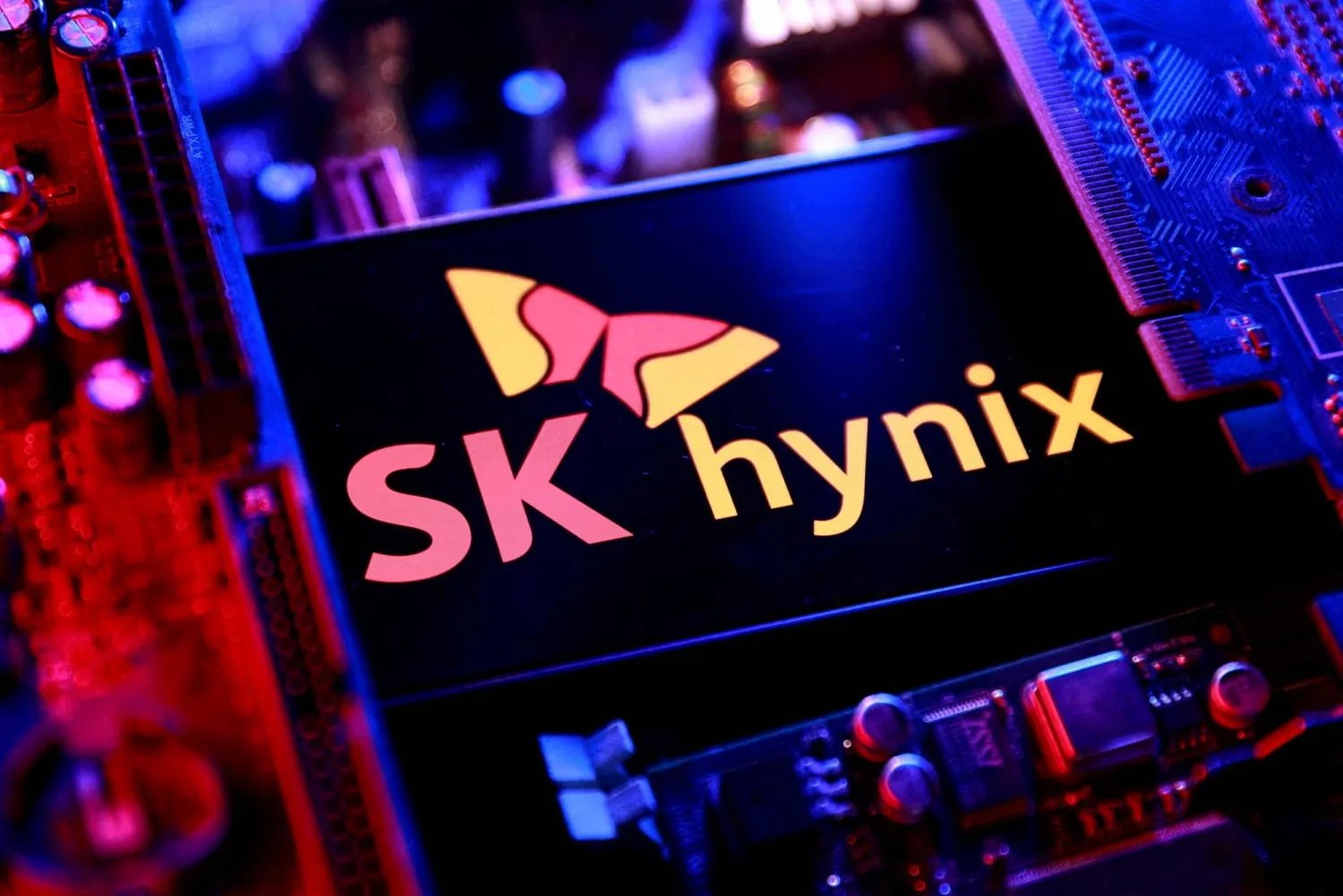
The SK Hynix logo and a computer motherboard appear in this illustration taken August 25, 2025. (Reuters)
TT

SK Hynix Overtakes Samsung to Become South Korea’s Most Valuable Company

The SK Hynix logo and a computer motherboard appear in this illustration taken August 25, 2025. (Reuters)

SK Hynix on Monday overtook Samsung Electronics to become South Korea's most valuable listed company, marking a dramatic reversal of fortunes for a chipmaker that two decades ago nearly collapsed under debt.

The company, now the dominant supplier of high-bandwidth memory (HBM) chips used in AI systems for customers such as Nvidia and Alphabet's Google, has emerged as one of the biggest beneficiaries of the global AI boom, propelling a more than 340% rally in its shares this year and lifting its market value above both Samsung Electronics and Micron.

Shares of SK Hynix, now the world's most valuable memory chipmaker, traded up 5.7% to bring the company's market capitalization to 2,082.5 trillion won ($1.35 trillion) as of 0347 GMT, compared with gains of 0.4% in Samsung Electronics to 2,081.3 trillion won, excluding preferred shares.

The stock hit the milestone as AI reshapes the global semiconductor industry, elevating specialized memory chips from commonly traded commodities into critical components of the infrastructure powering applications such as ChatGPT and advanced AI models.

SK Hynix focuses primarily on memory chips, whereas Samsung Electronics also manufactures logic chips and ‌consumer electronics such as smartphones ‌and TVs. Samsung Electronics had held the top spot since 2000.

"The emergence of customized AI memory ‌fundamentally ⁠changed the industry's economics ⁠and allowed SK Hynix to establish itself as the market leader," said Kim Sunwoo, a senior analyst at Meritz Securities.

Samsung said in a statement that any calculation of its market capitalization should include preferred shares, which would bring the value to around 2,252 trillion won.

SK Hynix's soaring share price marks the culmination of one of the biggest turnarounds in South Korea's corporate history.

In 2002, then-Hynix Semiconductor was on the verge of being sold to Micron, having been crippled by debt accumulated during an aggressive expansion drive.

The deal eventually fell through, leaving the company under creditor control for nearly a decade. Its shares plunged as low as 135 won in 2003, leaving it viewed as a penny stock, or "Dongjeon-ju" in Korean.

Its fortunes in the ⁠years since tracked the global memory industry's traditional boom-and-bust cycle.

In 2023, a severe downturn battered memory ‌prices, pushing SK Hynix to report an annual operating loss of 7.73 trillion won.

It ‌started recovering a year later as the AI boom gained momentum and the likes of Microsoft, Google and Meta invested heavily, pushing it to report an ‌annual operating profit of 23.5 trillion won in 2024, a record at the time.

TURNAROUND

Analysts attribute SK Hynix's central role in the ‌global AI ecosystem to its decision to continue investing in HBM, a specialized memory chip stacked vertically to deliver faster performance and lower power consumption, during a downturn in the memory industry.

Unlike conventional memory products, HBM chips are tightly integrated with AI processors, creating significantly higher barriers to entry and giving suppliers greater pricing power.

By 2025, SK Hynix captured 61% of the global HBM market, far ahead of Samsung Electronics' 17% and Micron's 21%.

SK Hynix was founded in 1983 ‌as a unit of Hyundai, but was later spun off and purchased by SK Group, the family-run "chaebol" conglomerate whose businesses span telecoms to energy.

SK Group Chairman Chey Tae-won, who faced strong ⁠opposition to the deal at the time, ⁠explained his thinking in a book published in January.

"What I really wanted to accomplish when we acquired Hynix was to transform it from a commodity memory producer into a mainstream semiconductor company whose products are indispensable," Chey said.

"In the past, it did not matter whether memory came from Hynix, Samsung or Micron. They were interchangeable commodity products. HBM is different. If SK Hynix's HBM is replaced with another product, the AI system may not function properly. What used to be a peripheral component has become a core component," Chey said.

Analysts say that Samsung's position as the world's largest DRAM producer could also be under threat by SK Hynix.

Bank of America estimates that SK Hynix's monthly DRAM output will reach about 589,000 wafers this year, compared with roughly 691,000 wafers for Samsung Electronics.

However, SK Hynix is likely to expand DRAM output by about 38% between 2025 and 2028, compared with about 17.5% growth at its rival. That would narrow SK Hynix's production gap to less than 10% by 2028 from about 23% in 2025, which would be a particularly significant achievement because of Samsung's larger manufacturing scale.

"Previously, the difference in manufacturing scale meant there was simply no way for rivals to close the profitability gap with Samsung," said Kim. Reuters has reported that SK Hynix is opting to choose the Nasdaq for its planned US listing, which would broaden the company's investor base and raise its profile further among global investors.



Meta’s Teen Safety Deal Runs into an Unsolved Problem: Proving Age

A Meta logo is seen at the Viva Technology conference dedicated to innovation and startups at Porte de Versailles exhibition center in Paris, France, June 14, 2023. (Reuters)
TT

Meta’s Teen Safety Deal Runs into an Unsolved Problem: Proving Age

A Meta logo is seen at the Viva Technology conference dedicated to innovation and startups at Porte de Versailles exhibition center in Paris, France, June 14, 2023. (Reuters)

Meta's landmark settlement with nearly every US state promises curfews and time limits for teens on Instagram and Facebook -- but rests on age and parent checks nobody has figured out how to make work.

The deal, which ended a federal trial in Oakland, California, on Wednesday, gives Meta one year to identify which of its users are 13 to 17 years old.

Those accounts will have curfews and time limits switched on by default, and only parents will be allowed to loosen them.

How that gets enforced is unclear -- and any system Meta builds risks angering privacy advocates, who warn it hands platforms and governments yet another way to identify users, infringing on civil liberty.

For the new regime to work, Meta must determine the age of every user in the participating states and territories, adults included.

Methods could include identification documents, mandatory selfies, or analysis of user activity. Any account not verified within 14 days will face the same constraints as a teenager's.

These approaches have already faltered elsewhere.

Eight months after social networks were banned for under-16s in Australia, teen usage has climbed back almost to previous levels, thanks to virtual private networks, or VPNs, that conceal a user's real identity and location.

As for parents, the agreement offers no way to establish that a supervising adult is who they claim to be.

What would stop an older sibling from passing themselves off as a guardian, Judge Yvonne Gonzalez Rogers asked Wednesday as she weighed Meta's plans.

"There is some fluidity, very intentionally," said Nicklas Akers, a California prosecutor, who added that there was no plan to require a birth certificate or identification from the parent.

- Margin of error -

With no reliable way of verifying ages and parents, curfews and time limits remain theoretical.

"Teens are notorious for finding workarounds to these types of rules, and parents can also override some of the most stringent ones," said social media industry expert Jasmine Enberg.

"Looking ahead, that could take some of the responsibility away from Meta and put it on parents, with the goal of helping insulate the company from similar cases in the future," she added.

In France, where a ban on under-15s was just struck down by the Constitutional Council, many children get around the rules with their parents' help, according to the communications regulator Arcom.

If Meta cannot verify a user with identification, such as a driver's license or passport, it will estimate age by analyzing that user's activity -- collecting still more data in the process.

"This enshrines Meta's harmful surveillance into law, and it will compromise users' privacy and anonymity while increasing their exposure to data breaches and government data requests," the digital rights group Electronic Frontier Foundation said in a statement.

The settlement does include safeguards, limiting data collection to what age estimation requires and letting adults wrongly classified as minors appeal.

It is "the most significant intervention in children's online safety we have seen," said Iain Corby, head of the AVPA, an industry association for age-verification providers.

Identification documents carry their own risks. In October, a breach at a third-party age-verification company potentially exposed the government IDs of 70,000 Discord users.

- Improvising -

With no reliable or trusted methods available, everyone is improvising.

OpenAI applies a restricted version of ChatGPT to minors by guessing a person's age from their usage patterns, an approach Meta's settlement allows.

In the European Union, where the tracking of minors is tightly constrained, it has delayed the rollout for months.

France has sketched out a different path, in which a trusted third party verifies ages using the "double-blind system" already in place for adult sites.

The verifier does not know which site is asking, and the site gets only a binary answer: allowed or not.

Nothing like that exists in the United States, where Meta will run the checks itself -- and keep the data.


Google Changes Spam Policy in EU to Avert Antitrust Fine

The Google logo is seen outside the company's offices in London, Britain, June 24, 2025. (Reuters)
TT

Google Changes Spam Policy in EU to Avert Antitrust Fine

The Google logo is seen outside the company's offices in London, Britain, June 24, 2025. (Reuters)

Alphabet's Google ‌on Friday said it had changed its spam policy in Europe to address EU concerns that could have resulted in an antitrust fine.

The US tech giant found itself in EU regulators' crosshairs after publishers complained about its site reputation abuse policy.

It targets the practice of publishing ‌third-party pages on a ‌site in an ‌attempt ⁠to abuse search rankings ⁠by taking advantage of the host site's ranking signals, commonly referred to as parasite SEO.

The EU said that its monitoring showed that Google's spam policy demoted news media ⁠and other publishers' websites and content ‌in Google ‌search results, when those websites include content ‌from commercial partners.

Google said that ‌from August 30 any manual actions taken to demote sites would not apply to users in the 27 EU ‌nations, Iceland, Norway and Liechtenstein (the European Economic Area).

The policy would not ⁠change ⁠outside the European Economic Area, it added.

Concerns about the policy had prompted the European Commission, which acts as the EU competition enforcer, to open an investigation under the Digital Markets Act, which aims to rein in the power of Big Tech.

DMA breaches can cost companies fines of up to 10% of their global annual turnover.


Meta Settlement Opens New Front in Global Fight Over Social Media Harm

The logo of Meta at the Meta Lab in Los Angeles, California, US, May 20, 2026. (Reuters)
TT

Meta Settlement Opens New Front in Global Fight Over Social Media Harm

The logo of Meta at the Meta Lab in Los Angeles, California, US, May 20, 2026. (Reuters)

Meta's move to restrict teenagers' use of social media in the US shows companies have tools to better protect young people online, Australian officials said on Thursday, while in the Philippines, an official said the US company had pledged to boost protection there too.

Meta's up to $18 billion settlement with nearly all US states over social media harm to teenagers has opened a new front in a global government fight to protect children and curb addiction to platforms such as Facebook and Instagram.

Governments around the world are trying to curb children's access to harmful online content, including a world-first ban in Australia late last year on social media for children under 16.

Australian Communications Minister Anika Wells said in an email to Reuters that social media companies "have the tools at their disposal to protect ‌young people from ‌their addictive features but have chosen not to use them".

Meta agreed to pay up to $18 ‌billion ⁠over a decade ⁠and limit how teenagers use Facebook and Instagram under an agreement with nearly all US states to resolve claims that it designed those platforms to addict children. Meta denied wrongdoing in agreeing to settle.

The deal brings sweeping changes to Meta's Facebook and Instagram platforms in the United States, including imposing a default two-hour limit on its apps for users under the age of 18.

In South Korea, the media regulator said some of Meta's measures should be applied to young users worldwide, rather than just in specific markets. Mexican president Claudia Sheinbaum said the government needed to review its potential impact for Mexico.

There were some early signs that the settlement could help other countries win similar measures.

Philippines Department of Information ⁠and Communications Technology Secretary Henry Aguda told Reuters that both Meta and gaming platform Roblox had ‌pledged in a meeting on Thursday to tighten age verification processes in the ‌country, as well as expand parental controls and implement time limits on the social media.

The European Commission said it was waiting for Meta ‌to present changes to limit the addictive designs of its social networks.

The Commission already issued preliminary findings earlier this year that Meta ‌breached the Digital Services Act (DSA). In July, it said Facebook and Instagram should disable autoplay and endless scrolling by default, introduce screen-time breaks and change recommendation systems to reduce incentives to keep users engaged — measures that go beyond the US settlement.

In April, the Commission said Meta had failed to stop children under 13 from opening or maintaining accounts. The US settlement could make it harder for Meta to argue that tougher age-verification measures are impractical.

"We ‌have been very clear ... we expect proper screen time management, we expect proper parental control on these platforms. Meta knows ... the ball is in Meta's court," said spokesperson Thomas Regnier.

EXECUTION ISSUES

Enforcement ⁠of restrictions in Australia has, ⁠however, been patchy so far.

Early evidence suggests the law has been undermined by weak age-verification systems, with multiple studies, including from Australia's internet regulator, showing 80% of minors were still on social media months after the ban took effect in December. That prompted lawmakers to double the maximum fine and increase regulatory powers.

In Asia, countries including China, South Korea, India, Malaysia, Indonesia and the Philippines are also seeking tighter oversight of social media as well as curbs, including to block alleged scams, and in particular to protect children.

Australian class-action law firm Shine Lawyers said it was in discussions with Mark Lanier, a lawyer who worked on the California action against Meta, about a potential similar action.

"For years, families have been asking whether enough has been done to protect children from platform features designed to maximize engagement," said Shine Lawyers head of class actions Craig Allsopp.

"We are now examining whether similar legal issues arise in Australia, including whether Australian children and families may have claims connected to the design, operation and promotion of social media platforms. If Australian families have been affected, they deserve answers."