


Taiwan Raids Tech Firms in China AI Chip Smuggling Probe

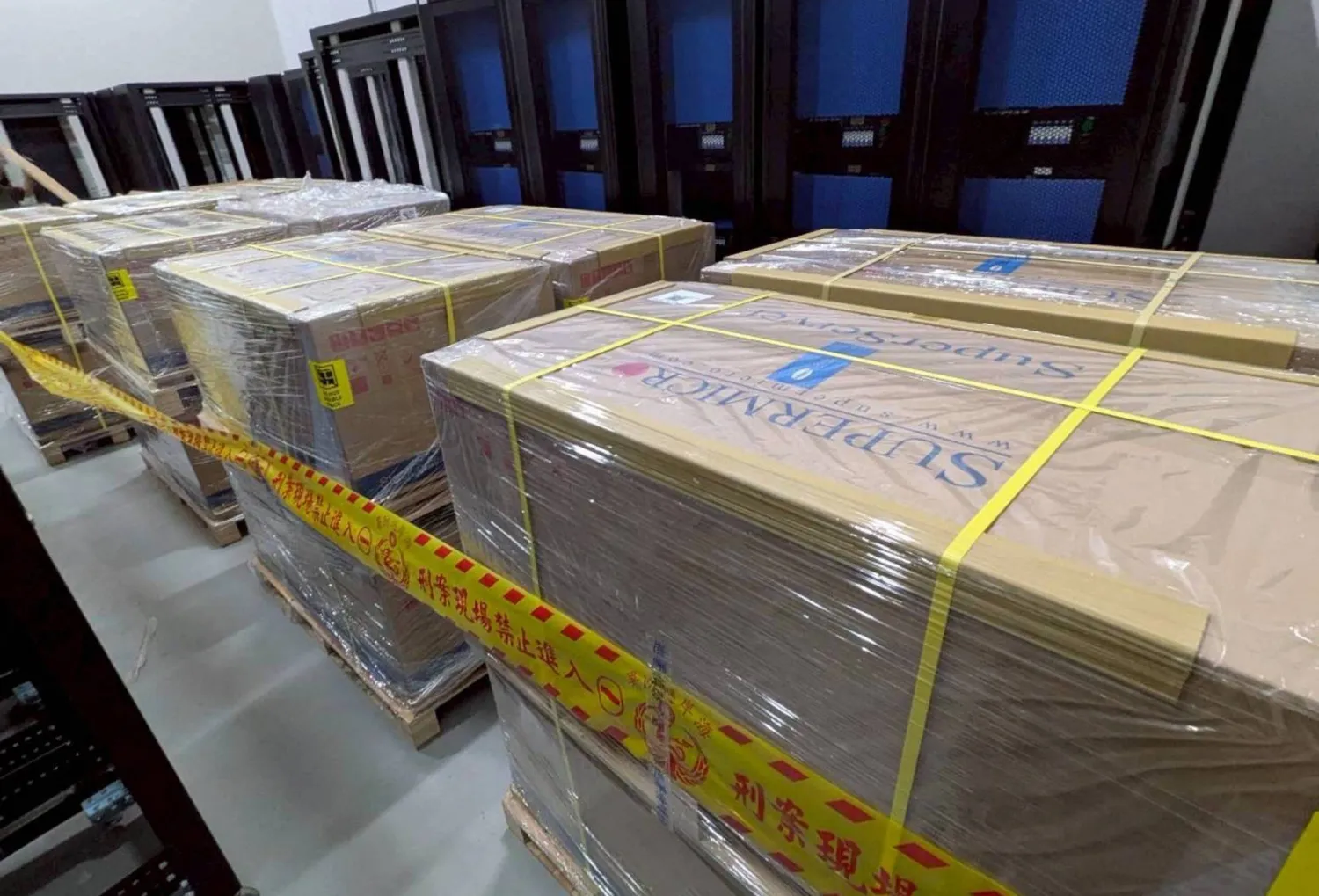
This handout photo from the Taiwan Coast Guard taken on May 20, 2026 and released on May 21 shows pallets of servers made by Super Micro Computer seized by Taiwanese authorities at an undisclosed location. (Photo by Handout / TAIWAN COAST GUARD / AFP)
TT

Taiwan Raids Tech Firms in China AI Chip Smuggling Probe

This handout photo from the Taiwan Coast Guard taken on May 20, 2026 and released on May 21 shows pallets of servers made by Super Micro Computer seized by Taiwanese authorities at an undisclosed location. (Photo by Handout / TAIWAN COAST GUARD / AFP)

Taiwanese investigators have raided the Taiwan offices of US company Super Micro Computer and two other tech firms, a prosecutor said Tuesday, as part of an expanded probe into the alleged smuggling of Nvidia AI chips to China.

Prosecutors said in May they were investigating the shipment of "high-end" AI servers containing advanced Nvidia chips to China, Macau and Hong Kong, in violation of US export controls.

Nine people are now under investigation, up from three previously, Huang Sheng, head prosecutor in the Keelung Prosecutors Office, told AFP.

They are accused of forging documents so they could ship roughly 50 servers made by Super Micro Computer to China.

Some of the servers were cleared by Taiwan customs and sent to China via Japan, an official previously told AFP on the condition of anonymity.

Twelve sites were raided on Monday as part of the probe, the prosecutors office said in a statement.

They included the homes of six people and offices of the companies they worked for -- Nasdaq-listed Super Micro Computer and Taiwan-listed firms Albatron Technology and Chief Telecom.

The United States restricts the export of its most cutting-edge AI chips to China, partly over concerns the technology could be used by Beijing's military.

But it is not a criminal offence in Taiwan -- a situation lawmakers and experts say needs to change -- with Taiwanese prosecutors relying on other laws to go after offenders.

Lawmaker Chung Chia-pin, who belongs to President Lai Ching-te's Democratic Progressive Party (DPP), plans to propose an amendment to the Foreign Trade Act to include a "mainland China semiconductor chip clause" that would make exporting chips there illegal.

Chung told AFP Tuesday that a loophole in the law was created under former president Ma Ying-jeou, who belongs to the Kuomintang party, and successive DPP-led governments have failed to close it.

Top-end chips made by US titan Nvidia -- the world's most valuable company -- are used to train and run AI systems.

In response to Washington's export restrictions, China has been accelerating efforts to develop its own AI chips and break away from reliance on US hardware.

This month, Taiwanese Deputy Economic Affairs Minister Ho Chin-tsang said Taiwan and the United States "will work to implement our shared export control goals", but the government has not provided details.

Chris McGuire, an expert on China and AI at the US-based Council on Foreign Relations, said chip smuggling was a "really significant problem" in Taiwan and Southeast Asia.

"It's really, really important that allies align with the United States on all of these policies and also legal authorities," McGuire, who worked at the National Security Council under former US president Joe Biden, told a forum in Taipei this month.

"It's not a criminal violation in Taiwan to export AI chips to China, obviously it is under US law, but it's not under Taiwanese law. That needs to change, right?"

Super Micro Computer, Albatron Technology and Chief Telecom have said separately they are cooperating with investigators. Their shares have seen sharp falls this week.

Prosecutors say it is too early to know if the case is linked to a Nvidia chip smuggling case involving Super Micro Computer employees in the United States.

A US indictment unsealed in March showed employees of the company allegedly raked in billions of dollars diverting Nvidia AI chips to China in breach of export controls.




Samsung Electronics Denies Report That It Is Exploring US Listing

The logo of Samsung Electronics is seen at the company's store in Seoul, South Korea, April 15, 2025. (Reuters)
TT

Samsung Electronics Denies Report That It Is Exploring US Listing

The logo of Samsung Electronics is seen at the company's store in Seoul, South Korea, April 15, 2025. (Reuters)

Samsung Electronics denied on Tuesday a report that it was in the early stages of exploring a potential US offering of American Depositary Receipts (ADRs).

"Samsung Electronics is not reviewing the possibility of issuing American Depositary ‌Receipts," a ‌Samsung spokesperson said in ‌a ⁠statement.

On Tuesday, Bloomberg ⁠News reported that Samsung has held preliminary discussions with banks, but has not yet made a decision about whether to proceed, ⁠citing people familiar ‌with the matter, ‌adding that the discussions might ‌not result in a listing.

The ‌South Korean chipmaker previously reviewed the possibility of an ADR offering before ultimately deciding against ‌it, though the successful US listing of SK ⁠Hynix has ⁠given Samsung fresh motivation to revisit the idea, the report said.

Last week, rival SK Hynix priced its ADRs at $149 each, raising about $26.5 billion in the largest-ever US listing by a foreign company.


China Smartphone Shipments Fall for Fifth Straight Quarter as Costs Rise

A customer looks at a new Huawei Pura 70 series smartphone, as the series models go on sale at a Huawei's flagship store in Beijing, China April 18, 2024. (Reuters)
TT

China Smartphone Shipments Fall for Fifth Straight Quarter as Costs Rise

A customer looks at a new Huawei Pura 70 series smartphone, as the series models go on sale at a Huawei's flagship store in Beijing, China April 18, 2024. (Reuters)

China's smartphone shipments fell 4.3% to 66 million units in the second quarter from a year earlier, as many manufacturers hiked prices to ‌reflect rising memory ‌and component costs, research firm ‌IDC ⁠said on Tuesday.

It ⁠was the fifth straight quarterly decline, and first-half shipments were down 4.2% from a year earlier.

Huawei Technologies and Apple were the only vendors to post growth in the quarter, with shipments up 19.4% and 24.4%, ⁠respectively.

"Huawei and Apple held their ‌prices steady while ‌competitors were raising theirs, and that gave hesitant buyers ‌a reason to go ahead and purchase ‌in a quarter when most of the market was giving them a reason to wait," said Arthur Guo, a senior analyst at IDC China.

Huawei ‌ranked first with a 22.6% market share, while Apple came second with ⁠an ⁠18.1% share. Xiaomi , which ranked fifth, saw its second-quarter shipments down 21.7%, with Oppo and Vivo seeing shipments fall 9.7% and 11.4%, respectively.

Most Android vendors raised prices or cut back on budget models in response to surging memory chips and other component costs, discouraging consumers from upgrading. The fading effect of government subsidies also removed a prop that had supported demand in earlier quarters, IDC said.


Meta Expands Louisiana Data Center to 5 Gigawatts Compute Capacity

FILE PHOTO: The logo of Meta at the Meta Lab in Los Angeles, California, US, May 20, 2026. REUTERS/Daniel Cole/File Photo
TT

Meta Expands Louisiana Data Center to 5 Gigawatts Compute Capacity

FILE PHOTO: The logo of Meta at the Meta Lab in Los Angeles, California, US, May 20, 2026. REUTERS/Daniel Cole/File Photo

Meta said ‌on Monday its data center in Richland Parish, Louisiana will expand to 5 gigawatts of compute capacity, in a bid to support the social media company's AI ambitions.

Since breaking ground in December 2024, local Louisiana businesses have received more than $1.6 billion ‌in contracts from Meta, ‌the company said.

Here ‌are ⁠some details:

* Meta ⁠said that the data center expansion is an investment of more than $50 billion in the Richland Parish region.

* Last year, US President Donald Trump ⁠had said the company's data ‌center project ‌would cost $50 billion.

* With this ‌expansion, the company said it ‌plans to invest over $1 billion in local infrastructure improvements, including roads, water and wastewater systems.

* Meta, like its ‌Big Tech peers, has been pouring billions of dollars into ⁠AI ⁠data centers and computing power, as demand continues to outstrip supply.

* The company has pledged to invest $600 billion in US infrastructure and jobs over the next three years, as it builds out massive data centers to power CEO Mark Zuckerberg's aggressive bets on AI agent technologies.