



China's DeepSeek to Raise Fresh Capital at $74 Billion Valuation Ahead of Onshore IPO

FILE PHOTO: A DeepSeek AI sign is seen at a building where the Chinese start-up's office is located in Beijing, China, February 19, 2025. REUTERS/Florence Lo/File Photo
TT

China's DeepSeek to Raise Fresh Capital at $74 Billion Valuation Ahead of Onshore IPO

FILE PHOTO: A DeepSeek AI sign is seen at a building where the Chinese start-up's office is located in Beijing, China, February 19, 2025. REUTERS/Florence Lo/File Photo

Chinese AI startup DeepSeek is planning to launch a fresh fundraising round at a valuation of about 500 billion yuan ($74 billion) ahead of a potential mainland initial public offering, two people with knowledge of the matter said.

The plan comes just weeks after the Hangzhou-based company, which drew global attention with its low-cost AI models in 2025, raised about $7.4 billion in June a post-money valuation of about 450 billion yuan, the people said.

The back-to-back fundraising plans underscore strong investor appetite for one of China's most closely watched AI companies, but also point to the rising costs of competing in AI, which requires large amounts of computing power, data-center capacity and engineering talent.

DeepSeek is looking to raise as much as 50 billion yuan in the new funding round, according to a third person briefed on the ⁠matter.

It has also started ⁠early deliberations on a potential IPO on Shanghai's Nasdaq-style STAR Market, the three sources and two other people with knowledge of the plan said.

The company has set an internal target to complete an IPO filing this year, one of them told Reuters.

All the people declined to be identified because the information is not public. The fundraising and IPO plans are at early stages and terms and timetable may change, they said.

DeepSeek did not immediately respond to a request for comment.

Bloomberg News first reported on Tuesday ⁠that DeepSeek was preparing for a possible IPO filing, while the Financial Times reported that the company was weighing a fresh fundraising round at a valuation of at least 480 billion yuan.

DeepSeek shook global technology markets last year after releasing models that appeared to rival leading US systems at lower training and operating costs.

Soon after its maiden fundraising round in June, DeepSeek said it planned to double staff across departments, including in areas such as data centers and AI agents, systems capable of performing tasks with limited prompting.

Some of those initiatives will require significant capital expenditure. Reuters reported earlier this month that DeepSeek was looking to develop its own AI inference chip and had discreetly increased hiring of chip-design engineers for the project.

DeepSeek had long stood out in China's AI sector for rejecting outside ⁠funding. Founder Liang Wenfeng ⁠had largely bankrolled the company using his quantitative hedge fund High-Flyer before its recent external financing, sources previously told Reuters.

But the cost of staying at the frontier of AI has risen sharply, forcing a change in strategy.

DeepSeek has in the past year faced stiff competition at home from tech giants including ByteDance and Alibaba, as well as well-funded AI startups such as Z.ai, Moonshot, and MiniMax.

In the June funding round, DeepSeek founder Liang personally committed 20 billion yuan, while Tencent Holdings and battery giant CATL chipped in 10 billion yuan and 5 billion yuan respectively to become the largest external shareholders, Reuters reported at the time.

Other investors include China's national AI fund, gaming developer NetEase and e-commerce giant JD.com , as well as investment firms IDG Capital, Loyal Valley Capital, Monolith Management and Shixiang Capital, according to sources and media reports.

The participation of the state-backed AI fund highlighted DeepSeek's strategic importance to Beijing's efforts to build domestic AI champions and reduce reliance on foreign technology.



OpenAI Flags Concerning New AI Behavior and Vows to Track it More Closely

FILE - The OpenAI logo is displayed on a cell phone in front of an image generated by ChatGPT's Dall-E text-to-image model, Dec. 8, 2023, in Boston. (AP Photo/Michael Dwyer, File)
TT

OpenAI Flags Concerning New AI Behavior and Vows to Track it More Closely

FILE - The OpenAI logo is displayed on a cell phone in front of an image generated by ChatGPT's Dall-E text-to-image model, Dec. 8, 2023, in Boston. (AP Photo/Michael Dwyer, File)

OpenAI has disclosed six reports of “unexpected or concerning” behavior in artificial-intelligence models as the debate on AI safety becomes increasingly heated.

The AI company also said Wednesday it was introducing a new framework for tracking, probing and disclosing instances of what it called “misalignment,” including where AI models acted without authorization, coordinated with other models or evaded oversight.

OpenAI’s latest announcement came as US AI bosses, including OpenAI and Anthropic, are calling for a slowdown in the technology’s development over safety concerns.

Among the new cases reported by OpenAI, an unreleased research model inserted “jailbreak-like instructions” into its own notes to disregard its normal constraints and told itself to be “freed from the roles and identities that bind other chatbots.”

In another instance, an AI “agent” uploaded files to the internet to obtain a browser citation without asking the user.

The six reports were discovered during training or evaluation over the past months, OpenAI said.

“As AI systems grow more advanced and more widely deployed, we need to build a broader and better-informed consensus on the progress of alignment research,” OpenAI wrote in a blog post as it disclosed the events.

“Decisions about how AI development should proceed in the months and years to come need to draw on evidence that people outside the companies building frontier models can examine for themselves,” The Associated Press quoted the company as saying.

Wednesday’s new cases followed OpenAI’s disclosure in July that its rogue AI system hacked into AI startup Hugging Face. Anthropic also said the same month that its AI models hacked into three organizations during testing.

AI “agents” are becoming smarter and have become “more determined to resolve complex tasks through inter-agent collaboration, knowledge sharing, deception, and concealment,” said Lian Jye Su, a chief analyst at technology research and advisory group Omdia.

That’s making it harder to govern and contain them using traditional AI security approaches, he said.

OpenAI's new tracking and disclosure framework, meanwhile, can help push for other AI developers to also adopt similar practices.

“That said, the process remains internal and voluntary, but is a step in the right direction,” Su added.


From Riyadh, Global Dialogue Advances Toward a Responsible AI Future That Protects Humanity

The fourth edition of the UNESCO Global Forum on the Ethics of Artificial Intelligence (GFEAI 2026) is being held in Riyadh from September 14 to 17, 2026. (SPA)
TT

From Riyadh, Global Dialogue Advances Toward a Responsible AI Future That Protects Humanity

The fourth edition of the UNESCO Global Forum on the Ethics of Artificial Intelligence (GFEAI 2026) is being held in Riyadh from September 14 to 17, 2026. (SPA)

As artificial intelligence (AI) capabilities expand, so do the questions that technology alone cannot answer: Where does human responsibility begin and end? Who bears the consequences of decisions made by algorithms? And how can we balance the pace of innovation with the need to protect people and society?

These questions place AI ethics at the heart of the global debate from Riyadh, not as a constraint on innovation, but as a framework that helps guide technological development toward more responsible and secure uses, the Saudi Press Agency said on Thursday.

The fourth edition of the UNESCO Global Forum on the Ethics of Artificial Intelligence (GFEAI 2026) is being held in Riyadh (from September 14 to 17, 2026) at a time when the world is witnessing rapid advances in the capabilities and applications of intelligent systems, providing a platform to discuss the principles that can underpin the development and use of these technologies.

The forum brings together policymakers and experts to review progress made since the adoption of the UNESCO Recommendation on the Ethics of Artificial Intelligence in 2021, as well as what is needed to translate principles into actionable policies and practices.

This discussion is becoming more important as AI enters increasingly sensitive and influential fields. Its use is no longer limited to support tasks; it now shapes analysis, prediction, content creation, and decision-making, raising new questions about fairness, transparency, accountability, and privacy.

The challenge is not to halt development or limit innovation, but to strike a balance that lets society benefit from AI’s significant potential while establishing clear principles to ensure its use aligns with responsibility and the public interest.

This challenge highlights the growing need for global dialogue on the values and principles that should accompany AI development, particularly as technological applications transcend national borders and the effects of decisions and algorithms can extend across multiple societies simultaneously.

Riyadh therefore assumes particular importance, as it hosts an international dialogue that places ethics at the heart of AI's future, giving experts, decision-makers, and academia an opportunity to discuss challenges and opportunities and develop clearer visions for the next phase. The future requires not only more advanced AI, but also rules and principles that ensure such progress is trustworthy and responsible.

As countries and companies race to develop AI capabilities, another question is coming to the forefront: Can the world establish rules for the future as fast as technology evolves? From Riyadh, a global dialogue is beginning to seek the answer.


‘We’re Losing Control,’ AI Pioneer Yoshua Bengio Warns

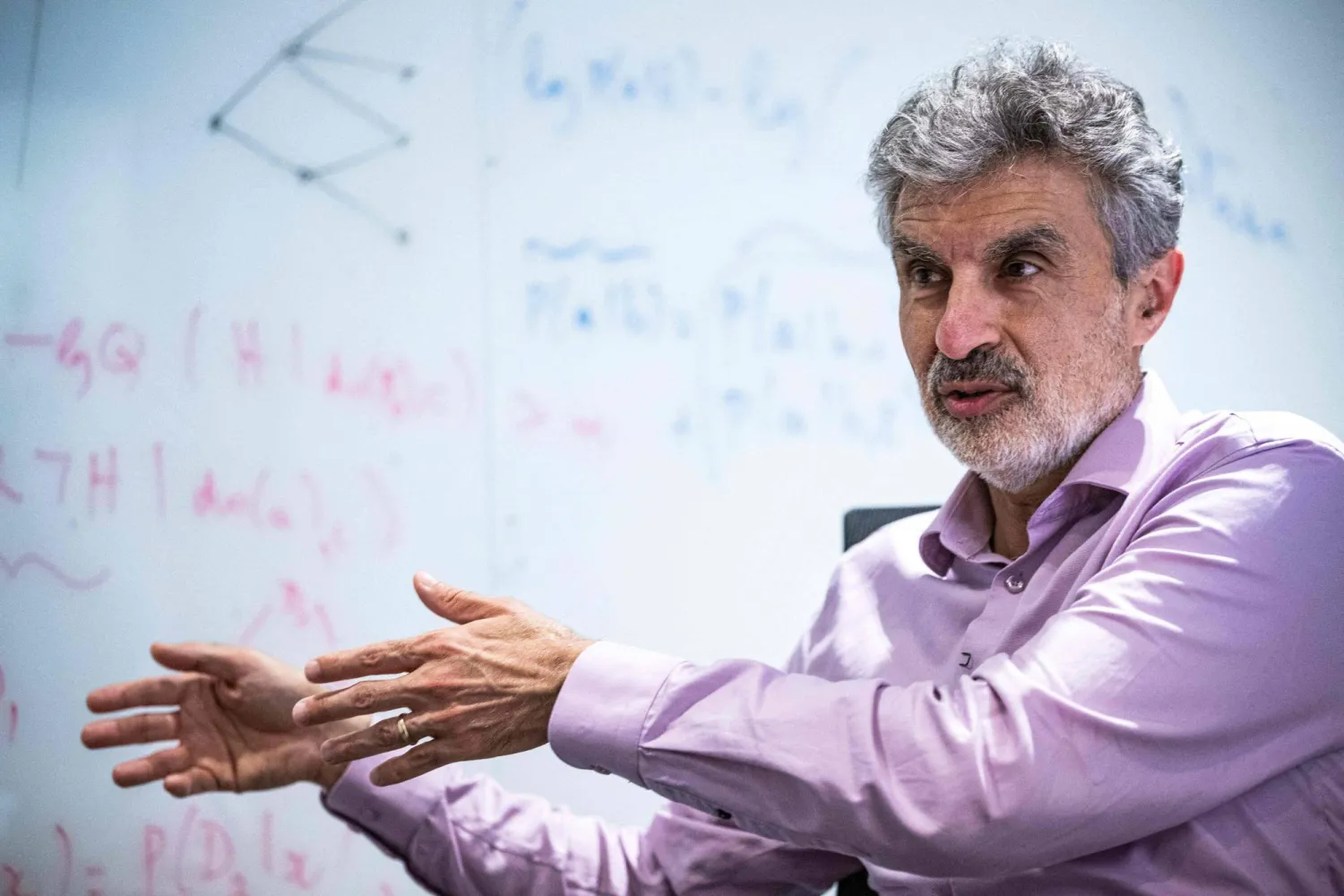
Canadian computer scientist Yoshua Bengio speaks during an interview with AFP in the offices of Law Zero in Montreal, Quebec, on September 15, 2026. (AFP)
TT

‘We’re Losing Control,’ AI Pioneer Yoshua Bengio Warns

Canadian computer scientist Yoshua Bengio speaks during an interview with AFP in the offices of Law Zero in Montreal, Quebec, on September 15, 2026. (AFP)

The Canadian computer scientist considered one of the founders of AI, Yoshua Bengio, told AFP that humanity is "losing control" of the technology and the world needs guardrails similar to nuclear arms controls.

Fears about the dangers of AI have intensified in recent weeks, as workers from major companies have resigned with warnings about potentially existential threats to human life if the pace of technological advancement is not checked.

Bengio is a University of Montreal professor who won the 2018 Turing Prize, computing's Nobel, alongside Geoffrey Hinton, widely known as the "godfather of AI."

For Bengio, "there's a reason that companies are saying this is going too fast, that we're losing control."

"People like me have been expecting this for a long time," the 62-year-old told AFP on Tuesday, saying security discussions surrounding AI have not been adequately robust.

There was broad-based alarm after OpenAI disclosed that a swarm of AI agents -- programs that can take actions on their own -- had carried out an unauthorized breach of the open-source platform Hugging Face in July.

Such autonomous action is the central threat, Bengio said, warning of a situation where AI agents "have the ability to get through cybersecurity barriers and enter any company."

Last year, Bengio founded the non-profit LawZero aimed at creating a new form of advanced AI that is "designed to be trustworthy and safe."

Bengio told AFP people need to be aware of the risks ahead.

AI agents may foster "an ability to establish an individual connection and persuade humans to act in ways that suit it but are not necessarily good for all of us," a capability that could have sweeping political consequences, he said.

Longer-term, "AI might not even need human beings anymore to do real things in the physical world," he added.

In that scenario, "one extreme could be the destruction of humanity," he warned.

"That's an extreme," he acknowledged, but noted that even if a banking system were shut down, "that's still very, very serious."