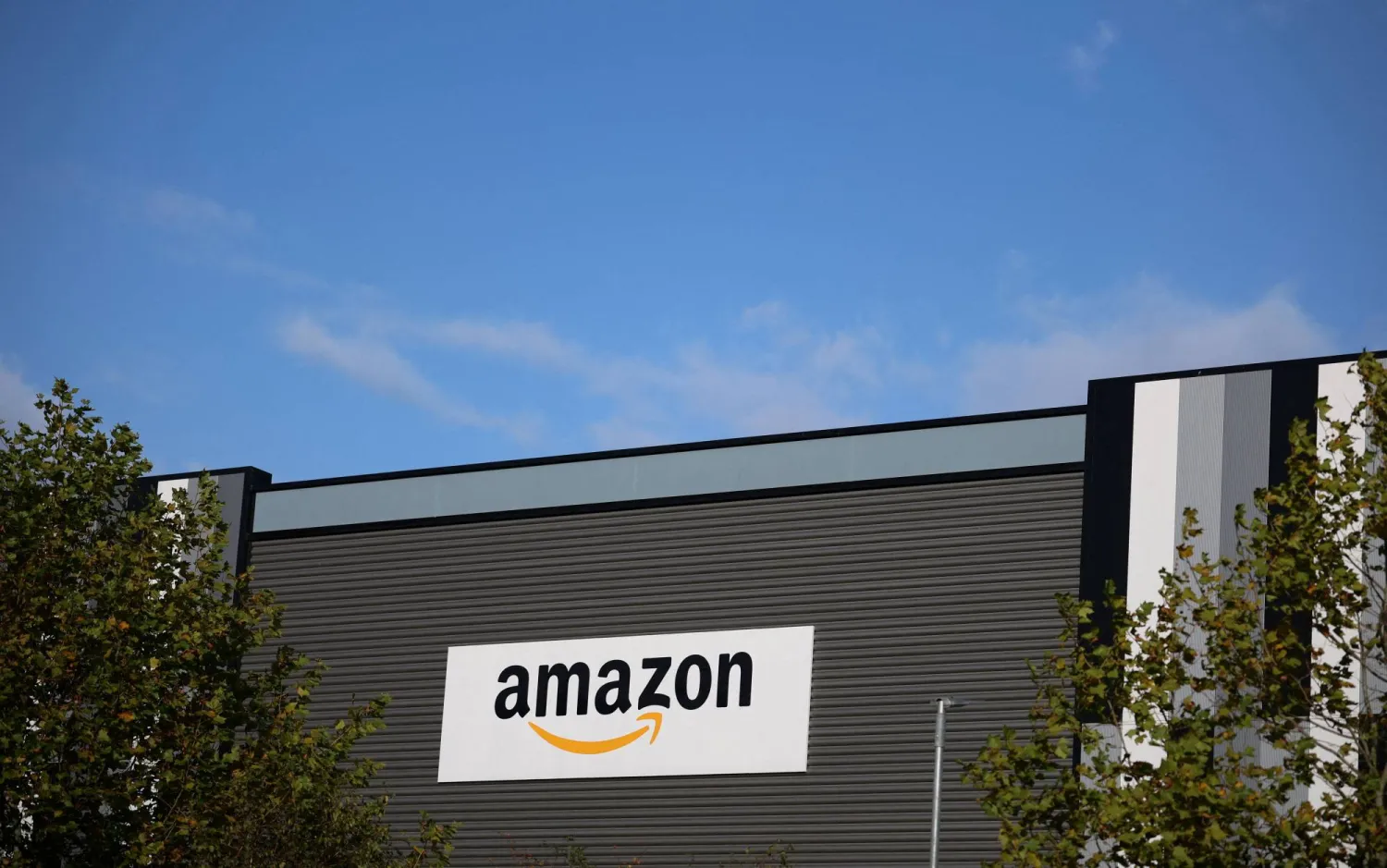
Amazon Surges to More than $3 tn in Market Value for 1st Time

FILE PHOTO: Amazon logo outside an Amazon warehouse in Manchester, Britain, October 28, 2025. REUTERS/Phil Noble/File Photo
TT

Amazon Surges to More than $3 tn in Market Value for 1st Time

FILE PHOTO: Amazon logo outside an Amazon warehouse in Manchester, Britain, October 28, 2025. REUTERS/Phil Noble/File Photo

Amazon reached a valuation of $3 trillion for the first time Monday following, rising for a second straight session after last week's strong earnings report.

Shares of the tech giant were up almost five percent at $284.49 in early trading, lifting the company's valuation to about $3.1 trillion, AFP reported.

Amazon posted quarterly profits of more than $62 billion behind huge increases in two of its artificial intelligence-related business, AI cloud and chips.


AI Opens New Market for Saudi Tech Companies

The words “artificial intelligence,” a keyboard and robotic hands are seen in this illustration. (Reuters)
TT

AI Opens New Market for Saudi Tech Companies

The words “artificial intelligence,” a keyboard and robotic hands are seen in this illustration. (Reuters)

Saudi technology companies are moving beyond digital transformation, tapping a new wave of spending on artificial intelligence, data centers, and digital infrastructure. The shift boosted the results of listed companies in the first half of 2026.

Companies in the Saudi Exchange’s software and services sector generated 12.99 billion riyals ($3.46 billion) in first-half revenue, up 14.7% from a year earlier. Combined net profit rose 4.73% to 2.14 billion riyals ($570 million).

The sector comprises seven listed companies. Six have fiscal years ending in December, while Saudi Azm’s fiscal year ends on June 30.

Five companies reported first-half net profits: Elm, Solutions, 2P, Al Moammar Information Systems, or MIS, and DBS. Arab Sea Information Systems posted a loss at the end of the period.

Solutions led the sector in revenue, generating about 6.24 billion riyals in the first half, up 9% year on year. Net profit rose 2.1% to 824 million riyals.

Elm ranked second, with revenue climbing 21.1% to 4.99 billion riyals. Profit exceeded 1.17 billion riyals, up 7.7% from a year earlier.

MIS placed third, with revenue jumping 28.2% to 910 million riyals from 709 million. Profit, however, fell 15.85 % to 55.6 million riyals from more than 66.13 million riyals a year earlier.

In the second quarter, the sector’s combined net profit fell 4.77 % to 1.058 billion riyals from 1.112 billion riyals a year earlier. Revenue rose 15.98% to 6.77 billion riyals from 5.84 billion.

Structural shift continues

G.WORLD Chief Executive Mohamed Hamdy Omar told Asharq Al-Awsat that the 14.7% revenue increase underscored the Saudi economy’s continued structural shift toward technology, data and digital services.

The results cover six listed companies with standard fiscal years and do not represent the entire Saudi technology market, he said. They nevertheless provide an important gauge of the sector’s direction.

The figures also align with the broader market. Saudi Arabia’s communications and information technology sector reached about 199 billion riyals by the end of 2025, recording a compound annual growth rate of 8% over the previous five years, according to reports by the Communications, Space and Technology Commission.

Omar identified three main drivers of revenue growth.

The first is continued growth in government and corporate spending on digital transformation, including technology infrastructure, managed services, cloud computing, cybersecurity, and the development and operation of digital platforms.

Company results clearly reflect that trend. Revenue from solutions’ core communications and information technology services rose 19.6% in the first half, while Elm’s digital business revenue grew 22.31%.

The second driver is the widening use of digital services and platforms by government agencies, companies and individuals. This is lifting demand for digital systems and continuous operational services while strengthening recurring revenue models.

Saudi Arabia’s digital infrastructure supports that growth. Internet penetration is near universal, data consumption is rising, and the adoption of AI tools and cloud services is accelerating.

The third driver — and one set to play a bigger role — is investment in data and AI infrastructure and data centers.

The market is gradually moving beyond software and technology purchases toward investment in computing capacity, hosting, data processing and the infrastructure needed to run AI applications. That shift is creating a new layer of demand for local technology companies.

Omar said company performance revealed sharply different growth models across the sector.

Solutions and Elm remain its largest companies by revenue and profit, providing a strong and stable base. Smaller companies tell a different story.

MIS recorded robust first-half revenue growth of 28.2%, but its profit fell 15.85%, highlighting the need to protect margins while expanding.

Meanwhile, 2P posted profit growth. Arab Sea returned to profitability in the second quarter but still recorded a modest first-half loss.

Omar also pointed to MIS’s award of a data center hosting services contract from Future Artificial Intelligence Company, known as HUMAIN. Including value-added tax, the contract is worth more than 30% of MIS’s total 2025 revenue.

Its significance extends beyond MIS, he said. The award shows the scale of demand that AI and data center investments are beginning to generate for local companies capable of building and operating digital infrastructure.

That demand could attract more investment, bring new players into the market and encourage existing companies to expand in the coming years.

Omar expects the sector’s revenue momentum to continue in the second half of 2026, supported by sustained spending on digital transformation, data centers, AI, cloud computing and managed services.

But the real test will be more than winning revenue, he said. Companies must ensure that revenue translates into cash flow and sustainable profit margins.

Project cost management, technology talent retention, operating expense controls, working capital and financing costs, and the efficient execution of major contracts will separate companies that merely grow revenue from those that turn that growth into lasting shareholder value, he added.

Omar also expects more mergers and acquisitions across the sector.

He cited Elm’s full acquisition of Thiqah Business Services in April 2025 for about 3.4 billion riyals as a clear example of the push toward inorganic growth and broader digital capabilities and services.

Elm has said it aims for acquisitions to contribute about 20% of its income over the next five years, reinforcing expectations of continued dealmaking in the sector.


Meta Reaches $17 Billion Settlement with States in Landmark Trial Over Teen Social Media Addiction

A security guard stands watch by the Meta sign outside the headquarters of Facebook parent company Meta Platforms Inc in Mountain View, California, US, November 9, 2022. (Reuters)
TT

Meta Reaches $17 Billion Settlement with States in Landmark Trial Over Teen Social Media Addiction

A security guard stands watch by the Meta sign outside the headquarters of Facebook parent company Meta Platforms Inc in Mountain View, California, US, November 9, 2022. (Reuters)

Meta has agreed to pay $17 billion and add stronger child-safety measures to its Facebook and Instagram platforms to end a landmark trial over teen social media addiction and settle claims filed by 47 states, state attorneys general announced Wednesday.

The settlement resolves a pivotal legal case years in the making that sought to hold the tech giant accountable for the role its platforms played in undermining children’s mental health. The effort targeted features designed to hook young people’s attention.

“For years, Meta intentionally deceived the public about the addictive and harmful design features that have wreaked havoc on youth mental health," Virginia Attorney General Jay Jones said. The settlement "will put an end to these dangerous practices and deliver meaningful relief that will protect children from online harm.”

California Attorney General Rob Bonta said the money would be paid out over 10 years, with the state getting at least $1.5 billion if the settlement is approved by the court. New Jersey expects to receive at least $525 million. Massachusetts said it was in line for at least $366 million. Virginia's share is worth $353 million.

Meta said in a blog post that it was “building on our longstanding efforts to empower parents and support teens.”

“Ensuring teens have a safe and productive experience on our platforms is an absolute imperative for Meta,” the company said. “We want to get this right for parents and teens, and that’s why we partnered with state attorneys general to set a new industry standard."

The company urged rivals TikTok and YouTube to adopt similar safety measures.

The $17 billion settlement is a fraction of Meta's 2025 revenue of $201 billion.

The agreement cuts short an ongoing court case involving California, Colorado, Kentucky and New Jersey, which were among 29 states that sued Meta in 2023. CEO Mark Zuckerberg was among those expected to take the stand before a jury in federal court in California.

The lawsuit accused Meta of contributing to the youth mental health crisis by deliberately designing features that addict children to its platforms and hiding them from the public. The case also argued that Meta violated federal laws by routinely collecting data on children under 13 without their parents’ consent.

The trial kicked off last week in Oakland, California, with US District Judge Yvonne Gonzalez Rogers overseeing the proceedings. Adam Mosseri, the head of Instagram, began his testimony late Tuesday and defended Meta’s record and progress on child safety and privacy.

The cases in other states had been expected to go to trial later. In addition, nine attorneys general filed lawsuits in their respective states.

New features to include time limits and curbs on push notifications

Under the proposed settlement, Meta agreed to adopt a series of safety features, including a “hard cap” on daily time limits and pauses for children using Instagram and Facebook.

It will eliminate push notifications during weekday school hours and bring in “robust” age-assurance measures and “age-appropriate” content controls to prevent bullying and harmful material about eating disorders and self-harm.

There will be stronger and more user-friendly parental controls and limits on social comparison features such as “like” counts.

An independent auditor will assess how Meta is implementing the safety features and how effective they are.

Meta put the settlement at $18 billion, a figure that apparently includes a large award for Texas.

The money is to be paid out annually over 10 years, to fund youth online safety initiatives. However, the company said 30% of that amount — about $5.3 billion — will only be released to states if rivals YouTube and TikTok meet two conditions: implementing similar safety features, including a one-hour daily time limit, a nighttime block and age-assurance measures; and paying the same amount, split between the two companies.

Neither YouTube owner Google nor TikTok responded immediately to requests for comments.


Robot Olympics Ends with Humanoid’s 8.64-Second 100m, Nearly a Second Faster Than Bolt

 Tiangong Ultra humanoid robots cross the finish line before Honor's Lightning humanoid robots in the 100m large-size group final race, during the second World Humanoid Robot Games at the National Speed Skating Oval in Beijing, China August 26, 2026. (Reuters)
Tiangong Ultra humanoid robots cross the finish line before Honor's Lightning humanoid robots in the 100m large-size group final race, during the second World Humanoid Robot Games at the National Speed Skating Oval in Beijing, China August 26, 2026. (Reuters)
TT

Robot Olympics Ends with Humanoid’s 8.64-Second 100m, Nearly a Second Faster Than Bolt

 Tiangong Ultra humanoid robots cross the finish line before Honor's Lightning humanoid robots in the 100m large-size group final race, during the second World Humanoid Robot Games at the National Speed Skating Oval in Beijing, China August 26, 2026. (Reuters)
Tiangong Ultra humanoid robots cross the finish line before Honor's Lightning humanoid robots in the 100m large-size group final race, during the second World Humanoid Robot Games at the National Speed Skating Oval in Beijing, China August 26, 2026. (Reuters)

A Chinese humanoid robot on Wednesday ran the 100 meters in 8.64 seconds, almost a second faster than Jamaican Usain Bolt's human world-record time, at the close of a five-day competition featuring robotic athletes, viral stumbles and industrial tests.

Tiangong Ultra, developed by the Beijing Humanoid Robot Innovation ‌Centre, won the ‌large-size robot 100m final at the ‌second ⁠World Humanoid Robot ⁠Games.

The robot improved rapidly through the event, running 9.39 seconds and 8.86 seconds in qualifying before the final.

Bolt's world record of 9.58 seconds was set at the 2009 world championships in Berlin.

As in human athletics, the 100m was one of the highlights of the Beijing games, underscoring advances in robot ⁠mobility, balance and control systems.

The event dubbed the "Robot ‌Olympics" brought together more than ‌2,000 robots from 666 teams, most of them Chinese. Its 51 ‌disciplines included sports contests as well as task-based challenges ‌in simulated factories, restaurants, offices and emergency settings.

Spectators said the robots appeared more capable than those seen at the inaugural games.

"Last year's robots looked a little stiff and uncoordinated," said 34-year-old Niu. "This year, ‌they are much better. They are like healthy newborn babies growing up."

Yang, 29, said she ⁠could imagine ⁠robots becoming as commonplace as smartphones.

"Maybe there will be one at home and one at work," she said, adding that robots could help with chores or care for elderly people.

For developers, the games offered a public test bed for embodied artificial intelligence, which combines AI software with machines that can perceive and act in the physical world.

He Wang, founder and chief technology officer of Galbot, said the competition would help teams improve their technology while showing what embodied AI systems could do autonomously.

"It will provide a huge boost for industry development," he said.