

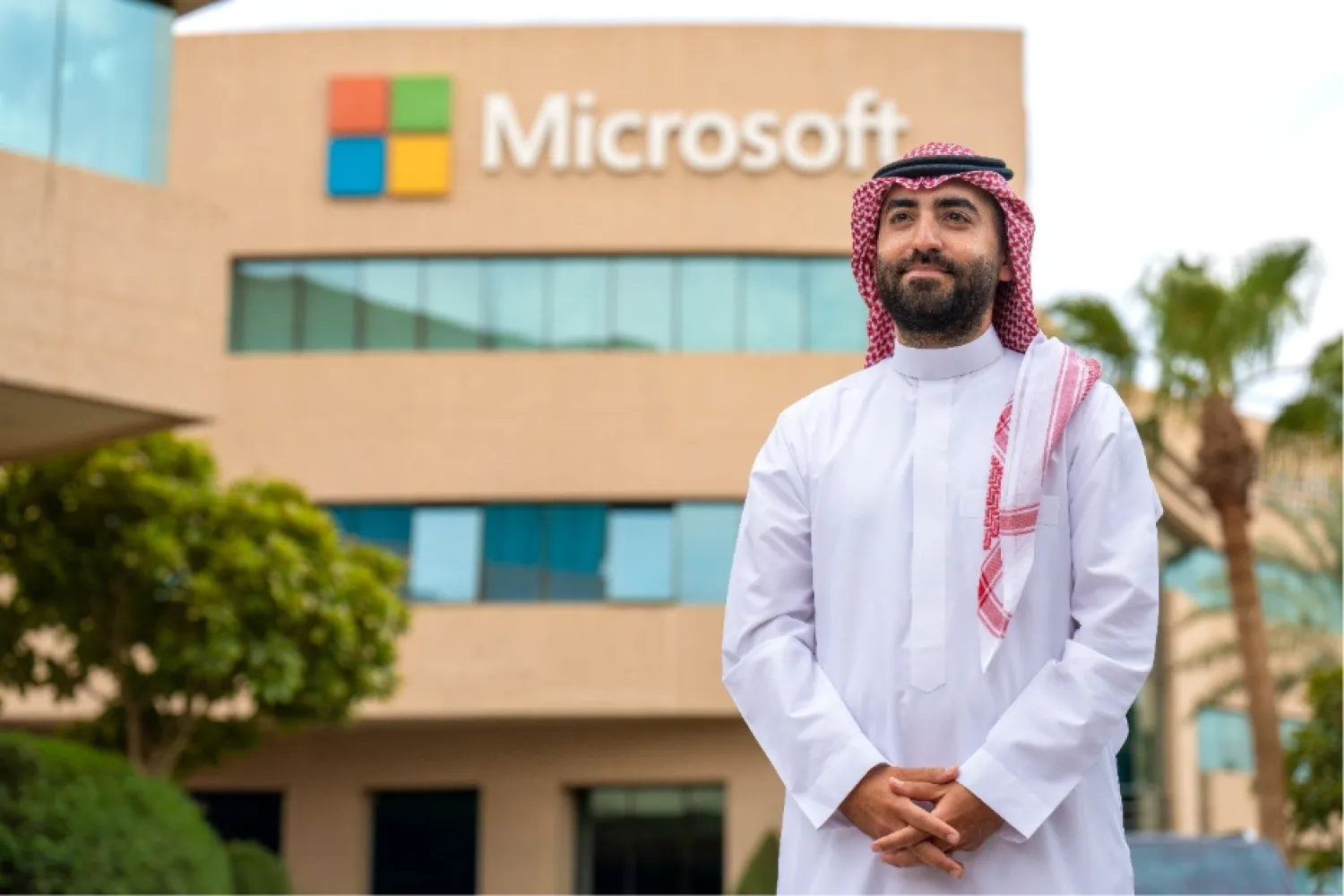

Microsoft Arabia Chief Outlines Saudi Arabia's AI Priorities for Next Phase

Ayman Al-Ghamdi, President of Microsoft Arabia (Company)
TT

Microsoft Arabia Chief Outlines Saudi Arabia's AI Priorities for Next Phase

Ayman Al-Ghamdi, President of Microsoft Arabia (Company)

After years of building infrastructure and regulatory frameworks, Saudi Arabia's challenge is shifting toward how to effectively integrate artificial intelligence into the core operations of institutions. This is the gap Ayman Al-Ghamdi, the new president of Microsoft Arabia, has placed at the top of his priorities as he takes over the company's business in the Kingdom.

In his first media interview since taking office last July, Al-Ghamdi identified three priorities for the next phase: building a trusted cloud foundation, moving AI from experimentation to practical deployment, and expanding local capabilities.

This comes alongside the launch of the Azure region in Saudi Arabia's Eastern Province, the expansion of skills programs, and the development of scalable local solutions that can grow regionally and globally.

The implementation gap within institutions

Al-Ghamdi says Saudi Arabia has completed much of the foundational work required to move toward an economy that relies more heavily on data and AI, pointing to progress in infrastructure, data governance, responsible AI, and capacity building.

In this context, he cites what he described as the progress made by the Saudi Data and Artificial Intelligence Authority, noting that the regulatory ecosystem includes 32 regulatory instruments related to data and 13 related to AI. However, he believes the next phase will depend more heavily on what happens within institutions themselves.

He tells Asharq Al-Awsat: "Many institutions are still treating AI as something to experiment with, rather than integrating it into core operations."

In his view, closing this gap requires linking AI directly to business and service performance and customer experience, while providing the appropriate data, governance, talent, and operating models capable of turning adoption into measurable impact.

This approach forms the central focus of Al-Ghamdi's priorities for his first year. He believes the goal is to make the impact of AI "real, not just a headline," so that it is reflected in how institutions operate, the services they provide, and the results they achieve.

Three priorities for the first year

Al-Ghamdi's first priority is what he calls a "trusted cloud foundation," particularly as the Azure region in the Kingdom's Eastern Province prepares to become available for customer workloads. He links this step to institutions' ability to modernize critical systems securely and responsibly, rather than simply adding more computing capacity inside the Kingdom.

The second priority is moving AI projects from experimentation to practical value. He says the measure of success will not be the number of use cases companies announce, but the extent of improvement achieved in productivity, services, operations, and customer experience.

He points to the O3ai platform, an intelligent system for smart factories developed by Obeikan Group, as an example of what this transition from experimentation to practical use could look like, according to his response.

The third priority is building Saudi capabilities, based on Microsoft's commitment to help 3 million people in Saudi Arabia acquire AI skills by 2030. He says the objective is for the transformation to be built and sustained locally, because "technology alone does not create transformation, people do."

The cloud region... more than local hosting

Al-Ghamdi does not present the launch of the Saudi cloud region simply as a matter of capacity or data residency. Instead, he links it to the ability of companies and government entities to modernize critical workloads and prepare to expand their use of AI.

He notes that expansion at the national level requires an integrated set of elements, including cloud readiness, data infrastructure, security, governance, skills, and a strong partner network. From this perspective, he believes the broader impact of the new region could emerge through a greater share of digital value creation shifting into the Kingdom.

He says this could mean more local solutions, deeper technical capabilities, greater innovation among partners, and, over the longer term, the production of intellectual property capable of serving the Saudi market and other markets in the region.

A more competitive market

Al-Ghamdi views the growing range of choices available to Saudi customers among local and global cloud service providers as a positive development, considering it a reflection of a "strong and rapidly maturing" market. As cloud capacity expands and access to advanced AI models becomes easier, he does not believe competition will remain focused solely on who owns the infrastructure or the model.

He notes that "differentiation will shift from access to impact," explaining that the question will not simply be who has the model, but who can help institutions use it safely and responsibly in ways that genuinely change how they work.

He links this to an effort to bring cloud, data, cybersecurity, productivity tools, business applications, developer tools, and model options together on a single platform, making AI part of daily workflows, decisions, operations, and customer experiences.

He also emphasizes control over the data, context, and institutional knowledge that distinguish each organization. Al-Ghamdi sums up the elements of competition on which Microsoft is betting in three concepts: "trust, choice, and control," alongside the ability to turn AI into measurable impact at scale.

Uneven returns from AI

Despite the acceleration of investment in generative AI, Al-Ghamdi acknowledges the risk that institutions may move toward these technologies faster than they can address problems with data, processes, and governance.

He says generative AI can accelerate what an organization is already doing, but it "cannot compensate for weak data foundations, fragmented processes, or the absence of clear governance." He believes institutions achieving stronger results are those that treat AI as part of business transformation rather than as a standalone technology project.

He cites the experience of Ma'aden, saying its teams save more than 2,200 hours per month using Microsoft 365 Copilot, Copilot Studio, and Azure OpenAI Service. In his view, the speed of adoption should not be considered separately from the quality of the foundations supporting it. He says security and governance must advance at the same pace, so the question is not whether an institution is moving too quickly, but whether its organizational, data, and security infrastructure is moving with it.

From consuming technology to producing it

Al-Ghamdi believes the next phase in Saudi Arabia is not only about using global platforms, but also about increasing the country's ability to build technologies from within the Kingdom that can expand beyond it.

He says Microsoft's role in this area is to provide cloud infrastructure, AI and cybersecurity tools, data platforms, and support from its partner ecosystem to Saudi companies, startups, and developers. He also stresses that the local cloud region can help build and host solutions inside the Kingdom while meeting data residency and regulatory requirements.

He adds that the long-term opportunity is for more Saudi institutions to move "from consuming technology to producing it," including by developing intellectual property, platforms, and AI solutions capable of competing regionally and globally.

Digital sovereignty... and local capability

Asked about digital sovereignty and the distinction between data residency, operational control, and technological independence, Al-Ghamdi focused in his response on increasing local capacity to build and host solutions inside the Kingdom.

He noted that the presence of local cloud infrastructure enables innovators to develop and host solutions within Saudi Arabia while taking data residency and regulatory requirements into account, linking this to the shift from using technology to producing it.

Al-Ghamdi did not directly distinguish between data residency, operational control, and technological independence. Instead, he linked the issue to the ability of Saudi companies, startups, and developers to retain a greater share of technological value, knowledge, and intellectual property within the Kingdom.

A role beyond infrastructure

Al-Ghamdi traces Microsoft's role in Saudi Arabia to more than 25 years of work with the government, institutions, companies, developers, partners, and educational organizations, including cooperation with the Ministry of Communications and Information Technology in cloud, skills, and responsible AI.

He says the current phase raises the level of responsibility from simply providing technology to turning it into national outcomes, such as improving services and productivity, strengthening secure digital environments, and creating broader opportunities for Saudi talent.

Al-Ghamdi takes up his position after more than 15 years of experience at Microsoft. Before that, he led the company's public sector business in Saudi Arabia, covering government entities, national institutions, education, and healthcare, in addition to participating in initiatives related to government cloud regulation and the National Analytics Platform. His career has also included roles at Oracle and Google.

The three-year test

In response to a question about the criteria by which his tenure could be assessed after three years, Al-Ghamdi did not tie success to business volume or the number of products sold. Instead, he framed it more broadly around turning AI ambitions into tangible results.

"After three years, I will measure success through one question: Did we help Saudi Arabia turn its AI ambition into progress that people can see?" he says.

He defines this in terms of the expansion of trusted cloud infrastructure across institutions and critical sectors, the transition of AI from experimentation to measurable improvements in productivity, services, and customer experience, as well as an increase in the number of Saudi talents, partners, and developers capable of creating digital value from within the Kingdom.

Within this framework, the phase described by Al-Ghamdi centers on testing whether technology investments can move from adoption to execution, and from the use of models and platforms to measurable outcomes in productivity, services, skills, and intellectual property within the Saudi economy.



Huawei Launches New Foldable Smartphone as Competition with Xiaomi, Apple Heats Up

The Huawei logo is seen in this illustration taken on January 29, 2025. (Reuters)
TT

Huawei Launches New Foldable Smartphone as Competition with Xiaomi, Apple Heats Up

The Huawei logo is seen in this illustration taken on January 29, 2025. (Reuters)

Huawei launched a new version of its flagship foldable smartphone on Monday as it seeks to defend its lead in the Chinese market for premium handsets against Apple and Xiaomi, both of which are also unveiling new products.

The new Mate XT2 folds out twice to open into a tablet-sized screen and ‌features Huawei's ‌new Kirin 9050 Pro chip.

Huawei ‌says ⁠the chip's design ⁠allows it to deliver more computing power while using less electricity, helping the company overcome US restrictions on access to advanced technology.

Xiaomi launches a rival foldable phone later on Monday, while Apple unveils its latest ⁠iPhone series on Wednesday, with expectations ‌high that it ‌too will be unveiling a foldable phone.

The Mate XT2 ‌features a redesigned folding mechanism, improved water ‌resistance as well as an optional screen that prevents people nearby from seeing what is displayed. It also has upgraded cameras and delivers ‌42% better overall performance than its predecessor, based on company tests.

Huawei, which ⁠does ⁠not sell in the US due to sanctions, leads China's smartphone market with a 22.6% share in the second quarter, ahead of Apple's 18.1%, according to consultancy IDC. Xiaomi has 12.4% of the market.

Huawei is even more dominant in folding phones, accounting for 68% of shipments in China in the second quarter, according to Smart Analytics Global, a US-based research company.


AI Data Centers Are Less Thirsty Now, Tech Giants Say

 A drone view shows construction underway on Microsoft's ATL11 data center in Union City, Georgia, US, September 1, 2026. (Reuters)
A drone view shows construction underway on Microsoft's ATL11 data center in Union City, Georgia, US, September 1, 2026. (Reuters)
TT

AI Data Centers Are Less Thirsty Now, Tech Giants Say

 A drone view shows construction underway on Microsoft's ATL11 data center in Union City, Georgia, US, September 1, 2026. (Reuters)
A drone view shows construction underway on Microsoft's ATL11 data center in Union City, Georgia, US, September 1, 2026. (Reuters)

Data centers are running into a wall of public anger in the United States over their thirst for water and power.

The tech giants spending billions of dollars on them say the water part, at least, is solvable.

Data centers are the warehouses full of computer servers that run the internet and increasingly artificial intelligence.

The computers get hot, and keeping them cool takes water.

American chip giant Nvidia said in a June report that it can eliminate water consumption almost entirely at some facilities when deploying DSX, its newest system for designing and managing AI data centers.

It's a bold claim, and one the industry is under mounting pressure to make good on.

In 2025, data centers consumed 222 billion liters (59 billion gallons) of water worldwide for cooling, according to consultancy Rystad Energy.

Without adaptive measures, the figure could nearly triple to 644 billion liters by 2030, Rystad estimates. Steps to limit the growth could keep it under double.

Nvidia's new method uses a closed-loop cooling system in which liquid flows directly through the servers, as close as possible to the chips, whose temperature can rise above 80C (176F).

The problem is that "there's a pretty direct trade-off between how much water is used and how much energy is used" for temperature control, said Andy Masley, an independent researcher who covers AI and data centers.

Cutting back on water use usually means more power as the liquid in those sealed pipes still has to be cooled down somehow, usually by blowing air over it -- and that takes electricity.

Nvidia gets around some of this by letting the liquid enter the servers warmer than usual, at 45C.

Most other closed-loop systems ran at about 32C in 2024, according to the Uptime Institute, which certifies data centers.

By starting with warmer water, Nvidia does not need to pump in cooled air year-round.

"Simple fans circulating the air" are often enough, though sometimes a mix of methods is needed, said Josh Parker, Nvidia's head of sustainability.

At sites in extreme climates, or during a heatwave, chill airflow or water evaporation is still necessary.

- Public relations -

Microsoft, Amazon Web Services (AWS) and Meta told AFP that they also use closed-loop systems, which they said involve no net water loss.

The two cloud computing giants, which have been expanding their already huge data center footprints, used more water overall between 2022 and 2025, but their water use efficiency improved by 25 percent at Microsoft and 37 percent at AWS, according to their most recent sustainability reports.

There is no industry-wide consistency, however, in how companies report data on so-called environmental, social and governance (ESG) efforts.

Elon Musk's SpaceX, now a major player in data centers after it acquired his artificial intelligence company xAI, has never published an ESG report.

In June, ratings agency MSCI gave SpaceX its lowest ESG score.

"Because water is generally much cheaper than electricity," companies have less incentive to cut water use on cost grounds alone, said Shaolei Ren, an engineering professor at the University of California, Riverside.

"There are incentives," Ren said, but they have more to do with public relations amid the growing backlash to data centers across the United States.

Another obstacle is that upgrading an older data center to newer, less thirsty technology is expensive.

That may matter less than it sounds.

Older data centers are smaller and less powerful than the enormous new ones being built now, so they need less cooling in the first place, said Minh K. Le, who leads data center and hydrogen research at Rystad.

And the water a data center uses directly is only part of the story.

Water is used to generate the electricity that powers the data center, and to manufacture its chips and servers.

In the United States, that hidden water use can be twice the amount a data center consumes on its own.


From Dance Floor to War: China Readies Humanoid Robots for Combat

A UBTech humanoid robot, Walker S, picks up an object operated by a staff member, during a demonstration simulating a factory's assembly line, at the robotics exhibition center Robot World, during an organized media tour to the Beijing Robotics Industrial Park, in Beijing Economic-Technological Development Area, also known as Beijing E-Town, in China May 16, 2025. (Reuters)
TT

From Dance Floor to War: China Readies Humanoid Robots for Combat

A UBTech humanoid robot, Walker S, picks up an object operated by a staff member, during a demonstration simulating a factory's assembly line, at the robotics exhibition center Robot World, during an organized media tour to the Beijing Robotics Industrial Park, in Beijing Economic-Technological Development Area, also known as Beijing E-Town, in China May 16, 2025. (Reuters)

At the World Humanoid Robot Games in China last month, robots jumped, boxed and danced. Some fleet-footed bots ran faster than Usain Bolt over 100 meters. Spectators cheered the machines’ improving capabilities and their meme-worthy stumbles.

Two days after the Games ended, the People's Liberation Army's official newspaper drew its own conclusions from the show. The PLA Daily called for researchers to accelerate the transfer of cutting-edge technologies from laboratories to military training grounds for robotic "combatants."

China's defense establishment is accelerating research into humanoids’ military uses and planning for their eventual wartime deployment, according to a Reuters review of more than 100 Chinese military procurement notices, academic studies, patents, official publications, government records and defense-company materials.

Military institutions are testing humanoids against battlefield requirements, seeking to acquire robots and technologies to train them, and studying how they might function alongside troops, the previously unreported records show. The work gained momentum in 2025 and 2026, focusing on robot perception, manipulation, and training data.

Chinese manufacturers accounted for about 95% of global humanoid shipments in 2025, according to BofA Global Research. That commercial dominance gives the PLA access to an expanding industry while developing its own military applications.

China’s robot defense research underscores how rapidly military technologies are evolving globally. In the Russia-Ukraine war, semiautonomous drones that use artificial intelligence for navigation and targeting have transformed reconnaissance and attack, while robots carry supplies and retrieve casualties. Reuters has previously documented the Chinese military’s efforts to learn from Europe’s deadliest conflict since World War II.

That evolution is driving worldwide military interest in autonomous systems.

"Going where we don’t want humans to go is one of the most compelling reasons to develop robots in the first place," said Dennis Hong, a professor of mechanical and aerospace engineering at UCLA. "If losing a robot means avoiding the loss of a human life, then the robot can become expendable."

China's defense ministry and the National University of Defense Technology (NUDT), the PLA’s premier research institution, ‌didn’t respond to requests ‌for comment about humanoid robots’ military applications.

Reuters found no evidence that China has deployed an armed humanoid with an operational PLA unit. The robots remain energy-intensive ‌and unreliable ⁠outside controlled demonstrations. Battlefield ⁠environments pose many variables and challenge robots’ abilities in unpredictable ways, said Aaron Johnson, a professor of mechanical engineering at Carnegie Mellon University.

URBAN ASSAULT FORCE

Already, China has a vision for humanoid robots in urban warfare.

Six "combat robots" – humanoids, robot dogs or unmanned vehicles – would be split up between two assault teams. Working with ground troops, the robots would clear an enemy-occupied building, floor-by-floor and room-by-room.

That scenario was described in an August 2025 paper by researchers at NUDT’s test center in Xi’an. The study modeled an urban assault force using equipment the authors projected could be available within five to 10 years. It didn’t specify the robots’ rules of engagement, the weapons they would carry, nor how they would handle civilian encounters.

Improvements in balance, perception and endurance could make humanoids useful in places including buildings, tunnels and ship interiors, said Juo-Min Chou, a researcher at Taiwan's Institute for National Defense and Security Research. "Their two hands and two feet could, in theory, combine mobility, climbing and manipulation," she said.

For simpler reconnaissance or logistics missions, however, quadruped, tracked or wheeled robots would generally be cheaper and easier to deploy at scale, Chou added.

Chinese military commentary envisions an expanding range of roles for humanoids. A July 2025 article in PLA Daily argued that humanoid ⁠missions could eventually evolve "from supporting combat toward primary combat" and discussed how robots might be authorized to fire on a living target that had been verified ‌by a human.

In December, the PLA Eastern Theater Command released an AI-generated montage that showed military robots, including humanoids and quadrupeds, overwhelming Taiwan's defenses in a hypothetical ‌future conflict.

China isn’t alone in exploring battlefield uses for humanoids. Last year, the US Army launched a competition to develop "militarized humanoid capabilities" that could eventually work alongside soldiers. The Army said potential roles included reconnaissance, security, obstacle clearing, hazardous-material operations and offensive ‌and defensive missions in urban terrain.

Up to 10 finalists were due to test their systems with US military experts this year, with as much as $1.25 million available for follow-on contracts.

The US robotics industry, however, trails ‌far behind China in developing two-legged and four-legged machines. Reuters reported last month that China’s Unitree robots – among the world’s leading producers of humanoids and quadrupeds – based designs for its best-selling robot dogs on innovations financed by the US military.

The Pentagon and the US Army didn’t comment for this story.

INFILTRATING ENEMY LINES

Chinese interest in humanoid robots’ military applications began to pick up in 2024. That year, NUDT and China’s Academy of Military Sciences hosted a defense-technology forum that included a session on military applications for humanoid systems, according to NUDT’s website. Neither institution responded to Reuters’ questions.

A year later, NUDT explicitly framed humanoid robots as battlefield tools. A university competition in June 2025 featured an event that simulated "infiltration behind enemy lines," requiring robots to enter an area, map it and locate targets, ‌according to its website. Another envisioned robots conducting identity checks, discipline inspections and security patrols at military bases.

The military-research university described the competition in part as a proving ground for humanoids to eventually "move toward the battlefield."

Procurement records around that time reflected that ultimate goal.

In May 2025, the PLA issued a tender to ⁠purchase a humanoid robot, including installation and technical training. Four months ⁠later, a procurement notice that listed an NUDT email as its contact address sought an "embodied humanoid robot intelligent perception and dexterous operation system."

The records contained few specifics. Reuters couldn’t determine whether the tenders were filled, and if so, which companies won or which robot models were supplied.

In June this year, the PLA budgeted about $300,000 for a system to collect and label camera, radar and motion data for humanoids, including information about terrain they could traverse, according to another military procurement document.

The specifications show Chinese military interest is extending from robot bodies into the perception, manipulation and training systems that defense scholars say are essential for humanoids to move beyond controlled demonstrations.

REMOTE OPERATION

By 2026, humanoid development had spread beyond military academia into China's defense industry.

The Fuxi robot made by Norinco, a state-owned defense conglomerate, is one example. Company materials published in August described the full-size humanoid as capable of sentry duty, all-weather reconnaissance, intelligent patrol and fulfilling dangerous roles.

Fuxi can be paired with Norinco’s teleoperation system, which allows a human operator to control a humanoid remotely, according to the company. Removing the need for a robot to make all decisions autonomously would address what many robotics experts say is the biggest challenge with humanoids.

Norinco didn’t respond to a request for comment.

Malcolm Davis, a senior analyst at the Australian Strategic Policy Institute, said he didn’t see humanoid robots as practical battlefield systems at present. "But in five to 10 years," he said, "they could very well be."

Even if remotely operated today, humanoid systems designed for autonomous deployment would eventually need to navigate ethical dilemmas. The laws of war require forces to distinguish combatants from civilians and to refrain from attacking wounded or surrendering fighters.

The International Committee of the Red Cross has cautioned that autonomous weapons may struggle to interpret signs of surrender reliably because such judgments can depend on context, conduct and intent.

The US military requires autonomous weapons to undergo legal review and realistic testing and for commanders and operators to exercise appropriate judgment over the use of force. China’s defense ministry said in March that AI-powered weapons should remain under human control.

Those concerns haven’t deterred China's exploration of humanoids’ military uses.

Wang Yonghua, a researcher at China’s Academy of Military Sciences, wrote in a November commentary that humanoids face unresolved problems in movement, perception and intelligence. Technical breakthroughs, lower manufacturing costs and industrial-scale production would be needed for humanoids to become widespread military systems.

If those conditions are met, Wang wrote, "humanoid robots will stream onto the battlefield."