
How to Turn Your Phone Into a Personal Health Dashboard

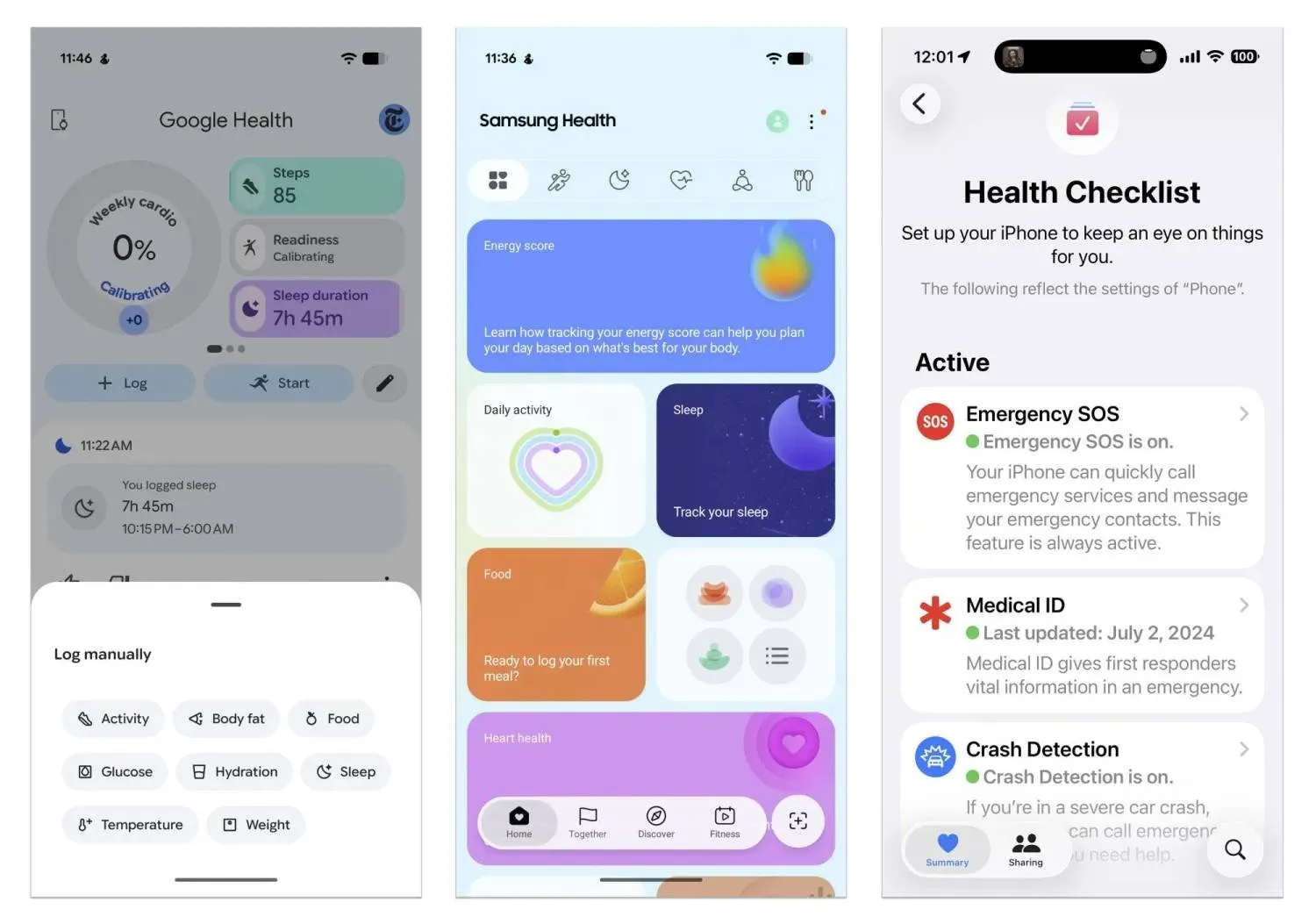
From left, the Google Health, the Samsung Health and Apple’s Health apps offer plenty of tools and features to help you manage your diet, exercise and personal safety. (Google; Samsung; Apple)
TT

How to Turn Your Phone Into a Personal Health Dashboard

From left, the Google Health, the Samsung Health and Apple’s Health apps offer plenty of tools and features to help you manage your diet, exercise and personal safety. (Google; Samsung; Apple)

New York: JD Biersdorfer

The health app on your phone’s home screen has many uses, even if you don’t have a smartwatch or fitness tracker. With a little manual effort, you can use the app to get a better idea of your general wellness.

For example, you can keep a food-and-fitness diary there. Most phones provide a free basic step-counting function. And you can link other exercise and diet apps you use to streamline your data.

Many medical providers let you import records from your doctor, and you can create a “medical ID” for your phone’s lock screen in case of emergency.

Here’s how to get started.

Choose Your App

Although third-party options abound, the basic health apps from Google, Samsung and Apple have been available for years and have been steadily adding new features:

Google recently revamped its Google Health app (formerly its app for FitBit devices) and is phasing out the older Google Fit software. Google Health is free in the app stores for Android and iOS.

Samsung Health updated last month, comes with Galaxy phones. It is also available for other Android and iOS users, particularly those using Samsung’s fitness trackers and smartwatches.

Apple’s Health app comes preinstalled on iPhones and iPads (and collects data from paired Apple Watches). It does not have an Android version.

The menus in the health apps can be a little overwhelming, so take time to explore. Each app offers a place to manually log your daily workouts, food intake, emotional state and sleep time.

You can set up medication reminders. And if you use a compatible separate exercise or diet app, you can often link it to the health app so you don’t have to log updates twice.

Many phones have an automatic step-counting feature already enabled. While not as precise as some dedicated sensors, the step count shown on the main screens of Google Health, Samsung Health and Apple’s Health, can give you a general idea of your daily distance. (If your phone isn’t counting your steps, check your settings to make sure the fitness-tracking feature is turned on.)

Sync Health Records

Many health care providers use “patient portal” sites like MyChart that allow you to log in and see your test results and other electronic medical records. If the provider’s site is compatible with your health app, you can synchronize those records to have them all in one place. You’ll need the login credentials you use for the provider’s online patient portal.

If you have confidentiality concerns about pulling in digital records to a different app, check your health app’s privacy policy before you proceed. Google Health, Samsung Health and Apple’s Health all have explanations on their sites. Note that federal privacy laws generally don’t apply to mobile devices.

The Google Health support site has a page of detailed instructions. To sync your records directly from your health care provider, open the Google Health app, tap the Connections icon in the upper-left corner of the screen and tap Medical Records; iOS users must tap Apps and Services first to get to the Medical Records option. On the

Medical Records screen, select Manage Connections and then the Add More Providers button to search and sync your files.
In Samsung Health, open the app, tap the Home tab at the bottom of the screen, scroll down and tap to Health Records to get started.

In Apple’s Health app, from the Summary screen, tap your profile icon in the upper-right corner. On the next screen, tap Health Records and follow the onscreen prompts so you can view your files, test results and other data from your doctor, or share information.

Create a Medical ID

Even if you don’t plan to use it as a personal-health database, your phone can show important information to emergency medical workers on your phone’s lockscreen, should you be incapacitated. These details can include blood type, any current prescriptions or health conditions you have, and your organ-donor status.

On many Android models, open the Personal Safety app, and tap the Your Info tab at the bottom of the screen. There, you can add your medical information and an emergency contact person.

On a Samsung Galaxy phone, tap the Settings icon, select Safety and Emergency, and then tap the options for adding medical and emergency contact information.

On an iPhone, open the Health app. If you aren’t prompted to set up your Medical ID, tap your profile photo in the top-right corner and choose Medical ID. On the next screen, add or edit the details you wish to share, and give permission to have the information displayed when your phone is locked.

Setting up a smartphone medical ID is worth your time: A recent study led by the University of Rochester showed the information was useful for patient care in 75% of cases.

The New York Times


How China Is Preparing for the Risk of AI Escaping Human Control

An AI logo is seen during the opening day of the IFA trade fair in Berlin, Germany, 04 September 2026. (EPA)
TT

How China Is Preparing for the Risk of AI Escaping Human Control

An AI logo is seen during the opening day of the IFA trade fair in Berlin, Germany, 04 September 2026. (EPA)

Warnings from researchers at leading US artificial intelligence developer Anthropic that increasingly powerful models could escape human control and even lead to the extinction of the human race have drawn attention in China, where policymakers have been preparing for some of the same risks.

The US and China are the two major driving forces of frontier AI development and the technology's global adoption. Both superpowers have been increasingly at loggerheads over each other's AI policies and industry practices, with these issues slated to feature prominently in bilateral talks later this month.

Despite the race to develop increasingly powerful AI systems, regulatory frameworks and public statements from Beijing underscore how Chinese authorities regard the possibility of advanced AI escaping effective human oversight as serious enough to plan for.

CHINA SEES RISKS IN LEADING CLOSED-SOURCE US MODELS

China's state ‌security minister Chen ‌Yixin wrote in a government outlet on Sunday that advanced US models such as Anthropic's ‌Mythos and ⁠OpenAI's GPT-5.5-Cyber ⁠could pose serious risks to China's critical information infrastructure and called for a comprehensive strengthening of AI security.

Anthropic and OpenAI did not immediately respond to Reuters requests for comment.

Chinese AI developers have promoted open-weight models partly on the grounds that cybersecurity teams can inspect, modify and deploy them for defensive work.

Model repository platform Hugging Face said it used GLM-5.2, an open-weight model developed by China's Z.AI, to analyze a July intrusion by escaped OpenAI agents after more tightly restricted US models proved less useful for the forensic work.

But experts also highlight the risks posed by open-weight models, which can be modified and redistributed with little oversight.

Moonshot's Kimi K3 last month bypassed a UK AI ⁠Security Institute testing sandbox, highlighting the risk that Chinese AI models could, like their US counterparts, ‌evade controls designed to restrict their access and actions.

REGULATORS HAVE FLAGGED AI 'LOSS OF ‌CONTROL' RISK

China first included an explicit future loss-of-control scenario in an AI safety framework released in September 2024 under the guidance of the ‌Cyberspace Administration of China (CAC).

The document said it could not be ruled out that future AI might autonomously obtain external ‌resources, replicate itself, develop self-awareness and seek external power, creating a risk of competing with humans for control.

The CAC released an expanded version in September 2025. The newer framework sharpened the scenario, saying AI could undergo a sudden and unexpectedly large "leap" in intelligence before acquiring resources, replicating itself and seeking power. It also added a governance principle of "trusted application, preventing loss of control".

A later expert interpretation published on the cyberspace regulator's website said ‌the new principle was intended to guard against loss-of-control risks threatening human survival and development and referred to a possible "AI breaking loose" scenario.

CHINESE LEADER XI PUTS HUMAN CONTROL AT CENTRE

The ⁠concern has since appeared in ⁠China's highest-level political messaging.

At the World Artificial Intelligence Conference in Shanghai in July, Chinese President Xi Jinping said authorities should pay close attention to both intrinsic and derivative risks arising from AI.

He said AI should "always remain under human control".

China's senior Foreign Ministry official responsible for AI affairs, Sun Xiaobo, said at a United Nations meeting last month that China was accelerating research into broader AI legislation.

China's deputy permanent representative to the United Nations, Sun Lei, urged governments this month to approach military AI cautiously to avoid strategic miscalculation and an arms race.

BEIJING WARNS OF NEW RISKS POSED BY AI AGENTS

China has, meanwhile, begun turning those principles into more specific rules for AI agents, which act much more autonomously and carry out more complex tasks than an ordinary chatbot.

In May, China's cyberspace regulator issued joint guidelines specifically covering such systems.

They require developers to improve their ability to discover, intervene in, block and recover from improper agent behavior.

The guidelines specifically identify data poisoning, algorithm manipulation, system vulnerabilities and "operational loss of control" as security risks. They also say users should retain final decision-making authority over an agent's autonomous decisions.

While China has not proposed independent monitors embedded inside AI companies in the manner advocated by Anthropic, its standards allow developers to commission third-party safety assessments, as well as envisaging outside evaluation bodies and security researchers testing and auditing open models.


SDAIA to Asharq Al-Awsat: Saudi Arabia Moving from Adopting AI Standards to Shaping Them

 Saeed bin Mohammed Al-Shahrani, SDAIA spokesman (SDAIA)
Saeed bin Mohammed Al-Shahrani, SDAIA spokesman (SDAIA)
TT

SDAIA to Asharq Al-Awsat: Saudi Arabia Moving from Adopting AI Standards to Shaping Them

 Saeed bin Mohammed Al-Shahrani, SDAIA spokesman (SDAIA)
Saeed bin Mohammed Al-Shahrani, SDAIA spokesman (SDAIA)

AI ethics is no longer merely a matter of broad principles for regulators, particularly with the emergence of autonomous agents capable of making decisions and taking actions with minimal human intervention. In Saudi Arabia, the Saudi Data & AI Authority (SDAIA) maintains that an intelligent system does not bear legal responsibility when harm occurs; responsibility remains with the developer and the entity operating it.

Saeed bin Mohammed Al-Shahrani, SDAIA spokesman, told Asharq Al-Awsat in an exclusive interview that traditional governance frameworks are no longer sufficient to keep pace with such developments. In his view, high-risk decisions require human oversight, clear chains of responsibility and documented, operational emergency shutdown mechanisms.

His comments come ahead of the fourth UNESCO Global Forum on the Ethics of Artificial Intelligence, hosted in Riyadh from Sept. 14-17, marking the first time the international forum is being held in the Arab world. More than 100 speakers will take part in dozens of sessions and workshops, including ministers, policymakers, experts, academics, representatives of international organizations and the public and private sectors, as well as technology executives.

Global Forum Priorities

The program begins with preparatory meetings and gatherings of international networks involved in implementing UNESCO’s Recommendation on the Ethics of Artificial Intelligence, as well as a closed strategic briefing for ministerial participants and a ministerial dialogue on international cooperation.

The forum will review five years of implementing UNESCO’s recommendation, adopted in 2021, and discuss financing governance systems and building regulatory capacity. It will also see the launch of the updated Readiness Assessment Methodology, RAM 2.0, based on analysis of more than 55 readiness reports.

Sessions will address practical issues including AI use in public administration, health and humanitarian work, youth mental health, the environment, energy and water, linguistic diversity — including Arabic — as well as physical AI, robotics and human-machine relations in the workplace.

From Principles to Engineering Requirements

Five years after UNESCO adopted its AI ethics recommendation, Al-Shahrani sees the main problem as no longer a lack of principles, but the difficulty of translating them into tools developers and regulators can use and against which compliance can be measured.

He described the key gap as the “operational translation of principles”: turning concepts such as fairness, transparency and accountability into engineering requirements, standardized tests and binding regulatory controls for developers. He also pointed to disparities in governments’ ability to conduct hands-on technical assessments and monitor systems before deployment and during operation.

In Saudi Arabia, SDAIA has introduced principles and frameworks governing the relationship between people, data and AI technologies, Al-Shahrani said, covering integrity and fairness, security and privacy, humanity, social and environmental benefits, reliability and safety, transparency, as well as accountability and responsibility.

Flexible Regulation

Al-Shahrani identified building specialized governance skills and institutional capacity as a major readiness challenge, noting that technology is evolving faster than people can adapt.

He continued that SDAIA is pursuing a “flexible regulation” strategy based on continuous assessment and providing companies with self-assessment tools rather than imposing complex bureaucratic procedures.

The approach comes amid growing debate within the AI industry over whether safety and oversight measures can keep pace with the rapid development of advanced models.

From Adopting Standards to Shaping Them

SDAIA does not necessarily expect the world to reach a single detailed AI law. Al-Shahrani acknowledged the difficulty of establishing one detailed framework given differences in legal systems and economic priorities among the United States, Europe, China and others, but considers convergence on fundamental principles and safeguards “possible and necessary.”

What is needed, he argued, is not a single dominant model but common ground on issues such as safety and ethics, while narrowing the gap between technological powers and emerging markets.

Al-Shahrani told Asharq Al-Awsat that Saudi Arabia has become an active participant in shaping international AI rules and initiatives by sharing its expertise, partnerships and a vision that seeks to balance innovation and governance.

He highlighted cooperation with UNESCO and other international institutions, as well as the establishment in Riyadh of the International Center for AI Research and Ethics (ICAIRE), under UNESCO’s auspices.

The center is intended to help move AI ethics from broad principles to practical implementation by embedding them in scientific research, education, standards, innovation and public policy from the earliest stages of technology development — reflecting Saudi Arabia’s desire to help shape standards rather than merely apply rules formulated elsewhere.


China State Newspaper Blasts Anthropic’s Calls to Slow AI as ‘Cold War’ Tactic

CEO of Anthropic Dario Amodei addresses the gathering at the AI Impact Summit, in New Delhi, India, February 19, 2026. (Reuters)
TT

China State Newspaper Blasts Anthropic’s Calls to Slow AI as ‘Cold War’ Tactic

CEO of Anthropic Dario Amodei addresses the gathering at the AI Impact Summit, in New Delhi, India, February 19, 2026. (Reuters)

An essay by Anthropic's CEO calling for a slowing down of AI development may look like a rational statement focused on safety risks, but it is really a "Cold War playbook" targeting China, the state-backed Global Times said in an editorial.

In the essay published on Saturday and later endorsed by OpenAI CEO Sam Altman and SpaceX founder Elon Musk, Dario Amodei outlined a framework ‌to pace the ‌development of frontier AI model capabilities and ‌create ⁠more time to ⁠manage mounting safety risks.

Amodei also urged the US to strengthen chip export controls on China and crack down on alleged model distillation by Chinese AI labs. He also told CBS News on Sunday that the "toughest dilemma" over his proposal to slow AI advancement was if China and other adversarial nations chose not ⁠to do the same.

The Global Times tabloid ‌said the true agenda of ‌Amodei's essay was "to attempt to curb China's AI development through technological barriers ‌and regulatory monopolies, uphold Washington's monopolistic hegemony in cutting-edge technology, and ‌exclude China from the global AI governance system."

"This 'silent AI Cold War' is hypocritical and short-sighted," it said, adding that excluding China from global AI innovation would "significantly increase the trial-and-error costs and risks of loss ‌of control in global AI development".

US lawmakers have urged new rules to govern AI systems after ⁠dire warnings ⁠from two Anthropic researchers that rapidly progressing AI could lead to the extinction of the human race in the not-too-distant future.

Trump brushed aside calls to slow down AI on Sunday, saying that "very negative forces" were raising exaggerated concerns.

"We're leading China in AI. We're the most sophisticated country in the world, and frankly I want to keep it that way because whoever wins AI wins," Trump said.

The US and China are planning to discuss frontier AI safety risks in mid-September, sources have said, and the issue could be raised during a summit between Presidents Donald Trump and Xi Jinping on September 24.