


Robot Olympics Ends with Humanoid’s 8.64-Second 100m, Nearly a Second Faster Than Bolt

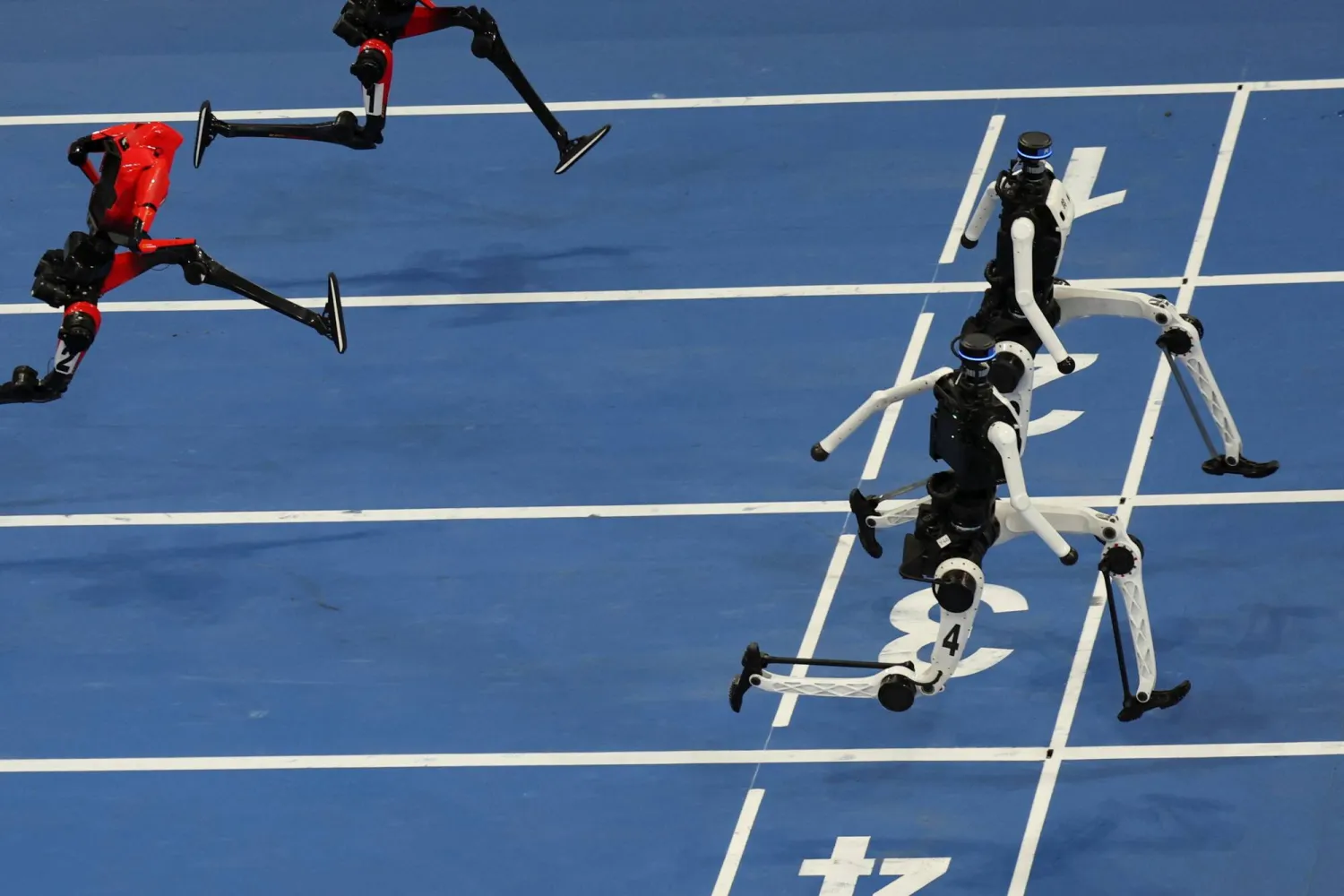
 Tiangong Ultra humanoid robots cross the finish line before Honor's Lightning humanoid robots in the 100m large-size group final race, during the second World Humanoid Robot Games at the National Speed Skating Oval in Beijing, China August 26, 2026. (Reuters)
Tiangong Ultra humanoid robots cross the finish line before Honor's Lightning humanoid robots in the 100m large-size group final race, during the second World Humanoid Robot Games at the National Speed Skating Oval in Beijing, China August 26, 2026. (Reuters)
TT

Robot Olympics Ends with Humanoid’s 8.64-Second 100m, Nearly a Second Faster Than Bolt

 Tiangong Ultra humanoid robots cross the finish line before Honor's Lightning humanoid robots in the 100m large-size group final race, during the second World Humanoid Robot Games at the National Speed Skating Oval in Beijing, China August 26, 2026. (Reuters)
Tiangong Ultra humanoid robots cross the finish line before Honor's Lightning humanoid robots in the 100m large-size group final race, during the second World Humanoid Robot Games at the National Speed Skating Oval in Beijing, China August 26, 2026. (Reuters)

A Chinese humanoid robot on Wednesday ran the 100 meters in 8.64 seconds, almost a second faster than Jamaican Usain Bolt's human world-record time, at the close of a five-day competition featuring robotic athletes, viral stumbles and industrial tests.

Tiangong Ultra, developed by the Beijing Humanoid Robot Innovation ‌Centre, won the ‌large-size robot 100m final at the ‌second ⁠World Humanoid Robot ⁠Games.

The robot improved rapidly through the event, running 9.39 seconds and 8.86 seconds in qualifying before the final.

Bolt's world record of 9.58 seconds was set at the 2009 world championships in Berlin.

As in human athletics, the 100m was one of the highlights of the Beijing games, underscoring advances in robot ⁠mobility, balance and control systems.

The event dubbed the "Robot ‌Olympics" brought together more than ‌2,000 robots from 666 teams, most of them Chinese. Its 51 ‌disciplines included sports contests as well as task-based challenges ‌in simulated factories, restaurants, offices and emergency settings.

Spectators said the robots appeared more capable than those seen at the inaugural games.

"Last year's robots looked a little stiff and uncoordinated," said 34-year-old Niu. "This year, ‌they are much better. They are like healthy newborn babies growing up."

Yang, 29, said she ⁠could imagine ⁠robots becoming as commonplace as smartphones.

"Maybe there will be one at home and one at work," she said, adding that robots could help with chores or care for elderly people.

For developers, the games offered a public test bed for embodied artificial intelligence, which combines AI software with machines that can perceive and act in the physical world.

He Wang, founder and chief technology officer of Galbot, said the competition would help teams improve their technology while showing what embodied AI systems could do autonomously.

"It will provide a huge boost for industry development," he said.



Meta Reaches $17 Billion Settlement with States in Landmark Trial Over Teen Social Media Addiction

A security guard stands watch by the Meta sign outside the headquarters of Facebook parent company Meta Platforms Inc in Mountain View, California, US, November 9, 2022. (Reuters)
TT

Meta Reaches $17 Billion Settlement with States in Landmark Trial Over Teen Social Media Addiction

A security guard stands watch by the Meta sign outside the headquarters of Facebook parent company Meta Platforms Inc in Mountain View, California, US, November 9, 2022. (Reuters)

Meta has agreed to pay $17 billion and add stronger child-safety measures to its Facebook and Instagram platforms to end a landmark trial over teen social media addiction and settle claims filed by 47 states, state attorneys general announced Wednesday.

The settlement resolves a pivotal legal case years in the making that sought to hold the tech giant accountable for the role its platforms played in undermining children’s mental health. The effort targeted features designed to hook young people’s attention.

“For years, Meta intentionally deceived the public about the addictive and harmful design features that have wreaked havoc on youth mental health," Virginia Attorney General Jay Jones said. The settlement "will put an end to these dangerous practices and deliver meaningful relief that will protect children from online harm.”

California Attorney General Rob Bonta said the money would be paid out over 10 years, with the state getting at least $1.5 billion if the settlement is approved by the court. New Jersey expects to receive at least $525 million. Massachusetts said it was in line for at least $366 million. Virginia's share is worth $353 million.

Meta said in a blog post that it was “building on our longstanding efforts to empower parents and support teens.”

“Ensuring teens have a safe and productive experience on our platforms is an absolute imperative for Meta,” the company said. “We want to get this right for parents and teens, and that’s why we partnered with state attorneys general to set a new industry standard."

The company urged rivals TikTok and YouTube to adopt similar safety measures.

The $17 billion settlement is a fraction of Meta's 2025 revenue of $201 billion.

The agreement cuts short an ongoing court case involving California, Colorado, Kentucky and New Jersey, which were among 29 states that sued Meta in 2023. CEO Mark Zuckerberg was among those expected to take the stand before a jury in federal court in California.

The lawsuit accused Meta of contributing to the youth mental health crisis by deliberately designing features that addict children to its platforms and hiding them from the public. The case also argued that Meta violated federal laws by routinely collecting data on children under 13 without their parents’ consent.

The trial kicked off last week in Oakland, California, with US District Judge Yvonne Gonzalez Rogers overseeing the proceedings. Adam Mosseri, the head of Instagram, began his testimony late Tuesday and defended Meta’s record and progress on child safety and privacy.

The cases in other states had been expected to go to trial later. In addition, nine attorneys general filed lawsuits in their respective states.

New features to include time limits and curbs on push notifications

Under the proposed settlement, Meta agreed to adopt a series of safety features, including a “hard cap” on daily time limits and pauses for children using Instagram and Facebook.

It will eliminate push notifications during weekday school hours and bring in “robust” age-assurance measures and “age-appropriate” content controls to prevent bullying and harmful material about eating disorders and self-harm.

There will be stronger and more user-friendly parental controls and limits on social comparison features such as “like” counts.

An independent auditor will assess how Meta is implementing the safety features and how effective they are.

Meta put the settlement at $18 billion, a figure that apparently includes a large award for Texas.

The money is to be paid out annually over 10 years, to fund youth online safety initiatives. However, the company said 30% of that amount — about $5.3 billion — will only be released to states if rivals YouTube and TikTok meet two conditions: implementing similar safety features, including a one-hour daily time limit, a nighttime block and age-assurance measures; and paying the same amount, split between the two companies.

Neither YouTube owner Google nor TikTok responded immediately to requests for comments.


Instagram Chief Admits Touting Teen Safety Tool While Omitting It Was Barely Used

Witness Adam Mosseri, head of Instagram, leaves the courthouse, as Meta faces a landmark trial in federal court over claims from 29 states that the company illegally collected and used children's data in violation of federal law, allegedly designed its social media platforms to keep young users hooked and misled consumers about their safety, in Oakland, California, US, August 25, 2026. (Reuters)
TT

Instagram Chief Admits Touting Teen Safety Tool While Omitting It Was Barely Used

Witness Adam Mosseri, head of Instagram, leaves the courthouse, as Meta faces a landmark trial in federal court over claims from 29 states that the company illegally collected and used children's data in violation of federal law, allegedly designed its social media platforms to keep young users hooked and misled consumers about their safety, in Oakland, California, US, August 25, 2026. (Reuters)

Adam Mosseri, who oversees Instagram at Meta, admitted in a California court on Tuesday that he touted newly launched safety tools for teens without disclosing low adoption rates from early testing several years ago.

With more than three billion users around the world, Meta is fending off accusations by a coalition of 29 US states that it deliberately designed its products to hook children and gather their data while misleading the public.

The trial entered its second week on Monday and is expected to last through late September.

A lawyer with the Colorado Attorney General's office, Jason Slothouber, questioned Mosseri about the low usage of the tools, known as Take a Break and Quiet Mode, which were launched in 2021 and 2023, respectively.

Other witnesses have testified over the past week that these tools weren't effective, though Mosseri pushed back on the idea that adoption remains low.

"This is one feature with a disappointingly low usage rate which since this time has significantly improved," Mosseri said.

On December 8, 2021, Mosseri testified at a Congressional hearing about the negative impacts of social media on young people. One day before, Meta published a blog post, authored by Mosseri, about rolling out new safety features for teens.

"Early test results show that once teens set the reminders, more than 90% of them keep them on," the blog post says.

However, that number referred to the number of people who kept it on after turning it on.

When asked if Meta disclosed its low adoption, which only reached 1 or 2 percent of the accounts, Mosseri admitted the company did not but said the safety features were later turned on by default in Teen Accounts, which have parental controls and launched in 2024.

However, Mosseri couldn't recall if Meta had ever disclosed the percentage of teen accounts that have parental controls turned on.

Mosseri will continue testifying on Wednesday. Founder and CEO Mark Zuckerberg is also expected to testify, though it's unclear when.

- 'Disappointing' adoption -

Meta knew that its tools for protecting teenagers on Instagram were largely ineffective, other witnesses have testified.

Internal Meta documents shown to jurors on Tuesday said that Take a Break, which allows users to set reminders to stop scrolling, reached an adoption rate of 1.8 percent, while Quiet Mode, which silences late-night notifications, reached 8.7 percent.

Under questioning from state lawyers, Francesco Fogu, Meta's director of product design at Instagram, said Tuesday that he was not aware of the numbers, but conceded that the company "knew adoption rates would be lower" if those tools were not turned on by default.

Judge Yvonne Gonzalez Rogers, who will decide the case using the jury's verdict as guidance, appeared stunned that Fogu was unaware of the internal data.

If Meta is convicted, US states will seek around $200 billion in penalties, and a court loss could force fundamental changes to its business model and send shockwaves through the industry.

Two former employees also testified that Take a Break and Quiet Mode were not effective.

"In my experience, Take a Break is a feature that's designed to fail," Arturo Bejar, a former Meta engineering director, testified last week.

George Volichenko, a data scientist who worked on safety features at Instagram in 2022 and 2023, said Monday that adoption rates for those features were "very low and disappointing" and just "a drop in the ocean."

He painted Meta's leadership as uninterested in meaningfully boosting their use.

Leadership did not approve turning on Quiet Mode by default for younger teens, which held down adoption because the setting was hard to find in the app, Volichenko said.

Switching the safety features on by default would have caused a "notable negative impact" on user engagement, he said.

Meta's business model revolves around selling advertising, and the company earns more when users spend more time on its apps.


China's Huawei, US PC Maker HP Sign Multi-year Wi-Fi Patent Deal

People walk past the Huawei booth, where the Atlas 950 SuperPoD system is displayed, during the World Artificial Intelligence Conference (WAIC) in Shanghai, China, July 17, 2026. (Reuters)
TT

China's Huawei, US PC Maker HP Sign Multi-year Wi-Fi Patent Deal

People walk past the Huawei booth, where the Atlas 950 SuperPoD system is displayed, during the World Artificial Intelligence Conference (WAIC) in Shanghai, China, July 17, 2026. (Reuters)

China's Huawei Technologies said on Wednesday it had reached a multi-year cross-license agreement with HP Inc, covering patents used in Wi-Fi technology, including the latest Wi-Fi 7 standard.

The deal gives HP access to Huawei patents and gives Huawei access to HP patents, though neither company disclosed financial terms. Huawei did not detail the scope of the patents it would receive from HP.

HP said the agreement was a routine license for technology used broadly across the industry, rather than the start of a wider ‌commercial relationship ‌with the Chinese technology company.

"This is a standard-essential patent license ‌covering ⁠Wi-Fi technology," an HP ⁠spokesperson said. "It is not new, and does not represent a broader strategic or commercial relationship, partnership, or collaboration with Huawei."

Standard-essential patents cover inventions that companies may need to use in order to make products compatible with an industry standard, such as Wi-Fi. Such licenses are common for makers of computers, printers, phones and other devices that connect to wireless networks.

The agreement shows Huawei remains an important holder of patents used in global ⁠wireless standards, despite US restrictions requiring US carriers to remove ‌their equipment from US networks.

HUAWEI-HP DEAL FOLLOWS LEGAL ‌DISPUTE

Huawei has expanded its patent portfolio and licensing business in recent years, reaching settlements with ‌companies including Amazon. It has said it is among the leading holders of patents ‌needed to implement Wi-Fi 6, the prior generation of the wireless standard.

Huawei has set a fee of 50 cents for each consumer device using its Wi-Fi 6 technology. More than 1.6 billion consumer electronic devices, excluding mobile phones, had used Huawei's Wi-Fi-related inventions by the end ‌of 2025, the company said.

Wednesday's agreement follows a lawsuit Huawei filed against HP at Europe's Unified Patent Court in August ⁠2025, accusing the US ⁠company of using a Wi-Fi 6 patent without permission, according to intellectual-property publication IAM.

HP joined the Sisvel Wi-Fi 6 patent pool in November 2025, ending legal actions against it by Huawei and Philips. The pool gives companies access through a single agreement to about 2,000 patents considered necessary for Wi-Fi 6 products.

Huawei said the new direct deal covers a broader set of its Wi-Fi patents, including Wi-Fi 7.

Huawei has faced US trade restrictions since 2019, when Washington added the company to a trade blacklist that generally requires suppliers to obtain government approval before providing certain US-origin technology.

The restrictions have limited Huawei's ability to buy advanced semiconductors and crucial software, but do not automatically bar patent-licensing agreements.

HP, based in Palo Alto, California, was the world's second-largest PC maker with a 21.3% market share, behind Lenovo, according to Gartner data.
