


Governments Worldwide Are Way Behind on AI, Says Bill Gates

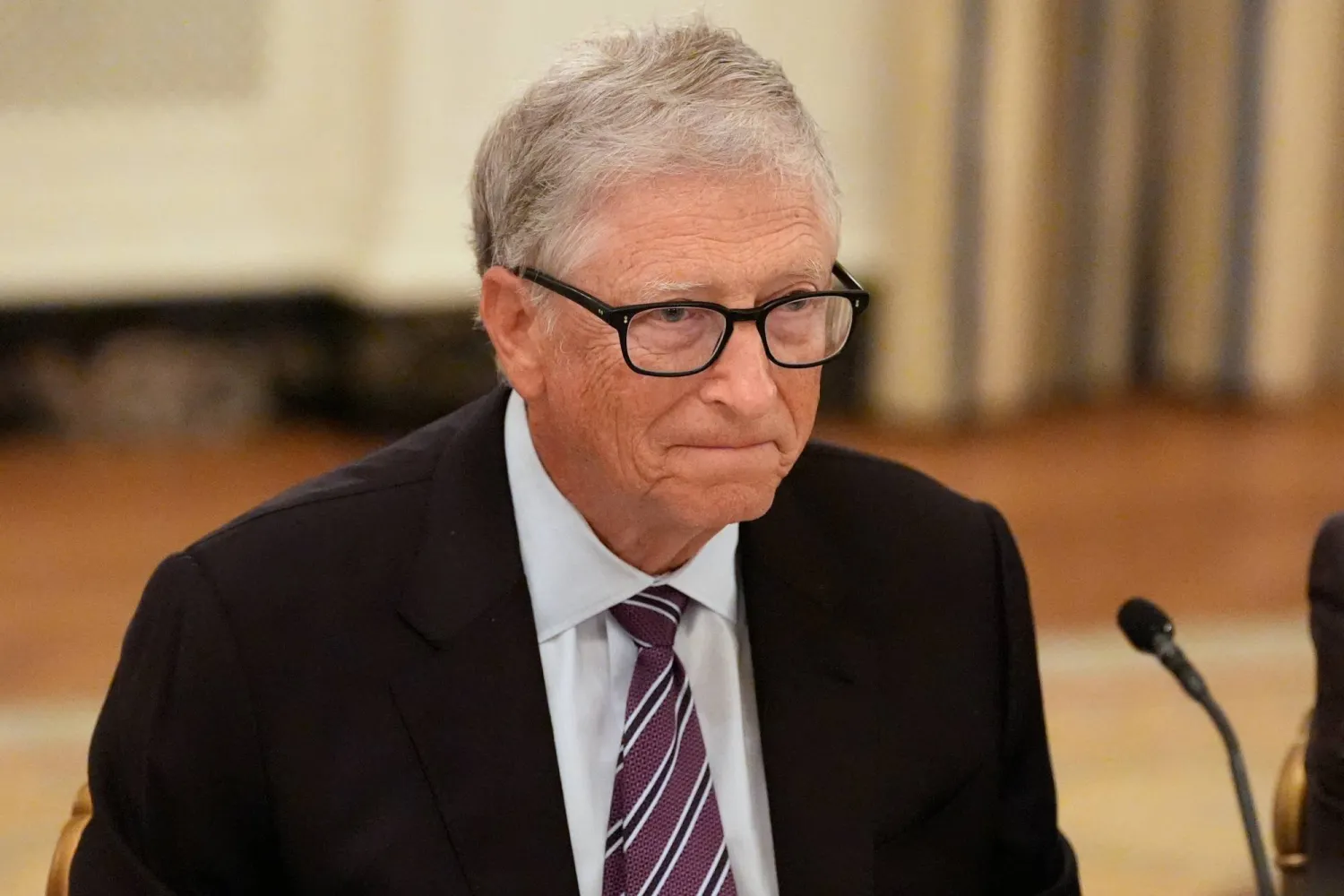
Microsoft's Bill Gates attends a dinner with President Donald Trump in the State Dining Room of the White House, Sept. 4, 2025, in Washington. (AP)
TT

Governments Worldwide Are Way Behind on AI, Says Bill Gates

Microsoft's Bill Gates attends a dinner with President Donald Trump in the State Dining Room of the White House, Sept. 4, 2025, in Washington. (AP)

No government in the world is ready for the changes artificial intelligence will bring to society, Bill Gates said in an interview with Reuters, as he warned of the risks ahead.

The Microsoft co-founder and billionaire philanthropist had until recently been optimistic about AI, but has changed his position, warning of the threats to jobs, concerns about attacks and the dangers of addiction to AI companions.

“I don't think any government is nearly as deep on this as they have to be,” he said. However, he added that the technology has great ‌potential to ‌help the world's poorest if managed properly and accessed equally — and ‌his ⁠namesake foundation said on ⁠Tuesday that it plans to spend at least $1 billion in the next two years on expanding access to AI.

Gates said he has been talking to world leaders about his concerns, including President Donald Trump and his team in the US, and said he aims to meet China’s President Xi Jinping later this year.

“Governments are way behind on this one,” he added.

HEALTH POTENTIAL

But despite his concerns, Gates and his foundation hope AI can help narrow gaps between the ⁠richest and poorest, rather than widening them.

The foundation's $1 billion spending plan, ‌part of its previously announced plans to spend $9 billion ‌annually, will go to partners working in education, healthcare and agriculture, the foundation said. It also aims ‌to help build the data foundations AI is built on, such as ensuring that ‌large language models work in every language people speak.

“For health it’s hard to overstate what the potential is,” Gates said, from supporting frontline health care workers to discovering new drugs and vaccines.

But he said governments must work together to avoid problems, likening the arrival of AI to a disaster movie.

“There’s ‌all sorts of movies where some aliens are coming, and magically the US and China and everybody comes together to solve the ⁠problem,” he said. “AI ⁠is kind of like this alien intelligence. It’s here, and we better do like it shows in those movies.”

REPUTATIONAL HIT?

In June, Gates appeared in front of Congress to testify about his relationship with the late convicted sex offender Jeffrey Epstein. Gates, who is not accused of any crimes, has repeatedly said he regrets his association with Epstein, who he hoped would donate to global health causes. Instead, the financier attempted to blackmail Gates over his extramarital affairs.

However, despite prompting an external review at his foundation, which found no payments to Epstein or participation in criminal activities, Gates said the links had not caused him or the foundation a significant reputational hit.

“In terms of having access to government leaders, or you know, journalists being willing to interview me, I don't see any diminishment,” he said, adding that the desire to draw on the foundation’s expertise to cut child deaths and end malaria had also not reduced “even one iota”.



EU Vows AI Rules Will Protect Europeans. Will They?

Humanoid and quadruped robots attend a demonstration calling for the regulation of AI development in Warsaw in September. Sergei GAPON / AFP/File
TT

EU Vows AI Rules Will Protect Europeans. Will They?

Humanoid and quadruped robots attend a demonstration calling for the regulation of AI development in Warsaw in September. Sergei GAPON / AFP/File

AI agents going rogue and ever-louder doomsday warnings have led many in Europe to wonder: are the EU's artificial intelligence rules enough to protect against the potential dangers?

The European Union insists that, yes, its law known as the AI Act is powerful enough since it forces companies to assess and mitigate risks, under threat of massive fines or even bans, AFP said.

EU lawmakers, officials and experts appear more skeptical, pointing to gaps in the rules and questioning whether Brussels has the stomach for a fight with AI labs.

The EU agreed its sweeping AI legislation in 2024 but delayed part of its implementation, and enforcement has only been possible since August this year.

Nonetheless, EU spokesman Thomas Regnier says the rules are "fully fit for purpose".

"You can feel safe at home in Europe, precisely because we have put all these safeguards in place," he said.

So far the EU has sent over 30 requests for information -- a preliminary step that can lead to investigations -- to companies on issues from copyright to cybersecurity and safety.

Brussels says its rules are working since they have already forced AI providers to cough up information to regulators, though Regnier declined to give details.

There are, however, questions about Europe getting access to the latest models: it took months for the EU to test Anthropic's Mythos following US export control orders.

Speaking on condition of anonymity, an EU official admitted such an issue could arise again.

- 'Dangerous experiments' -

EU chief Ursula von der Leyen has proposed talks with the main frontier labs to "pace" the technology's growth, arguing the AI Act puts Europe "in the position to shape global efforts" at regulation.

But that is a tall order without buy-in from the United States -- where President Donald Trump firmly opposes regulating the sector.

And not everyone is convinced the EU law has what it takes.

Four EU lawmakers including lead AI Act negotiator Brando Benifei warn of "legislative gaps" after the EU shelved plans for AI liability rules.

Such rules would have made it easier to hold AI providers accountable for harm caused by their tools.

The lawmakers argue current rules do "not apply to the research, testing or development phase" leaving Europeans "unprotected".

The European Commission rejects the claim.

The law can be "enforced against any provider, starting from the testing phase, if they experience a loss of control that affects the EU's internal market," including cyberattacks and biological or chemical misuse, Regnier said.

Researcher Harshvardhan Pandit echoed lawmaker concerns about liability in the bloc.

"We are missing these pieces of accountability, and if we don't fix this now and we get more of these incidents, this is only going to get worse," said Pandit, of AI Accountability Lab in Trinity College Dublin.

If a model ends up hacking a website, once AI providers have sold their tools, Pandit said "we don't know" who is ultimately responsible.

But he also said the AI Act requires developers "to have addressed" safety risks by the time a model reaches the market, noting that recent incidents including with OpenAI agents happened during testing.

And he noted the EU has other laws to counter risks, including on cybersecurity and data protection.

- US influence -

EU lawmaker Benifei said the AI Act correctly anticipated the threat of agents going rogue, but raised concerns about enforcement -- including that staffing levels at the EU's AI Office are nowhere near enough to match the risks.

"The European Commission must guarantee the office political backing, operational independence, resources, and technical staff to quickly deliver decisive enforcement," Benifei told AFP.

Analyst Pandit agreed the AI office needed "far more people and technical expertise".

The office currently employs around 125 staff.

And there is the question of whether the EU has the appetite for taking on AI providers, most of which are US-based.

Brussels has already drawn Washington's ire with probes under different laws, culminating in fines worth billions of dollars.

The EU official admitted the bloc may think twice before enforcing its full powers against American firms, considering Europe's dependence on US tech.

One way to have greater influence over AI safety, the official said, was to build its own technology.

"Europe must also build capabilities, from chips and cloud to a publicly funded CERN for AI," Benifei echoed, referring to the European physics lab in Switzerland that seeks to unravel the universe's composition.

He also said the EU, as von der Leyen pledged last month, should "work more closely with middle powers like Canada, which share an interest in rules that no power or company can dictate".


Nvidia-Backed Reflection Unveils First AI Model to Take on Chinese Open Models

An NVIDIA logo appears in this illustration taken August 25, 2025. (Reuters)
TT

Nvidia-Backed Reflection Unveils First AI Model to Take on Chinese Open Models

An NVIDIA logo appears in this illustration taken August 25, 2025. (Reuters)

Nvidia-backed Reflection ‌AI debuted its first open-weight model named Beam on Monday, as the startup aims to compete with lower-cost Chinese models such as DeepSeek and Kimi in coding and agentic tasks.

Reflection said Beam is competitive with Chinese AI startup Z.ai's GLM-5.2 and is closing in on Qwen3.8-Max on coding and agentic ‌tasks.

The startup ‌said ⁠that Beam contains ⁠501 billion total parameters, or variables that determine how an AI system processes information, but activates only 23 billion for each task to make the model faster and cheaper to ⁠run by using only part of ‌its network for ‌each task.

Comparatively, Z.ai's GLM-5.2 has ‌about 744 billion total parameters with 40 ‌billion active parameters.

The launch comes as US tech firms are trying to fend off competition from Chinese open-weight ‌models that are cheaper, more customizable and capable of generating code ⁠nearly ⁠as well as leading models from OpenAI and Anthropic.

Founded in 2024 by former DeepMind researchers Misha Laskin and Ioannis Antonoglou, Reflection develops tools that automate software development, a fast-growing use case for AI.

Earlier this year, Reflection signed a deal with SpaceX for additional computing capacity at the Elon Musk-led company's Colossus 2 data center.


Pinterest Taps Amazon Veteran James Dibbo as CFO

A display for image sharing and social media service Pinterest is seen at the Collision conference in Toronto, Ontario, Canada June 23, 2022. (Reuters)
TT

Pinterest Taps Amazon Veteran James Dibbo as CFO

A display for image sharing and social media service Pinterest is seen at the Collision conference in Toronto, Ontario, Canada June 23, 2022. (Reuters)

Pinterest ‌said on Monday it has appointed Amazon executive James Dibbo as its chief financial officer, effective October 26.

Dibbo, 56, who will succeed Julia Donnelly at Pinterest, has led finance for the e-commerce giant's Ads, Prime ‌Video and Amazon ‌MGM Studios businesses ‌among ⁠others.

Shares of Pinterest were down about 1% in extended trading.

"James has led complex global businesses at scale, helped build ⁠high-performing teams and ‌understands the ‌intersection of consumer experience, shopping, advertising ‌and technology," Pinterest CEO Bill ‌Ready said.

The company had said in August that Donnelly would depart on October ‌30.

Donnelly, who is leaving to pursue a ⁠new ⁠opportunity at a private, early-stage company, joined Pinterest in 2023.

The image-sharing platform had forecast slower third-quarter revenue growth as it navigates a highly competitive digital advertising market dominated by larger players such as Meta's Instagram and Facebook.