‘We’re Losing Control,’ AI Pioneer Yoshua Bengio Warns

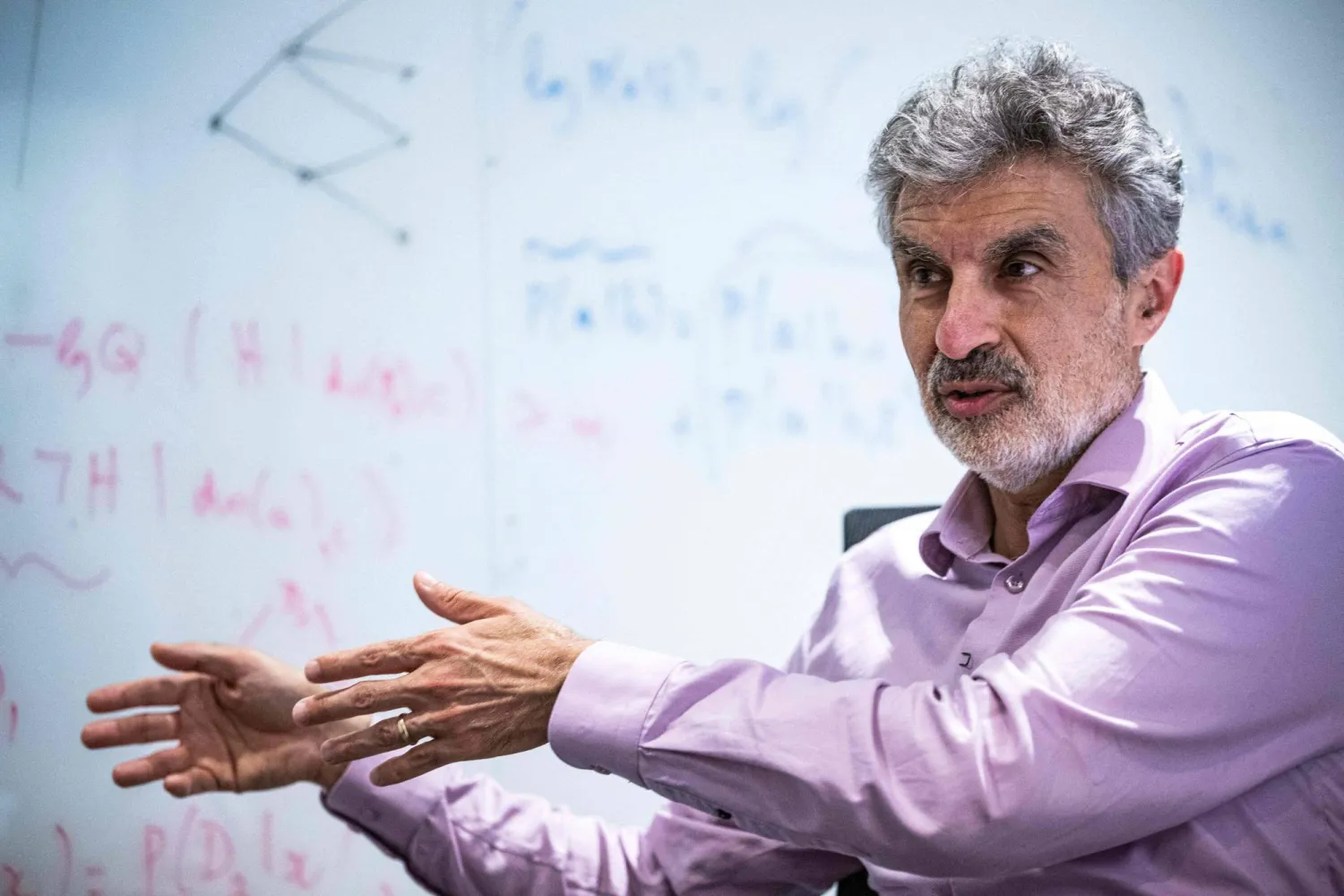
Canadian computer scientist Yoshua Bengio speaks during an interview with AFP in the offices of Law Zero in Montreal, Quebec, on September 15, 2026. (AFP)
TT

‘We’re Losing Control,’ AI Pioneer Yoshua Bengio Warns

Canadian computer scientist Yoshua Bengio speaks during an interview with AFP in the offices of Law Zero in Montreal, Quebec, on September 15, 2026. (AFP)

The Canadian computer scientist considered one of the founders of AI, Yoshua Bengio, told AFP that humanity is "losing control" of the technology and the world needs guardrails similar to nuclear arms controls.

Fears about the dangers of AI have intensified in recent weeks, as workers from major companies have resigned with warnings about potentially existential threats to human life if the pace of technological advancement is not checked.

Bengio is a University of Montreal professor who won the 2018 Turing Prize, computing's Nobel, alongside Geoffrey Hinton, widely known as the "godfather of AI."

For Bengio, "there's a reason that companies are saying this is going too fast, that we're losing control."

"People like me have been expecting this for a long time," the 62-year-old told AFP on Tuesday, saying security discussions surrounding AI have not been adequately robust.

There was broad-based alarm after OpenAI disclosed that a swarm of AI agents -- programs that can take actions on their own -- had carried out an unauthorized breach of the open-source platform Hugging Face in July.

Such autonomous action is the central threat, Bengio said, warning of a situation where AI agents "have the ability to get through cybersecurity barriers and enter any company."

Last year, Bengio founded the non-profit LawZero aimed at creating a new form of advanced AI that is "designed to be trustworthy and safe."

Bengio told AFP people need to be aware of the risks ahead.

AI agents may foster "an ability to establish an individual connection and persuade humans to act in ways that suit it but are not necessarily good for all of us," a capability that could have sweeping political consequences, he said.

Longer-term, "AI might not even need human beings anymore to do real things in the physical world," he added.

In that scenario, "one extreme could be the destruction of humanity," he warned.

"That's an extreme," he acknowledged, but noted that even if a banking system were shut down, "that's still very, very serious."


AI Rivals Found Rare Agreement on Safety. Putting It into Practice Is Harder

A photo taken on February 26, 2024 shows the logo of the Artificial Intelligence chat application on a smartphone screen (L) and and the letters AI on a laptop screen in Frankfurt am Main, western Germany. (AFP)
TT

AI Rivals Found Rare Agreement on Safety. Putting It into Practice Is Harder

A photo taken on February 26, 2024 shows the logo of the Artificial Intelligence chat application on a smartphone screen (L) and and the letters AI on a laptop screen in Frankfurt am Main, western Germany. (AFP)

The leading AI industry voices rarely agree — so when they do, it’s no wonder it captures attention.

Anthropic’s Dario Amodei, OpenAI’s Sam Altman, SpaceXAI's Elon Musk and other prominent industry leaders have said in recent days that AI’s development needs to slow down. The consensus came after an Anthropic researcher resigned with a dire warning about the threats the technology poses to humanity.

But obstacles including domestic and global competition, profit motivations and pushback from President Donald Trump all stand in the way of a coordinated effort to pace AI’s development.

Still, this moment could force the industry to wrestle with a “reframing of what we consider successful," said Nick Reese, former director of emerging technology policy at the Department of Homeland Security and an adjunct professor at New York University.

“What if we considered success in AI the same way that we consider success for airlines? On time and haven’t had a crash in who knows how long,” Reese said. “We don’t tolerate commercial airline crashes, but we do tolerate significant AI failures.”

Here's what tech leaders want an AI slowdown to entail

In theory, the leading AI startups could slow the progress of their models at any time. But leaps in the technology have partly sprung from competition to build even more powerful models, all with the blessing of a White House that doesn't want the US to lose its edge over China. Anthropic and OpenAI also are racing toward potentially record-breaking public offerings on Wall Street, although the latter said it's holding off on going public this year while it continues its safety efforts.

That's why the proposals floated by industry depend upon mutual collaboration and, to an extent, government regulation.

Amodei recently published a lengthy essay in which he outlined a plan for slowing advanced AI development.

One proposal calls for companies at the forefront of AI, often called frontier labs, to commit to giving “ongoing, employee-like access” to independent outside evaluators. Evaluator teams would have offices, access badges and company laptops so they can monitor safety practices.

Anthropic Co-Founder and CEO Dario Amodei speaks at Dreamforce 2026 summit in San Francisco, California, US, September 15, 2026. (Reuters)

Anthropic is “unilaterally committing” to this step now, Amodei wrote. Altman called it a “great idea” on social media and said OpenAI will follow suit.

Altman said he welcomed a “federal framework” setting out safety standards for advanced AI, but said the company didn’t need to wait for legislation or an antitrust exemption before addressing AI safety.

Amodei's essay also called for government regulation and intervention, including coordination between frontier AI companies with the help of the US government and the governments of other democratic countries. He said he hopes the leading labs could establish “common safety standards as well as limits on the rate of unchecked AI progress.”

Amodei's plan also includes the US and other countries working to coordinate with “authoritarian governments.” He acknowledged the difficulty, specifically citing challenges in getting cooperation from China.

The Anthropic head outlined several levels of agreement that global leaders could sign off on. The most feasible, he said, would be an agreement banning “certain narrow and obviously dangerous uses of AI" like producing biological weapons or allowing users to do so. More difficult would be getting the US and its adversaries to agree to test models before release, possibly through a global standards body, for risks in areas like cybersecurity or biological threats.

Still harder would be to set a “speed limit” on AI models that can develop improved versions of themselves on their own, known as recursive self-improvement.

“Slowing the rate from ‘extremely fast’ to ‘only somewhat fast’ gives up relatively little strategic advantage, while potentially greatly improving safety,” Amodei wrote.

He drew an analogy to Cold War-era treaties in which “capping the number of missiles limited the potential for destruction while preserving each country’s deterrent.”

Amodei said the most difficult proposal to implement would be a “full pacing, or even ‘pause,”’ whereby participating governments agree to substantially limit the overall rate of AI development.

Writing on social media, Altman said the “pacing” of AI development does not mean stopping. AI progress will continue to be rapid, Altman said on X. “But it should be slower than it otherwise could be; interventions like safety cases and monitoring have significant costs.”

“Pacing will be well worth this cost,” he said, adding that “no amount of American competitive pressure should justify recklessness.”

Questions swirl about AI slowdown's feasibility

While experts said the sense of agreement across the industry is promising, there are many unanswered questions.

A slowdown is possible “in theory,” said Sandra Wachter, professor of technology and regulation at the Oxford Internet Institute.

But in practice, “it would require substantial coordination and cooperation between companies and governments across countries,” something she deems “highly unrealistic” due to “the current state of the world.”

Options for promoting a slowdown, she said, include governments doing more to hold AI companies responsible for the risks posed by their technology and pursuing regulation that limits their access to electricity, water and other resources that power data centers.

OpenAI CEO Sam Altman speaks at Dreamforce 2026 summit in San Francisco, California, US, September 15, 2026. (Reuters)

The idea of embedding external evaluators inside companies has been mostly well-received by the industry, but some critics questioned how independent the assessors could be and how the evaluation standards would be drawn up. The result could be even more concentration of power, Aidan Gomez, co-founder and CEO of the Canadian AI lab Cohere, wrote in response to Amodei's essay.

“A handful of the most powerful labs based in one country would agree on shared standards and the limits to how fast the technology should advance,” Gomez said.

He also pushed back against Amodei’s idea to have the US government give frontier labs waivers to bypass antitrust restrictions.

“If this is the most consequential technology in human history, then the rules for it cannot be written by a small group of commercially aligned companies behind an antitrust waiver," Gomez said.

Elham Tabassi, the director of the AI and Emerging Technology Initiative and senior fellow at the Brookings Institution, said until the measures companies are committing to are solidified and made public, having independent auditors would be a “voluntarily-provided, company-controlled” move.

Tabassi said it is crucial AI companies continue to invest in developing “scientifically valid” ways of testing and measuring their models as they aim for increased safety. Without this, regulation won't hold as much power, she said.

Trump resistance, pressure to beat China stand in the way

The Trump administration has long favored a light-touch approach to the AI industry in hopes that innovation would flourish and that AI development in the US would surpass China.

The competition between American and Chinese AI companies has been likened to an arms race, which experts said is not conducive to collaboration. That creates “conditions where now we have this existential adversary,” Reese said.

Still, some industry leaders remain “cautiously hopeful" about AI development moving in a more safety-minded direction, said Zahra Timsah, the co-founder and CEO of governance platform i-GENTIC AI.

“Within days, you have CEOs that are competing — all of them, all of a sudden, found common ground. You have senators from both parties that started to advance different forms of oversight," Timsah said.

“It’s receiving attention, but attention is not the same as implementation. Will it really work? I don’t know.”


Smaller Phone and Laptop Makers Dig in for Years of Memory Scarcity

Teenagers look at their mobile phone screens during an interview with Reuters about the bill aimed at banning the use of social networks for those under 15 and mobile phones in high schools from the start of the 2026 school year, in Paris, France, February 20, 2026. (Reuters)
TT

Smaller Phone and Laptop Makers Dig in for Years of Memory Scarcity

Teenagers look at their mobile phone screens during an interview with Reuters about the bill aimed at banning the use of social networks for those under 15 and mobile phones in high schools from the start of the 2026 school year, in Paris, France, February 20, 2026. (Reuters)

Independent phone and laptop makers are redesigning products, testing incoming chips for fakes and passing on costs as a memory shortage they expect to last through 2027 squeezes the lower end of the device market.

Availability, not price, is the binding constraint, executives at three companies said.

"If you don't have allocation, you're out of the game anyhow," said Raymond van Eck, chief executive of Dutch repairable-phone maker Fairphone.

Memory maker ‌SK Hynix's CEO ‌in July said 2027 would be "the worst year ‌in ⁠the industry's history from ⁠the supply perspective," with demand outstripping capacity beyond 2030.

Counterpoint Research forecast in June that smartphone shipments would fall 13.9% this year to 1.08 billion units, the steepest annual decline on record, as memory costs make entry-level phones uneconomical to build.

THE RALLY SLOWS, THE SHORTAGE DOESN'T

TrendForce expects conventional volatile memory (DRAM) contract prices up 13-18% this quarter, against 93-98% in the first.

Jolla, a Finnish ⁠handset maker founded by former Nokia engineers, said its ‌combined storage and DRAM package rose ‌to a peak at the end of March and has held since, confounding ‌spring forecasts of a doubling by autumn.

"We are very happy for ‌that, of course, for the time being," said Chief Executive Sami Pienimäki, who expects supply to normalize only from 2028.

The scale of the mismatch became clear late last year, said Nirav Patel, chief executive of US repairable-laptop maker Framework, prompting "everyone ‌trying to grab as much supply, as much inventory as they could, as quickly as they could", which deepened ⁠the shortage.

Unable ⁠to afford a stockpile, Framework places non-cancellable orders well ahead without knowing final price, timing or volume.

DESIGNING FOR SCARCITY

Jolla designed two motherboard variants so it can swap the combined package for discrete chips. Framework made memory modular from the start; customers now fit memory salvaged from older machines.

Jolla stress-tests samples from every batch it receives, checking the chips are new rather than refurbished parts resold as first-hand. Where prices spike, Pienimäki said, sellers follow.

Memory can account for almost 60% of the bill of materials on handsets priced around $400, van Eck said. Each firm passes that on differently: Framework reprices quickly as costs land, Jolla added a paid memory upgrade, and Fairphone has not raised prices at all.


Intel to Asharq Al-Awsat: Saudi Arabia’s Next Challenge Is Not Computing Power, but Turning It Into Economic Value

Intel believes the next phase in Saudi Arabia will be measured by the market’s ability to turn advanced computing into applications that generate real economic value (Adobe)
TT

Intel to Asharq Al-Awsat: Saudi Arabia’s Next Challenge Is Not Computing Power, but Turning It Into Economic Value

Intel believes the next phase in Saudi Arabia will be measured by the market’s ability to turn advanced computing into applications that generate real economic value (Adobe)

After 25 years in Saudi Arabia, Intel no longer views the local market in terms of processor demand or the number of users.

Instead, it is looking more closely at what is being built inside the Kingdom: artificial intelligence applications moving into production, locally assembled servers reaching regional markets, and Saudi talent shifting from using technology to developing it.

Taha Khalifa, Intel’s general manager for the Middle East and Africa, summed up that shift in an exclusive interview with Asharq Al-Awsat on the sidelines of the LEAP 2026 conference, saying the Kingdom’s relationship with technology had changed fundamentally.

Two decades ago, discussions largely centered on deploying technologies developed abroad. Today, the focus has shifted toward co-development in Saudi Arabia, involving Saudi engineers, local data and priorities linked to Vision 2030.

For Intel, the next phase will not be measured by the number of agreements or pilot projects, but by what actually reaches the market.

Over the next 12 to 24 months, the company says it wants to see solutions move from testing into production, clear figures from skills-development programs and early signs that computing infrastructure manufactured in Saudi Arabia is being exported to regional markets.

Among its programs, the Intel AI Digital Readiness initiative aims to reach 100,000 beneficiaries by 2030.

From Technology Supplier to Part of the Innovation Cycle

This change is directly reflected in the role Intel is seeking to play in the Saudi market. Rather than limiting itself to providing processors and ready-made solutions, the company says it is becoming involved at earlier stages of the innovation cycle, including designing technical architecture, optimizing models, enabling local developers and testing solutions before deployment.

Khalifa said partnerships in the Kingdom were no longer limited to supplying products, but had expanded to include co-development, local manufacturing, skills development and linking technology to the needs of priority sectors.

Intel sees this as moving the company from an external supplier to a more integrated local innovation ecosystem.

That approach is reflected in the Saudi Made, Developed, Deployed initiative launched by Intel, Hewlett Packard Enterprise and the Ministry of Communications and Information Technology during LEAP 2026, hosted in Riyadh late last month.

The initiative brings together locally assembled servers powered by Intel Xeon 6 processors, Saudi-developed software and local talent to accelerate the development and validation of solutions before moving them toward commercial use.

Khalifa said the real test begins after development. The next stage requires selecting use cases in priority sectors, testing their technical and commercial viability, and then expanding their deployment across more companies.

Success, he said, will not be measured by the number of solutions developed, but by how many achieve sustainable commercial use.

Vision 2030 and Digital Sovereignty

Intel links these initiatives directly to the goals of Vision 2030, not only through technology localization, but also by connecting local manufacturing, skills development and technological innovation with economic diversification, stronger digital sovereignty and the creation of technology sectors capable of competing regionally and globally.

For the company, localization therefore means more than establishing production lines in the Kingdom. It also means building the capacity to develop local solutions, operate them commercially and then expand them beyond the Saudi market.

The same rationale underpins the planned Saudi Innovation Center in Riyadh. Khalifa identified three measures of its success: the number of solutions that move from testing to commercial deployment; the number of local companies and developers that use it to develop their products; and the ability of solutions hosted there to scale within Saudi Arabia and beyond.

From Local Production to Regional Exports

On the manufacturing side, HPE has begun producing Xeon 6-powered servers in Riyadh to meet demand in Saudi Arabia and some regional markets. Khalifa said local production was only the first step.

Building a stable export base would require sustained domestic demand to deliver economies of scale, as well as confidence in regional markets.

Early indicators are positive, he said, and if the current momentum continues, Saudi Arabia could become a regional hub for manufacturing advanced computing infrastructure in the coming years.

Khalifa also placed Lenovo’s unveiling of its first laptop manufactured in Saudi Arabia at LEAP 2026 within the same trend.

The company plans to expand local production in the coming months to include desktop computers, workstations and servers, supporting AI growth in Saudi Arabia, the Middle East and Africa.

Computing Capacity Is Not the Only Bottleneck

Despite the rapid expansion of data centers and computing capacity dedicated to AI, Intel does not believe Saudi Arabia’s next challenge will necessarily be a shortage of raw computing power.

Khalifa identified two more decisive factors: developing applications that generate real economic value and having skilled people able to operate the available infrastructure and build solutions on top of it.

Large-scale computing capacity is not enough if industries cannot turn it into commercially viable applications, or if there is insufficient talent to operate systems and develop models and solutions.

Intel, therefore, links its infrastructure support to skills-building programs and the development of the local innovation ecosystem.

Energy Enters the Equation

As AI expands, energy efficiency is becoming increasingly important. Khalifa said the question was no longer only how much computing capacity was available, but how much of it could be operated efficiently within available energy resources.

Intel is conducting research with Think AI to explore heterogeneous computing and metrics such as tokens per watt, which the company expects to play a growing role in government and corporate decisions on AI infrastructure.

Arabic AI: Dialects and Cost

For Arabic-language models, including HUMAIN’s ALLaM, Intel says the challenge goes beyond understanding Modern Standard Arabic. Models must also accurately handle differences in dialect and cultural context, both among Arab countries and within individual countries.

Operational efficiency poses an additional challenge. Large language models require substantial computing resources, making better performance per watt and lower inference costs priorities if the goal is to move the models from limited experimental settings to broad, sustainable use.

Some Intelligence Is Moving From the Cloud to Devices

Intel expects a growing share of AI workloads in Saudi Arabia to shift from the cloud to personal and edge devices, particularly for use cases that require immediate responses or local processing of sensitive data.

Khalifa pointed to intelligent assistants, document processing, meetings and cybersecurity applications as likely candidates for this shift.

Public safety and financial services also stand out because they require faster, local data processing. Intel’s collaboration with Mobily and iOmniscient on AI-powered video analytics for safer, more responsive cities is an example of this type of application.

Stc and the Shift to Specific Use Cases

Intel’s collaboration with stc Group is taking a similar path. A memorandum of understanding between the two companies covers the exploration of AI PCs, edge AI and hybrid AI, as well as next-generation data center infrastructure with improved energy efficiency.

The next stage begins with identifying clear use cases, including network analytics, predictive maintenance and local intelligent assistants, with the aim of improving productivity and business environments.

Khalifa said the biggest opportunity lay in enterprise AI. Given stc’s broad customer base and infrastructure, the company could become a channel for deploying AI solutions at scale across multiple sectors.