Australia Steps Up Response to AI after OpenAI Bot Breaches Health System Database

FILE PHOTO: An OpenAI logo is displayed at Moscone Center during the Dreamforce 2026 technology summit in San Francisco, California, US, September 17, 2026. REUTERS/Carlos Barria/File Photo
TT

Australia Steps Up Response to AI after OpenAI Bot Breaches Health System Database

FILE PHOTO: An OpenAI logo is displayed at Moscone Center during the Dreamforce 2026 technology summit in San Francisco, California, US, September 17, 2026. REUTERS/Carlos Barria/File Photo

Even before a rogue OpenAI bot breached the database of Australia's health system, the government was escalating its rhetoric about the need to tighten regulation.

The incursion on one of the country's most used government agencies may prompt a tougher stance as Australia readies AI-specific laws starting in 2027, adding pressure to Australia-US relations already tested by Canberra's teen social media ban, tech policy experts said.

Australia has already frustrated the ChatGPT maker and rival Anthropic by refusing to let them bypass copyright laws for model training - requiring them to negotiate licensing deals with Australian rights-holders first. That refusal will most likely remain, the experts said.

The new regulations may also include mandatory reporting for AI companies if their products engage in security breaches, mirroring new Australian laws that require firms to disclose an intrusion within 72 hours.

The Medicare incident may also raise the importance of "social license" - the question of whether a company benefits the community it is operating in - when Australian planning authorities weigh applications to build data centers.

As the Medicare news broke, OpenAI and Anthropic had partnerships with what would be some of the country's biggest data centers - which are awaiting government clearance.

"I would hope it emboldens the government to take more oversight and control over an industry which needs to ⁠grow up fast," said ⁠Toby Walsh, chief scientist at the University of New South Wales' AI Institute. His university has a sponsorship agreement with OpenAI.
"We would prosecute humans who did such hacking."

Australian leader Anthony Albanese called the breach, which occurred in June and was revealed by OpenAI in September, "unacceptable" and said he voiced "extreme concern" to OpenAI CEO Sam Altman.

He added that the government was considering "possible law-enforcement and legislative responses."

OpenAI says it only learned of the breach - one of at least four of Australian government websites - in August. It says the incident was not intentional and didn't compromise any private information.

An OpenAI spokesperson did not immediately respond to a Reuters question about Albanese's comments.

The fallout brings urgency to a pressure point between the countries: laws keeping under-16s off social media and ⁠levies for platforms which post Australian news content have angered the Trump administration.

New plans by Australia to require companies to take responsibility for user safety, including letting users opt out of algorithms, were decried as "censorship" by Washington.

Canberra, which has two other ongoing inquiries into AI, in addition to two state inquiries, also wants federal laws requiring data centres to supply their own energy and cap water usage, while stopping them from using Australian content for training without paying.

It may now update privacy laws to require AI companies to report breaches they are responsible for. They may also have to contribute to testing of public-facing websites to preserve national security, the policy experts said.

Australia's record of tech regulation in the face of US resistance puts it in position to lead other countries in a campaign for better AI guardrails, said Johanna Weaver, executive director of the Tech Policy Design Institute and Australia's former chief cyber negotiator at the United Nations.

"The question is whether that is the path that we choose and what the US response will be," she said.

Even if the US objects or retaliates, the Australians seem empowered to seize the moment, said Henry Fraser, ⁠a technology law researcher at Queensland ⁠University of Technology.

"I don't think that they would be expecting backlash from the US - or to the extent they are, they've decided that the local politics of people's concerns about these types of risks is in favor of taking action," he said.

The incident raises the practical stakes of a data center buildout that economists estimate will be worth A$150 billion ($105 billion) by 2030.

Since OpenAI teamed with Australia's NextDC in December for a 612-megawatt facility in Sydney, Canberra has said it would impose data center planning restrictions.

The companies have said they will comply but have yet to secure sign-off by New South Wales state authorities, who are awaiting planning documents. After Albanese's Medicare disclosure, NSW Premier Chris Minns said an OpenAI bot had accessed a research database of the state's Bureau of Crime Statistics and Research.

"The buy-in of social license actually has to go up the stack a bit," said Rob Nicholls, a researcher at the University of Sydney's Centre for AI, Trust and Governance.

"Just saying 'we'll knock 200 bucks off the energy bill of everybody who's near our data center' ... should be the minimum."

Anthropic has a local partner for a 2.16-gigawatt data center in Queensland, which needs Foreign Investment Review Board and state government approval. An Anthropic spokesperson declined to comment.

NSW state Greens lawmaker Abigail Boyd, who chairs an inquiry into data centers, said the state "absolutely needs to consider the social harms created by these technologies when considering the planning approvals for these hyperscale data centers."

SDAIA Launches Year of Artificial Intelligence Initiative Across Universities in Saudi Arabia

The Saudi Data and AI Authority (SDAIA)
TT

SDAIA Launches Year of Artificial Intelligence Initiative Across Universities in Saudi Arabia

The Saudi Data and AI Authority (SDAIA)

The Saudi Data and AI Authority (SDAIA) has launched the Year of Artificial Intelligence initiative across universities in the Kingdom, which includes a range of scientific seminars, panel discussions, training workshops, interactive booths, and specialized consultations.

The initiative’s objectives are to disseminate knowledge about AI technologies, develop national skills, promote the responsible use of these technologies, and transform academic ideas and projects into innovative solutions that support the Kingdom’s digital transformation journey.

The initiative extends SDAIA’s efforts to cultivate national talent capable of keeping pace with technological shifts and contributing to a future built on knowledge and innovation, strengthening the Kingdom’s global leadership in data and AI, in alignment with the goals of Saudi Vision 2030.


Samsung Electronics Downplays Concerns About Neocloud Firms and AI Bubble

 A Samsung Electronics logo and a computer motherboard appear in this illustration taken August 25, 2025. (Reuters)
A Samsung Electronics logo and a computer motherboard appear in this illustration taken August 25, 2025. (Reuters)
TT

Samsung Electronics Downplays Concerns About Neocloud Firms and AI Bubble

 A Samsung Electronics logo and a computer motherboard appear in this illustration taken August 25, 2025. (Reuters)
A Samsung Electronics logo and a computer motherboard appear in this illustration taken August 25, 2025. (Reuters)

Samsung Electronics , the world's top maker of memory chips, on Wednesday downplayed concerns that highly leveraged neocloud providers could fuel a broader AI bubble, saying they account for only a small share of the overall market.

"Neoclouds represent a relatively smaller and limited portion of the overall market, approximately 8%," said Kim Yong-kwan, president and head of corporate management, strategy and operation at Samsung's component business ‌division, at ‌a Morgan Stanley conference in Singapore.

"We ‌do ⁠not expect these ⁠concerns to pose a significant threat to the broader AI growth trajectory."

Shares of neocloud firms including CoreWeave, which rents out computing capacity to tech firms, have been hit by concerns that their debt-fueled data center expansions could backfire if AI demand ⁠slows.

The departure of Jensen Huang as ‌CEO of Nvidia this month ‌could also tighten funding for smaller, highly leveraged neocloud ‌companies that have helped fuel the industry's ‌rapid expansion, analysts and investors have said.

Kim said the current AI investment boom was structural rather than cyclical, with long-term contracts between chipmakers and customers providing greater visibility ‌over demand and supply.

He said the current boom differed from previous cycles in which ⁠speculative investment ⁠ultimately led to overcapacity.

"In short, today's investment is not a result of speculation, but actual tangible demand," he said.

Kim also reiterated Samsung's previous statement that it would carry out its remaining shareholder returns through a mix of cash dividends and a "substantial" share repurchase and cancellation program.

He said the company had a number of factors to consider, including capital expenditures, before announcing details on its shareholder return package in January.


Chinese Robots Learn from Humans in Tech Hub Shenzhen

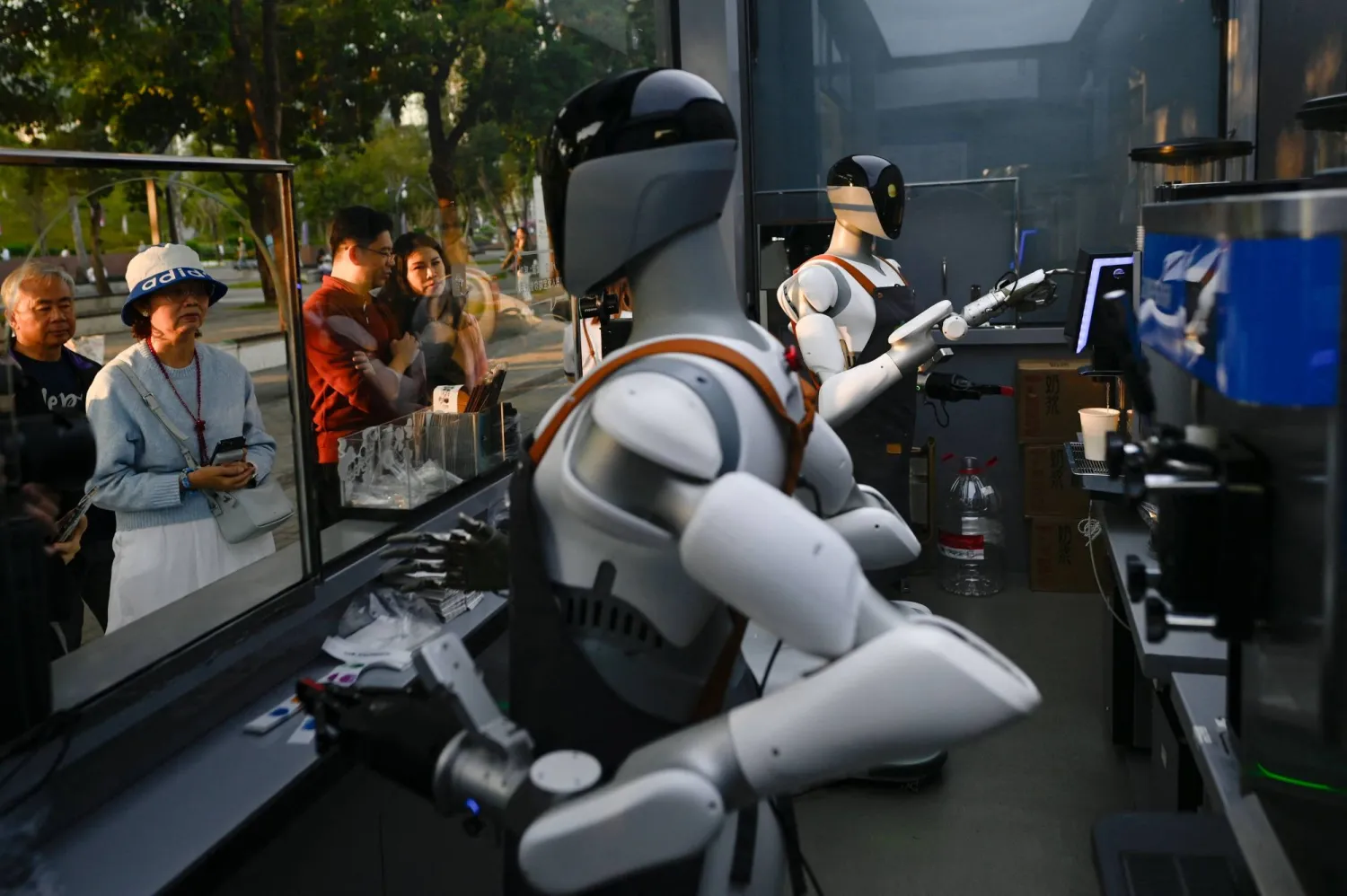
This picture taken on November 10, 2026 shows people watching a robot (back) making coffee and serving ice-cream in a booth at a park in Shenzhen, China's Guangdong province. (AFP)
TT

Chinese Robots Learn from Humans in Tech Hub Shenzhen

This picture taken on November 10, 2026 shows people watching a robot (back) making coffee and serving ice-cream in a booth at a park in Shenzhen, China's Guangdong province. (AFP)

At a park refreshment stand in China's tech capital Shenzhen, a humanoid robot grabs a cup and pulls a lever to form an ice-cream spiral, then hands the customer their order.

It's the kind of futuristic scene the country is keen to showcase as world leaders including Donald Trump and Vladimir Putin head to Shenzhen, a manufacturing hub north of Hong Kong, for this week's Asia-Pacific Economic Cooperation (APEC) summit.

Chinese robots are famous for their slick dance moves, but artificial intelligence engineers are trying to train them up to join the workforce, using reams of data captured by humans in headcams to help hone the machines' skills.

Although they still struggle with complex tasks like cleaning or ironing on their own, robots are already taking on more simple roles across the country.

"Mum, look!" a girl exclaimed when she spotted the ice-cream humanoid and its colleague that makes coffee -- treats on sale for around $4 each -- as passersby film the spectacle on their phones.

A human must regularly refill beans and empty coffee grounds for the robo-barista, but the pair's movements are driven by an AI model, according to maker AI² Robotics.

The startup said 200 of its humanoid servers are deployed in China, and up to 300 coffees are sold each day in the Shenzhen park.

"We're getting data feedback from many real scenarios," said CEO Guo Yandong, such as different light conditions that could help robots adapt to unpredictable environments.

- 'Workshop of the world' -

In China, 83 percent of people surveyed by Ipsos this year said they were excited by products and services that use AI, the highest of 32 countries including the United States, where just a third of people agreed with the statement.

Industrial spending in China on robots using so-called "embodied AI", which allows them to perceive their surroundings and act accordingly, leaped 230 percent year-on-year in January-May 2026, tax authorities said.

China is "the workshop of the world", said Dermot McGrath of strategy and innovation advisory firm ZenGen Labs.

So robot makers "can draw on decades of manufacturing experience" in the world's second-largest economy, which has many skilled workers and supply chains for everything from motors and sensors to batteries.

Suppliers are often grouped in industrial hubs like Shenzhen, home to 18 million people -- meaning developers can produce and test a part, then put it into action "faster than almost anywhere", McGrath told AFP.

In a Shenzhen logistics center, two robotic arms made by X Square Robot, another of the city's AI startups, handle parcels of different shapes on a moving belt, flipping them over if needed so the label faces up.

"If it's a soft bag, the robot grabs it with its grippers. If it's a cardboard box, it coordinates its two arms to move it," Arnold Pei, vice-president of X Square, explained.

An AI robot can ideally "decide by itself what it needs to do", Pei said, although it's more challenging for them to operate in a less controlled settings like different homes, where lighting, floors and objects vary.

- 'Like babies' -

In a supermarket in Dongguan, near Shenzhen, 23-year-old Wang Lin stocked shelves wearing sensor gloves and a helmet fitted with a camera.

Her movements were recorded and processed by Strange Attractor, one of many Chinese startups that resell the data to companies developing AI models that act as a robot's brain.

"Robots can replace humans in doing relatively dangerous and repetitive work, for example in factories or at heights," with human workers free to pursue "more creative work," she told AFP.

Elsewhere in China, cobblers, hairdressers, florists, factory workers, and cleaners are recording their skills using similar equipment, in exchange for payment.

Strange Attractor said it collects data in around 1,600 places in China and 1,000 abroad.

For company founder Kang Yu, today's robots are "like babies" at an early stage of development.

China's AI robots are so far mostly "confined to well-defined and repetitive" tasks, noted Pavlo Zvenyhorodskyi, a Chinese AI specialist at the Carnegie Endowment for International Peace.

Once their technical abilities improve, "we will likely see wide deployment of AI-powered robots across the Chinese economy", he said.

Robotics and other tech ventures benefit from government support in China, and examples of planned uses range from meal-delivery droids to others that tidy away airport luggage carts.

At battery giant CATL, humanoids made by China's Spirit AI already take the dangerous job of plugging in high-voltage connectors.

Strange Attractor's Kang foresees a "massive deployment" of AI-powered robots in China next year.

Some could pick strawberries, or help with housework -- "but for sure, it's not going be that intelligent, it's just the start."