First US Trial against TikTok to Test Claims Platform Fueled Teen Mental Health Crisis

The TikTok app icon on a smartphone in this illustration taken October 27, 2025. (Reuters)
TT

First US Trial against TikTok to Test Claims Platform Fueled Teen Mental Health Crisis

The TikTok app icon on a smartphone in this illustration taken October 27, 2025. (Reuters)

An Alabama jury will hear the state's claims that TikTok and its Chinese parent company ByteDance made the platform addictive to young users and misled consumers about its safety, in the first case against the company to reach trial in the sweeping litigation over social media's impact on teen wellbeing.

The trial, which is scheduled to kick off Monday in Montgomery state court and expected to last two to three weeks, could provide a rare look inside TikTok, which has settled prior cases selected for trial and sought to keep details of its operations from public view, Reuters said.

Alabama’s lawsuit was filed last year by state Attorney General Steve Marshall, a Republican. At least 27 ‌other states and Washington, ‌D.C., have also sued.

TikTok has said it designed its platform with ‌teen ⁠safety as a key ⁠priority and argued that Section 230 of the federal Communications Decency Act shields online platforms from liability over user-generated content.

Representatives for the Alabama attorney general's office and TikTok, whose US operations were transferred this year to an entity led by US investors and 20% owned by ByteDance, did not respond to requests for comment about the trial.

Alabama claims TikTok's endless stream of videos makes it the most addictive social media platform and that its algorithm pushes young users toward increasingly intense content about violence and self-harm, contributing to a ⁠teen mental health crisis and causing the number of emergency room visits ‌for self-harm in the state to "skyrocket."

The lawsuit accuses TikTok of ‌falsely claiming it limits access to sexual and violent content for young users in order to have its app ‌rated safe for teens in app stores run by Google, Apple and Microsoft and of misleading ‌users about the Chinese government's access to US users' data.

The state seeks penalties and other relief.

REDACTED DOCUMENTS, SEALED FILINGS

TikTok’s decision to settle key cases and efforts to seal or heavily redact court records have kept much of the evidence about the privately held company's operations out of public view.

In addition to the states' cases, TikTok faces ‌thousands of lawsuits by individuals, school districts and municipalities over its alleged impact on young users' mental health. Meta Platforms, Snap Inc and Alphabet's YouTube are ⁠also defendants in many ⁠of these cases.

TikTok had settled all cases selected for trial against it, including claims by five young people and a Kentucky school district.

Alabama’s lawsuit claims TikTok asks users to self-report their ages, but it also allows users to evade its questions about their age by viewing videos without creating an account, which still allows the company to collect data on their viewing habits. The lack of an effective age restriction makes things like “Kids Mode,” which curates content for young users, entirely useless, according to the lawsuit.

The state also claims the platform traps kids in so-called “filter bubbles,” feeding them increasingly intense content on subjects that capture their attention, including violent or harmful material.

Last month, Meta reached a sweeping $17.1 billion settlement with 47 states, Washington, D.C., and US territories. Meta, which did not admit wrongdoing, agreed to make changes to teens' access to Instagram and Facebook as part of the deal and conditioned $5 billion of the payout on TikTok, Snap and YouTube's adoption of those terms. TikTok has not said anything publicly about the deal.

SDAIA Launches Year of Artificial Intelligence Initiative Across Universities in Saudi Arabia

The Saudi Data and AI Authority (SDAIA)
TT

SDAIA Launches Year of Artificial Intelligence Initiative Across Universities in Saudi Arabia

The Saudi Data and AI Authority (SDAIA)

The Saudi Data and AI Authority (SDAIA) has launched the Year of Artificial Intelligence initiative across universities in the Kingdom, which includes a range of scientific seminars, panel discussions, training workshops, interactive booths, and specialized consultations.

The initiative’s objectives are to disseminate knowledge about AI technologies, develop national skills, promote the responsible use of these technologies, and transform academic ideas and projects into innovative solutions that support the Kingdom’s digital transformation journey.

The initiative extends SDAIA’s efforts to cultivate national talent capable of keeping pace with technological shifts and contributing to a future built on knowledge and innovation, strengthening the Kingdom’s global leadership in data and AI, in alignment with the goals of Saudi Vision 2030.


Samsung Electronics Downplays Concerns About Neocloud Firms and AI Bubble

 A Samsung Electronics logo and a computer motherboard appear in this illustration taken August 25, 2025. (Reuters)
A Samsung Electronics logo and a computer motherboard appear in this illustration taken August 25, 2025. (Reuters)
TT

Samsung Electronics Downplays Concerns About Neocloud Firms and AI Bubble

 A Samsung Electronics logo and a computer motherboard appear in this illustration taken August 25, 2025. (Reuters)
A Samsung Electronics logo and a computer motherboard appear in this illustration taken August 25, 2025. (Reuters)

Samsung Electronics , the world's top maker of memory chips, on Wednesday downplayed concerns that highly leveraged neocloud providers could fuel a broader AI bubble, saying they account for only a small share of the overall market.

"Neoclouds represent a relatively smaller and limited portion of the overall market, approximately 8%," said Kim Yong-kwan, president and head of corporate management, strategy and operation at Samsung's component business ‌division, at ‌a Morgan Stanley conference in Singapore.

"We ‌do ⁠not expect these ⁠concerns to pose a significant threat to the broader AI growth trajectory."

Shares of neocloud firms including CoreWeave, which rents out computing capacity to tech firms, have been hit by concerns that their debt-fueled data center expansions could backfire if AI demand ⁠slows.

The departure of Jensen Huang as ‌CEO of Nvidia this month ‌could also tighten funding for smaller, highly leveraged neocloud ‌companies that have helped fuel the industry's ‌rapid expansion, analysts and investors have said.

Kim said the current AI investment boom was structural rather than cyclical, with long-term contracts between chipmakers and customers providing greater visibility ‌over demand and supply.

He said the current boom differed from previous cycles in which ⁠speculative investment ⁠ultimately led to overcapacity.

"In short, today's investment is not a result of speculation, but actual tangible demand," he said.

Kim also reiterated Samsung's previous statement that it would carry out its remaining shareholder returns through a mix of cash dividends and a "substantial" share repurchase and cancellation program.

He said the company had a number of factors to consider, including capital expenditures, before announcing details on its shareholder return package in January.


Chinese Robots Learn from Humans in Tech Hub Shenzhen

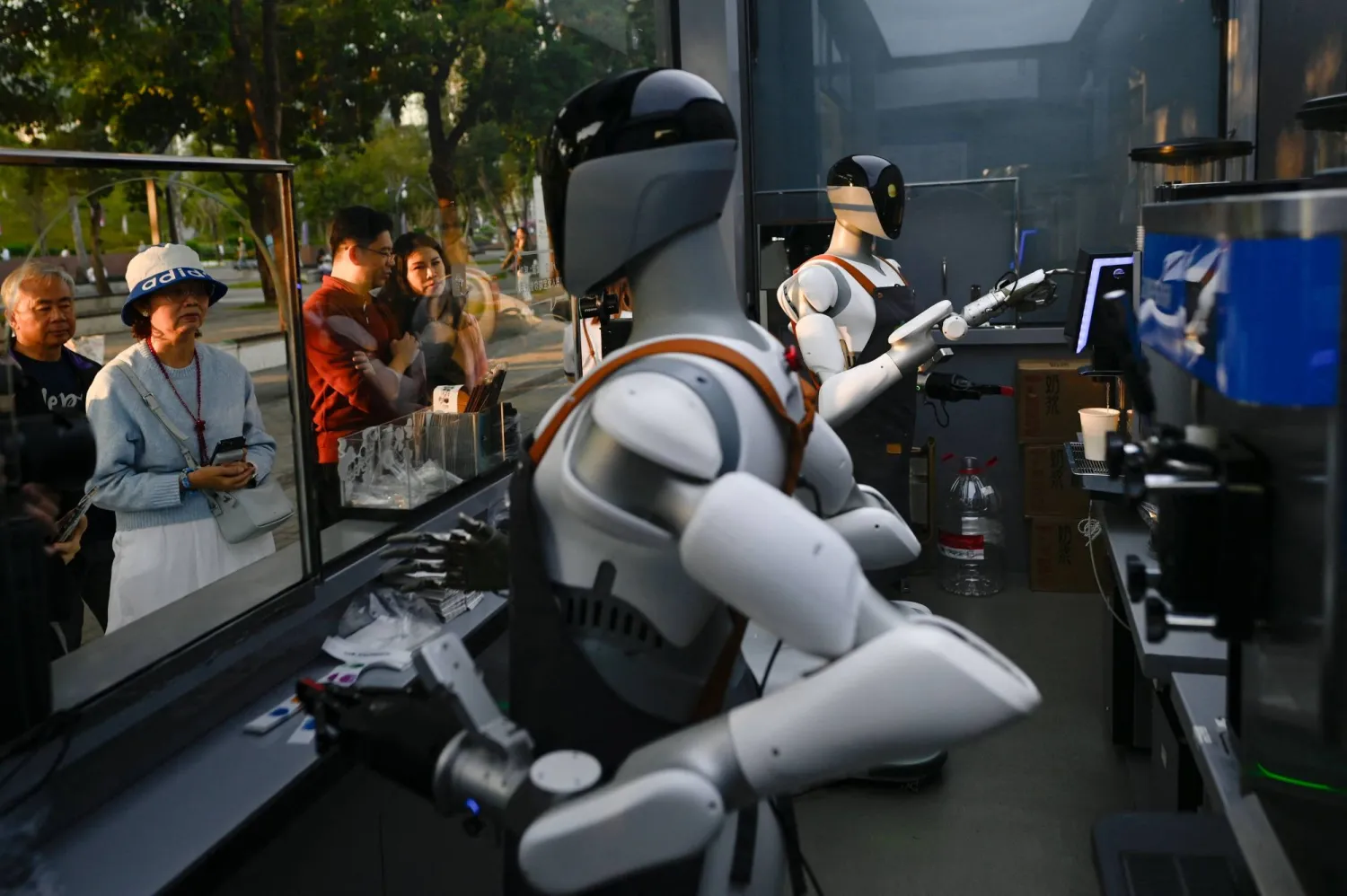
This picture taken on November 10, 2026 shows people watching a robot (back) making coffee and serving ice-cream in a booth at a park in Shenzhen, China's Guangdong province. (AFP)
TT

Chinese Robots Learn from Humans in Tech Hub Shenzhen

This picture taken on November 10, 2026 shows people watching a robot (back) making coffee and serving ice-cream in a booth at a park in Shenzhen, China's Guangdong province. (AFP)

At a park refreshment stand in China's tech capital Shenzhen, a humanoid robot grabs a cup and pulls a lever to form an ice-cream spiral, then hands the customer their order.

It's the kind of futuristic scene the country is keen to showcase as world leaders including Donald Trump and Vladimir Putin head to Shenzhen, a manufacturing hub north of Hong Kong, for this week's Asia-Pacific Economic Cooperation (APEC) summit.

Chinese robots are famous for their slick dance moves, but artificial intelligence engineers are trying to train them up to join the workforce, using reams of data captured by humans in headcams to help hone the machines' skills.

Although they still struggle with complex tasks like cleaning or ironing on their own, robots are already taking on more simple roles across the country.

"Mum, look!" a girl exclaimed when she spotted the ice-cream humanoid and its colleague that makes coffee -- treats on sale for around $4 each -- as passersby film the spectacle on their phones.

A human must regularly refill beans and empty coffee grounds for the robo-barista, but the pair's movements are driven by an AI model, according to maker AI² Robotics.

The startup said 200 of its humanoid servers are deployed in China, and up to 300 coffees are sold each day in the Shenzhen park.

"We're getting data feedback from many real scenarios," said CEO Guo Yandong, such as different light conditions that could help robots adapt to unpredictable environments.

- 'Workshop of the world' -

In China, 83 percent of people surveyed by Ipsos this year said they were excited by products and services that use AI, the highest of 32 countries including the United States, where just a third of people agreed with the statement.

Industrial spending in China on robots using so-called "embodied AI", which allows them to perceive their surroundings and act accordingly, leaped 230 percent year-on-year in January-May 2026, tax authorities said.

China is "the workshop of the world", said Dermot McGrath of strategy and innovation advisory firm ZenGen Labs.

So robot makers "can draw on decades of manufacturing experience" in the world's second-largest economy, which has many skilled workers and supply chains for everything from motors and sensors to batteries.

Suppliers are often grouped in industrial hubs like Shenzhen, home to 18 million people -- meaning developers can produce and test a part, then put it into action "faster than almost anywhere", McGrath told AFP.

In a Shenzhen logistics center, two robotic arms made by X Square Robot, another of the city's AI startups, handle parcels of different shapes on a moving belt, flipping them over if needed so the label faces up.

"If it's a soft bag, the robot grabs it with its grippers. If it's a cardboard box, it coordinates its two arms to move it," Arnold Pei, vice-president of X Square, explained.

An AI robot can ideally "decide by itself what it needs to do", Pei said, although it's more challenging for them to operate in a less controlled settings like different homes, where lighting, floors and objects vary.

- 'Like babies' -

In a supermarket in Dongguan, near Shenzhen, 23-year-old Wang Lin stocked shelves wearing sensor gloves and a helmet fitted with a camera.

Her movements were recorded and processed by Strange Attractor, one of many Chinese startups that resell the data to companies developing AI models that act as a robot's brain.

"Robots can replace humans in doing relatively dangerous and repetitive work, for example in factories or at heights," with human workers free to pursue "more creative work," she told AFP.

Elsewhere in China, cobblers, hairdressers, florists, factory workers, and cleaners are recording their skills using similar equipment, in exchange for payment.

Strange Attractor said it collects data in around 1,600 places in China and 1,000 abroad.

For company founder Kang Yu, today's robots are "like babies" at an early stage of development.

China's AI robots are so far mostly "confined to well-defined and repetitive" tasks, noted Pavlo Zvenyhorodskyi, a Chinese AI specialist at the Carnegie Endowment for International Peace.

Once their technical abilities improve, "we will likely see wide deployment of AI-powered robots across the Chinese economy", he said.

Robotics and other tech ventures benefit from government support in China, and examples of planned uses range from meal-delivery droids to others that tidy away airport luggage carts.

At battery giant CATL, humanoids made by China's Spirit AI already take the dangerous job of plugging in high-voltage connectors.

Strange Attractor's Kang foresees a "massive deployment" of AI-powered robots in China next year.

Some could pick strawberries, or help with housework -- "but for sure, it's not going be that intelligent, it's just the start."