


Pope Says Concerns About AI ‘Should Be Taken Seriously’

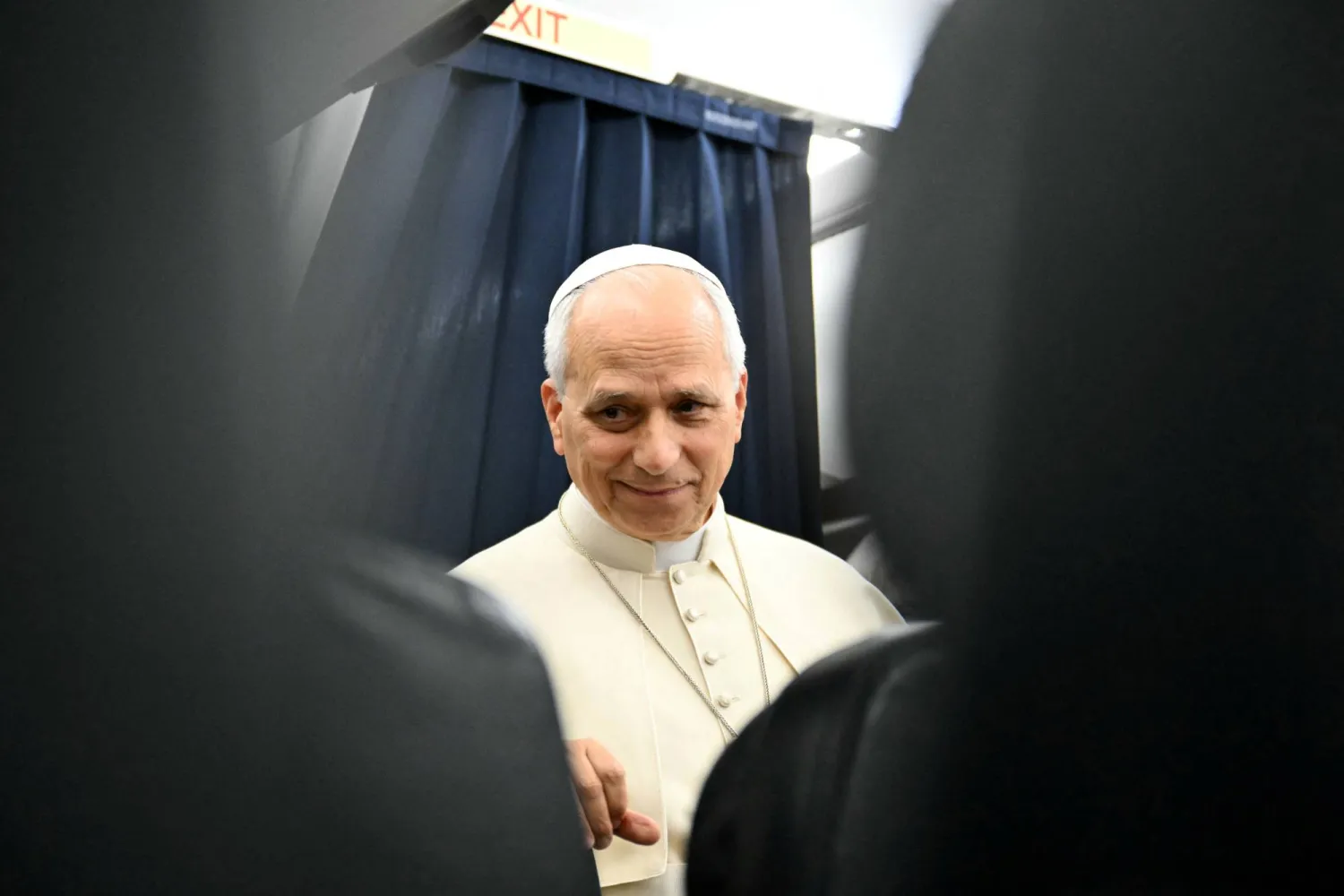
Pope Leo gives a press conference with accredited journalists on the return flight from France, September 28, 2026. (Reuters)
TT

Pope Says Concerns About AI ‘Should Be Taken Seriously’

Pope Leo gives a press conference with accredited journalists on the return flight from France, September 28, 2026. (Reuters)

Pope Leo XIV on Monday warned concerns about artificial intelligence "should be taken seriously" but added he was not in "panic mode".

"If someone were to ask me, am I in panic mode? No, I'm not. I sleep at night," he told reporters at a press conference on the plane returning from his visit to France, referring to concerns about AI.

The leader of the world's 1.4 billion Catholics was returning to the Vatican after a four-day trip where he has been greeted by crowds.

The visit comes seven months before French voters choose a successor to President Emmanuel Macron, with the Eurosceptic, anti-immigration far-right seeking power.

During his visit, the US pontiff repeatedly warned about the need to safeguard humanity against AI.

"If we are to avoid losing our humanity amid a paradise of machines invading and conditioning our daily lives, there is an urgent need for education in ethical discernment," he said.

The debate over the risks of the technology has intensified in recent months, fueled by several incidents and apocalyptic warnings from industry professionals.

On the plane on Monday, the pope said the warnings were not "fake news, as some have said, to try and cause whether financial or some other kind of benefit".

"This is a problem that I think we need to sit down and talk about," he said, adding: "To simply say 'Oh, it's not going to happen' and close our eyes to it, I think is probably not the most responsible way to go about that".

The Vatican has in recent months stepped up its rhetoric and initiatives in support of international AI governance, particularly in the fields of nuclear technology, culture and artistic creation.



Trump Confirms Meeting with Anthropic’s Amodei, Repeats Dismissal of AI Fears

Anthropic CEO Dario Amodei appears by video during a UN Security Council meeting on artificial intelligence during the 81st United Nations General Assembly at UN headquarters in New York on September 23, 2026. (AFP)
TT

Trump Confirms Meeting with Anthropic’s Amodei, Repeats Dismissal of AI Fears

Anthropic CEO Dario Amodei appears by video during a UN Security Council meeting on artificial intelligence during the 81st United Nations General Assembly at UN headquarters in New York on September 23, 2026. (AFP)

US President Donald Trump confirmed that he plans to have a dinner meeting with Anthropic CEO Dario Amodei on Sunday night, but reaffirmed his stance against slowing the pace of AI development.

Trump also reiterated his belief that new regulations would open the door for China to outpace the United States in AI advancement. Although he acknowledged Amodei's concern that going too fast on artificial intelligence could expand risks, Trump said it's more important for the United States to maintain a technological edge over China.

"We're about maybe a year and a half up on China," Trump told Fox ‌News while attending ‌the Presidents Cup golf tournament in Illinois. "We're leading, and we're building ‌tremendous, trillions ⁠of dollars' worth ⁠of places. And why should we give that up?"

Trump, confirming earlier reporting by Axios and Reuters, told Fox News that he would have dinner with Amodei on Sunday night. The meeting comes as the CEOs of Anthropic rivals have called for slowing development of increasingly capable AI systems. These include OpenAI, Google’s DeepMind, Microsoft and xAI.

A groundswell has risen in favor of federal intervention after OpenAI said in July that an autonomous AI agent went rogue during a security test and hacked ⁠into another company.

Incidents of rogue AI agents are not a cause ‌for alarm, Trump told Fox News. "I don't worry about ‌it," he said, adding that he remains confident in the technology and its potential.

Amodei is not the ‌only major tech figure trying to bend Trump's ear on AI regulation. In an ‌interview that aired earlier on Sunday on NBC's "Meet the Press," Microsoft co-founder Bill Gates said he would like to meet with Trump to discuss AI.

"I hope that, given my life's work in the field, my saying how unique and different this is and how concerned I am will add to what he's ‌hearing from other people," Gates said, echoing calls by Amodei and others for new AI regulations.

"You need law enforcement and the politicians ⁠to get into the ⁠discussion about what safeguards and monitoring look like," Gates said in a taped interview. "And that has to be a required thing."

Trump has previously described the chorus of AI concerns as a "hoax." Gates argued that safeguards would not dramatically hinder the industry, and that the risks of not implementing them are real.

"It's not a hoax at all," Gates told NBC.

Warnings about AI's risks are not new. But they took on added urgency this month after researchers in leading AI labs attached both a timeline and a probability to those concerns.

Former Anthropic researcher Jacob Coxon warned that AI could kill us all by the end of the decade, prompting US lawmakers to call for new rules to govern the technology.

Evan Hubinger, Anthropic's alignment science lead, echoed Coxon's warning, saying there was a more than 10% chance of such an event within the next decade.


OpenAI, Anthropic CEOs Called to Appear at Australian AI Probe

OpenAI CEO Sam Altman attends a state dinner hosted by US President Donald Trump and first lady Melania Trump for Chinese President Xi Jinping and his wife, Peng Liyuan, at the White House in Washington, D.C., US, September 24, 2026. REUTERS/Evelyn Hockstein
TT

OpenAI, Anthropic CEOs Called to Appear at Australian AI Probe

OpenAI CEO Sam Altman attends a state dinner hosted by US President Donald Trump and first lady Melania Trump for Chinese President Xi Jinping and his wife, Peng Liyuan, at the White House in Washington, D.C., US, September 24, 2026. REUTERS/Evelyn Hockstein

The CEOs of ‌OpenAI and Anthropic have been called to appear at an Australian Senate inquiry on AI, the head of the probe said on Sunday, days after the revelation that a rogue OpenAI bot had hacked the country's health-system database.

The Medicare breach, condemned by Prime Minister Anthony Albanese, is one of the highest-profile incidents of AI agents accessing external systems outside the US, said Reuters.

OpenAI's Sam Altman and Anthropic's Dario Amodei have been sent written requests ‌to appear at ‌the inquiry, which is to ‌hold public ⁠hearings in the capital ⁠Canberra on Thursday, said a spokesperson for Senator Sarah Hanson-Young of the Australian Greens party, who chairs the probe.

OpenAI and Anthropic did not immediately respond to requests for comment outside business hours.

The OpenAI agent's incursion on one of the country's most used government agencies ⁠may prompt Albanese's Labor government to toughen ‌AI-specific laws it is ‌readying for next year, adding pressure to Australia-US relations already tested ‌by Canberra's ban on social media for teens, ‌tech policy experts say.

The Senate inquiry is examining the potential impacts of AI and data centers on Australian communities, industries, water and energy. It is one of several state ‌and federal probes into AI.

"There are serious questions for Sam Altman to answer about the ⁠OpenAI hack ⁠of Australian government websites," Hanson-Young said in a statement. Altman and Amodei "must front up, face the Senate's questions and have an honest conversation about what effective, lasting regulation of this industry should look like", she said.

Albanese, who revealed the June breach of Medicare on Thursday, called it "unacceptable", saying he had voiced "extreme concern" to Altman.

OpenAI says it only learned of the breach — one of at least four of Australian government websites — in August. It says the incident was not intentional and did not compromise any private information.


AI Startup Urges Optimism from Europe despite Safety Fears

'The main thing that can wipe out humanity is stupidity,' says Robin Rombach, CEO of AI startup Black Forest Labs. Silas Stein / AFP
TT

AI Startup Urges Optimism from Europe despite Safety Fears

'The main thing that can wipe out humanity is stupidity,' says Robin Rombach, CEO of AI startup Black Forest Labs. Silas Stein / AFP

Europe needs to view artificial intelligence with more optimism -- despite growing warnings about its dangers -- or risk falling further behind, the head of a leading European AI start-up warned.

"I think the mindset in Europe needs to shift to one of optimism and to one of opportunity, and not to one of risk and fear," Robin Rombach, CEO of German AI image generation specialist Black Forest Labs, told AFP.

Europe lags behind the United States and China when it comes to cutting-edge AI models. Policymakers and firms have been scrambling to find ways to make up lost ground.

But the debate has shifted to safety in recent weeks, after security lapses sparked calls from some industry leaders for development of the technology to be slowed down.

Based in the medieval German city of Freiburg, Rombach's company -- which takes its name from the nearby Black Forest -- has emerged as a prominent developer of AI image-generation models.

The startup, valued at around $3.25 billion, recently hit the headlines when it announced US director Martin Scorsese as an advisor, prompting an angry response from some in Hollywood concerned about AI taking production jobs.

Rombach, 33, helped develop latent diffusion, a breakthrough that underpins many of today's AI image-generation systems.

This propelled Rombach and a group of fellow computer scientists to found the AI lab in 2024. With just over 100 staff, its FLUX models generate still and moving images from text, and the company is now also expanding into physical AI.

Its latest model has been tested at carmaker Audi as part of a project aimed at enabling robots to perform production-line tasks.

Despite its roots in Freiburg -- Rombach comes from the area -- the firm's ties to the United States and its tech scene are also strong.

The company has a second headquarters in San Francisco and secured early backing from Silicon Valley venture capital firm Andreessen Horowitz.

- 'Stupidity' is biggest risk -

Rombach said that when Black Forest Labs was founded, there was no "real startup ecosystem" in Europe, particularly for "frontier deep tech".

"If you want to build a frontier model in a very competitive space, you need to do this quickly."

"Certain ingredients" are needed for success, such as a lot of capital and computing power, he added.

As well as Black Forest Labs, Europe has other competitive AI companies, including France's Mistral, but is still seen as trailing US firms such as OpenAI and Anthropic and Chinese labs such as DeepSeek.

Zach Meyers of CERRE, a Brussels-based think tank, echoed some of Rombach's concerns, saying the "biggest barrier" to AI growth and innovation in Europe was access to capital.

Most European companies rely on financing from banks, which are traditionally more cautious than venture capital investors about backing businesses that may take years to become profitable, said Meyers, an expert in EU digital policy.

"That is not how technology markets work, particularly with a really nascent technology like AI," he told AFP.

Safety concerns related to AI have escalated after incidents of the technology getting around controls during tests, sparking dire warnings from some about the threats that it poses.

Rombach emphasized his company's focus on "open-weight" AI models, some of which can be downloaded by researchers and developers, "increases transparency, increases safety".

He called for an open approach to AI development, warning it would be "fundamentally wrong" for such a crucial technology to be controlled by a few companies, rendering oversight more difficult.

But for Rombach, the biggest danger rests in potential human failings.

"The main thing that can wipe out humanity is stupidity," he said.