New ‘Scentronic’ Technology Can Detect and Transmit Aromas Remotely

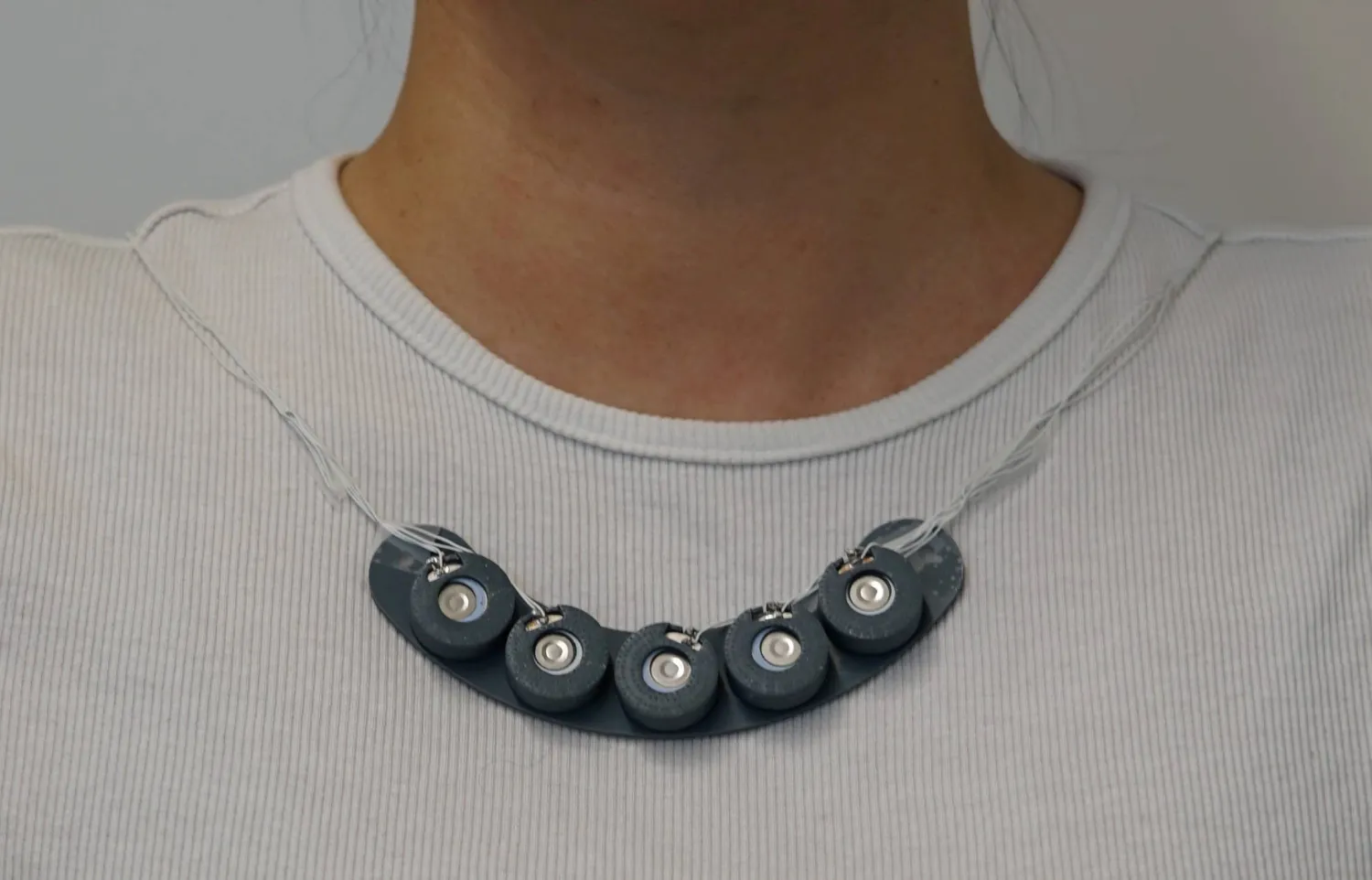
Ohio State University researcher Chunyu Yang wears a prototype odor generator device which is part of a technology called Scentronic that can detect scents and transmit them remotely, at Columbus, Ohio, on June 13, 2025, in this image released October 21, 2026. (Shaoru Cheng/Handout via Reuters)
TT

New ‘Scentronic’ Technology Can Detect and Transmit Aromas Remotely

Ohio State University researcher Chunyu Yang wears a prototype odor generator device which is part of a technology called Scentronic that can detect scents and transmit them remotely, at Columbus, Ohio, on June 13, 2025, in this image released October 21, 2026. (Shaoru Cheng/Handout via Reuters)

People can readily share images and sounds digitally, as evidenced by the billions of smartphones in use globally that often overload the human senses of sight and hearing. But smell generally remains missing from remote communication. That could soon change.

Researchers have developed technology that features an electronic nose that recognizes certain smells, like the distinctive aroma of coffee, and then instructs a small and wearable remote device to release scent molecules matching it. The digital communication can take place at any distance, from across the room to around the world.

"In simple terms, it connects 'smelling something here' with 'recreating the corresponding smell somewhere else,'" said Chunyu Yang, an Ohio State University doctoral student in materials science and engineering and lead author of a study describing the technology published in the journal Science Advances.

"The idea is to add smell to the visual and audio information we already share remotely, making those experiences more engaging," Yang said.

The researchers call this latest development in the field of digital scent technology "Scentronic."

"What makes Scentronic ‌different is that ‌it brings odor sensing and generation together for remote sharing. To the best of our knowledge, ‌our ⁠study is the ⁠first to explore this integration in a compact platform for remote odor sharing," Yang said.

The researchers created an e-nose, a device that uses an array of gas sensors to detect chemical compounds associated with different odors. A machine-learning model then classifies odors that the e-nose has been trained to recognize — cake, coffee and oranges.

The technology uses an online platform to transmit the odor information to a scent generator, which then releases fragrances to recreate the aroma at the receiving end. The scent molecules themselves are not transmitted over the internet.

The e-nose device is roughly 6 inches (15 cm) in diameter and is portable, though not designed to be worn. The researchers developed several versions of ⁠the odor generator, including wristband, necklace and handheld designs.

'EVERYDAY ODORS'

At this point, the e-nose recognizes ‌just the five scents.

"We chose these because they are familiar everyday odors with ‌different scent profiles, making them useful examples for demonstrating the system. We have not yet expanded beyond those categories," Yang said.

"A broader scent library ‌is possible in principle, but an unlimited repertoire is far beyond what we have demonstrated. Recognizing an odor and accurately reproducing ‌it are separate challenges. Covering a useful range of everyday scents is a more realistic goal, although that would still require substantial development," Yang said.

The receiving device cannot recreate every smell Scentronic encounters.

"To support additional odors, we would need to train the electronic nose to recognize them and provide corresponding scented liquids in the odor generator," Yang said.

The researchers see various potential applications for the technology.

"For example, someone could share the scent of ‌a meal with family or friends who live far away. Other potential applications include more immersive virtual and augmented reality experiences and online shopping that allows customers to sample selected scents remotely," ⁠Yang said.

'A RESEARCH PROTOTYPE'

The research ⁠was conducted and the devices developed without the involvement of a company, Yang said.

"At present, this is a research prototype. Moving toward commercialization would require a larger, more diverse training dataset and reliable odor recognition under real-world conditions, where smells often occur in mixtures," Yang said.

"The odor generator would also need further development to support more scents while remaining compact and convenient to use. Other considerations include scent fidelity, refillability, durability, manufacturing costs and the safety of repeated exposure to the scented mist," Yang said.

Smartphones are becoming increasingly capable. Could they in the future incorporate scent technology so that, for instance, a person at a tailgate party before an Ohio State football game could call a friend and share video, audio and the aroma of hot dogs on the grill?

"In principle, a smartphone could connect to a scent-generating accessory. Integrating everything into the phone itself would be more challenging because the scent reservoirs, electronics and atomizers all take up space and add weight. Miniaturization and convenient refilling would be important considerations," Yang said.

"The tailgate example illustrates the idea well. A future system could potentially combine video and audio with a corresponding scent, provided it could recognize the relevant odor and the receiver had a suitable scent formulation available. Our current system has not demonstrated the transmission of a grilling-hot-dog scent or the exact mixture of smells at a tailgate party," Yang said.

Tesla Invites Select Customers to Buy Cybercab for Personal Use

A passenger waves from a Tesla Cybercab driverless taxi as it travels through downtown Austin, Texas, US, October 27, 2026. (Reuters)
TT

Tesla Invites Select Customers to Buy Cybercab for Personal Use

A passenger waves from a Tesla Cybercab driverless taxi as it travels through downtown Austin, Texas, US, October 27, 2026. (Reuters)

Tesla said on Friday it was inviting select customers to buy the Cybercab for personal use, marking a push towards delivering fully designed autonomous vehicles to customers.

Tesla posted the announcement on X ‌with an ‌image of the golden butterfly door ‌two-seater, ⁠priced at $29,990 with ⁠an “Autonomy Subscription” of $299 a month.

Chief Executive Elon Musk said in a post on X that the offering would be available nationwide as Tesla receives regulatory approval.

"The monthly fee is too ⁠high," Musk said, adding that ‌it should match the ‌cost of Tesla Full Self Driving and connectivity ‌for other models, which is about $115 ‌per month.

The EV maker aims to start selling its Cybercab robotaxis to the public by the end of this year, ‌Lars Moravy, Tesla's vice president of vehicle engineering, said last month.

The ⁠Cybercab will work unsupervised in all the same geo locations as the robotaxi, Tesla’s head of artificial intelligence, Ashok Elluswamy, said in a separate X post.

Tesla launched its unsupervised robotaxi service in Austin, Texas, in June 2025, expanded the offering to Dallas and Houston in April 2026 and rolled it out in Miami in July 2026.


Microsoft Says All Services Restored After Global Outage

A view shows a Microsoft logo at Microsoft offices in Issy-les-Moulineaux near Paris, France, January 9, 2025. (Reuters)
TT

Microsoft Says All Services Restored After Global Outage

A view shows a Microsoft logo at Microsoft offices in Issy-les-Moulineaux near Paris, France, January 9, 2025. (Reuters)

Microsoft said on Saturday that services had fully recovered across Teams, Outlook and its other products, ending a global outage that crippled online communications for businesses and governments for over 24 hours. 

"We have completed our efforts to address the underlying issue of the incident and restored service to the remaining impacted customers and regions," the company posted on X. 

Microsoft had said server issues were behind the incident that also affected its Copilot AI assistant, and that it was not aware of any malicious activity, ruling out AI as the cause. 

Outlook and Teams are two of the most widely used workplace applications with hundreds of millions of users. The outage prevented people from performing essential functions such as sending emails, managing calendars and hosting virtual meetings. 

It affected government agencies from Australia and Japan to the United States, caused delays at trading firms, hindered some companies from publishing earnings and prompted airlines to warn customers of communication lags, according to public statements. 

Organizations that host Microsoft services on ‌their own servers, rather than ‌in the cloud, were somewhat spared. 

ANOTHER OUTAGE FOR MICROSOFT 

The outage, reports of which started climbing around ‌1725 GMT on ⁠Thursday according to ⁠Ookla, is one of the longest in Microsoft's history and the second disruption to its services this year. 

Microsoft said the outage specifically hit features tied to Exchange Online — its cloud-based email and scheduling hub — leaving unconnected applications operational. 

The incident deepens questions about the global reliance on a handful of Big Tech companies that supply both the essential software and the cloud infrastructure that underpins it. 

It also highlighted the dependence on Microsoft's workplace software, with outage reports spiking as employees began their workdays across Asia and Europe, according to Downdetector's parent company, Ookla. 

Downdetector logged more than 7.4 million reports worldwide, peaking at nearly 20,000 a minute, more than 1,500 times normal levels. 

"It shows how much of the working day now runs through one provider's email and collaboration tools," said Luke Kehoe, lead industry analyst at Ookla. 

Microsoft shares closed flat at $523.88 on Friday. The stock has ⁠gained roughly 8% so far this year. 

Disruptions and financial losses from the outage could result in numerous insurance claims, ‌but the overall hit to insurers is expected to be limited, said Mario De Cicco, vice president ‌of European financial institutions at Morningstar DBRS. 

De Cicco estimated global insured losses from the incident at between $300 million and $500 million, well below the $400 million to $1.5 billion financial toll from the ‌2024 CrowdStrike outage that crashed more than 8 million Windows-based computers and caused widespread disruptions. 

Microsoft also faced an outage with its 365 services in January this ‌year and in October last year. Last month, it reported an outage of its Azure cloud platform that impacted its suite of productivity software and a range of industries worldwide. 

"The bigger worry is that this is not the first Microsoft 365 outage this year," said Josh Gilbert, a market analyst at trading platform eToro. 

"If reliability starts to look like a recurring problem, it hands every IT department a reason to think twice before putting even more of their business in one provider's hands." 

Still, some analysts have questioned whether such ‌incidents can push customers on to rivals due to the steep switching costs of replacing tools embedded so deeply in daily operations. 

TRADES HAD TO BE CONFIRMED BY FAX 

A spokesperson for the UK government said it was ⁠working with Microsoft to find a solution ⁠for the outage that hit organizations such as the NHS and London's Metropolitan Police. 

Lack of access to emails and other services was impacting the Metropolitan Police's ability to report some crimes online, though its ability to respond to calls was not affected. 

The NHS said its local services were turning to alternate measures such as using IT systems or paper records. 

For businesses, the fallout was widespread. 

European exchange operator Euronext reported email disruptions, British insurer Aviva activated backups for its earnings calls and Danish shipping giant Maersk warned customers of delayed updates. 

American AI giants OpenAI and Anthropic also faced issues with Microsoft connectors that were later resolved, while Indian airlines IndiGo, Akasa Air and Air India said their email support services were impacted. 

The outage also disrupted fund management at Taiwanese securities firms, life insurers, and investment trust companies. One of the companies went as far as cancelling a bond repurchase transaction, a source familiar with the situation told Reuters. 

Another Taiwanese financial company resorted to using fax to confirm trades, a second source said. 

In the US, electric truck maker Workhorse Group rescheduled its results on Thursday to November 16, while Switzerland's Richemont briefly delayed its first-half results announcement on Friday. 

In Australia, where the spy agency and federal police were among organizations caught in the outage, Cyber Security Minister Tony Burke said Microsoft does not suspect a cyberattack. 


Hours-Long Microsoft Outage Disrupts Businesses, Governments Globally

This illustration photograph shows the Microsoft Outlook logo (C) displayed on a smartphone with the backdrop of Microsoft logo on a screen, in New Delhi on November 13, 2026. (AFP)
TT

Hours-Long Microsoft Outage Disrupts Businesses, Governments Globally

This illustration photograph shows the Microsoft Outlook logo (C) displayed on a smartphone with the backdrop of Microsoft logo on a screen, in New Delhi on November 13, 2026. (AFP)

A more than 12-hour outage of Microsoft Outlook and Teams crippled communications for businesses and governments globally on Friday, forcing some organizations to revert to fax machines and halting at least one bond repurchase in Europe.

Microsoft said server issues were behind the incident that also affected its Copilot AI assistant and that a broader roll-out of software fixes was starting to stabilize the system. It said it was not aware of any malicious activity.

Outlook and Teams are two of the most widely used workplace applications with hundreds of millions of users. The outage prevented people from performing essential functions such as sending emails, managing calendars and hosting virtual meetings.

It affected government agencies from Australia to Japan and the United States, caused delays at trading firms, hindered some companies from publishing earnings and prompted airlines to warn customers of communication lags, according to public statements.

Organizations that host Microsoft services ‌on their own servers, ‌rather than in the cloud, were somewhat spared.

ANOTHER OUTAGE FOR MICROSOFT

The outage is one of ‌the ⁠longest in Microsoft's ⁠history and the second disruption to its services this year.

Microsoft said the outage specifically hit features tied to Exchange Online - its cloud-based email and scheduling hub - leaving unconnected applications operational.

The incident deepens questions about the global reliance on a handful of Big Tech companies that supply both the essential software and the cloud infrastructure that underpins it.

Microsoft shares were down 0.4% in early trading. They have gained roughly 8% so far this year.

Disruptions and financial losses from the outage could result in numerous insurance claims, but the overall hit to insurers is expected to be limited, said Mario De Cicco, vice president of European financial institutions at Morningstar DBRS.

De Cicco estimated global insured losses from the incident at between $300 million and $500 million, well below ⁠the $400 million to $1.5 billion financial toll from the 2024 CrowdStrike outage that crashed more than 8 million ‌Windows-based computers and caused widespread disruptions.

Microsoft also faced an outage with its 365 services in January ‌this year and in October last year. Last month, it reported an outage of its Azure cloud platform that impacted its suite of productivity software, ‌and a range of industries worldwide.

"The bigger worry is that this is not the first Microsoft 365 outage this year," said Josh ‌Gilbert, a market analyst at trading platform eToro.

"If reliability starts to look like a recurring problem, it hands every IT department a reason to think twice before putting even more of their business in one provider’s hands."

Still, some analysts have questioned whether such incidents can push customers on to rivals due to the steep switching costs of replacing tools embedded so deeply in daily operations.

TRADES HAD TO BE CONFIRMED BY FAX

A spokesperson for the UK government said ‌it was working with Microsoft to find a solution for the outage that hit organizations such as the NHS and London’s Metropolitan Police.

Lack of access emails and other services was impacting ⁠the Metropolitan Police's ability to report some ⁠crimes online, though its ability to respond to calls was not affected.

NHS said its local services were turning to alternate measures such as using IT systems or paper records.

For businesses, the fallout was widespread.

European exchange operator Euronext reported email disruptions, British insurer Aviva activated backups for its earnings calls and Danish shipping giant Maersk warned customers of delayed updates.

American AI giants OpenAI and Anthropic also faced issues with Microsoft connectors, while Indian airlines IndiGo, Akasa Air and Air India said their email support services were impacted.

The outage also disrupted fund management at Taiwanese securities firms, life insurers, and investment trust companies. One of the companies went as far as cancelling a bond repurchase transaction, a source familiar with the situation told Reuters.

Another Taiwanese financial company resorted to using fax to confirm trades, a second source said.

In the US, electric truck maker Workhorse Group rescheduled its results on Thursday to November 16, while Switzerland's Richemont briefly delayed its first-half results announcement on Friday.

In Australia, where the spy agency and federal police were among organizations caught in the outage, Cyber Security Minister Tony Burke said Microsoft does not suspect a cyber attack.

"The impact that they are dealing with ... is very much on email systems," the minister added.