
Argentina’s Milei Pitches a Regulation-Free AI Haven at the End of the World

Argentina's President Javier Milei delivers a statement at the Organization for Economic Co-operation and Development headquarters, ahead of the ''Argentina Week'', an event aimed at promoting investment and business opportunities, in Paris, Oct. 1, 2026. (AP)
TT

Argentina’s Milei Pitches a Regulation-Free AI Haven at the End of the World

Argentina's President Javier Milei delivers a statement at the Organization for Economic Co-operation and Development headquarters, ahead of the ''Argentina Week'', an event aimed at promoting investment and business opportunities, in Paris, Oct. 1, 2026. (AP)

Data centers have become one of the most polarizing issues in the world. Argentina’s president wants to lure as many of them as he can get.

As residents and policymakers in the United States and Europe fight the facilities that power artificial intelligence, President Javier Milei is pitching Argentina as a haven, promising a hands-off approach to draw foreign investment his crisis-prone country needs.

Like his ally, US President Donald Trump, Milei frequently posts AI-generated images on social media. He has proposed creating “nonhuman corporations” run entirely by AI agents.

“We are not going to regulate artificial intelligence,” Milei told the US Chamber of Commerce in Washington last month. “We are going to leave it free.”

Visitor logs obtained by The Associated Press show a steady stream of tech figures meeting with Milei and his aides in recent months, from venture capitalist Peter Thiel to representatives of OpenAI, Amazon, Google, Oracle and data center companies. Foreign Ministry records show that data center developer Crusoe, which helped build OpenAI’s flagship campus in Texas, sought talks this year with Argentine energy officials about US government-backed investments.

Milei’s hopes rest as much on geography as on ideology. Patagonia offers vast, open plains where noisy server farms can be built far from population centers, a chilly climate to cool the machines, powerful winds to generate electricity and one of the world’s largest shale deposits in Vaca Muerta to fuel power plants.

“In densely populated parts of the US and Europe, there’s a lot of fighting over access to the grid and who should get the electricity,” said Marta Zlotkowska, head of international development at Green Capital, a Polish renewable energy company that plans to build a $3 billion data center in Patagonia to lease to big tech firms for AI computing, though it has yet to secure a customer.

“We compared potential locations for the project around the world and Argentina — well, Patagonia — came out on top in every category," she said.
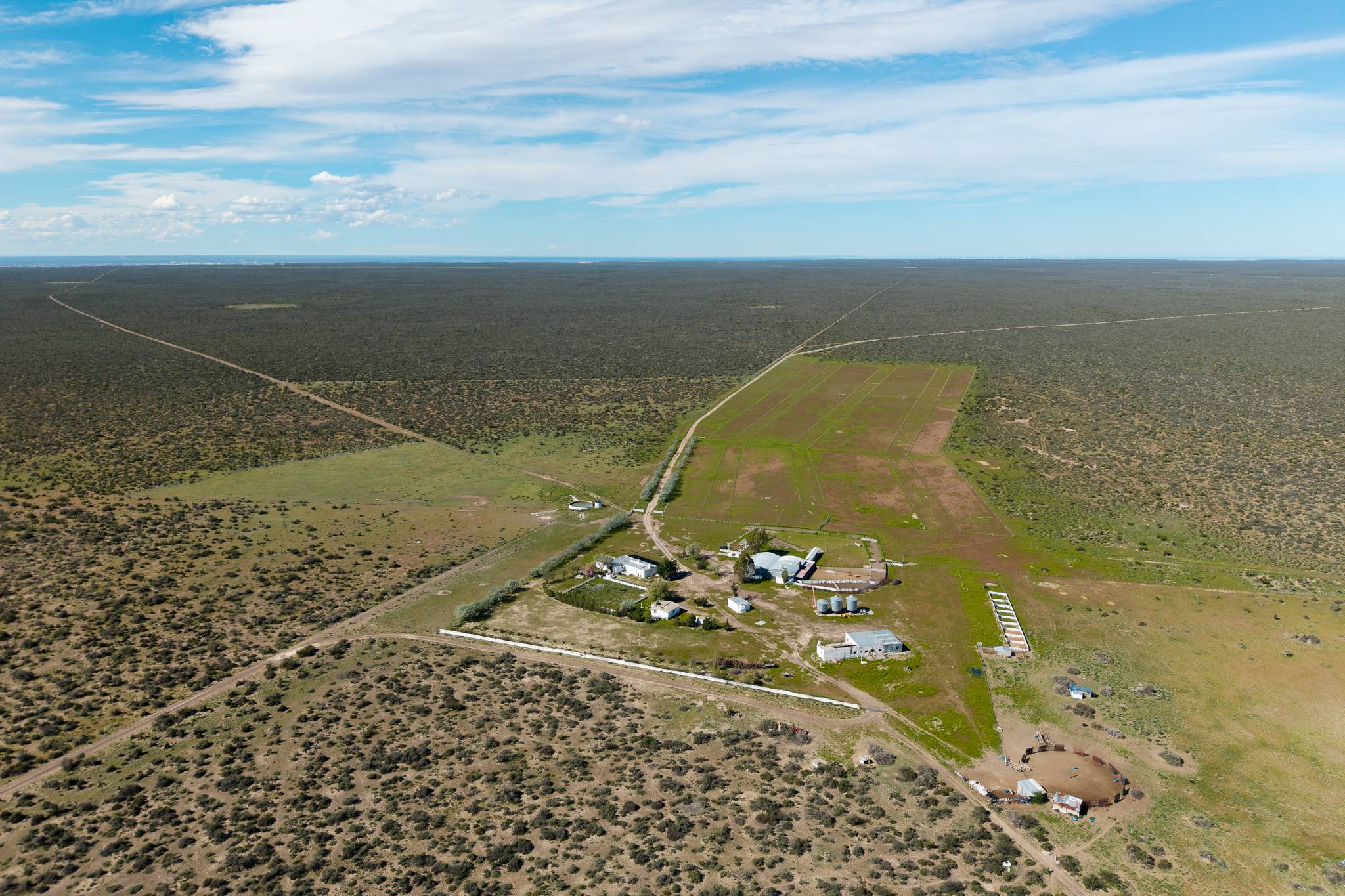
A view of Tatay ranch, one of the properties, picked to host a proposed data center complex near Trelew, Tuesday, Oct. 27, 2026. (AP)

Patagonia’s AI promise

For Argentina’s energy industry, already booming as the Iran war hikes oil prices, data centers represent a tantalizing new market. Pampa Energía, one of the country’s biggest power companies, has announced plans to supply immense amounts of gas-fired power to a data center near Vaca Muerta and is seeking developers.

“Being at the end of the world used to be a disadvantage,” said Rubén Etcheverry, a top official in Neuquén, the Patagonian province home to Vaca Muerta. “But today, faced with energy shortages and rising costs, investors are looking at us.”

To win over companies wary of Argentina’s chronic economic instability, Milei is pushing an incentive scheme that would slash the corporate income tax rate to 15% from 25% for projects of at least $1 billion in AI and other emerging industries. The measure is awaiting Senate approval.

The payoff for Argentines remains unclear. Data centers employ relatively few people. Milei’s proposed incentives don’t require companies to reserve computing capacity for local consumption or to disclose their energy and water use.

“We’re not talking about data centers designed to strengthen Argentine technological sovereignty,” said Alan Rocha Varsanyi, a researcher at Observatorio Petrolero Sur, an Argentine environmental group. “The computing capacity will be exported wherever OpenAI or the other companies need it.”

Blueprints, not yet bulldozers

For all Milei’s hype, Argentina lags behind in the race to become a regional data center hub, as its neighbors tout cheap land, renewable power and expanding fiber-optic connections to US tech giants.

Milei insists his calls for unfettered AI give Argentina an edge at a time when the European Union and a growing number of US states have adopted new regulations. Critics warn he is pushing to deploy AI in Argentina without safeguards against risks ranging from mass surveillance to cyberattacks.

“Without rules, Argentina will become a laboratory — like when companies go to developing countries to test strange drugs they can’t test in major developed countries,” said Nicolás Wolovick, a computer science professor at the National University of Córdoba.

Milei may hear similar concerns next week when Pope Leo XIV, who has warned of AI’s threats to humanity, visits Argentina on his Latin American tour.

Even some in Milei’s own government acknowledge that his anti-regulation stance complicates efforts to build a clear legal framework, with one senior official not authorized to brief media saying companies are waiting for Argentina to settle rules on training AI with copyrighted works and sending personal data abroad.

Some investors are holding back until next year’s potentially tight presidential election, worried that if Milei loses, the next government could unravel his free-market reforms.

“One of our major challenges is getting foreign investors to understand that Argentina remains a friendly place for investment under different political parties,” said Andrés Arbeletche, cabinet coordination secretary for Chubut, a Patagonian province courting several AI mega-projects.
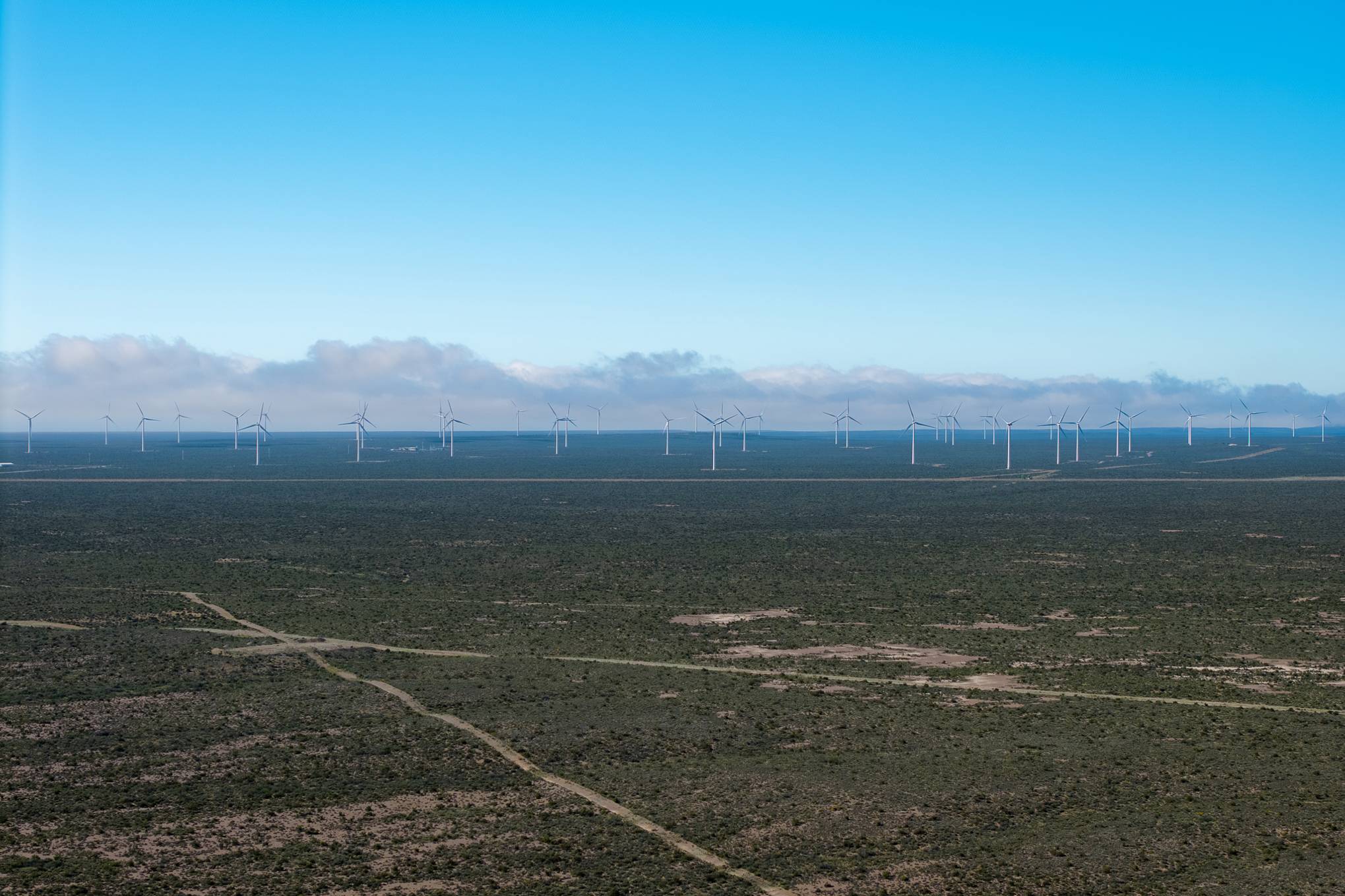
Wind turbines stand on the field near Trelew, Argentina, Wednesday, Oct. 28, 2026. (AP)

Farms of servers and sheep

In remote ranching outposts across the treeless plateau of Chubut province, life revolves around tending flocks on steppes and shearing sheep in sheds. With the wool industry in decline after decades of drought, overgrazing and soaring production costs, some ranchers are betting on a different kind of shed — filled not with fleece but with blinking racks of servers.

“Sheep farmers are looking very hard at what alternatives can be found to bring in more income,” said Francisco Sáenz, an agricultural engineer and fourth-generation sheep farmer whose family is among 14 landowners who have leased a combined 130,000 hectares (about 321,000 acres) to Green Capital for its planned data center. The ranchers expect to keep grazing sheep alongside their colossal future neighbor.

Construction isn’t expected to begin until around 2028. If operated continuously at its projected peak demand, the finished campus would use about 2.7 times as much electricity in a year as the entire city of Buenos Aires consumed in 2025, according to an AP calculation.

Green Capital promises to generate all its own electricity from wind turbines, solar farms and gas-fired generators rather than strain Argentina’s congested grid. Provincial officials are counting on the project to deliver billions of dollars in investment, highly skilled jobs and a market for surplus wind power.

“For us, it is all a benefit, and we give nothing up,” Arbeletche said.

But some residents of Trelew, a dust-blown city near the proposed site, say they have no way to judge those assurances. Environmental studies are still underway, permits are pending and the company hasn’t specified how much water the project would need or how much of its power would come from gas.

“There’s just so little information,” said Cristina Gibón, 46, who fears the environmental toll of data centers. “Maybe we’ll have water until we’re old. But afterward, our children will still be here, and they won’t have those resources.”

Worries like hers are feeding a wider backlash against Milei's courtship of Big Tech. In Trelew, a small group of residents has rallied online and in the main square under the banner “Trelew Free of Data Centers.” In Congress, where lawmakers recently accused Milei of selling off the country at a hearing on billionaire Peter Thiel’s interests in Argentina, the opposition has forced the president to gut a bill easing restrictions on foreign land ownership and has stalled his plan to let AI agents control companies.

Back on his family’s farm, Sáenz sees a familiar Argentine reflex.

“Whenever a foreign company wants to make a major investment in Argentina, there’s a lot of criticism. Many people’s first reaction is to say, ‘No, they’re terrible people coming from the outside to take our resources,’” he said. “I’m not saying big companies are the best thing ever. I’m just saying that when I look at other countries, I see stable economies."


Impossible Metals Says It Has Successfully Tested AI Seabed Mining Robot

Impossible Metals tested an autonomous AI robot that retrieved about 450 grams of polymetallic nodules from more than 4,000 meters deep in the Pacific Ocean in September. (AFP)
TT

Impossible Metals Says It Has Successfully Tested AI Seabed Mining Robot

Impossible Metals tested an autonomous AI robot that retrieved about 450 grams of polymetallic nodules from more than 4,000 meters deep in the Pacific Ocean in September. (AFP)

Deep-sea mining firm Impossible Metals said on Monday it has successfully tested an autonomous robot that uses AI to selectively retrieve critical minerals at depths of more than 4,000 meters in the ‌Pacific Ocean.

Parts of the ocean seabed contain potato-shaped rocks known as polymetallic nodules filled with copper, nickel and other minerals used in electric vehicles and electronics, reported Reuters.

Many companies in the nascent industry plan to use a vacuum-like device to retrieve those nodules, sparking controversy from environmentalists.

Impossible Metals, which is ⁠backed by Y Combinator, has developed a robot with a large claw that it says uses artificial intelligence to avoid aquatic life and reduce environmental impacts.

The test was part of a scientific expedition in September.

The robot directed itself to the seabed, retrieved about 450 grams of nodules and then returned to the surface.

Results from the test will be used to develop a larger version of the robot. The company still needs regulatory approval from the International Seabed Authority or the US government.

Separately, Impossible Metals said that the family of FedEx founder Fred Smith had participated in the company's Series A funding round, which closed earlier this year.

The company declined to provide the value of the round, but media reports put it near $25 million, ⁠an amount that values the company at roughly $110 million.

Richard Smith, a FedEx executive and vice chairman of FWS Enterprises, the Smith family office, said it was Impossible's technology that ⁠drew him in.

“It very responsibly, in an ecologically friendly way, goes down there and plucks these nodules off the seabed floor without disturbing the environment,” ⁠said Smith, who declined to provide the value of the investment but said it was “substantial.”

The Smith family is now Impossible's second-largest shareholder.


Nvidia Heads for $400 Billion Two-Day Wipeout as CEO Affair Fallout Deepens

The Nvidia logo outside Nvidia's Shanghai office building in Shanghai, China, November 10, 2026. (Reuters)
TT

Nvidia Heads for $400 Billion Two-Day Wipeout as CEO Affair Fallout Deepens

The Nvidia logo outside Nvidia's Shanghai office building in Shanghai, China, November 10, 2026. (Reuters)

Nvidia shares extended losses on Tuesday, putting the chip giant on track to shed about $400 billion in market value over two sessions as concerns mounted over the fallout from CEO Jensen Huang's affair with a Chinese businesswoman alleged to be a spy for Beijing.

The CEO's relationship with Alice Huang helped facilitate shipments of at least $7.5 billion worth of Nvidia chips to Chinese firms, The Information reported on Tuesday, citing two people who know her. Alice Huang and Jensen Huang are not related.

The allegations have intensified scrutiny of Nvidia's governance, export-control compliance and reliance on Huang's leadership, adding to investor unease over whether massive spending on artificial intelligence infrastructure ‌will deliver adequate ‌returns.

Nvidia shares fell more than 5% after losing 4.3% ‌on ⁠Monday, when the company ⁠shed $192.08 billion in market value. Tuesday’s decline put another roughly $221 billion at risk if losses hold.

"The investment debate is whether this remains company-specific or triggers restrictions and disruption across AI infrastructure," Bank of America analysts wrote in a note. "We would not equate allegations with proven business damage."

Nvidia's board launched an internal investigation on Sunday, while the FBI is examining whether the 63-year-old Huang was targeted by a ⁠foreign intelligence operation. Huang has told employees he was unfaithful ‌to his wife but provided no ‌details about the relationship.

Alice Huang, also known as Huang Le, along with her husband and sister, ‌built a network of companies across China and Singapore to acquire Nvidia ‌chips, The Information reported.

At the center of the network was Shanghai Century Litong, a China-based company that secured preferred cloud partner status with Nvidia in 2023, giving it priority access to the company's chips, the report said.

When orders for Nvidia chips subject to ‌US export restrictions stalled, Alice Huang used ties to Nvidia and its distributors to secure supplies, helping move about 240,000 H100, ⁠H200 and some ⁠A100 chips into China, according to the report.

Century Litong rented computing capacity and operated data centers using Nvidia chips, including some barred from sale to China. Some of the chips ultimately served Alibaba, Tencent and smaller Chinese AI labs, The Information reported.

Alice Huang also held an executive position at Singapore-registered Megaspeed, which was linked to Century Litong and has been investigated by US authorities over Nvidia chip shipments from Southeast Asia to China, the report said.

The Information reported that Alice Huang leveraged her relationship with Jensen Huang to bolster her credibility while keeping her role vague and avoiding a paper trail.

Nvidia did not immediately respond to a Reuters request for comment. Alibaba, Tencent, Megaspeed and Shanghai Century Litong were not immediately available for comment outside regular business hours. Reuters could not independently verify the report.


Quantum Could Solve AI Energy Drain, Says Tech Founder

Founder of Australian startup company Diraq, Andrew Dzurak, is reflected in a panel housing a cooling system for a quantum chip and computer, as he poses for a photograph at a data center located in Sydney on November 9, 2026. (AFP)
TT

Quantum Could Solve AI Energy Drain, Says Tech Founder

Founder of Australian startup company Diraq, Andrew Dzurak, is reflected in a panel housing a cooling system for a quantum chip and computer, as he poses for a photograph at a data center located in Sydney on November 9, 2026. (AFP)

Quantum computers could curb the vast energy demands of artificial intelligence data centers with their ability to run complex calculations, one of the tech's pioneers told AFP.

Australian startup Diraq is conducting the first field test worldwide putting a small quantum computer based on a silicon chip in a commercial data center in Sydney.

Gigawatt-scale energy demand from large data centers -- warehouse-like buildings full of servers used to train or run AI tools -- requires new power plants or increases pressure on electrical grids, sparking community backlash.

But, according to Diraq founder Andrew Dzurak, quantum computing is making the leap out of university labs and will be ready to lift the burden in data centers within five years.

"One of the reasons the next generations of AI are looking to consume so much power is that a whole class of the problems they are solving are problems that really are much better suited to quantum calculations," he told AFP.

Quantum computers harness the power of quantum mechanics -- laws that govern how physics operates at atomic and sub-atomic scales -- to process information in ways traditional computers cannot.

They usually require extremely cold cryogenic temperatures.

But Diraq's model, a self-contained system, draws less than 20 kilowatts of power as it runs alongside a computer humming at room temperature in the data center.

Potential uses beyond powering AI include rapidly and energy-efficiently calculating the "behavior of molecules that could be used in pharmaceuticals, or much lighter batteries or the chemical industry", Dzurak said.

Using quantum for drug trials could boost success by 10 percent and reduce the cost of bringing a new medicine to market by a third, if it runs for under $100 million per year, the company estimates.

"It will only happen if we can build quantum computers that are cost-effective," Dzurak said.

- Australia's Silicon Valley -

Diraq is among six global companies at the third stage of the US Defense Advanced Research Projects Agency (DARPA) quantum benchmarking initiative -- which will test if any quantum computer can solve real problems at a cost that delivers value by 2033.

Another Australian startup, PsiQuantum, is also on the DARPA list and backed by a Au$1 billion Australian government investment to build a different model of quantum computer in Queensland state. Construction started in June.

The country is experiencing a Silicon Valley moment in quantum, said Dzurak.

Australian physicist Michelle Simmons' startup Silicon Quantum Computing was named by Time magazine as having one of the best inventions of 2026, a quantum-enhanced AI chip.

Australia has been a global leader in quantum science for decades, partly because of investment in startups emerging from universities, said President of the Australian Academy of Technological Sciences and Engineering Cathy Foley.

"Australia has more than 50 quantum-related businesses operating here," she told AFP.

But "commercialization is certainly one of our biggest challenges", she said.

"Australia is very good at making discoveries, but turning them into successful businesses requires much more than great science."

The Australian government has made quantum a priority through its AUKUS defense technology partnership with Britain and the United States, Foley said.

AUKUS has reduced the security barriers for sharing quantum technology between the countries, which has been "essential" for Diraq to work across Australia and its offices in the larger US market, said Dzurak.

Diraq's computer installed in Equinix's Sydney data center has eight quantum bits, or qubits, on a silicon chip. This will be gradually upgraded to 150,000 qubits by 2029.

Qubits, the basic unit of information, can store more data and make more advanced calculations faster than classical computers, using quantum mechanics principles.

Diraq plans to have a system with two million qubits on a silicon chip that reaches DARPA's definition by 2031, two years ahead of the deadline.

"We will have an energy usage of a couple of hundred kilowatts," he said.