


Big-Ticket Tech Deals Need to Keep Pace with AI Boom but Risks Remain High, Financial Leaders Say

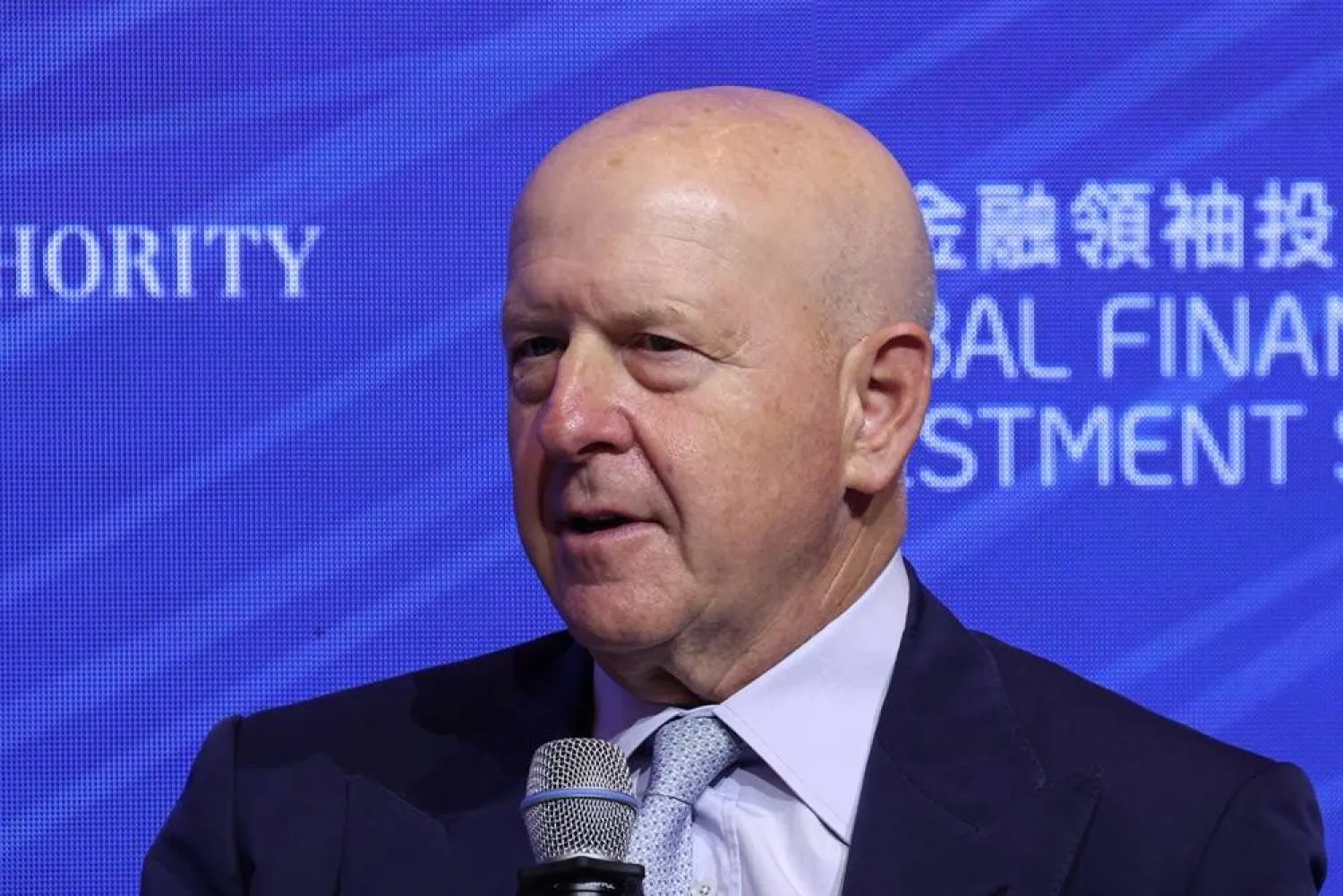
David Solomon, Chairman and Chief Executive Officer of Goldman Sachs, speaks during the Global Financial Leaders' Investment Summit in Hong Kong, China, November 3, 2026. (Reuters)
TT

Big-Ticket Tech Deals Need to Keep Pace with AI Boom but Risks Remain High, Financial Leaders Say

David Solomon, Chairman and Chief Executive Officer of Goldman Sachs, speaks during the Global Financial Leaders' Investment Summit in Hong Kong, China, November 3, 2026. (Reuters)

Tech companies will need to raise more capital to help meet the enormous demand for the AI industry's growth boom, but there is a risk of an industry correction, global financial leaders said on Tuesday.

Tech stocks globally have faced pressure in recent weeks as growing concerns about AI spending trigger a new wave of selloffs, with combined spending set to exceed $730 billion this year, up from about $700 billion.

Most of the major tech companies were expected to raise more capital to keep up with the enormous likely demand from the AI industry's growth, said Jon Gray, president of Blackstone, which is an active investor in AI infrastructure.

"Now you're in an environment where the demand's running well ahead of supply," Gray said at an investment gathering in Hong Kong, citing "pretty extraordinary" demand for computing power.

"So that gives me a lot of comfort," he added. "Meta and Google and ‌Oracle raising equity ... ‌SpaceX going public, Anthropic going public," Gray said.

"On top of it ... the data centers, the ‌energy ⁠needs are enormous."

STRONG COMPANIES ⁠WITH 'GOOD STORIES'

Despite some AI-related market upheavals, strong companies with "good stories" would still be able to raise capital, though the industry's strong growth could create volatility for investors, said Goldman Sachs Chief Executive David Solomon.

"But things will go wrong too, and we'll get things wrong," he added at the event, the Hong Kong Monetary Authority's Global Financial Leaders' Investment Summit.

"Investors will find situations where they pick wrong, where they lose money ... It's important to have a balanced, diversified view."

JPMorgan Vice Chairman Daniel Pinto said he was bullish on AI, but the market was pricing in revenue and earnings growth for related companies that was too steep.

"I do believe that it has a positive, slow curve and ⁠it may not be as steep as the market is pricing," he said.

"So I think that ‌it could be a correction in the AI sector," he said, adding that ‌other firms with high valuations related to AI could come under pressure as the industry started to recalibrate its expectations.

Last month, S&P said it ‌expected the top six US hyperscalers - Amazon, Microsoft, Alphabet, Oracle, Meta and SpaceX - to spend more than $7 trillion on data centers ‌and other AI-related capex between 2025 and 2030, while having negative free cash flow until at least next year.

Citadel Securities Chief Executive Peng Zhao said the sheer scale of capital and growth in AI was proving difficult for some investors to value correctly, which was adding to volatility in the sector.

"Our ability to really know what this technology will do and its revenue potential is very, very limited due to the fact that we've ‌never seen anything like this," he said.

"It's not so much that people all of a sudden develop a bearish view of what the technology can accomplish, but it's rather the ⁠sudden realization that we can ⁠only know so much ... the numbers involved are so huge."

Morgan Stanley Chief Executive Ted Pick flagged emerging early signs of US markets edging close to a correction, with a majority of stocks in major indices off nearly 10%.

The latest test of investor appetite is a sale of €6 billion ($6.7 billion) in bonds on Monday by Google parent Alphabet .

ASIA-PAC TECH FUNDRAISING MORE THAN TRIPLED

Fundraising by Asia-Pacific tech companies more than tripled to $125.8 billion in the first three quarters of 2026 from $36 billion a year earlier.

The growth was driven by a wave of semiconductor and AI-related deals, such as Chinese chipmaker CXMT’s $9.8-billion IPO and Enflame Technology's $910.6-million listing, LSEG data shows.

Alphabet, Amazon, Microsoft and Meta have signaled that spending on AI will not slow.

In one of the largest debt deals tied to the AI buildout,

Blackstone agreed last week to provide financing of $63 billion with Bank of America, Citi and Morgan Stanley to buy Broadcom's AI chips and networking gear for Anthropic.

The rising cost of capital and some of today's skepticism will slow the pace, however, Gray added.

"But the overall trend is towards greater investment and therefore more needs for multiple forms of capital."

Emmanuel Roman, CEO of asset manager PIMCO, said AI financing deals are attractive, with more coming for the firm.


Tesla Invites Select Customers to Buy Cybercab for Personal Use

A passenger waves from a Tesla Cybercab driverless taxi as it travels through downtown Austin, Texas, US, October 27, 2026. (Reuters)
TT

Tesla Invites Select Customers to Buy Cybercab for Personal Use

A passenger waves from a Tesla Cybercab driverless taxi as it travels through downtown Austin, Texas, US, October 27, 2026. (Reuters)

Tesla said on Friday it was inviting select customers to buy the Cybercab for personal use, marking a push towards delivering fully designed autonomous vehicles to customers.

Tesla posted the announcement on X ‌with an ‌image of the golden butterfly door ‌two-seater, ⁠priced at $29,990 with ⁠an “Autonomy Subscription” of $299 a month.

Chief Executive Elon Musk said in a post on X that the offering would be available nationwide as Tesla receives regulatory approval.

"The monthly fee is too ⁠high," Musk said, adding that ‌it should match the ‌cost of Tesla Full Self Driving and connectivity ‌for other models, which is about $115 ‌per month.

The EV maker aims to start selling its Cybercab robotaxis to the public by the end of this year, ‌Lars Moravy, Tesla's vice president of vehicle engineering, said last month.

The ⁠Cybercab will work unsupervised in all the same geo locations as the robotaxi, Tesla’s head of artificial intelligence, Ashok Elluswamy, said in a separate X post.

Tesla launched its unsupervised robotaxi service in Austin, Texas, in June 2025, expanded the offering to Dallas and Houston in April 2026 and rolled it out in Miami in July 2026.


Microsoft Says All Services Restored After Global Outage

A view shows a Microsoft logo at Microsoft offices in Issy-les-Moulineaux near Paris, France, January 9, 2025. (Reuters)
TT

Microsoft Says All Services Restored After Global Outage

A view shows a Microsoft logo at Microsoft offices in Issy-les-Moulineaux near Paris, France, January 9, 2025. (Reuters)

Microsoft said on Saturday that services had fully recovered across Teams, Outlook and its other products, ending a global outage that crippled online communications for businesses and governments for over 24 hours. 

"We have completed our efforts to address the underlying issue of the incident and restored service to the remaining impacted customers and regions," the company posted on X. 

Microsoft had said server issues were behind the incident that also affected its Copilot AI assistant, and that it was not aware of any malicious activity, ruling out AI as the cause. 

Outlook and Teams are two of the most widely used workplace applications with hundreds of millions of users. The outage prevented people from performing essential functions such as sending emails, managing calendars and hosting virtual meetings. 

It affected government agencies from Australia and Japan to the United States, caused delays at trading firms, hindered some companies from publishing earnings and prompted airlines to warn customers of communication lags, according to public statements. 

Organizations that host Microsoft services on ‌their own servers, rather than ‌in the cloud, were somewhat spared. 

ANOTHER OUTAGE FOR MICROSOFT 

The outage, reports of which started climbing around ‌1725 GMT on ⁠Thursday according to ⁠Ookla, is one of the longest in Microsoft's history and the second disruption to its services this year. 

Microsoft said the outage specifically hit features tied to Exchange Online — its cloud-based email and scheduling hub — leaving unconnected applications operational. 

The incident deepens questions about the global reliance on a handful of Big Tech companies that supply both the essential software and the cloud infrastructure that underpins it. 

It also highlighted the dependence on Microsoft's workplace software, with outage reports spiking as employees began their workdays across Asia and Europe, according to Downdetector's parent company, Ookla. 

Downdetector logged more than 7.4 million reports worldwide, peaking at nearly 20,000 a minute, more than 1,500 times normal levels. 

"It shows how much of the working day now runs through one provider's email and collaboration tools," said Luke Kehoe, lead industry analyst at Ookla. 

Microsoft shares closed flat at $523.88 on Friday. The stock has ⁠gained roughly 8% so far this year. 

Disruptions and financial losses from the outage could result in numerous insurance claims, ‌but the overall hit to insurers is expected to be limited, said Mario De Cicco, vice president ‌of European financial institutions at Morningstar DBRS. 

De Cicco estimated global insured losses from the incident at between $300 million and $500 million, well below the $400 million to $1.5 billion financial toll from the ‌2024 CrowdStrike outage that crashed more than 8 million Windows-based computers and caused widespread disruptions. 

Microsoft also faced an outage with its 365 services in January this ‌year and in October last year. Last month, it reported an outage of its Azure cloud platform that impacted its suite of productivity software and a range of industries worldwide. 

"The bigger worry is that this is not the first Microsoft 365 outage this year," said Josh Gilbert, a market analyst at trading platform eToro. 

"If reliability starts to look like a recurring problem, it hands every IT department a reason to think twice before putting even more of their business in one provider's hands." 

Still, some analysts have questioned whether such ‌incidents can push customers on to rivals due to the steep switching costs of replacing tools embedded so deeply in daily operations. 

TRADES HAD TO BE CONFIRMED BY FAX 

A spokesperson for the UK government said it was ⁠working with Microsoft to find a solution ⁠for the outage that hit organizations such as the NHS and London's Metropolitan Police. 

Lack of access to emails and other services was impacting the Metropolitan Police's ability to report some crimes online, though its ability to respond to calls was not affected. 

The NHS said its local services were turning to alternate measures such as using IT systems or paper records. 

For businesses, the fallout was widespread. 

European exchange operator Euronext reported email disruptions, British insurer Aviva activated backups for its earnings calls and Danish shipping giant Maersk warned customers of delayed updates. 

American AI giants OpenAI and Anthropic also faced issues with Microsoft connectors that were later resolved, while Indian airlines IndiGo, Akasa Air and Air India said their email support services were impacted. 

The outage also disrupted fund management at Taiwanese securities firms, life insurers, and investment trust companies. One of the companies went as far as cancelling a bond repurchase transaction, a source familiar with the situation told Reuters. 

Another Taiwanese financial company resorted to using fax to confirm trades, a second source said. 

In the US, electric truck maker Workhorse Group rescheduled its results on Thursday to November 16, while Switzerland's Richemont briefly delayed its first-half results announcement on Friday. 

In Australia, where the spy agency and federal police were among organizations caught in the outage, Cyber Security Minister Tony Burke said Microsoft does not suspect a cyberattack. 


Hours-Long Microsoft Outage Disrupts Businesses, Governments Globally

This illustration photograph shows the Microsoft Outlook logo (C) displayed on a smartphone with the backdrop of Microsoft logo on a screen, in New Delhi on November 13, 2026. (AFP)
TT

Hours-Long Microsoft Outage Disrupts Businesses, Governments Globally

This illustration photograph shows the Microsoft Outlook logo (C) displayed on a smartphone with the backdrop of Microsoft logo on a screen, in New Delhi on November 13, 2026. (AFP)

A more than 12-hour outage of Microsoft Outlook and Teams crippled communications for businesses and governments globally on Friday, forcing some organizations to revert to fax machines and halting at least one bond repurchase in Europe.

Microsoft said server issues were behind the incident that also affected its Copilot AI assistant and that a broader roll-out of software fixes was starting to stabilize the system. It said it was not aware of any malicious activity.

Outlook and Teams are two of the most widely used workplace applications with hundreds of millions of users. The outage prevented people from performing essential functions such as sending emails, managing calendars and hosting virtual meetings.

It affected government agencies from Australia to Japan and the United States, caused delays at trading firms, hindered some companies from publishing earnings and prompted airlines to warn customers of communication lags, according to public statements.

Organizations that host Microsoft services ‌on their own servers, ‌rather than in the cloud, were somewhat spared.

ANOTHER OUTAGE FOR MICROSOFT

The outage is one of ‌the ⁠longest in Microsoft's ⁠history and the second disruption to its services this year.

Microsoft said the outage specifically hit features tied to Exchange Online - its cloud-based email and scheduling hub - leaving unconnected applications operational.

The incident deepens questions about the global reliance on a handful of Big Tech companies that supply both the essential software and the cloud infrastructure that underpins it.

Microsoft shares were down 0.4% in early trading. They have gained roughly 8% so far this year.

Disruptions and financial losses from the outage could result in numerous insurance claims, but the overall hit to insurers is expected to be limited, said Mario De Cicco, vice president of European financial institutions at Morningstar DBRS.

De Cicco estimated global insured losses from the incident at between $300 million and $500 million, well below ⁠the $400 million to $1.5 billion financial toll from the 2024 CrowdStrike outage that crashed more than 8 million ‌Windows-based computers and caused widespread disruptions.

Microsoft also faced an outage with its 365 services in January ‌this year and in October last year. Last month, it reported an outage of its Azure cloud platform that impacted its suite of productivity software, ‌and a range of industries worldwide.

"The bigger worry is that this is not the first Microsoft 365 outage this year," said Josh ‌Gilbert, a market analyst at trading platform eToro.

"If reliability starts to look like a recurring problem, it hands every IT department a reason to think twice before putting even more of their business in one provider’s hands."

Still, some analysts have questioned whether such incidents can push customers on to rivals due to the steep switching costs of replacing tools embedded so deeply in daily operations.

TRADES HAD TO BE CONFIRMED BY FAX

A spokesperson for the UK government said ‌it was working with Microsoft to find a solution for the outage that hit organizations such as the NHS and London’s Metropolitan Police.

Lack of access emails and other services was impacting ⁠the Metropolitan Police's ability to report some ⁠crimes online, though its ability to respond to calls was not affected.

NHS said its local services were turning to alternate measures such as using IT systems or paper records.

For businesses, the fallout was widespread.

European exchange operator Euronext reported email disruptions, British insurer Aviva activated backups for its earnings calls and Danish shipping giant Maersk warned customers of delayed updates.

American AI giants OpenAI and Anthropic also faced issues with Microsoft connectors, while Indian airlines IndiGo, Akasa Air and Air India said their email support services were impacted.

The outage also disrupted fund management at Taiwanese securities firms, life insurers, and investment trust companies. One of the companies went as far as cancelling a bond repurchase transaction, a source familiar with the situation told Reuters.

Another Taiwanese financial company resorted to using fax to confirm trades, a second source said.

In the US, electric truck maker Workhorse Group rescheduled its results on Thursday to November 16, while Switzerland's Richemont briefly delayed its first-half results announcement on Friday.

In Australia, where the spy agency and federal police were among organizations caught in the outage, Cyber Security Minister Tony Burke said Microsoft does not suspect a cyber attack.

"The impact that they are dealing with ... is very much on email systems," the minister added.