

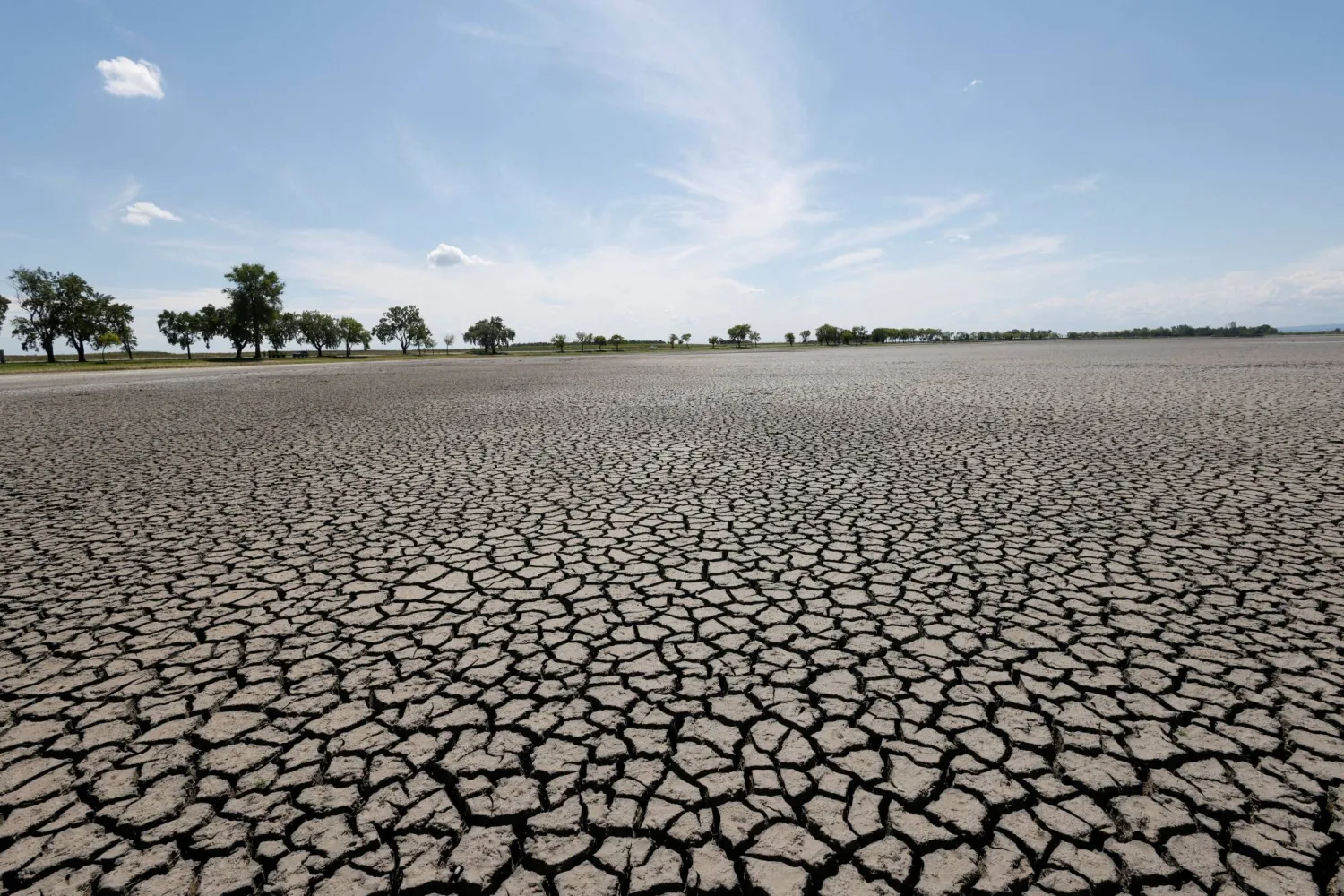

For the Third Day in a Row, the Earth's Average Temperature Remained at a Record High

A general view shows almost dried up Lake Zicksee near Sankt Andrae, as another heatwave is predicted for parts of the country, in Austria, August 12, 2022. REUTERS/Leonhard Foeger/
TT

For the Third Day in a Row, the Earth's Average Temperature Remained at a Record High

A general view shows almost dried up Lake Zicksee near Sankt Andrae, as another heatwave is predicted for parts of the country, in Austria, August 12, 2022. REUTERS/Leonhard Foeger/

Earth’s average temperature remained at a record high Wednesday, after two days in which the planet reached unofficial records. It’s the latest marker in a series of climate-change-driven extremes.
The average global temperature was 17.18 Celsius (62.9 degrees Fahrenheit), according to the University of Maine’s Climate Reanalyzer, a tool that uses satellite data and computer simulations to measure the world’s condition. That matched a record set Tuesday of 17.18 Celsius (62.9 Fahrenheit), and came after a previous record of 17.01 Celsius (62.6 degrees Fahrenheit) was set Monday.
Scientists have warned for months that 2023 could see record heat as human-caused climate change, driven largely by the burning of fossil fuels like coal, natural gas and oil, warmed the atmosphere. They also noted that La Nina, the natural cooling of the ocean that had acted as a counter to that warming, was giving way to El Nino, the reverse phenomenon marked by warming oceans. The North Atlantic has seen record warmth this year.
“A record like this is another piece of evidence for the now massively supported proposition that global warming is pushing us into a hotter future,” said Stanford University climate scientist Chris Field, who was not part of the calculations.
University of Maine climate scientist Sean Birkle, creator of the Climate Reanalyzer, said the daily figures are unofficial but a useful snapshot of what’s happening in a warming world.
While the figures are not an official government record, “this is showing us an indication of where we are right now,” said National Oceanic and Atmospheric Administration chief scientist Sarah Kapnick. And NOAA indicated it will take the figures into consideration for its official record calculations.
Even though the dataset used for the unofficial record goes back only to 1979, Kapnick said that given other data, the world is likely seeing the hottest day in “several hundred years that we’ve experienced.”
Scientists generally use much longer measurements — months, years, decades — to track the Earth’s warming. But the daily highs are an indication that climate change is reaching uncharted territory.
On Wednesday, 38 million Americans were under some kind of heat alert, Kapnick said.
That included communities that aren't used to feeling such heat. In North Grenville, Ontario, the city turned ice hockey rinks into cooling centers as temperatures Wednesday hit 90 degrees Fahrenheit (32 degrees Celsius), with humidity making it feel like 100.4 degrees (38 degrees Celsius).
“I feel like we live in a tropical country right now,” city spokeswoman Jill Sturdy said. “It just kind of hits you. The air is so thick.”
With many places seeing temperatures near 100 degrees Fahrenheit (37.8 degrees Celsius), the average temperature records might not seem very hot. But Tuesday’s global high was nearly 1.8 degrees Fahrenheit (a full degree Celsius) higher than the 1979-2000 average, which already topped the 20th- and 19th-century averages.
High-temperature records were surpassed this week in Quebec and Peru. Beijing reported nine straight days last week when the temperature exceeded 35 degrees Celsius (95 degrees Fahrenheit), and ordered a stop to all outdoor work Wednesday as more high temperatures were forecast. Cities across the US from Medford, Oregon to Tampa, Florida have been hovering at all-time highs, said Zack Taylor, a meteorologist with the National Weather Service.
Alan Harris, director of emergency management for Seminole County, Florida, said the county has already surpassed last year for the number of days they’ve activated their extreme weather plan — something that happens when the heat index hits 108 Fahrenheit or greater.
“It’s just been kind of brutally hot for the last week, and now it looks like potentially for two weeks,” Harris said.
In the US, heat advisories include portions of western Oregon, inland far northern California, central New Mexico, Texas, Florida and the coastal Carolinas, according to the National Weather Service Weather Prediction Center. Excessive heat warnings are continuing across southern Arizona and California.



Saudi Arabia: Newest State-of-the-Art Film Production Hub Launched in Qiddiya City

Located at the heart of Qiddiya City, PlayMaker Studios sits just 40 minutes from Riyadh
TT

Saudi Arabia: Newest State-of-the-Art Film Production Hub Launched in Qiddiya City

Located at the heart of Qiddiya City, PlayMaker Studios sits just 40 minutes from Riyadh

Qiddiya Investment Company has announced the official opening of PlayMaker Studios at Qiddiya City, marking the launch of Saudi Arabia’s newest state-of-the-art film production hub. The opening represents a major milestone in the Kingdom’s rapidly advancing film and creative industries.

The launch of PlayMaker Studios marks a strategic addition to Saudi Arabia’s production infrastructure. The studios feature two high-spec, purpose-built soundstages, flexible workshops, and fully integrated production facilities designed to meet the needs of large-scale international and regional productions. The complex also includes modern production offices and on-site support amenities, offering a seamless, end-to-end production environment.

With strong demand already recorded for studio space, construction has begun on two additional world-class soundstages, scheduled for completion in 2026, which will significantly expand PlayMaker Studios’ capacity and enable it to host multiple major productions simultaneously.

Qiddiya Investment Company has also established a dedicated on-the-ground team to provide hands-on support for producers across permitting, logistics, and operational services. In addition, PlayMaker Studios offers streamlined access to Saudi Arabia’s industry-leading 40% production cash rebate, one of the most competitive incentives globally.

As part of its long-term development strategy, PlayMaker Studios will introduce dedicated post-production, visual effects, volumetric, and music studios, further strengthening the Kingdom’s creative and production ecosystem. The complex is set to become both a creative powerhouse and a core pillar of Qiddiya City’s entertainment offering.

Qiddiya Investment Company Managing Director Abdullah Aldawood said: “PlayMaker Studios is a cornerstone of Qiddiya City’s ambition and builds on Saudi Arabia’s growing success in the creative industries. It marks an important step in strengthening this momentum and realizing our vision to create a world class destination where innovation, culture and entertainment come together, and where the global film industry can find a new home in the Kingdom.”

Located at the heart of Qiddiya City - the world’s first destination where culture, sport, and creativity converge - PlayMaker Studios sits just 40 minutes from Riyadh, offering producers integrated logistics solutions, premium accommodation options for production teams, and direct access to a dynamic entertainment environment designed to inspire world-class content creation.


Brigitte Macron Visits an Old Friend in China: Giant Panda Called Yuan Meng

FILE - French First lady Brigitte Macron attends a naming ceremony of the panda born at the Beauval Zoo, in Saint-Aignan-sur-Cher, France, on Dec. 4, 2017. (AP Photo/Thibault Camus, Pool, File)
TT

Brigitte Macron Visits an Old Friend in China: Giant Panda Called Yuan Meng

FILE - French First lady Brigitte Macron attends a naming ceremony of the panda born at the Beauval Zoo, in Saint-Aignan-sur-Cher, France, on Dec. 4, 2017. (AP Photo/Thibault Camus, Pool, File)

French first lady Brigitte Macron caught up with an old friend — a giant panda born in France — at the tail end Friday of a visit to China with President Emmanuel Macron.

At a panda reserve in southwest China that Yuan Meng now calls home, the first lady marveled at how big he has grown. She helped choose his name — which means “accomplishment of a dream” — when he was born in a French zoo in 2017.

“When they're born, they're like this,” she said, holding up two fingers a short distance apart. Meanwhile, the chunky male roamed in his enclosure, feasting on bamboo and ignoring bystanders who cried out his name, hoping to elicit a reaction.

“They have a very independent character,” she said. “They do only what they want.”

For decades, China has deployed what's often called “panda diplomacy” to smooth and promote relations with other countries, gifting the animals to friendly nations and lending pandas to zoos overseas on commercial terms.

Emmanuel Macron’s state visit this week to China, his fourth as president, included meetings with Chinese leader Xi Jinping and other officials, discussing Russia’s war in Ukraine, trade ties and other issues.

The China Wildlife Conservation Association said during the visit that it signed a letter of intent to send two of the animals to the Beauval Zoo south of Paris in 2027 under what would be a new 10-year round of panda cooperation with France.

The French zoo sent two 17-year-old pandas — Huan Huan, a female, and her partner Yuan Zi — back to China last month after 13 years on loan in France.

Yuan Meng was their cub, conceived using artificial insemination.

Despite being made in France, he officially belonged to the Chinese government. Yuan Meng bid ‘’adieu’’ to France in 2023, sent off to a new life in the Chengdu Research Base of Giant Panda Breeding in southwest China where Brigitte Macron, considered to be his “godmother,” dropped in to see him.

Huan Huan and Yuan Zi also produced female twins in France in 2021.

Huanlili and Yuandudu are also expected to leave the Beauval Zoo for China in the future. The China Wildlife Conservation Association has previously said that it expects them to remain at the French zoo until January 2027.


Florida Kicks Off 1st Black Bear Hunt in a Decade, Despite Pushback

FILE - A black bear is weighed by FWC Biologists Alyssa Simmons and Mike Orlando at the Rock Springs Run Wildlife Management Area near Lake Mary, Fla., Oct. 24, 2015. (Luis Santana/Tampa Bay Times via AP, file)
TT

Florida Kicks Off 1st Black Bear Hunt in a Decade, Despite Pushback

FILE - A black bear is weighed by FWC Biologists Alyssa Simmons and Mike Orlando at the Rock Springs Run Wildlife Management Area near Lake Mary, Fla., Oct. 24, 2015. (Luis Santana/Tampa Bay Times via AP, file)

For the first time in a decade, hunters armed with rifles and crossbows are fanning out across Florida's swamps and flatwoods to legally hunt the Florida black bear, over the vocal opposition of critics.

The state-sanctioned hunt began Saturday, after drawing more than 160,000 applications for a far more limited number of hunting permits, including from opponents who are trying to reduce the number of bears killed in this year's hunt, the state's first since 2015, The Associated Press reported.

The Florida Fish and Wildlife Conservation Commission awarded 172 bear hunt permits by random lottery for this year's season, allowing hunters to kill one bear each in areas where the population is deemed large enough. At least 43 of the permits went to opponents of the hunt who never intend to use them, according to the Florida chapter of the Sierra Club, which encouraged critics to apply in the hopes of saving bears.

The Florida black bear population is considered one of the state's conservation success stories, having grown from just several hundred bears in the 1970s to an estimated more than 4,000 today.

Opponents have questioned whether the hunt was necessary, but they were unable to convince the courts to halt it.

Here's what to know.

A limit of one bear per hunter The 172 people who were awarded a permit through a random lottery will be able to kill one bear each during the 2025 season, which runs from Dec. 6 to Dec. 28. The permits are specific to one of the state's four designated bear hunting zones, each of which have a hunting quota set by state officials based on the bear population in each region.

In order to participate, hunters must hold a valid hunting license and a bear harvest permit, which costs $100 for residents and $300 for nonresidents, plus fees. Applications for the permits cost $5 each.

The regulated hunt will help incentivize maintaining healthy bear populations, and help fund the work that is needed, according to Mark Barton of the Florida chapter of Backcountry Hunters and Anglers, an advocacy group that supported the hunt.

Having an annual hunt will help guarantee funding to "keep moving conservation for bears forward,” Barton said.

Hunting as a management tool According to state wildlife officials, the bear population has grown enough to support a regulated hunt and warrant population management. The state agency sees hunting as an effective tool that is used to manage wildlife populations around the world, and allows the state to monetize conservation efforts through permit and application fees.

"While we have enough suitable bear habitat to support our current bear population levels, if the four largest subpopulations continue to grow at current rates, we will not have enough habitat at some point in the future," reads a bear hunting guide published by the state wildlife commission.

Opponents meanwhile have called the hunt cruel, unnecessary and an excuse for hunters to bag a trophy animal when the real issue is the ever-growing human population encroaching on bear habitat.

Stricter regulations than the last hunt This year’s hunting plan has more stringent rules than the 2015 hunt, in which permits were provided to anyone who could pay for them, resulting in more than 3,700 permits issued. That led to a chaotic event that was shut down days early. Of the 304 bears killed, at least 38 were females with cubs, meaning the young bears may have died too.

Ultimately, wildlife officials decided to call off the hunt after its second day after a higher than expected number of bears were killed, though hunters did not exceed the statewide quota.

Doug Moore regularly sees bears on the more than 6,000 acres of timberland that he manages in northeast Florida. The president of a local hunting club, Moore is generally supportive of the new regulations for the bear hunt, even though he and his family members weren't issued a permit this year.

Moore described the management of the 2015 hunt as “fouled up” and “totally wrong" but said, “they’re doing it right this time."

Activists were issued dozens of permits Backers of the hunt have said that growing numbers of bears present a safety problem, with local officials sharing reports of bears on porches, rooting through garbage cans and roaming neighborhoods and playgrounds.

Activists have argued that the state should instead focus on other means of curbing nuisance bears and assuring safety through better trash management.

While opponents failed to convince a judge to stop the hunt, they were issued about a quarter of the overall permits, after activists applied for hunting tags they never intend to use.

“Somewhere out there a bear will be walking the grounds of the Panhandle, and I gave them a stay of execution,” said Joel Cleveland, an opponent of the hunt who was issued one of the permits.