


Fuzzy Invasion of Domestic Rabbits Has a Florida Suburb Hopping Into a Hunt for New Owners 

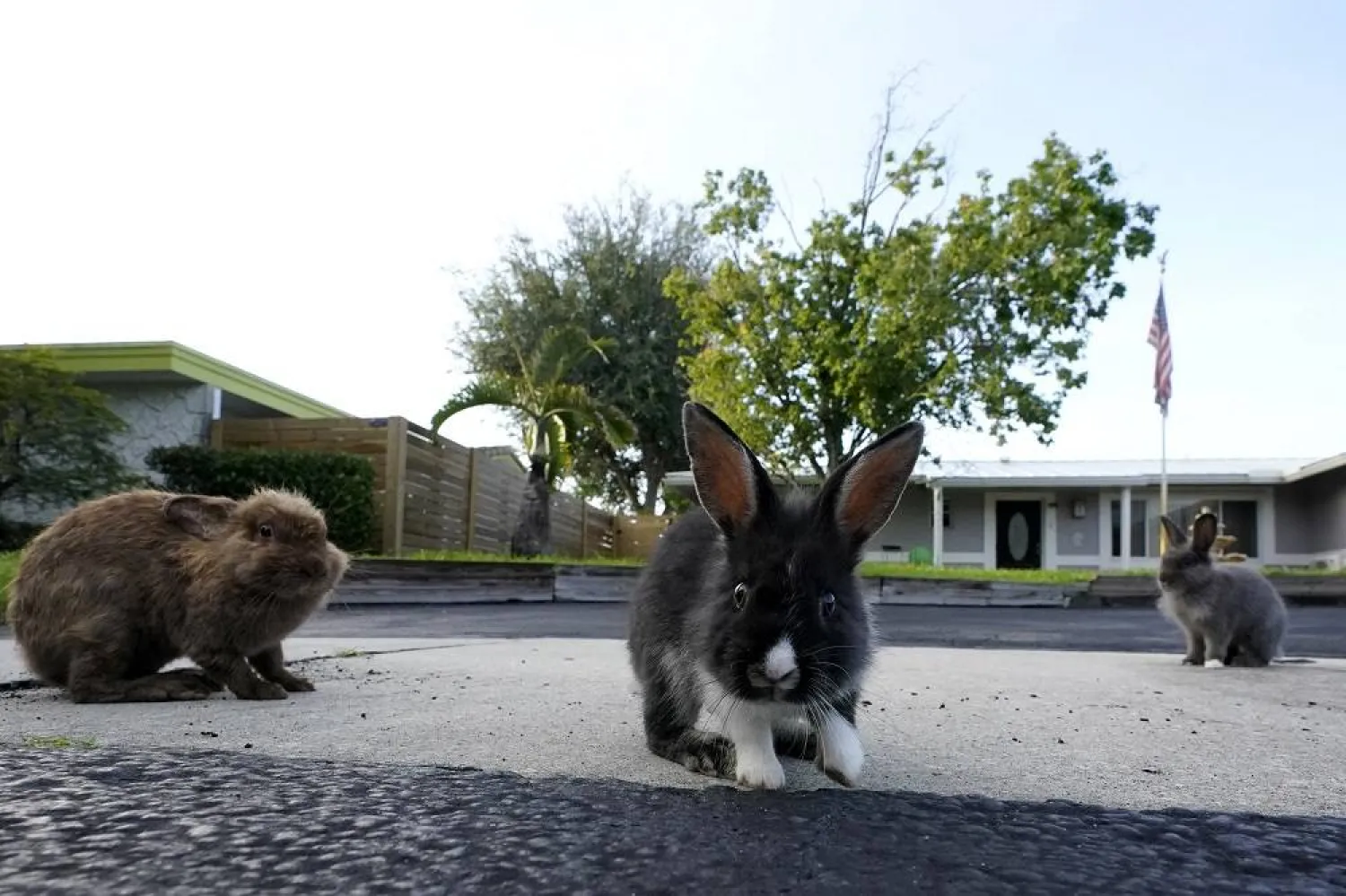
A trio of rabbits gather on a driveway, Tuesday, July 11, 2023, in Wilton Manors, Fla. (AP)
TT

Fuzzy Invasion of Domestic Rabbits Has a Florida Suburb Hopping Into a Hunt for New Owners 

A trio of rabbits gather on a driveway, Tuesday, July 11, 2023, in Wilton Manors, Fla. (AP)

When Alicia Griggs steps outside her suburban Fort Lauderdale home, Florida's latest invasive species comes a-hoppin' down the street: lionhead rabbits.

The bunnies, which sport an impressive flowing mane around their heads, want the food Griggs carries. But she also represents their best chance of survival and moving where this domesticated breed belongs: inside homes, away from cars, cats, hawks, Florida heat and possibly government-hired exterminators.

Griggs is spearheading efforts to raise the $20,000 to $40,000 it would cost for a rescue group to capture, neuter, vaccinate, shelter and then give away the estimated 60 to 100 lionheads now populating Jenada Isles, an 81-home community in Wilton Manors.

They are descendants of a group a backyard breeder illegally let loose when she moved away two years ago.

"They really need to be rescued. So we’ve tried to get the city to do it, but they’re just dragging their feet," Griggs said. "They think that if they do that, then they’ll have to get rid of iguanas and everything else that people don’t want around."

Monica Mitchell, whose East Coast Rabbit Rescue would likely lead the effort, said capturing, treating and finding homes for them "is not an easy process." Few veterinarians treat rabbits and many prospective owners shy away when they find out how much work the animals require. Griggs agreed.

"People don’t realize they’re exotic pets and they’re complicated. They have a complicated digestive system and they have to eat a special diet," said Griggs, a real estate agent. "You can't just throw any table scraps at them."

Wilton Manors is giving Griggs and other supporters time to raise money and relocate the rabbits rather than exterminate them, even though the city commission voted in April to do just that after receiving an $8,000 estimate from a trapping company.

The vote came after some residents complained the lionheads dig holes, chew outdoor wiring and leave droppings on sidewalks and driveways. City commissioners also feared the rabbits could spread into neighboring communities and cities and become a traffic hazard if they ventured onto major streets.

"The safety of this rabbit population is of utmost importance to the City, and any decision to involve ourselves will be certain to see these rabbits placed into the hands of people with a passion to provide the necessary care and love for these rabbits," Police Chief Gary Blocker said in a statement.

The Florida Fish and Wildlife Conservation Commission, which often culls invasive animals, has told the city it will not intercede. The rabbits pose no immediate threat to wildlife.

Lionhead rabbits aren't the only invasive species causing headaches or worse for Floridians. Burmese pythons and lionfish are killing off native species. Giant African snails eat stucco off homes and carry human disease. Iguanas destroy gardens. Like the Wilton Manors lionhead rabbits, those populations all started when people illegally turned them loose.

But unlike those species, Florida's environment is not friendly to lionheads. Instead of the 7 to 9 years they live when properly housed, their lives outdoors are nasty, brutal and shortened.

The lionheads' heavy coat makes them overheat during Florida summers and their lack of fear makes them susceptible to predators. Munching on lawns is not a healthy diet. Their illnesses go untreated. They need owners.

"Domesticated (rabbits) released into the environment are not equipped to thrive on their own," said Eric Stewart, executive director of the American Rabbit Breeders Association. He said the breeder who released them should be prosecuted, a path the city has not pursued.

The Wilton Manors colony survives and grows only because lionheads breed like the rabbits they are, with females birthing litters of two-to-six offspring every month, starting when they are about 3 months old.

On a recent morning in Jenada Isles, clutches of two to 10 bunnies dotted the streets and lawns, the bravest hopping up to residents and visitors in search of treats.

A large group of rabbits gathered on the driveway of Gator Carter, who puts out food for them. He said the lionheads bring the neighborhood joy, and his two young grandchildren love giving them carrots.

"People drive by, stop, love ’em, feed ’em," Carter said. "They don't bother me. We have a couple Airbnbs on the island here and the people (guests) are just amazed that the rabbits come right up to them."

But Jon King said he wants the rabbits gone soon. They dig in his yard and he spent $200 repairing his outdoor lights after they damaged the wiring. He bought rabbit repellent, but that didn't work, and his little dog doesn't scare them: "He's their best friend."

"Every morning, I get up and first thing I do is cover up the holes and chase them out of the backyard. I like them, I just wish they would go somewhere else," King said. "Rescue would be great."




Myrrh Tree that's Key to Luxury Perfumes, African Incomes Threatened by Drought

Stephen Johnson gathers data on a large, healthy Commiphora myrrha tree, the source of myrrh, Saturday, Jan. 10, 2026, in Sanqotor, Ethiopia. (AP Photo/Julianne Gauron)
TT

Myrrh Tree that's Key to Luxury Perfumes, African Incomes Threatened by Drought

Stephen Johnson gathers data on a large, healthy Commiphora myrrha tree, the source of myrrh, Saturday, Jan. 10, 2026, in Sanqotor, Ethiopia. (AP Photo/Julianne Gauron)

The critical note in some of the world’s most well-known perfumes is myrrh, a tree resin from the Horn of Africa that is under pressure from what experts say has been a historic drought.

Threatened by the lack of water and nibbled by starving livestock, the trees that once formed a dense forest in the Somali region of Ethiopia are in danger, locals say.

Earlier this year, researchers supported by the American Herbal Products Association, a trade group, and Born Global, a nonprofit, visited a source of the prized resin that makes its way to global markets from some of the most vulnerable places on earth.

Their goal was to ensure that those who harvest the resin get more of the direct profits instead of middlemen along the opaque supply chain, The Associated Press reported.

Ethiopia is a major source of myrrh, which has been used in beauty, health and religious practices since at least ancient Egypt. Traditional harvesting in the region has not changed, which helps to protect the trees and produces the highest quality resin.

Myrrh’s hand-harvested nature raises its price, but those doing the work see little of the profit. Collecting a kilogram (2.2 pounds) of the resin brings as little as $3.50 and as much as $10.

That’s far from the prices for the perfumes it helps to create, which are marketed by well-known fashion brands like Tom Ford, Comme des Garcons and Jo Malone, and sold at prices as high as $500 a bottle.

Meanwhile, curiosity about myrrh’s other potential uses is growing with increased global interest in natural remedies.

For now, most myrrh from this part of eastern Ethiopia is purchased by traders from neighboring Somalia. Ethiopia collects no taxes on the goods.

Local residents hope more visibility will help them as the climate crisis threatens their ways of life.

“They expressed hope that a direct market would enable them to secure better prices, ensuring sustainable livelihoods,” said Abdinasir Abdikadir Aweys, senior researcher with the Somali Regional Pastoral and Agro-Pastoral Research Institute and a member of the research team.

The researchers were led by Anjanette DeCarlo, an expert in sustainable supply chains and resins at the University of Vermont, and Stephen Johnson, resin expert and owner of FairSource Botanicals. They found that communities practice traditional harvesting by collecting resin from trees’ naturally occurring wounds instead of by making intentional cuts, which makes trees more vulnerable to pests and disease.

“Traditional practice is in balance and protects trees. It should be celebrated,” DeCarlo said.

But the drought worried the team. The annual rains have been failing over the past several years, interrupted in 2023 by devastating flooding.

The arid region has long seen droughts, but this one has been historic. Experts have blamed the changing climate.

Myrrh harvesting is threatened. While adult trees are generally healthy, they are producing less resin. And fewer young trees are surviving.

“Unfortunately, many seedlings are uprooted by children who graze their livestock nearby, and the animals often eat the buds of the young trees,” said a local elder, Mohamed Osman Miyir, adding: “We are deeply worried about the declining population of myrrh trees.”

Without proper rain, other young trees are likely to fail. DeCarlo worried that eventually even the adult trees will die.

Villagers’ days are spent hauling water for themselves and their livestock. Herders travel over the parched, cracked earth as far as 200 kilometers (125 miles) to Sanqotor village, which has a rare well with water.

“Guests water animals first, then the villagers,” said local headman Ali Mohamed, watching hundreds of livestock crowd around the well.

But not everyone has livestock — the poorest residents rely solely on tree resin like myrrh for their survival.


In Europe First, Netherlands to Allow Teslas to Self-Drive

01 September 2025, Brandenburg, Gruenheide: The Tesla logo is seen on a vehicle at the Tesla Gigafactory Berlin-Brandenburg. (dpa)
TT

In Europe First, Netherlands to Allow Teslas to Self-Drive

01 September 2025, Brandenburg, Gruenheide: The Tesla logo is seen on a vehicle at the Tesla Gigafactory Berlin-Brandenburg. (dpa)

In a first for Europe, the Netherlands is poised to allow Tesla owners to use their car's self-driving feature -- as long as they are in the vehicle and keeping a watchful eye over it.

The country's RDW agency for roadworthiness certifications said in a statement late Friday: "Thanks to the type approval, the driver assistance system can now be used in the Netherlands, with possible future expansion to all member states of the European Union."

The move aligns the Netherlands with what is allowed in the United States, where Tesla owners can already use the Full Self-Driving (Supervised) (FSD Supervised) function in the cars.

That mode hands over driving to the Tesla's computer system, including steering, braking, route navigation and parking, all under the active supervision of the driver, who remains at the controls ready to take over if needed.

The European subsidiary of Tesla, the electric-vehicle company run by the world's richest person, Elon Musk, hailed the Netherlands' move.

"FSD Supervised has been approved in the Netherlands & will begin rolling out in the country shortly!" it said on X.

"No other vehicle can do this. We're excited to bring FSD Supervised to more European countries soon."

The Dutch RDW agency stressed the difference between FSD Supervised, with a human remaining at the controls, and full autonomous driving.

"A vehicle with FSD Supervised is not self-driving. It is a driver assistance system, and the driver remains responsible and must always maintain control," it said.

RDW's decision has to go to the European Commission for authorization, so that its national certification has EU weight.

Tesla sales have been facing headwinds in Europe -- including in the Netherlands -- in the last couple of years.

Potential clients have turned off by Musk's political activism supporting hard-right politics in the US and Germany, while the brand is also facing increased competition from Chinese electric vehicle manufacturers.


'A Perfect Mission': Artemis II Astronauts Return to Earth

In this image provided by NASA, the Artemis II crew, counterclockwise from top left, Mission Specialist Christina Koch, Mission Specialist Jeremy Hansen, Commander Reid Wiseman, and Pilot Victor Glover pose with eclipse viewers during a lunar flyby, Monday, April 6, 2026. (NASA via AP)
TT

'A Perfect Mission': Artemis II Astronauts Return to Earth

In this image provided by NASA, the Artemis II crew, counterclockwise from top left, Mission Specialist Christina Koch, Mission Specialist Jeremy Hansen, Commander Reid Wiseman, and Pilot Victor Glover pose with eclipse viewers during a lunar flyby, Monday, April 6, 2026. (NASA via AP)

An elated NASA late Friday was celebrating its successful voyage around the Moon, after four astronauts safely returned to Earth having completed the first lunar flyby in more than 50 years.

The NASA spacecraft carrying four astronauts -- three Americans and one Canadian -- splashed down without a hitch off the California coast, capping the US space agency's crewed test mission that returned with spectacular images of the Moon, said AFP.

"What a journey," said mission commander Reid Wiseman, who reported that the crewmembers -- himself along with Christina Koch, Victor Glover and Jeremy Hansen -- were "stable" and "green."

"They're in great condition, that's what that means," said Rob Navias, the NASA public affairs official who narrated their return on the agency's livestream.

Following an expected but nerve-wracking communications blackout during their high-stakes re-entry, Wiseman's voice triggered relief that the astronauts were well on their way back home.

"We have you loud and clear," he said following a voice check from mission control in Houston.

NASA personnel and the US military helped extract the astronauts from the bobbing capsule -- to the applause of those watching from mission control.

By late Friday, helicopters had lifted the astronauts to a recovery ship off the Pacific coast near San Diego, where they all proved capable of walking unassisted.

NASA administrator Jared Isaacman called the voyage "a perfect mission."

"We're back in the business of sending astronauts to the Moon," he said, and "this is just the beginning."

- 'A great day' -

As the astronauts returned to Earth their spacecraft reached maximum speeds more than 30 times the speed of sound, and faced searing temperatures around half as hot as the surface of the Sun.

It was a key test of their heat shield, which in an earlier trial uncrewed mission had faced complications that they attempted to mitigate this time around by shifting the return trajectory.

"If you didn't have anxiety bringing this spacecraft home, you probably didn't have a pulse," said flight director Rick Henfling.

But the Artemis II re-entry was smooth sailing.

The Orion capsule will now be painstakingly examined to assess how it fared.

US President Donald Trump praised the astronauts for their "spectacular" trip and said he "could not be more proud" -- while wasting no time in looking ahead to the eventual goal of sending missions even further into space.

"Next step, Mars!" he wrote on social media.

Artemis II was the inaugural crewed mission of NASA's program aiming to install a sustained presence on the Moon, including the eventual construction of a base that could be used for further exploration including to Mars.

- 'Fresh confidence' -

From liftoff to splashdown, the trip clocked in at nine days, one hour, 31 minutes and 35 seconds -- though NASA rounds up and calls it a 10-day mission.

It began with a dramatic launch from Florida on April 1, and was studded with firsts, records and extraordinary moments.

The four astronauts become the humans to travel furthest away from the Earth, at 252,756 miles (406,771 kilometers).

While hurtling through deep space and zipping around the Moon they took thousands of photographs, amassing a stunning portfolio of images that captivated people on Earth.

They also witnessed a solar eclipse along with extraordinary meteorite strikes on the lunar surface.

Several achievements added to the voyage's historic nature: Glover was the first person of color to fly around the Moon, Koch was the first woman, and Canadian Hansen the first non-American.

Astronomer Derek Buzasi of the University of Chicago called the mission "an almost flawless success."

"I admit to having had my doubts about the Artemis program, but now I have fresh confidence in our next steps as we go back to the Moon to stay," he told AFP.

- 'Eye on the prize' -

NASA is hoping it can put boots on the lunar surface as soon as 2028 -- the final full year of Trump's second White House term.

Experts, however, have voiced skepticism that the lunar landers being developed by SpaceX and Blue Origin, companies owned by billionaires Elon Musk and Jeff Bezos respectively, will be ready in time.

China, meanwhile, is forging ahead with its own effort targeting 2030 to put astronauts on the Moon.

In the meantime, NASA is hoping to capitalize on the Artemis II mission's success to drum up excitement about space exploration.

Clayton Swope, a space policy expert at of the Center for Strategic and International Studies, told AFP that the mission stands as "proof that when America keeps its eye on the prize, it can still do very great things."