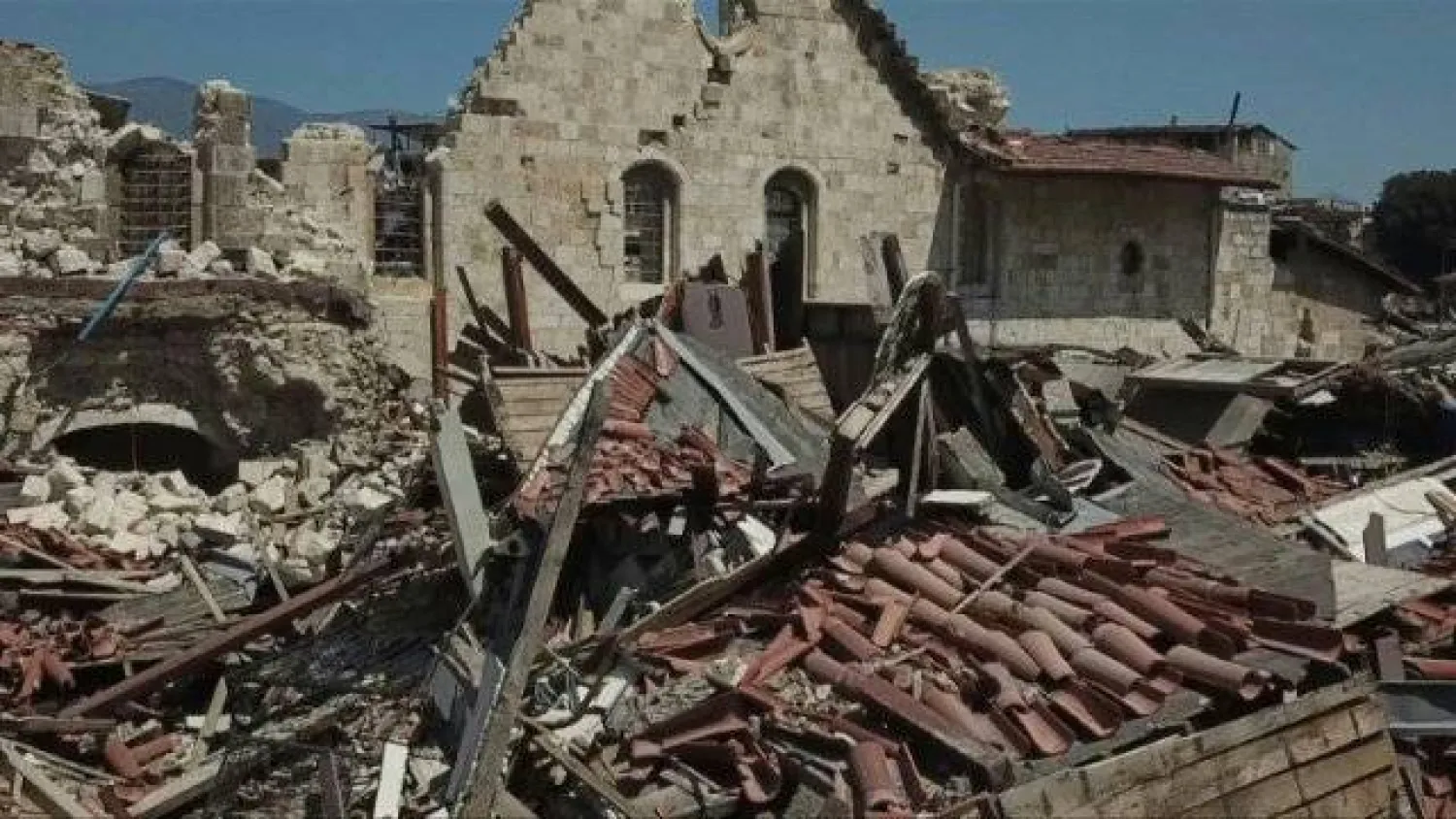
Türkiye Fights to Protect Ancient Antakya's Heritage Ruined by Quake

AFP
AFP
TT

Türkiye Fights to Protect Ancient Antakya's Heritage Ruined by Quake

AFP
AFP

Antakya, a city rich with two millennia of heritage and historical significance, has faced a heartbreaking tragedy since the February 6 earthquake that struck southern Türkiye and Syria.

This cataclysmic event left much of the city's invaluable heritage in ruins.

Conservationists are calling on the Turkish government to do more to preserve what remains of the city's historical sites, AFP reported.

"Antakya has existed for thousands of years. Antakya is very important," said a local told AFP, as many historical buildings now lie in ruins on the site of the ancient city of Antioch.


Everything about Christmas, and How it Has Evolved into a Global Holiday

 People browse products at a Christmas market stall in downtown Madrid, Spain, 18 December 2025 (issued 20 December 2025). People continue to do last-minute shopping ahead of Christmas. EPA/SERGIO PEREZ
People browse products at a Christmas market stall in downtown Madrid, Spain, 18 December 2025 (issued 20 December 2025). People continue to do last-minute shopping ahead of Christmas. EPA/SERGIO PEREZ
TT

Everything about Christmas, and How it Has Evolved into a Global Holiday

 People browse products at a Christmas market stall in downtown Madrid, Spain, 18 December 2025 (issued 20 December 2025). People continue to do last-minute shopping ahead of Christmas. EPA/SERGIO PEREZ
People browse products at a Christmas market stall in downtown Madrid, Spain, 18 December 2025 (issued 20 December 2025). People continue to do last-minute shopping ahead of Christmas. EPA/SERGIO PEREZ

Christmas is a Christian holiday that observes the birth of Jesus. But did you know that the earliest followers of Jesus did not annually commemorate his birth? Or that Santa Claus is inspired by the acts of kindness of a fourth-century Christian saint? And have you heard about the modern-day Japanese tradition of eating Kentucky Fried Chicken on Christmas?

Since the early 20th century, Christmas has evolved from a religious holiday to a hugely popular cultural holiday observed by Christian and secular people across the globe who gather with families, exchange gifts and cards and decorate Christmas trees.

Here’s a look at the history, beliefs and the evolution of Christmas according to the AP news:

Origins and early history of Christmas Early followers of Jesus did not annually commemorate his birth but instead focused on commemorating their belief in his resurrection at Easter.

The story of the birth of Jesus appears only in two of the four Gospels of the New Testament: Matthew and Luke. They provide different details, though both say Jesus was born in Bethlehem.

The exact day, month and even year of Jesus’s birth are unknown, said Christine Shepardson, a professor at the University of Tennessee who studies early Christianity.

The tradition of celebrating Jesus’ birth on Dec. 25, she said, only emerged in the fourth century.

“It’s hard to overemphasize how important the fourth century is for constructing Christianity as we experience it in our world today,” Shepardson said. It was then, under Emperor Constantine, that Christians began the practice of gathering at churches instead of meeting at homes.

Some theories say the date coincides with existing pagan winter solstice festivals, including the Roman celebration of Sol Invictus, or the “Unconquered Sun,” on Dec 25.

While most Christians celebrate Christmas on Dec. 25, some Eastern Orthodox traditions celebrate the holy day on Jan. 7. That’s because they follow the ancient Julian calendar, which runs 13 days behind the Gregorian calendar, used by Catholic and Protestant churches as well as by much of the secular world.
For centuries, especially during the Middle Ages, Christmas was associated with rowdy street celebrations of feasting and drinking, and for many Christians, it “was not in good standing as a holiday,” said Thomas Ruys Smith, a professor of American literature and culture at the University of East Anglia in England.

“Puritans,” he said, “were not fond of Christmas.”

But in the 19th century, he said, Christmas became “respectable” with “the domestic celebration that we understand today — one centered around the home, the family, children, gift-giving.”

The roots of modern-day Christmas can be traced back to Germany. In the late 19th century, there are accounts of Christmas trees and gift-giving that, according to Smith, later spread to Britain and America, helping to revitalize Christmas on both sides of the Atlantic.

Christmas became further popularized with the publication of “A Christmas Carol” by Charles Dickens in 1843, and the writings of Washington Irving, who was a fan of St. Nicholas and helped popularize the celebration of Christmas in America.

The first Rockefeller Center Christmas tree was put up by workers in 1931 to raise spirits during the Great Depression. The tradition stuck as the first tree-lighting ceremony was held in 1933 and remains one of New York City’s most popular holiday attractions.

America’s secular Santa is inspired by a Christian saint St. Nicholas was a fourth-century Christian bishop from the Mediterranean port city of Myra (in modern-day Türkiye). His acts of generosity inspired the secular Santa Claus legend.

The legends surrounding jolly old St. Nicholas — celebrated annually on Dec. 6 — go way beyond delivering candy and toys to children. He is believed to have interceded on behalf of wrongly condemned prisoners and miraculously saved sailors from storms.

Devotion to St. Nicholas spread during the Middle Ages across Europe and he became a favorite subject for medieval artists and liturgical plays. He is the patron saint of sailors and children, as well as of Greece, Russia and New York.

Devotion to St. Nicholas seems to have faded after the 16th century Protestant Reformation, except in the Netherlands, where his legend remained as Sinterklaas. In the 17th century, Dutch Protestants who settled in New York brought the Sinterklaas tradition with them.

Eventually, St. Nicholas morphed into the secular Santa Claus.

It’s not just Santa who delivers the gifts In the UK, it’s Father Christmas; in Greece and Cyprus, St. Basil (who arrives on New Year’s Eve). In some parts of Italy, it’s St. Lucy (earlier in December) and in other Italian regions, Befana, a witch-like figure, who brings presents on the Epiphany on Jan. 6.

Instead of a friendly Santa Claus, children in Iceland enjoy favors from 13 mischievous troll brothers, called the Yule Lads. They come down from their mountain cave 13 days before Christmas, according to folklore.

One of the oldest traditions around Christmas is bringing greenery — holly, ivy or evergreen trees — into homes. But determining whether it’s a Christian tradition is harder. “For many people, the evergreen can symbolize Christ’s promise of eternal life and his return from death,” Smith said. “So, you can interpret that evergreen tradition within the Christian concept.”

The decorating of evergreen trees is a German custom that began in the 16th century, said Maria Kennedy, a professor at Rutgers University—New Brunswick’s  Department of American Studies. It was later popularized in England and America.

“Mistletoe, an evergreen shrub, was used in celebrations dating back to the ancient Druids — Celtic religious leaders — some 2,000 years ago,” Kennedy writes in The Surprising History of Christmas Traditions.

“Mistletoe represented immortality because it continued to grow in the darkest time of the year and bore white berries when everything else had died.”

Other traditions include Christmas services and Nativity scenes at homes and churches. More recently, Nativity scenes — when erected on public property in the US — have triggered legal battles over the question of the separation of church and state.

Christmas caroling, Kennedy writes, can also be traced back to European traditions, where people would go from home to home during the darkest time of the year to renew relationships within their communities and give wishes for good luck, health and wealth for the forthcoming year.

“They would recite poetry, sing and sometimes perform a skit. The idea was that these acts would bring about good fortune to influence a future harvest,” Kennedy writes.

Kentucky Fried Chicken for Christmas in Japan Among the many Christmas traditions that have been adopted and localized globally, there’s one that involves KFC.

In 1974, KFC launched a Christmas campaign where they began to sell fried chicken with a bottle of wine so it could be used for a Christmas party.

KFC says the idea for the campaign came from an employee who overheard a foreign customer at one of its Tokyo restaurants saying that since he couldn’t get turkey in Japan, he’d have to celebrate Christmas with Kentucky Fried Chicken.

“That really stuck,” Smith said. “And still today, you have to order your KFC months in advance to make sure that you’re going to get it at Christmas Day.”


NORAD Continues Decades-long Tradition of Tracking Santa's Trip around the World

Christmas trees are displayed inside a hangar at Peterson Space Force Base in Colorado Springs, Colo., on Thursday, Dec. 18, 2025 in advance of the annual NORAD Tracks Santa Operation, at the North American Aerospace Defense Command. (AP Photo/Thomas Peipert)
TT

NORAD Continues Decades-long Tradition of Tracking Santa's Trip around the World

Christmas trees are displayed inside a hangar at Peterson Space Force Base in Colorado Springs, Colo., on Thursday, Dec. 18, 2025 in advance of the annual NORAD Tracks Santa Operation, at the North American Aerospace Defense Command. (AP Photo/Thomas Peipert)

Sometimes kids drop the phone after hearing Santa won't show up if they're not asleep. Others who call the NORAD Tracks Santa hotline wonder if St. Nick will be able to find them.

Adults who also remain devoted to the jolly figure said to deliver presents around the world are checking up on his journey. For 70 years, that's been the tradition at the North American Aerospace Defense Command — a joint United States and Canadian operation charged with monitoring the skies for threats since the Cold War, The AP news reported.

More than 1,000 volunteers will be taking calls to 1-877-HI-NORAD on Christmas Eve from 4 a.m. to midnight Mountain Standard Time. For the first time this year, Santa seekers can place a call through the program's website, which organizers say will be easier for people outside North America.

The website allows people to follow Santa’s journey in nine languages, including English and Japanese.

Last year, about 380,000 calls came into a hangar festooned with Christmas decorations at Peterson Space Force Base in Colorado Springs — the home of NORAD.

While Santa is no threat, the same combination of radar, satellites and jets that help NORAD carry out its mission throughout the year make it capable of tracking the progress of Santa starting from the international date line over the Pacific Ocean, said Col. Kelly Frushour, a NORAD spokesperson.

Rudolph's nose gives off a heat signature similar to a missile that is picked up by NORAD's satellites, she said.

‘Faster than starlight’ Last year, Frushour said one girl was upset after hearing Santa was on his way to the International Space Station, where two astronauts were stranded.

“Thankfully, by the time the call was over, Santa Claus had moved on to another destination and the child was reassured that Santa was not trapped in space and was going to make it to her house later that evening,” Frushour said.

A special needs man named Henry who calls every year once asked if the jet pilot escorting Santa through North America could put a note in the plane letting Santa know he was in bed and ready for him to come, said Michelle Martin, a NORAD staffer and Marine veteran.

She said she explained that Santa travels “faster than starlight.”

"I don’t know that our pilot can catch up with him fast enough. He just waves and he goes,” she recalled saying.

A tradition started by mistake The tradition started in 1955 when NORAD’s predecessor, the Continental Air Defense Command, was on the lookout for any sign of a possible nuclear attack from the then-Soviet Union. NORAD says a child mistakenly called the combat operations center and asked to speak to Santa Claus. The commander on duty, Air Force Col. Harry Shoup didn't want to disappoint the child, so he ordered staffers to start tracking Santa and take calls from children.

The story goes that the first phone call was either the result of a misprint or a misdial of a number included in a Sears advertisement in the Colorado Springs newspaper encouraging children to call Santa.

The legend developed into the first call coming into a dedicated hotline that connected the command with a general in case of an attack. In 2015, The Atlantic magazine doubted the flood of calls to the secret line, saying a call to a public phone line was more probable and noting that Shoup had a flair for public relations.

In a 1999 interview with The Associated Press, Shoup recalled playing along once he figured out what was happening, telling the first caller, “Ho, ho, ho, I am Santa.”

“The crew was looking at me like I had lost it," he recalled.

He said he told his staff what was happening and told them to play along, too.

It’s not clear what day the first call came in, but by Dec. 23 of that first year, The Associated Press reported that CONAD was tracking Santa.

CONAD soon became North American Aerospace Defense Command. It used to operate inside nearby Cheyenne Mountain. A network of tunnels had been blasted out of the mountain's hard granite so NORAD officers could survive a nuclear attack.


British Baker’s Criticism of Mexican ‘Ugly’ Bread Triggers Social Media Outrage

Bolillos, a traditional Mexican bread, sit for sale at a street stand in Mexico City, Thursday, Dec. 18, 2025. (AP Photo/Marco Ugarte)
TT

British Baker’s Criticism of Mexican ‘Ugly’ Bread Triggers Social Media Outrage

Bolillos, a traditional Mexican bread, sit for sale at a street stand in Mexico City, Thursday, Dec. 18, 2025. (AP Photo/Marco Ugarte)

A blunt critique of Mexican bread by a British baker sparked a cascade of social media outrage, ultimately leading to a public apology.

In an interview for a food-themed podcast that resurfaced online, Richard Hart, the co-founder of Green Rhino bakery in Mexico City and a well-known figure in international baking circles, said Mexicans “don’t really have much of a bread culture,” adding that “they make sandwiches on these white, ugly rolls that are pretty cheap and industrially made.”

His comments quickly rippled across Instagram, TikTok and X, with many Mexicans accusing him of being dismissive and insulting of Mexico’s traditional breads.

What began as a dispute over bread soon ignited a national debate over food identity — not only over who defines Mexican culinary traditions, but also over the growing influence of foreigners in a capital already tense from a surge of US expatriates and tourists, according to AP.

Social media was soon flooded with memes, reaction videos, and passionate defenses of Mexican bread.

Users took to social media to praise everyday staples — from the crusty bolillos used for tortas to the iconic conchas found in neighborhood bakeries.

In many cases, these simple street foods act as a uniting factor across social groups and classes, and often cut to the core of the country’s cultural identity.

While wheat bread was introduced to Mexico during the colonial period, the classic food staple evolved into a distinct national tradition, blending European techniques with local tastes and ingredients. Today, small neighborhood bakeries remain central to daily life in cities and towns, serving as social hubs as well as food sources.

The incident prompted many to question why a foreign entrepreneur would publicly disparage a staple so deeply embedded in Mexican life. For many, Hart’s remarks echoed long-standing frustrations over foreign chefs and restaurateurs receiving disproportionate prestige, as well as concerns over gentrification in the capital.

“Don’t mess with the bolillo,” warned one viral post on X.

As criticism mounted, Hart issued a public apology on Instagram, saying his comments were poorly phrased and did not show respect for Mexico and its people. He acknowledged the emotional response and said he didn’t behave as a “guest.”

“I made a mistake,” Hart said in his statement. “I regret it deeply.”