Heat, Wildfires Put Southern Europe's Vital Tourism Earnings at Risk

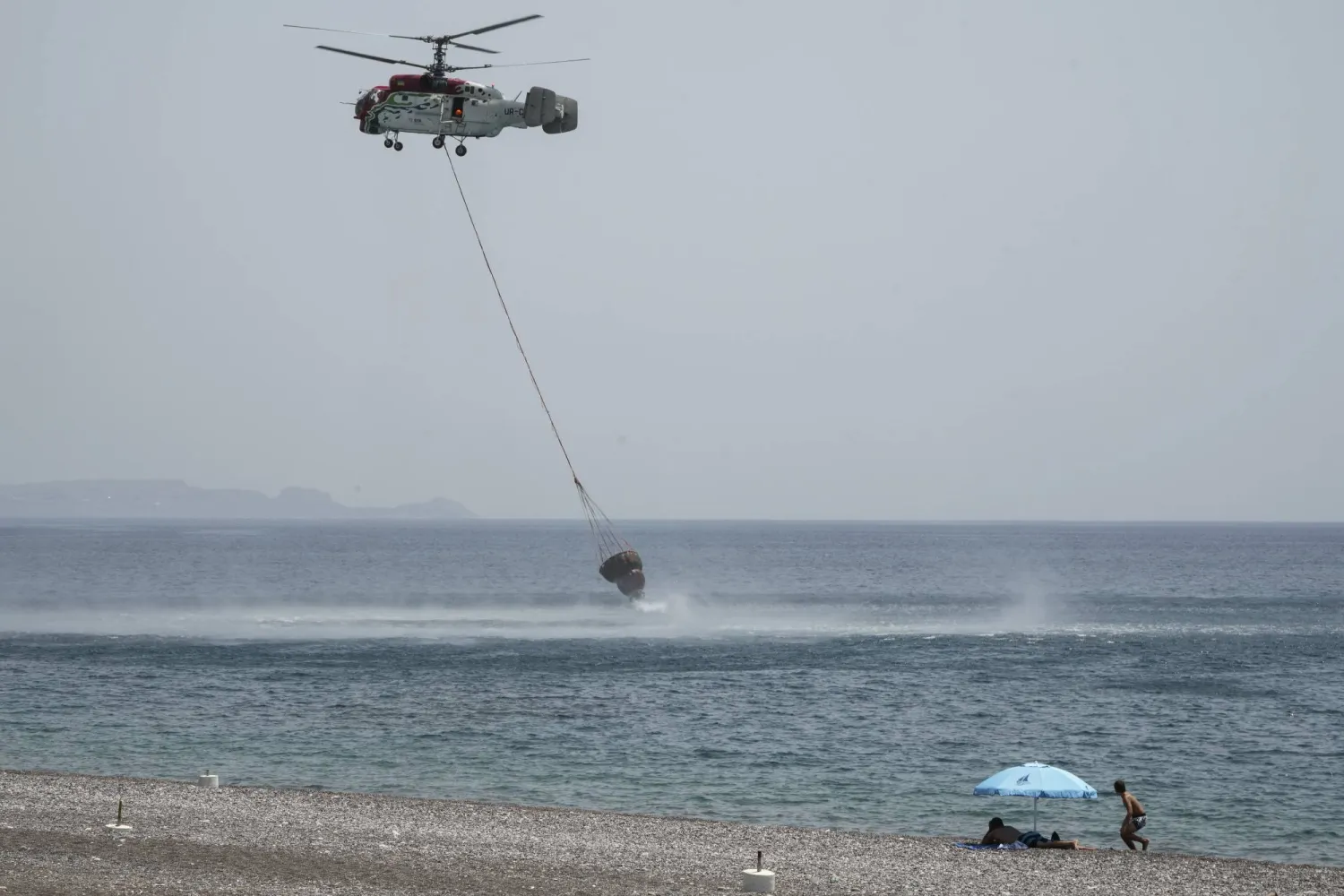
FILE - Beachgoers watch a helicopter filling water from the sea during a wildfire, near Gennadi village, on the Aegean Sea island of Rhodes, southeastern Greece, on July 27, 2023. (AP Photo/Petros Giannakouris, File)
TT

Heat, Wildfires Put Southern Europe's Vital Tourism Earnings at Risk

FILE - Beachgoers watch a helicopter filling water from the sea during a wildfire, near Gennadi village, on the Aegean Sea island of Rhodes, southeastern Greece, on July 27, 2023. (AP Photo/Petros Giannakouris, File)

Tourists at a seaside hotel on the Greek island of Rhodes snatched up pails of pool water and damp towels as flames approached, rushing to help staffers and locals extinguish one of the wildfires threatening Mediterranean locales during recent heat waves.
The quick team effort meant that “by the time the fire brigade came, most of the fire actually was dealt with,” said Elena Korosteleva from Britain, who was vacationing at the Lindos Memories hotel.
The next morning, some unsettled guests cut their holiday short — but most stayed on as the resort wasn't damaged in the small brush fire outside its grounds.
The Greek island known for sparkling beaches and ancient sites is nursing its wounds after 11 days of devastating wildfires in July. After thousands of people were evacuated during the height of travel season, Rhodes is weighing how the crisis will affect its vital tourism sector, which fuels most of its economy and some 20% of Greece's.
It’s the same for other Mediterranean destinations, like Italy and Spain, where the tourism sector also is being hit by heat waves and wildfires. Greece, Italy, Algeria and Tunisia combined lost more than 1,350 square kilometers (520 square miles) to blazes that affected 120,000 people in late July, according to European Union estimates. And Greece is expecting even more extreme heat in the coming days.
According to The Associated Press, the mayor of Villardeciervos village, in part of northwestern Spain ravaged by fires last summer, said hikers are still coming.
“Tourism is bound to suffer a bit in the next few years, (whether) we like it or not,” Rosa María López said. “On the hiking trails, there are no trees, and it is very sad to see. ... But this area is still highly valued by tourists in spite of everything. We will have to adapt.”
Fires have chased away tourists in hard-hit parts of Greece and Italy. Rhodes saw mass cancellations of flights and the trend is similar in Sicily, said Olivier Ponti, vice president of insights at ForwardKeys, a travel data company with access to airline industry ticketing data.
While travel to Greece overall has not been hit too hard, Italy isn't as lucky. Wildfires “have caused a slowdown in bookings for many Italian destinations, even places not close to the fires,” he said, noting a drop for Rome in the last week of July.
Even without the flames, summer heat intensified by climate change can be a turnoff for travelers.
Hoteliers are worried in southeastern Spain’s coastal resort city of Benidorm, a longtime favorite for British and Scandinavian tourists.
“If heat waves were to be repeated every summer, the impact on our economy would be significant,” said Antonio Mayor, chair of the hotel and tourism association in the Valencia region, which includes Benidorm. “Our activity is centered on the three summer months.”
That could mean tourists head north to Scandinavian countries or the United Kingdom instead.
“Record-setting temperatures in European countries such as Greece, Italy and Spain are not scheduled to ease up as we enter August, so it might be considered a much safer option to opt for a stay in northern Europe,” said Tim Hentschel, CEO of digital booking platform HotelPlanner.
The World Meteorological Organization and the EU's Copernicus Climate Change Service calculated July to be the hottest month on record. Heat records foreshadow changes ahead as the planet warms, scientists say, including more flooding, longer-burning wildfires and extreme weather events that put people at risk.
With that in mind, U.S.-based climate technology startup Sensible Weather is developing insurance that would compensate people if extreme heat wrecks their holiday.
It's rolled out “weather guarantee” coverage to travel companies in the U.K., France and the U.S., which pays travelers if prolonged rain ruins their beach break or there’s no snow for a ski trip.
Sensible Weather will soon add a heat cover option “in anticipation of next summer,” founder Nick Cavanaugh said. “People are asking me about it more because they’re thinking about these things more.”
While people differ on how hot is too hot, “in the simplest version, if it was 42 degrees Celsius (107.6 Fahrenheit) for three hours in the middle of the day and you couldn’t go out and do an activity, we could give you some money back,” he said.
Rhodes had expected foreign arrivals to increase 8%-10% over a bumper year in 2022, when about 2.6 million people flew in to the Greek island, mostly from Britain and Germany. But after the fires, flight cancellations in the last week of July exceeded all bookings made in the equivalent week in 2019, said Ponti of ForwardKeys.
Manolis Markopoulos, head of the Rhodes hotel association, is optimistic that rebounding arrivals to parts of the island not damaged by flames can salvage much of the projected boost in tourism.
“Every day we're seeing more business,” he said. “By Aug. 8-10, I think we'll be back to our normal pace at all these resorts," which account for about 90% of the island's 220,000 beds.
In damaged areas, “some brave tour operators have already decided to bring customers from this coming weekend," Markopoulos said. “These areas have a longer road before they return to normality — but they're not even 10% of the (island's) total capacity.”
New bookings for future travel to Rhodes did take a hit, falling 76% the week of July 17, when the fires began, over the previous week. For Greece as a whole, they slumped 10%, Ponti said.
While some major British operators briefly canceled all Rhodes flights and holidays — offering refunds to people who’d booked for fire-hit areas — other budget airlines kept offering seats and reported normal travel figures, HotelPlanner’s Hentschel said.
In Germany, leading travel operator TUI is again offering vacations to all parts of Rhodes after it stopped flying tourists in.
“We would do more damage to the people of Rhodes if no more tourists came now after the forest fires,” TUI CEO Sebastian Ebel told Germany's dpa news agency.
Greek Prime Minister Kyriakos Mitsotakis offered an additional incentive, appearing on ITV’s “Good Morning Britain” this week to promise people whose Rhodes vacations were spoiled by the fires a free week on the island next spring or fall.
Korosteleva, the Rhodes vacationer, said the blazes should motivate action against climate change.
“It makes people aware what we’ve caused to the planet, that this change may not be reversible. So it’s not just about tourism,” said Korosteleva, who heads the University of Warwick’s Institute of Global Sustainable Development. “I think it actually clearly touches upon how we need to start acting now.”



Abandoned Baby Monkey Finds Comfort in Stuffed Orangutan

A baby Japanese macaque named Punch sits next to a stuffed orangutan at Ichikawa City Zoo, in Ichikawa, Chiba Prefecture, Japan, February 19, 2026. REUTERS/Kim Kyung-Hoon
TT

Abandoned Baby Monkey Finds Comfort in Stuffed Orangutan

A baby Japanese macaque named Punch sits next to a stuffed orangutan at Ichikawa City Zoo, in Ichikawa, Chiba Prefecture, Japan, February 19, 2026. REUTERS/Kim Kyung-Hoon

At a zoo outside Tokyo, the monkey enclosure has become a must-see attraction thanks to an inseparable pair: Punch, a baby Japanese macaque, and his stuffed orangutan companion.

Punch's mother abandoned the macaque when he was born seven months ago at the Ichikawa City Zoo and when an onlooker noticed and alerted zookeepers, they swung into action.

Japanese baby macaques typically cling to their mothers to build muscle strength and for a ‌sense of security, ‌so Punch needed a swift intervention, zookeeper ‌Kosuke ⁠Shikano said. The keepers ⁠experimented with substitutes including rolled-up towels and other stuffed animals before settling on the orange, bug-eyed orangutan, sold by Swedish furniture brand IKEA.

“This stuffed animal has relatively long hair and several easy places to hold," Shikano said. "We thought that its resemblance to a monkey might help ⁠Punch integrate back into the troop later ‌on, and that’s why ‌we chose it."

Punch has rarely been seen without it since, ‌dragging the cuddly toy everywhere even though it is ‌bigger than him, and delighting fans who have flocked to the zoo since videos of the two went viral, Reuters reported.

“Seeing Punch on social media, abandoned by his parents but still trying ‌so hard, really moved me," said 26-year-old nurse Miyu Igarashi. "So when I got the ⁠chance to ⁠meet up with a friend today, I suggested we go see Punch together.”

Shikano thinks Punch's mother abandoned him because of the extreme heat in July when she gave birth.

Punch has had some differences with the other monkeys as he has tried to communicate with them, but zookeepers say that is part of the learning process and he is steadily integrating with the troop.

"I think there will come a day when he no longer needs his stuffed toy," Shikano said.


Trump Says he’s Ordering Release of Data on UFOs, Aliens

US President Donald Trump speaks aboard Air Force One (AP)
TT

Trump Says he’s Ordering Release of Data on UFOs, Aliens

US President Donald Trump speaks aboard Air Force One (AP)

US President Donald Trump said on Thursday he is ordering federal agencies to begin “identifying and releasing” government files related to UFOs and aliens, a move sought for decades by some Americans.

“Based on the tremendous interest shown, I will be directing the Secretary of War, and other relevant Departments and Agencies, to begin the process of identifying and releasing Government files related to alien and extraterrestrial life, unidentified aerial phenomena (UAP), and unidentified flying objects (UFOs),” Trump posted on his Truth Social platform.

Trump claimed earlier Thursday that his predecessor, former President Barack Obama, made classified information public when he confirmed the existence of extraterrestrial life.

“He gave classified information. He's not supposed to be doing that,” he told reporters on Air Force One. “He made a big mistake.”

During an ⁠interview with podcast host Brian Tyler Cohen released ‌on Saturday, Obama was asked if aliens were real.

“They're real, but I haven't seen them, and they're not being kept in ... Area 51. There's no underground facility unless there's this enormous conspiracy and they hid it from the president of the United States,” Obama said.

Area ⁠51 is a classified Air Force facility in Nevada that fringe theorists have speculated holds alien bodies and a crashed spaceship. CIA archives released in 2013 said it was a test site for top-secret spy planes.

“I saw no evidence during my presidency that extraterrestrials have made contact with us. Really!” Obama said in an Instagram post on Sunday.

In the post, Obama explained his belief that aliens exist by saying the statistical odds of life beyond Earth were high because the universe is so ⁠vast. He added that the chances of extraterrestrial life visiting Earth were low given the distance.

Following his comments ⁠on Obama, Trump added that he had not seen evidence that aliens exist, saying, “I don't know ⁠if they're ⁠real or not.”


Fossils of New Species of Huge Dinosaur Unearthed in Niger

Paleontologist Paul Sereno poses in his Fossil Lab at the University of Chicago with a reconstructed skull of the dinosaur Spinosaurus mirabilis. The photograph was released by the University of Chicago on February 19, 2026. Keith Ladzinski/Handout via REUTERS
TT

Fossils of New Species of Huge Dinosaur Unearthed in Niger

Paleontologist Paul Sereno poses in his Fossil Lab at the University of Chicago with a reconstructed skull of the dinosaur Spinosaurus mirabilis. The photograph was released by the University of Chicago on February 19, 2026. Keith Ladzinski/Handout via REUTERS

At a remote and barren Sahara desert site in Niger, scientists have unearthed fossils of a new species of Spinosaurus, among the biggest of the meat-eating dinosaurs, notable for its large blade-shaped head crest and jaws bearing interlocking teeth for snaring slippery fish.

It prowled a forested inland environment and strode into rivers to catch sizable fish like a modern-day wading bird - a "hell heron," as one of the researchers put it, considering it was about 40 feet (12 meters) long and weighed 5-7 tons.

The dinosaur presented a striking profile on the Cretaceous Period landscape of Africa some 95 million years ago as it hunted large fish like coelacanths in the region's waterways. Its bony cranial crest, about 20 inches (50 cm) tall, resembled a curved sword called a scimitar, and it had a large sail-like structure on its back and an elongated crocodile-like snout.

Along with the existing genus name Spinosaurus, meaning "spine lizard," the researchers gave it the species name mirabilis, meaning "astonishing," referring to ‌its crest. A genus ‌is a group of closely related species bearing similar traits. For example, lions and tigers ‌are ⁠the same genus ⁠but different species.

It is only the second known species of Spinosaurus, a dinosaur that has gained fame in popular culture for its depiction in the "Jurassic Park" movies. The other one, Spinosaurus aegyptiacus, was named in 1915 based on fossils from Egypt.

Spinosaurus, the only known semiaquatic dinosaur predator, joins Tyrannosaurus, Giganotosaurus and Carcharodontosaurus among the largest meat-eating dinosaurs.

The two Spinosaurus species, which were contemporaneous, shared the same general body plan including long dorsal spines forming the sail-like structure and a skull adapted for hunting fish. The crest of Spinosaurus mirabilis is much larger compared to Spinosaurus aegyptiacus, and it has a more elongated snout, teeth more spread out from each other and longer hind limbs.

The researchers said its crest likely ⁠was for display, since it appears too fragile to have been used as a weapon, ‌even though it was solid bone without the air sacs present in some other ‌dinosaur crests. The crest, probably sheathed in keratin like a bull's horns, may have been vividly colored and instrumental in sexual or territorial competition ‌or recognition between individuals.

"It's about love and life - attracting a mate, defending your hot feeding shallows," said University of Chicago paleontologist Paul ‌Sereno, lead author of the research published on Thursday in the journal Science. "What else could be more important?"

The retracted location of its nostrils, farther back than usual, let it submerge most of its snout under water to stalk swimming prey for as long as necessary while breathing normally. In addition, its upper and lower rows of teeth fit neatly together during a bite, called interdigitation.

"Their large conical teeth without serrations that interdigitate form a 'fish trap' ‌that is very good at piercing and trapping slippery fish in the jaws, preventing them from sliding," said paleontologist and study co-author Daniel Vidal of the University of Chicago and Universidad ⁠Nacional de Educación a Distancia in ⁠Spain.

"Spinosaurus mirabilis has some of the most extreme piscivorous adaptations of any dinosaur, so we know it was better at preying upon fish than it would have been at preying upon other dinosaurs," Reuters quoted Vidal as saying.

Fossils of Spinosaurus aegyptiacus come from sites in Egypt and Morocco near the Cretaceous coastline of the Tethys Sea, predecessor to today's Mediterranean Sea and Indian Ocean. That fact, plus certain skeletal traits, led some scientists to hypothesize Spinosaurus was fully aquatic, an open-water swimmer and diving pursuit predator in a marine setting.

But the Spinosaurus mirabilis fossils were found far inland, roughly 300-600 miles (500-1,000 km) from the nearest ocean shoreline. That fact, coupled with aspects of the animal's anatomy, instead point to Spinosaurus as a shallow-water predator and not fully aquatic, the researchers said.

Sereno called the Spinosaurus mirabilis discovery "the coup de grâce for the aquatic hypothesis."

Jenguebi, where the fossils were discovered, is a remote Sahara locality, with fossil-rich sandstone outcrops surrounded by sand dunes. For their 2022 expedition, the researchers set out from the city of Agadez in a convoy and drove off-road through desert terrain for almost three days, often getting stuck in the sand.

The journey paid off, as they discovered parts of three Spinosaurus mirabilis skulls and other bones, along with fossils of other creatures.

Long overshadowed in the public imagination by T. rex, Spinosaurus is now having its time in the spotlight.

"It's a dino-happening," Sereno said.