


Acai Berry Craze: Boon or Threat for the Amazon?

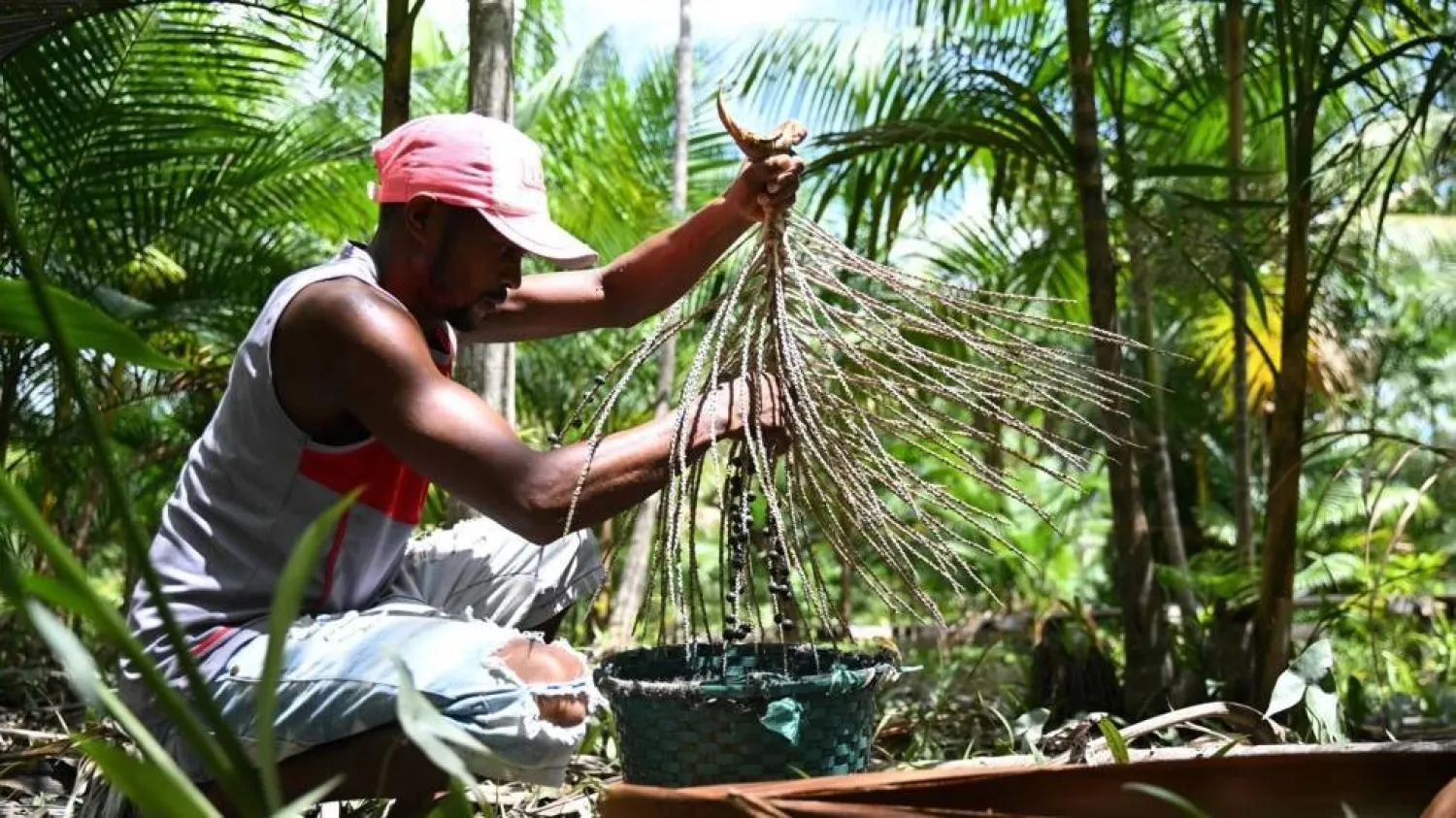
Farmer Jose Santos Diogo harvests berries from an acai palm tree at his plantation in Abaetetuba, Para State. Evaristo SA / AFP
TT

Acai Berry Craze: Boon or Threat for the Amazon?

Farmer Jose Santos Diogo harvests berries from an acai palm tree at his plantation in Abaetetuba, Para State. Evaristo SA / AFP

Working in the sweltering heat of the Brazilian Amazon, Jose Diogo scales a tree and harvests a cluster of black berries: acai, the trendy "superfood" reshaping the world's biggest rainforest -- for better and worse.

Diogo, 41, who lives in a poor, remote community founded by escaped slaves, is a world away from the upscale supermarket aisles of New York or Tokyo, where berries like these are sold in sorbets, smoothies, juices, powders and pills, popularized by the likes of Gwyneth Paltrow and Meghan Markle.

But he has a front-row view of the changes the acai craze is bringing to the Brazilian Amazon, AFP said.

Since acai rose to international fame in the 2000s, touted for its rich nutritional and antioxidant properties, it has unleashed an economic boom for traditional farmers in the Amazon region, and been lauded as a way to bring "green development" to the rainforest without destroying it.

But experts say it is also threatening the Amazon's biodiversity, as single-crop fields of acai palms become increasingly common.

Diogo, who lives in the village of Igarape Sao Joao, in the northern state of Para, is building himself a brick house thanks to the money he has made from acai.

"Things get a lot better for us every harvest season," he says, scraping the small berries into a large basket.

He can fill 25 such baskets on a good day, bringing home between 300 and 625 reais ($60 to $128), he says.

The berries are brought by boat to Belem, the state capital, where sweating workers carry huge loads of them to market to be sold as quickly as possible, before the fragile fruit goes bad.

'Acai-ification' of the Amazon
Long eaten by Indigenous groups, acai is a culinary mainstay in northeastern Brazil, eaten with manioc flour or used to accompany fish and other dishes.

Its deep-purple pulp shot to popularity across Brazil over the past two decades, often drunk as juice or made into a sweetened sorbet and served with fruit and granola.

From there, acai went on to win fans worldwide, from the United States to Europe, Australia and Japan, where it can sell from around $5 per bowl to upwards of $20 for a 100-gram packet of organic acai powder.

Brazilian exports of acai and its derivatives surged from 60 kilograms in 1999 to more than 15,000 tonnes in 2021.

Para, the source of 90 percent of Brazil's acai, produced almost 1.4 million tonnes of it in 2021, worth more than $1 billion for the state's economy.

But studies show the expansion of acai palms in the Amazon is causing a loss of biodiversity in some regions by replacing other species.

"Leave nature to its own devices, and you get 50 or maybe 100 acai plants per hectare," says biologist Madson Freitas of the Museu Goeldi research institute in Belem.

"When you go beyond 200, you lose 60 percent of the diversity of other native species."

He has published a study on the phenomenon, which he calls "acai-ification."

The loss of other plant species in turn has a negative effect on acai, which becomes less productive because of a loss of pollinators such as bees, ants and wasps, he says.

Longer dry periods in the Amazon, which may be exacerbated by climate change, are also hurting acai, which tends to grow on land that floods during the rainy season.

'Environmental service'
Freitas, like Diogo, comes from a "quilombo," communities founded by runaway slaves in Brazil in the 17th and 18th centuries.

He says stronger conservation laws and policing are needed to combat single-crop farming -- as well as incentives for farmers to preserve the rainforest.

Salomao Santos, a local leader in Igarape Sao Joao, admits acai's dominance could become a problem.

"Those of us who live in the Amazon know we can't live on one single species," he says.

He recalls the commodity booms and busts of the past, such as sugar cane and rubber.

He wants compensation for quilombo residents and others who preserve the Amazon, whose hundreds of billions of carbon-absorbing trees are a vital resource against climate change.

"We provide a huge environmental service to the world," he says.



Three Million Pounds to Save Polar Explorer Shackleton's Villa

A person taking a photo of Ernest Shackleton's grave, polar explorer, who died after a heart attach in 1922 (Shutterstock)
TT

Three Million Pounds to Save Polar Explorer Shackleton's Villa

A person taking a photo of Ernest Shackleton's grave, polar explorer, who died after a heart attach in 1922 (Shutterstock)

Work is under way on a South Atlantic island to preserve a key building in the story of polar explorer Ernest Shackleton.

Shackleton famosly reached the whaling station of Stromness on South Georgia in 1916 after spending 18 months stranded on Antarctica with his crew.

The now-dilapidated Stromness Manager's Villa was used as a base by Shackleton while he orchestrated the rescue of his men.

The Dundee-based South Georgia Heritage Trust have been working to stabilize the structure, with plans to create a digital “twin” of the building for people around the world to see it.

A 2022 survey found the building was very close to collapse.

Alison Neil, chief executive of the South Georgia Heritage Trust, said: “The reason for that is rotting timbers. This is an old-fashioned version of a flat-pack house. They would've been brought down from Norway on ships and then assembled on the island.”

The trust raised more than £3 million to send a team to South Georgia.
They arrived in October and have been working on stabilizing the structure.

Alison said: “It's in the middle of a whaling station that's full of asbestos, dangerous debris, and is not accessible to the public. Our plan is not to open it up to the public, our plan is to maintain it for the future.”

Shackleton's extraordinary story of survival has fascinated and inspired people for more than a century.

His most famous mission was his plan to cross Antarctica through the South Pole after travelling on board his ship The Endurance.

In 1915, The Endurance became trapped in ice, and his crew abandoned ship, crossing onto floating ice, which they hoped would drift towards land.

But by April 1916, the ice floes were breaking up, so Shackleton took his crew in lifeboats first to Elephant Island, then led a smaller group to find help for the others.

They crossed about 800 miles (1,300km) of ocean in the open boat before reaching the island of South Georgia.

Leaving three of the men behind with the boat, Shackleton, Frank Worsley and Tom Crean trekked across the island for three days until they reached Stromness whaling station on the far side of the island.

Alison said the men made it to the villa in a dishevelled state.

She said: “No-one recognized them, they must've looked terrifying. They knocked on the door of the villa and famously the whaling manager opened the door and said, 'who the hell are you?' Shackleton allegedly said: 'My name is Shackleton'.”

It was the men's first contact with the outside world for 17 months.

Shackleton, Worsley and Crean were invited in to the villa where they had a hot meal and a bath, before immediately starting the rescue of the rest of their crew with the help of the whalers.

Alison said: “That's a really important part of The Endurance story and it effectively is the next chapter on from the sinking of the vessel.”


James Cameron Describes Strategy for Surviving Titanic Disaster

Titanic ocean liner after it struck an iceberg in 1912 off the coast of Newfoundland in the Atlantic Ocean (Shutterstock/3d illustration)
TT

James Cameron Describes Strategy for Surviving Titanic Disaster

Titanic ocean liner after it struck an iceberg in 1912 off the coast of Newfoundland in the Atlantic Ocean (Shutterstock/3d illustration)

James Cameron, the filmmaker behind the hit 1997 disaster movie Titanic, has revealed his strategy for hypothetically surviving the famed 1912 cruise liner sinking.

Titanic starred Leonardo DiCaprio and Kate Winslet and is one of the highest-grossing films of all time. The film was set during the sinking of the RMS Titanic, which claimed the lives of more than 1,500 people.

In a new interview with The Hollywood Reporter, Cameron was asked: “If you were traveling by yourself as a second-class passenger on Titanic when it hit an iceberg, what would you have done?”

As the filmmaker explained, third-class passengers were trapped below decks, while first-class passengers were more likely to secure a spot on the lifeboats, according to the interview reported by The Independent.

“I think there were interesting ways to what-if or second-guess the whole thing,” Cameron replied. “One I like to play with my Titanic experts is – with what we know now, and if you had the captain’s ear – how could you save everybody?

“The other is: What if you’re a time traveler, you go back and want to experience the sinking, and your little time-travel thing that gets you back fails, and you’re like, ‘I’m really on the ship, I’ve got to get off it.'”

In this latter scenario, Cameron argued that the best thing to do would be to stand by the edge of the deck, and wait for a lifeboat to launch during the early stages of the evacuation. At this point, he would jump off, and swim to the boat, relying on the passengers to pull him aboard.

“Most people wouldn’t have had the courage to jump into the water,” he continued. “They couldn’t quite believe that the ship was really going to sink. But if you knew for sure it was going to sink and you weren’t on a lifeboat, you jump in the water next to the boat the second it casts off."


Hiker Killed in Rare Suspected Mountain Lion Attack in Colorado

FILE - The General Store is seen Oct. 24, 2006, in Glen Haven, Colo. (AP Photo/The Denver Post, Karl Gehring, File)
TT

Hiker Killed in Rare Suspected Mountain Lion Attack in Colorado

FILE - The General Store is seen Oct. 24, 2006, in Glen Haven, Colo. (AP Photo/The Denver Post, Karl Gehring, File)

A hiker in Colorado has died in the state's first suspected fatal mountain lion attack in over 25 years, authorities said.

The woman was found unresponsive by other hikers on the Crosier Mountain trail northeast of Estes Park around noon on Thursday.

The hikers saw a mountain lion near the woman's body and scared it away by throwing rocks. A doctor was among the hikers and attended to the woman but found no pulse, Colorado Parks and Wildlife spokesperson Kara Van Hoose told reporters, according to Reuters.

CPW officers responded to the ⁠scene and shot dead two lions in the area. It is not known whether one or multiple animals were involved in the suspected attack, the agency said in a statement. It is believed the woman was hiking alone.

“There were signs that this was consistent with a mountain lion attack,” Van Hoose told a press ⁠conference.

Mountain lion attacks on humans in Colorado are rare, with 28 reported to CPW since 1990. The last fatal attack was in 1999.

CPW pathologists are performing necropsies on the dead animals to check for abnormalities and neurological diseases like rabies and avian influenza, as well as human DNA, Van Hoose said.

CPW policy mandates the killing of any mountain lion involved in an attack on a human so as to prevent repeat incidents. If human DNA is not found on either dead lion, authorities will continue to ⁠search for animals that may have been involved, Van Hoose said.

Larimer County Coroner will release the identity of the victim and cause of death, she said.

Colorado has a healthy mountain lion population, estimated by CPW to be between 3,800 and 4,400 adults. Conservation efforts have brought the species back from near extinction in the 1960s due to bounty hunting.

Mountain lions are common in the Front Range area where the woman was found, Van Hoose said. The animals go down to lower elevations in winter in search of prey like deer and elk, increasing chances of encounters with humans.
