


Scientists Discover How Brain Cells Die in Alzheimer’s Patients

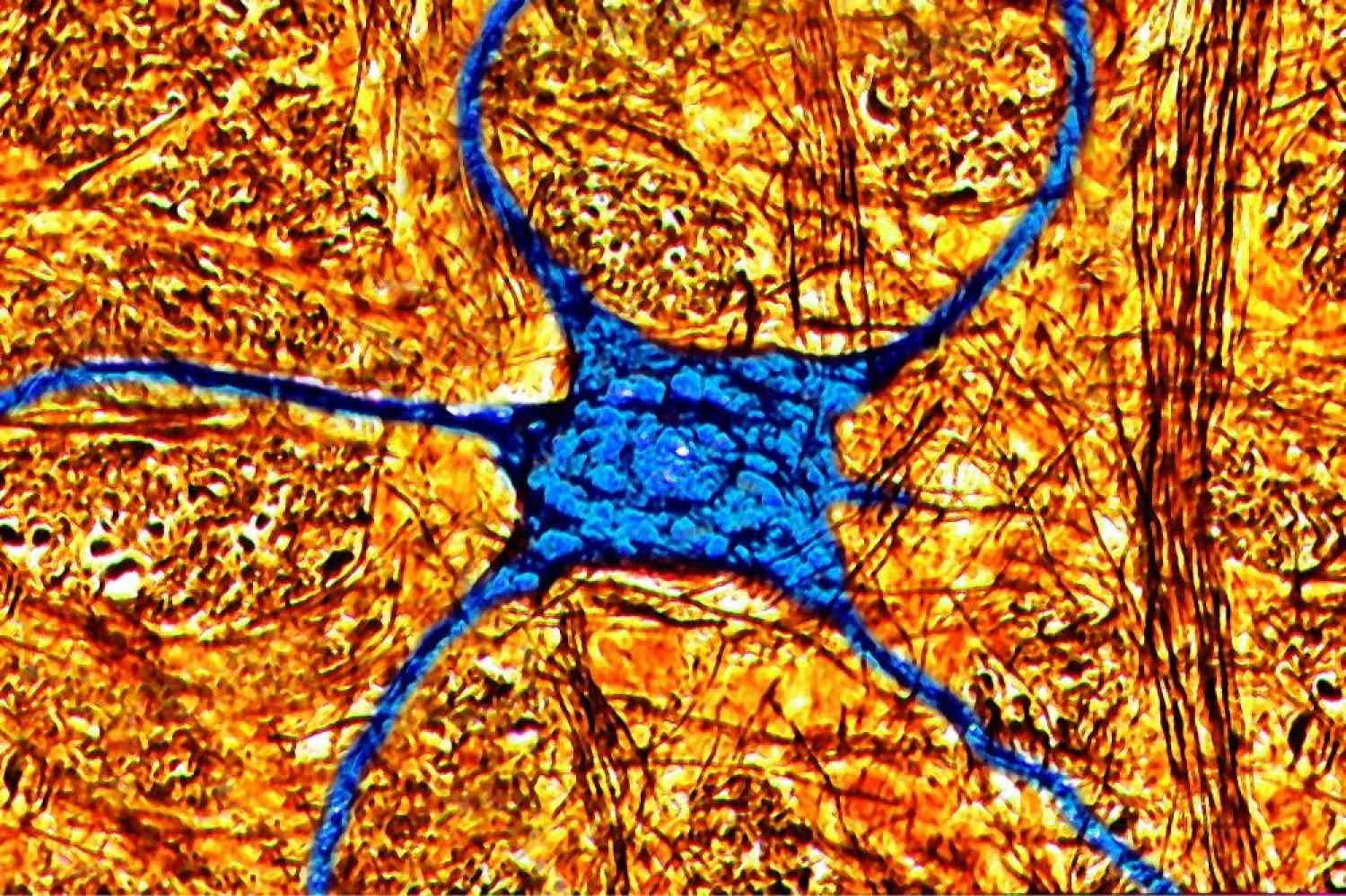
A neuron imaged under a microscope. (BSIP/UIG/Getty Images)
TT

Scientists Discover How Brain Cells Die in Alzheimer’s Patients

A neuron imaged under a microscope. (BSIP/UIG/Getty Images)

Scientists in the UK and Belgium think they have figured out how brain cells die in Alzheimer's disease. It has been a mystery and a source of scientific debate for decades, BBC reported.

But the team, writing in the journal Science, connect the abnormal proteins that build up in the brain with "necroptosis" - a form of cellular suicide.

The findings have been described as "exciting", as they give new ideas for treating the disease

It is the loss of brain cells, called neurons, that lead to the symptoms of Alzheimer's, including memory loss.

And if you look inside the brains of people with the disease, you'd see the build-up of abnormal proteins called amyloid and tau. But scientists have not been able to join the dots between these key traits of the disease.

This is what the researchers - at the UK's Dementia Research Institute at University College London and KU Leuven in Belgium - now think is happening.

They say abnormal amyloid starts to build up in the spaces between neurons, leading to brain inflammation, which the neurons do not like. This starts to change their internal chemistry.

Tangles of tau appear and the brain cells start producing a specific molecule (it's called MEG3) that triggers death by necroptosis. Necroptosis is one of the methods our bodies normally use to purge unwanted cells as fresh ones are made.

The brain cells survived when the team were able to block MEG3.

"This is a very important and interesting finding. For the first time we get a clue to how and why neurons die in Alzheimer's disease. There's been a lot of speculation for 30-40 years, but nobody has been able to pinpoint the mechanisms," researcher Prof. Bart De Strooper, from the UK's Dementia Research Institute, told the BBC.

The answers came from experiments where human brain cells were transplanted into the brains of genetically modified mice. The animals were programmed to produce large quantities of abnormal amyloid.

There has been recent success in developing drugs that strip amyloid out of the brain and they mark the first treatments to slow the destruction of brain cells.

Prof. De Strooper says the discovery that blocking the MEG3 molecule can hold off brain cell death could lead to a "whole new line of drugs development".

However, this will take years of research.

Prof. Tara Spires-Jones, from the University of Edinburgh and the president of the British Neuroscience Association, said "it is a cool paper. It addresses one of the fundamental gaps in Alzheimer's research... these are fascinating results and will be important for the field moving forward."

However, she stressed that "many steps are needed" before knowing whether it could be harnessed as an effective treatment for Alzheimer's.

Dr. Susan Kohlhaas, from Alzheimer's Research UK, said the findings were "exciting" but still at an early stage.

"This discovery is important because it points to new mechanisms of cell death in Alzheimer's disease that we didn't previously understand and could pave the way for new treatments to slow, or even stop disease progression in the future," she added.




Geologists Discover Earth’s Oldest Water Beneath Canadian Mine

The saltiness and bitterness of the water confirmed that it had been isolated for an incredibly long time. (Shutterstock)
TT

Geologists Discover Earth’s Oldest Water Beneath Canadian Mine

The saltiness and bitterness of the water confirmed that it had been isolated for an incredibly long time. (Shutterstock)

Geologists have unearthed the world’s oldest known water, hidden deep beneath the surface of a Canadian mine for around 2.64 billion years.

The find, which was detailed in a 2016 study published in Nature, has profound implications not only for understanding the planet’s history but also for the possibility of life on other planets.

Within the depths of a Canadian mine nearly 3-kilometers below the Earth’s surface, geologists stumbled upon an unexpected and extraordinary find: a pocket of water believed to be over 2.6 billion years old.

What they found was a water source that had been sealed within the rock for nearly the entire span of Earth’s existence, offering researchers a unique opportunity to study a pristine, untouched ecosystem.

The sheer volume of the water was unexpected, defying initial assumptions and opening new avenues for scientific exploration.

What makes this discovery even more significant is the evidence of life that the water contained. Scientists analyzed the water for traces of sulfate and hydrogen, chemicals that provide clues to the presence of microbial life from ancient times.

The traces found in the water indicate that microorganisms once thrived in this environment, even in the absence of sunlight.

The water’s chemical composition also raised intriguing questions about the Earth’s geological processes.

Researchers discovered that the sulfate found in the water was not modern sulfate that had flowed down from surface waters but rather sulfate produced by a reaction between the water and rock.

Long Li, an assistant professor at the University of Alberta, explained the significance of the finding. “The sulfate in this ancient water is not modern sulfate from surface water flowing down. What we’ve found is that the sulfate, like the hydrogen, is actually produced in place by reaction between the water and rock,” he said. “What this means is that the reaction will occur naturally and can persist for as long as the water and rock are in contact, potentially billions of years.”

Perhaps the most astonishing moment of this discovery came when Professor Sherwood Lollar took the unprecedented step of tasting the ancient water.

While not typical in scientific studies, Lollar’s decision to taste the water was motivated by a desire to understand its unique properties.

“If you’re a geologist who works with rocks, you’ve probably licked a lot of rocks,” she told CNN.

She noted that she was looking for a salty taste, as saltier water tends to be older, and to her surprise, the ancient liquid was “very salty and bitter,” much saltier than seawater.

The saltiness and bitterness of the water confirmed that it had been isolated for an incredibly long time, allowing for the accumulation of minerals and other substances that contributed to its distinct taste. Lollar’s tasting of the water further emphasized the extraordinary nature of this find.


Russian Spacecraft Antenna Problem Forces Manual Docking with ISS

FILE PHOTO: A Soyuz-2.1a rocket booster with a Progress MS-33 cargo spacecraft blasts off to the International Space Station (ISS) from the launch pad at the Baikonur Cosmodrome, Kazakhstan March 22, 2026. Roscosmos/Handout via REUTERS
TT

Russian Spacecraft Antenna Problem Forces Manual Docking with ISS

FILE PHOTO: A Soyuz-2.1a rocket booster with a Progress MS-33 cargo spacecraft blasts off to the International Space Station (ISS) from the launch pad at the Baikonur Cosmodrome, Kazakhstan March 22, 2026. Roscosmos/Handout via REUTERS

An unmanned Russian cargo spacecraft has a problem with an antenna so it will have to be manually docked when it reaches the International Space Station (ISS), Russia's Roscosmos state space corporation said in a statement.

A Soyuz-2.1a rocket launched the Progress MS-33 cargo spacecraft on Sunday from Baikonur in Kazakhstan ⁠but a problem with ⁠one of the KURS automated rendezvous antennas was identified, Roscosmos said.

Russian cosmonaut Sergei Kud-Sverchkov, the current ISS commander, will manually dock the cargo ship on ⁠Tuesday at about 13:35 GMT, Reuters quoted Roscosmos as saying.

"A manual approach of ships to the ISS is regularly practiced by cosmonauts in training," said Oleg Kononenko, head of Russia's Cosmonaut Training Center.

NASA said all other systems are operating as normal and that Roscosmos will continue troubleshooting the ⁠antenna.

The ⁠cargo ship is carrying about 2.5 tons of food, water, fuel, oxygen and supplies for the crew aboard the ISS.

There are currently seven crew aboard the ISS including Russians Kud-Sverchkov, Sergei Mikayev and Andrei Fedyaev, US astronauts Christopher Williams, Jessica Meir and Jack Hathaway, and France's Sophie Adenot.


UN: Planet Trapped Record Heat in 2025

A volunteer holds a bottle of water as a wildfire burns in the village of Vati, on the island of Rhodes, Greece, July 26, 2023. REUTERS/Nicolas Economou/File photo
TT

UN: Planet Trapped Record Heat in 2025

A volunteer holds a bottle of water as a wildfire burns in the village of Vati, on the island of Rhodes, Greece, July 26, 2023. REUTERS/Nicolas Economou/File photo

The amount of heat trapped by the Earth reached record levels in 2025, with the consequences of such warming feared to last for thousands of years, the UN warned Monday.

The 11 hottest years ever recorded were all between 2015 and 2025, the United Nations' WMO weather and climate agency confirmed in its flagship State of the Global Climate annual report.

Last year was the second or third hottest year on record, at about 1.43 Celsius above the 1850-1900 average, the World Meteorological Organization said.

"The global climate is in a state of emergency. Planet Earth is being pushed beyond its limits. Every key climate indicator is flashing red," said UN Secretary-General Antonio Guterres.

"Humanity has just endured the 11 hottest years on record. When history repeats itself 11 times, it is no longer a coincidence. It is a call to act,” AFP quoted him as saying.

For the first time, the WMO climate report includes the planet's energy imbalance: the rate at which energy enters and leaves the Earth system.

Under a stable climate, incoming energy from the Sun is about the same as the amount of outgoing energy, the Geneva-based agency said.

However, the increase in concentrations of heat-trapping greenhouse gases -- carbon dioxide, methane and nitrous oxide -- "to their highest level in at least 800,000 years" has "upset this equilibrium", the WMO said.

"The Earth's energy imbalance has increased since its observational record began in 1960, particularly in the past 20 years. It reached a new high in 2025."

WMO chief Celeste Saulo said scientific advances had improved understanding of the energy imbalance and its implications for the climate.

"Human activities are increasingly disrupting the natural equilibrium and we will live with these consequences for hundreds and thousands of years," she said.

More than 91 percent of the excess heat is stored in the ocean.

"Ocean heat content reached a new record high in 2025 and its rate of warming more than doubled from 1960-2005 to 2005-2025," the WMO said.

Ocean warming has far-reaching consequences, such as degradation of marine ecosystems, biodiversity loss and reduction of the ocean carbon sink, the agency said.

"It fuels tropical and subtropical storms and exacerbates ongoing sea-ice loss in the polar regions."

The Antarctic and Greenland ice sheets have both lost considerable mass, and the annual average extent of Arctic sea ice in 2025 was the lowest or second-lowest ever recorded in the satellite era.

Last year, the global mean sea level was around 11 centimeters higher than when satellite altimetry records began in 1993.

Ocean warming and sea level rise are projected to continue for centuries.

WMO scientific officer John Kennedy said global weather is still under the influence of La Nina, a naturally occurring climate phenomenon that cools surface temperatures in the central and eastern equatorial Pacific Ocean. It brings changes in winds, pressure and rainfall patterns.

Conditions oscillate between La Nina and its warming opposite El Nino, with neutral conditions in between.

The warmest year on record, 2024, was around 1.55C above the 1850-1900 average, and started in a strong El Nino.

Forecasts indicate neutral conditions by the middle of 2026 with a possible El Nino developing before the end of the year, said Kennedy.

If so, "then we're likely to see maybe elevated temperatures again in 2027", he told a press conference.

The World Meteorological Organization's deputy chief, Ko Barrett, said the outlook was a "dire picture".

She said the WMO provided the evidence it sees, hoping that the information "will encourage people to take action".

But there was "no denying" that "these indicators are not moving in a direction that provides for a lot of hope", she said.

With war gripping the Middle East and fuel prices soaring, Guterres said the world should heed the alarm call.

"In this age of war, climate stress is also exposing another truth: our addiction to fossil fuels is destabilizing both the climate and global security," he said.

"Today's report should come with a warning label: climate chaos is accelerating and delay is deadly," he said.