In New York City, Scuba Divers’ Passion for Sport Becomes Mission to Collect Undersea Litter

Atlantic goliath grouper fish swim near Boynton Beach, Florida on September 10, 2023. (AFP)
TT

In New York City, Scuba Divers’ Passion for Sport Becomes Mission to Collect Undersea Litter

Atlantic goliath grouper fish swim near Boynton Beach, Florida on September 10, 2023. (AFP)

On a recent Sunday afternoon, the divers arrived on a thin strip of sand at the furthest, watery edge of New York City. Oxygen tanks strapped to their backs, they waded into the sea and descended into an environment far different from their usual terrestrial surroundings of concrete, traffic and trash-strewn sidewalks.

Horseshoe crabs and other crustaceans crawl on a seabed encrusted with barnacles and colonies of coral. Spiny-finned sea robin, blackfish and wayward angelfish swim in the murky ocean tinted green by sheets of algae.

Not all is pretty. Plastic bottles, candy wrappers and miles and miles of fishing line drift with the tides, endangering sea life.

The undersea litter isn't always visible from the shore. But it has long been a concern of Nicole Zelek, a diving instructor who four years ago launched monthly cleanups at this small cove in the community of Far Rockaway, where New York City meets the Atlantic Ocean, about 4 miles (6.4 kilometers) south of John F. Kennedy International Airport in Queens.

A throwaway culture of single-use plastics and other hard-to-degrade material has sullied the world's waters over the decades, posing a danger to marine life such as seals and seabirds. By 2025, some 250 million tons (226.7 million metric tons) of plastic will have found its way into the oceans, according to the PADI AWARE Foundation, a conservation group sponsoring a global project called Dive Against Debris.

Dive by dive, small groups like Zelek's have been trying to undo some of the damage.

“Every month we have a prize for the weirdest find,” she said. They have included the occasional goat skull, perhaps used as part of some ritual, Zelek surmises.

“The best find of all time was an actual ATM machine. Unfortunately, it was empty,” she said.

The divers' haul one late-summer Sunday wasn’t much, but there were clumps and clumps of fishing line untangled from underwater objects. What the divers can’t pull away by hand is cut with scissors.

“Unfortunately, tons of crabs and horseshoe crabs — which are under threat — get tangled in the fishing line and then they die,” Zelek said.

While more ambitious projects are underway to scoop up huge accumulations of floating debris in deeper waters, small-scale coastal cleanups like Zelek's are an important part of the battle against ocean pollution, said Nick Mallos, vice president of conservation for Ocean Conservancy.

“The science is very clear and that’s to tackle our global plastic pollution crisis,” he said. “We have to do it all.”

Every September, the conservancy holds monthlong international coastal cleanups. Since its inception nearly four decades ago, the cleanups have retrieved about 400 million pounds (181.4 million kilograms) of trash from coastal areas around the world.

The best way to combat plastics going into the oceans, Mallos said, is to reduce the globe's dependence on them, particularly in packaging consumer products. But human-powered cleanup is the least costly of all cleanup options.

The Dive Against Debris project invites what organizers call “citizen scientists” to survey their diving sites to help catalog the myriad items that don’t belong in oceans, lakes and other bodies of water. By the group’s count, more than 90,000 participants have conducted more than 21,000 such surveys and removed 2.2 million pieces of junk, big and small.

Zelek and her fellow divers have contributed their finds to the project.

Surface trash might be easy enough to clear with a rake, but the task is more challenging beneath the water. Over the years, the layers of monofilament fishing line have accumulated. And until a few years ago, no one was scooping out the line, hooks and lead weights.

Untangled, a pound of medium-weight fishing filament would stretch to a bit more than 4 miles (6.4 kilometers). It’s anybody’s guess how many miles of fishing line remain on the channel’s bottom.

“Those small things are really what start to accumulate and become a much larger and bigger problem,” said Tanasia Swift, who has been with the group for a year and works for an environmental nonprofit focused on restoring the health of New York City’s waters.

“If there’s anything that we see that doesn’t belong in the water, we take it out,” she said.

While the drivers work, fishermen cast their lines from a ledge where the city's concrete stops. The beach is frequented mostly by residents who live nearby.

Raquel Gonzalez is one such resident, and she's been coming to the beach for years. She and a neighbor brought a rake with them on the same Sunday the divers were there.

“Needs a lot of cleanup here. There's nobody that does any cleanup around here. We have to clean it up ourselves," she said.

“I love this spot, I love the scuba divers," Gonzalez said. “Look at all the good people here.”



Just Days Before Cesar Awards, French Movie Stars Warn AI Plundering Industry

An expressive image of the debate between French cinema industry and AI (Shutterstock)
TT

Just Days Before Cesar Awards, French Movie Stars Warn AI Plundering Industry

An expressive image of the debate between French cinema industry and AI (Shutterstock)

Just days before France’s version of the Oscars, thousands of French actors and filmmakers have warned that AI tools are “plundering” talent across the industry.

“We are facing a profound upheaval in our profession with the arrival of artificial intelligence,” said the op-ed in Le Parisien, which was signed by some 4,000 artists.

The petition stated that the industry has already been struggling with unauthorized voice cloning, image scraping and undervalued AI licensing deals for some time.

Signatories included many French movie stars, such as Berenice Bejo, Léa Drucker, Swann Arlaud, José Garcia, Karin Viard, Franck Dubosc and Elodie Bouchez.

The op-ed, released ahead of the 51st edition of the French film industry’s Cesar Awards, warned of the rise of “unauthorized voice cloning,” which has taken the industry by storm.

“This tool, extraordinarily valuable for certain professions, is also a devouring hydra for the artists that we are,” the op-ed said, adding that “Not a week goes by without an artist sounding the alarm over the brutal competition AI is inflicting on their work.”

It stated that just recently, “an actor was offered a contract to use his image by AI for the creation of a new commercial for a major French group, simply replacing two days of filming. A Faustian pact... paid 250 euros!”

The op-ed also pointed to the hundreds of lesser-established actors, often lacking leverage, and who feel pressured to sign contracts granting AI rights, “despite the risks to their image and their future.”

As such, French actors said they demand “guarantees that no artist will be forced to give up their digital identity.”

“This organized plundering is not hypothetical — it’s happening here and now. It’s intolerable, and it’s taking place before our very eyes.” The artists called for a clear “legal framework” so that AI can “coexist with artistic work, with the protection of copyright and related rights.”

In recent months, the industry has introduced various initiatives to tackle the threat posed by AI and the flood of content replicating artists and their voices almost perfectly.

In January, eight French voice actors sent formal notices to two US companies that had cloned their voices without consent. Actors have also taken to the streets of Paris under the slogan “Touche pas à ma VF” (Hands off my French dub).

The debate goes far beyond France. Last week, Hollywood heavyweights accused the Chinese software Seedance 2.0, built by TikTok owner ByteDance, of copyright infringement after AI-generated videos, including of Tom Cruise brawling with Brad Pitt, went viral.


Two Holy Mosques Exhibition Welcomes Visitors for Founding Day Celebrations

The exhibition is open daily from 10:00 a.m. to 1:30 a.m - SPA
TT

Two Holy Mosques Exhibition Welcomes Visitors for Founding Day Celebrations

The exhibition is open daily from 10:00 a.m. to 1:30 a.m - SPA

In celebration of the Kingdom’s Founding Day, the Exhibition of the Two Holy Mosques Architecture in Makkah is welcoming visitors to explore a comprehensive historical journey.

The exhibition presents the evolution of the Two Holy Mosques through rare artifacts, historical photographs, and documentation of successive Saudi expansions, according to SPA.

The halls highlight the Kingdom’s long-standing dedication to serving the Two Holy Mosques. They combine heritage and modern technology to present the architectural development of Islam’s holiest sites.

The exhibition is open daily from 10:00 a.m. to 1:30 a.m.


Photos Show Filming of Ramadan TV Drama Series on the War-scarred Streets of Syria's Aleppo

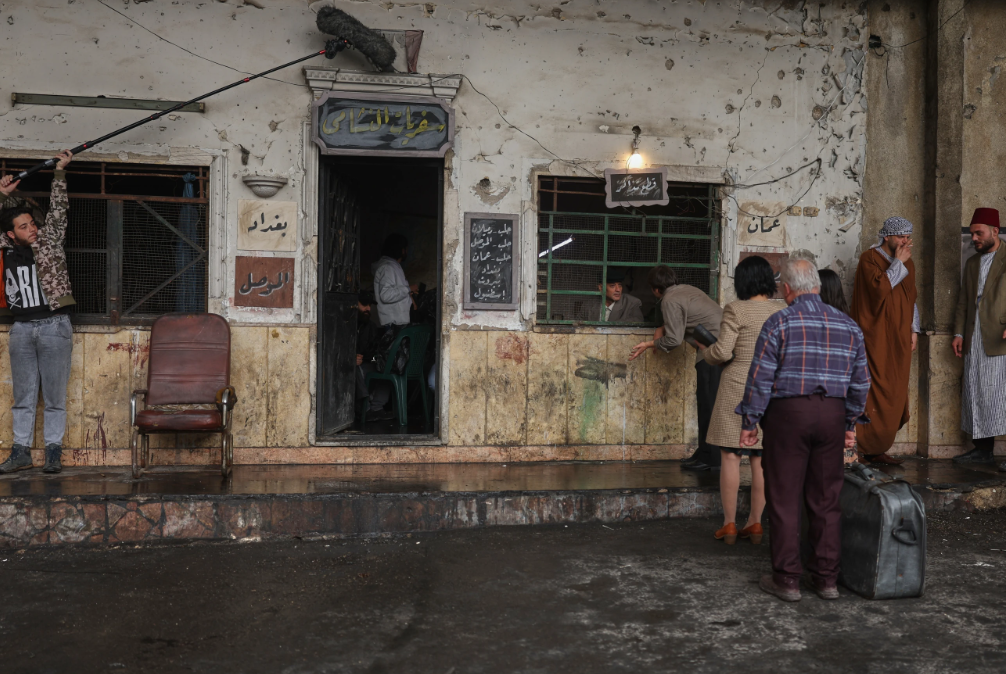
Extras stand by as a television crew films an episode of the TV series “Al-Souriyoun al-Aada” (“The Syrian Enemies”), based on a novel of the same name that was banned under Bashar Assad, along a transformed street in central Aleppo, Syria, Friday, Feb. 13, 2026. (AP Photo/Ghaith Alsayed)
TT

Photos Show Filming of Ramadan TV Drama Series on the War-scarred Streets of Syria's Aleppo

Extras stand by as a television crew films an episode of the TV series “Al-Souriyoun al-Aada” (“The Syrian Enemies”), based on a novel of the same name that was banned under Bashar Assad, along a transformed street in central Aleppo, Syria, Friday, Feb. 13, 2026. (AP Photo/Ghaith Alsayed)

Ramadan in the Arab world is a month of fasting and prayer by day — and television by night. For decades, families have gathered after the iftar, the evening meal that breaks the daytime fast, to follow the season’s highly anticipated drama series, produced specially to air during the Islamic holy month.

In the week before Ramadan, a television crew in central Aleppo was busy preparing one of those productions, with a battered street in the historic city transformed into a scene from decades past.

Lamees Al-Ali, an extra in the series, poses for a photograph during the filming of an episode of the TV series “Al-Souriyoun al-Aada” (“The Syrian Enemies”), based on a novel of the same name that was banned under Bashar Assad, along a transformed street in central Aleppo, Syria, Friday, Feb. 13, 2026. (AP Photo/Ghaith Alsayed)

Classic 1970s cars lined the curb. A horse-drawn cart rolled through the frame. A vendor in a red tarboush, a brimless cone-shaped hat, stood beside steaming pots of sahlep — a sweet, thickened milk drink flavored with spices and associated with winter evenings.

Just outside the camera’s view stood a stark reminder of Syria's more recent history. Collapsed buildings and damaged facades testified to Aleppo’s role as a major battleground during the country's civil war. However, with costumes, props and careful framing, the production temporarily carried the street back to what it portrays as a more innocent era, according to The AP news.

A television crew films an episode of the TV series “Al-Souriyoun al-Aada” (“The Syrian Enemies”), based on a novel of the same name that was banned under Bashar Assad, along a transformed street in central Aleppo, Syria, Friday, Feb. 13, 2026.(AP Photo/Ghaith Alsayed)

The series being filmed — “Al-Souriyoun al-Aada,” or “The Syrian Enemies” — is based on a novel that was banned during the rule of former President Bashar Assad. The story examines painful chapters of Syria’s past, including the 1982 events in Hama, when government forces crushed an uprising led by the Muslim Brotherhood, killing or disappearing an estimated 10,000 to 40,000 people and leaving the city in ruins.

As filming continues into Ramadan, the production reflects both a cherished seasonal tradition and Syria’s complex, layered history.