


Extreme Cold Leaves Thousands Without Power in Nordic Countries as Floods Persist in Germany 

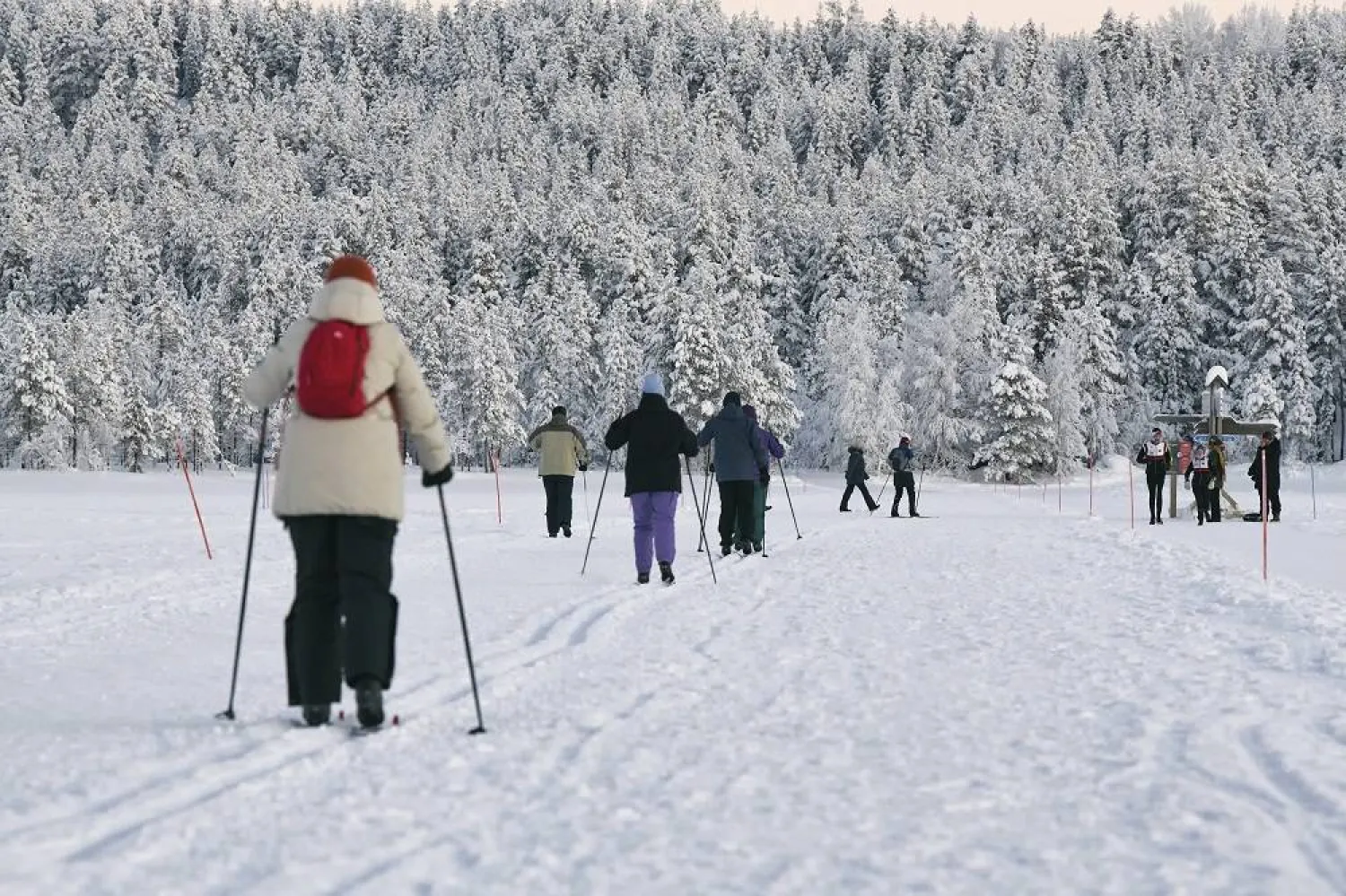
People ski in the town of Akaslompolo, in Finnish Lapland, Thursday Jan. 4, 2024. (AP)
TT

Extreme Cold Leaves Thousands Without Power in Nordic Countries as Floods Persist in Germany 

People ski in the town of Akaslompolo, in Finnish Lapland, Thursday Jan. 4, 2024. (AP)

Extremely cold temperatures compounded by gale-force winds and snow wreaked havoc across the Nordic region Thursday, leaving thousands without power while others braved the cold for hours stuck in their cars along clogged highways.

Heavy rains in Germany, France and the Netherlands again caused floods in regions that have seen persistent flooding in the last two weeks. One death was reported in France.

The deep freeze disrupted transportation throughout the Nordic region amid reports of traffic chaos following closures of sections of highways and major roads. Problems with rail service have also been reported.

Electricity was cut to some 4,000 homes in Arctic Sweden where temperatures plummeted to minus 38 degrees Celsius (minus 36.4 degrees Fahrenheit), according to Swedish public radio. In the southern part of the country, motorists were stuck in their cars or evacuated to a nearby sporting complex where they spent the night.

In neighboring Denmark, police urged motorists to avoid unnecessary trips as wind and snow battered the northern and western parts of the country.

In Finnish Lapland, the municipality of Enontekio, near the border with Norway and Sweden, recorded the country's lowest temperature this winter on Thursday at minus 43.1 degrees C (minus 45.6 degrees F). Meteorologists are forecasting even colder temperatures for the rest of the week.

A ferry sailing between the capitals of Norway and Denmark finally docked in Copenhagen on Thursday after some 900 passengers spent the night aboard the vessel, which had been idling in the Oresund Strait between Denmark and southern Sweden. On Wednesday, weather hampered the Crown Seaways vessel from sailing into the Copenhagen harbor.

In Germany, heavy rain has resumed in regions that have seen persistent flooding over the past two weeks. Chancellor Olaf Scholz on Thursday made his second visit this week to inspect a dike and a sandbag-filling facility in the eastern town of Sangerhausen.

After several days of rain and rising waters, several towns in northern France were left underwater Thursday. Hundreds of people have been evacuated in recent days. The area was also hit by flooding in November and December, and some towns still hadn’t recovered. Government ministers are traveling to the area on Thursday.

A 73-year-old man was found dead in his partially submerged car near the city of Nantes, France's national gendarme service said. He was reported missing Tuesday after he left his home to buy bread and didn’t return, and was found Wednesday as waters began receding in the area.

In Britain, there was little respite from the bad weather with widespread flooding across central England, particularly in the vicinity of the River Trent in Nottinghamshire, and more heavy rain hitting southern areas.

As of Thursday evening, more than 220 flood warnings, where flooding is expected, remain in place across England, while almost 300 flood alerts, where flooding is possible, are also in place.

The flooding comes just days after Storm Henk, named by the official weather services of Britain, Ireland and the Netherlands, battered large areas of England and Wales, leaving the ground saturated and prone to flooding.

It also emerged Thursday that an 87-year-old woman died near Oxford on Tuesday during Storm Henk when she drove into a fallen tree that had been reported fallen to police about 90 minutes earlier. The local Thames Valley Police force has referred itself for independent investigation.

Earlier this week, a driver also died after a tree fell on his car in western England, and in the Netherlands police in Eindhoven said strong winds may have played a role in the death of a 75-year-old man who fell off his bicycle late Tuesday.

The government in low-lying Netherlands, which also faced extremely high water levels in rivers and lakes, said it would send pumps to France to help it tackle widespread flooding.

“It has rained a lot recently, which means that the water in France can no longer be drained properly. In many places, rivers have already burst their banks. That is why it is important to help each other get rid of the water as quickly as possible,” Infrastructure and Water Minister Mark Harbers said in a statement.

The Dutch emergency pumps can each process 5 million liters (1.3 million gallons) of water per hour.


Emergency Room for Injured Wild Birds Opens at Warsaw Zoo in Poland

A male bullfinch is treated at the birds' hospital at the Warsaw Zoo after crashing against the window of an apartment building, in Warsaw, Poland, Monday, March 16, 2026. (AP Photo/Claudia Ciobanu)
TT

Emergency Room for Injured Wild Birds Opens at Warsaw Zoo in Poland

A male bullfinch is treated at the birds' hospital at the Warsaw Zoo after crashing against the window of an apartment building, in Warsaw, Poland, Monday, March 16, 2026. (AP Photo/Claudia Ciobanu)

When a male bullfinch smashed into Marcin Jarzębski’s apartment window, he took it in but realized it needed expert treatment. So the next morning he brought it to Warsaw’s new emergency room for wild birds.

He placed the tiny, plump bird with a black head, gray back and reddish chest feathers into a shoebox and took it as one of the first patients to the new drop-off center for sick and injured birds at the entrance of the Warsaw Zoo.

“The bird stayed with us overnight, but unfortunately it probably has a broken wing so we brought it to the bird hospital,” The Associated Press quoted Jarzebski as saying.

The 24/7 emergency room in the Polish capital is actually a system of automated metal containers – something like a parcel room – where the containers can keep the birds warm in winter. The boxes send an immediate signal to the bird hospital just a few meters away, where veterinarians bring the birds for diagnosing and treatment.

Jarzebski filled out a questionnaire and carefully placed the shoebox and the paper form into one of the containers, assured that the bullfinch would now have its best chance of surviving.

The box system, designed based on ideas of the workers at the bird hospital, locks the birds in to keep them safe until a doctor can collect them. The drop-off center, opened in February, is boosting the efficiency of a bird hospital that has operated at the Warsaw Zoo since 1998 and now treats about 9,000 patients annually.

It’s the brainchild of the zoo director, ornithologist Andrzej Kruszewicz, who said that people have a responsibility to care for creatures whose habitat they have altered, such as that of the bullfinch.

“This bird is a child of the forest who, during migration, didn’t understand the window,” Kruszewicz said.

“Humans often cause problems: car accidents, crashes into windows, electrocutions, tangled strings on storks’ legs,” he said. “All this is humans’ fault and they should feel responsible to give these birds a second chance.”


Treated storks are seen in an external cage outside the birds' hospital at the Warsaw Zoo in Warsaw, Poland, Monday, March 16, 2026. (AP Photo/Claudia Ciobanu)


Typical patients at the Warsaw Zoo include common songbirds like tits, sparrows, thrushes and starlings, as well as pigeons. However, in a green city like Warsaw, which has the river Vistula running through it, rarer species also can appear.

Hospital manager Andżelika Gackowska says that warm winters caused by climate change have meant birds that were previously migrating south, including cranes or herons, are choosing to stay in Poland.

“Birds who stopped migrating because of warm winters were caught off guard by such a harsh winter as this year,” Gackowska said. Some birds developed anemia during the cold months because of tough conditions and insufficient nutrition, making them more vulnerable to disease.

The emergency room was financed in part with money from Warsaw’s citizen budget, a program that chooses projects based on their popularity in online surveys of city residents.

Warsaw Zoo workers say residents have become more conscious about providing help if they see a sick bird, although they also warn against overzealousness, saying that people shouldn't pick up young and healthy birds that they might believe are orphans.

“In spring, we always make an information campaign warning people not to ‘kidnap’ birds,” Gackowska said. “Birds take care of their small ones differently than humans. If we see a baby bird on the grass alone, it is likely just training how to fly independently.”

In the bird hospital, veterinarian assistants are constantly on their feet, feeding and giving medicine to the various birds, located across multiple rooms depending on species and degree of illness.

Once birds are stronger, they are placed in large cages outside, to readjust to their natural environment before being released.

Releasing the cured birds back into their habitat is the ultimate goal, veterinarian Ewelina Chudziak said.

“We are fighting for freedom,” she said.


Nepal's 'Icefall Doctors' Fix Everest Route for Spring Season

A tourist looks at a view of Mt. Everest from the hills of Syangboche in Nepal December 3, 2009. REUTERS/Gopal Chitrakar
TT

Nepal's 'Icefall Doctors' Fix Everest Route for Spring Season

A tourist looks at a view of Mt. Everest from the hills of Syangboche in Nepal December 3, 2009. REUTERS/Gopal Chitrakar

Highly skilled mountaineers known in Nepal as "icefall doctors" have begun fixing ropes and ladders on Mount Everest to prepare for the coming spring climbing season, officials said Wednesday.

The team has reached the base camp before starting work on the treacherous Khumbu Icefall, a constantly shifting maze of crevasses and ice blocks that forms the gateway to the world's highest peak.

"Our team of eight have reached the base camp and begun their work," Lama Kazi Sherpa, chair of the Sagarmatha Pollution Control Committee, which oversees route-setting, told AFP.

As tradition dictates, the group began with a sacred ceremony at base camp to seek divine blessings before stepping onto the mountain.

This year, authorities increased the permit fee for the spring season from $11,000 to $15,000 for climbers aiming to scale the 8,849-metre (29,032-foot) summit.

Authorities also tightened rules to reduce pollution, requiring each climber to bring back at least two kilograms (4.4 pounds) of waste to Camp 2 and enforcing the use of "poo bags".

Camp 2 is a broad glacial valley above the Khumbu Icefall where climbers often spend several days to acclimatize for higher altitudes.

Expedition operators in Kathmandu are also gearing up for the season, although they anticipate some impact from the travel chaos caused by the Middle East war.

"Flight disruption may affect some of the climbers but we don't expect a big impact," said Dambar Parajuli, president of the Expedition Operators Association.

Nepal is home to eight of the world's 10 highest peaks and attracts hundreds of climbers each spring, when temperatures are warmer and winds calmer.

A climbing boom has made mountaineering a lucrative business since Edmund Hillary and Tenzing Norgay Sherpa made the first ascent in 1953.

Around 700 people reached Everest's summit last year, according to Nepal's tourism department, with another 100 climbers believed to have reached the peak from the northern Tibet side.


Chinese University Tells Students to 'Fall in Love' During Spring Break

FILE PHOTO: A couple react during their wedding photoshoot near the Forbidden City, as the city is hit by sandstorm, in Beijing, China March 15, 2021. REUTERS/Tingshu Wang/File Photo
TT

Chinese University Tells Students to 'Fall in Love' During Spring Break

FILE PHOTO: A couple react during their wedding photoshoot near the Forbidden City, as the city is hit by sandstorm, in Beijing, China March 15, 2021. REUTERS/Tingshu Wang/File Photo

A Chinese university is urging students to "enjoy the flowers, fall in love" during their mid-term break, an unusual directive in a nation obsessed with getting good grades, as authorities seek new ways to spur marriages and domestic consumption.

"See the flowers and enjoy romance" is the theme for the spring holidays from April 1 to 6, the Sichuan Southwest Vocational College of Aviation said on its official Wechat account.

Tuesday's notice exhorting teachers and students to put down the books came about two weeks after China said it would introduce spring and autumn holidays for schools, ⁠in addition to the ⁠traditional times of summer and winter.

Authorities have said they will also encourage staggered paid leave to enable workers to travel in off-peak seasons.

Provinces such as Sichuan and eastern Jiangsu, along with cities like Suzhou and Nanjing, have unveiled plans for spring breaks, most set for April or ⁠early May.

China seeks to boost domestic consumption by encouraging travel and leisure activities among its population of 1.4 billion. Authorities also hope more free time will set the stage for births to reverse a worrisome trajectory of decline.

In 2025, the population fell for a fourth consecutive year, as the birth rate dropped to a record low, with experts warning of further decline.

Beijing also issued a guideline on Tuesday to promote child-friendly development, the powerful state planner, the National Development and Reform ⁠Commission (NDRC), said ⁠in a notice.

According to Reuters, it called for coordinated efforts to bring about "child-friendly cities", by improving public services in areas from education and health to travel, sports and recreation.

Society needs to have enough time and money to raise children, said James Liang, the co-founder of Chinese travel company Trip, who called for more such initiatives.

"Greater efforts are needed to educate young people on the social and personal benefits of raising larger families," added Liang, who is also a prominent demographic expert.

The government could establish a broader support framework by reallocating resources and boosting financial assistance, he said.