An aerial view taken on January 15, 2024 shows a lava stream near Grindavik, southwest of the capital Reykjavik, after a volcanic eruption. (AFP)
TT
TT
Icelandic Volcano Calms Down but Risk Remains
An aerial view taken on January 15, 2024 shows a lava stream near Grindavik, southwest of the capital Reykjavik, after a volcanic eruption. (AFP)
A volcanic eruption in Iceland that had threatened to engulf a seaside town appeared to have calmed down early on Tuesday, although authorities and geologists warned that danger still persisted.
A flow of red-hot lava on Sunday reached the outskirts of Grindavik, a fishing town of some 4,000 residents, setting three houses ablaze but causing no harm to people who had been evacuated for a second time since November.
Live video footage on Tuesday morning no longer showed signs of molten rock erupting from the ground, even as experts warned that new fissures could emerge at short notice.
Grindavik resident Hrannar Jon Emilsson watched his almost-finished house burn down on live TV after the volcano erupted on Sunday.
"You sit and watch the news showing everything go up in smoke," Emilsson told Icelandic independent broadcaster Channel 2.
"Last week I asked the electricians to start their work so that they could finalize their part of the work with the view of arranging for moving in before springtime. Things change fast," he said.
The Icelandic Meteorological Office (IMO) late on Monday said new cracks could still open in the earth's surface without warning, adding that it was difficult to assess how long the eruption would last.
It was the second eruption on the peninsula of Reykjanes in four weeks, and the fifth since 2021.
The Icelandic Civil Defense, the IMO and other experts are due to meet later on Tuesday to discuss the situation.
Located between the Eurasian and North American tectonic plates, among the largest on the planet, Iceland is a seismic hot spot, with more than 30 active volcanoes.
Snow Geese Take Off for the Arctic in Mesmerizing Sunrise Displayhttps://english.aawsat.com/varieties/5250797-snow-geese-take-arctic-mesmerizing-sunrise-display
Snow geese take to the sky at sunrise after a stopover at the Middle Creek Wildlife Management Area, Monday, March 9, 2026, in Kleinfeltersville, Pa. (AP Photo/Robert F. Bukaty)
Snow Geese Take Off for the Arctic in Mesmerizing Sunrise Display
Snow geese take to the sky at sunrise after a stopover at the Middle Creek Wildlife Management Area, Monday, March 9, 2026, in Kleinfeltersville, Pa. (AP Photo/Robert F. Bukaty)
A few dozen birdwatchers gathered in the predawn darkness to wait for the moment when thousands of migrating snow geese stopped honking and preening to suddenly take flight from a Pennsylvania reservoir.
The mesmerizing display, about an hour after sunrise, was over almost as soon as it began. The birds circled a few times and then headed out to neighboring farm fields, seeking unharvested grains and other sustenance on their epic annual spring flight northward into New York state and Quebec.
The Pennsylvania reservoir was built a half-century ago to attract waterfowl and over the years the gaggle has grown. Pennsylvania Game Commission environmental education specialist Payton Miller described it as a raucous bird tornado that lifts off the water.
“All it takes is for me to come out here on a really nice morning where there’s a huge morning flight and I’m kind of reminded how awesome it is to see such a large number of such a beautiful bird,” The Associated Press quoted Miller as saying. “I never get sick of it.”
Among those taking it all in was Adrian Binns, a safari guide from Paoli, Pennsylvania, who went to the Middle Creek Wildlife Management Area for “the whole enjoyment of seeing something you don't see every day.”
Snow geese have been arriving in growing numbers at the 6,300-acre (25 square kilometers) Middle Creek property since the late 1990s. At this time of year, they have just spent months along the Atlantic coast, from New Jersey south to the Carolinas, with many of them overwintering on the Delmarva Peninsula that forms the Chesapeake Bay.
They don’t stay long at Middle Creek — it’s just a way station on their journey to summer breeding grounds in the Canadian Arctic and western Greenland.
But for a few short weeks they are the main attraction at Middle Creek, which draws about 150,000 visitors annually — including about a thousand hunters.
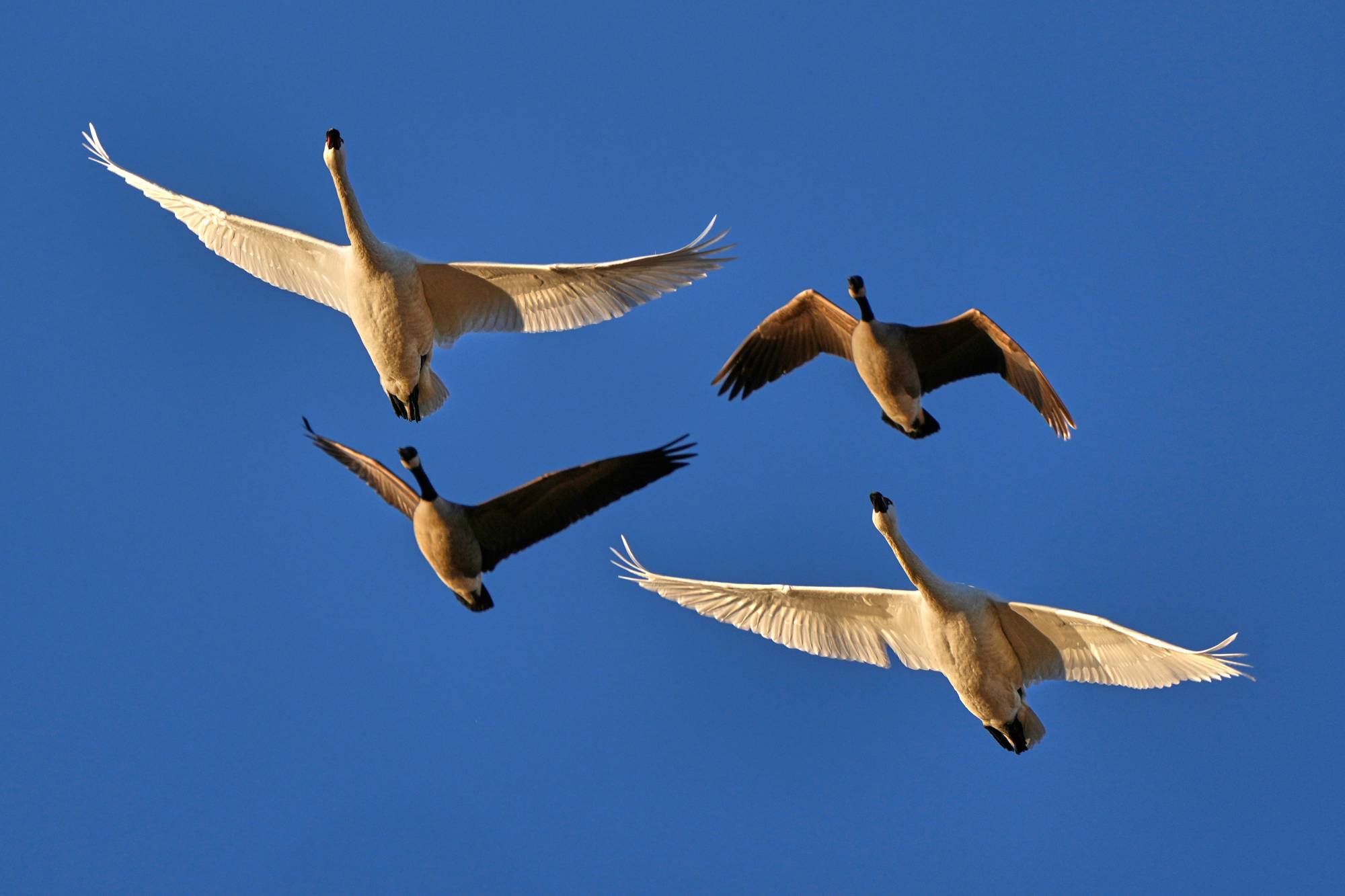
Pairs of tundra swans (larger birds) and Canada geese fly over the Middle Creek Wildlife Management Area, Monday, March 9, 2026, in Kleinfeltersville, Pa. (AP Photo/Robert F. Bukaty)
The Pennsylvania Game Commission, which owns Middle Creek, says about 100,000 snow geese were roosting there on the busiest day last year, on par with recent peak activity but below the single-day record of about 200,000 on Feb. 21, 2018.
Snow geese are doing well, but their large numbers have come with a cost.
According to a 2017 study published by Springer Nature, greater snow geese grew in population from about 3,000 in the early 20th century to some 700,000 by the 1990s. By some estimates, there are about a million of the birds now — along with maybe 10 million of lesser snow geese, which are smaller — that also breed in the Arctic.
The number of migrating tundra swans at Middle Creek, while far lower, has also increased over time, from a dozen or so in the mid-1970s to 5,000 or more in recent years. Middle Creek birders have also identified more than 280 bird species on the site, among them bald eagles, northern harriers, ospreys and owls.
As snow geese numbers have boomed in recent decades, wildlife officials in the US and Canada have navigated a balancing act involving hunting regulations, concerns about crop damage, shifts in snow geese migration and changes to overwintering patterns. Environmental damage from overgrazing in the Arctic has led experts to conclude the birds are overabundant.
David M. Bird, a McGill University wildlife biology professor, described the population as “probably one of the biggest conservation problems facing wildlife biologists in North America today.” Snow geese feed by pulling up plants by the roots, which damages habitats for themselves, various birds and other kinds of wildlife.
The Pennsylvania Game Commission reported recently that avian influenza viruses, present in the state since 2022, continue to circulate among the state’s wild birds. The game agency asked for the public’s help in reporting sick or dead wild birds and reported that about 2,000 wild bird carcasses — mostly snow geese — had to be removed from a quarry a few miles north of Bethlehem in December and January.
Bird said that for nature lovers, snow geese can be a delight but for farmers, they're a pest. For hunters, they're food but for animal rights advocates, they're a species that needs protection, he said.
“But if you are a paid professional wildlife manager at a municipal, state or federal level whose challenging job is to try to please all of the aforementioned parties, then you will undoubtedly experience many sleepless nights in the fall when the geese arrive,” Bird said.
London’s Most Urban Riding School Transforms Lives Through Horseshttps://english.aawsat.com/varieties/5250746-london%E2%80%99s-most-urban-riding-school-transforms-lives-through-horses
Children ride horses around a paddock during a class at the Ebony Horse Club in Brixton, Britain's most urban riding school, where children from under-privileged communities are taught to ride horses, in London, Britain, March 10, 2026. (Reuters)
TT
TT
London’s Most Urban Riding School Transforms Lives Through Horses
Children ride horses around a paddock during a class at the Ebony Horse Club in Brixton, Britain's most urban riding school, where children from under-privileged communities are taught to ride horses, in London, Britain, March 10, 2026. (Reuters)
Sandwiched between social housing blocks and busy train tracks in south London is Britain's most urban riding school, where children from disadvantaged backgrounds learn to ride horses as part of a project aimed at improving their well-being.
About 160 children each week attend the Ebony Horse Club, a 30-year-old charity in the Brixton area of the capital which ranks amongst the most deprived in England and is a hotspot for knife crime.
Outside the stables, opened in 2011 by Queen Camilla, nine-year-old Matthew Sanchez shoveled horse dung into a wheelbarrow before his lesson.
Like many of the children who come for classes, he had never encountered a horse before. But riding teacher Rachel Scott-Hayward, 37, said the children grow in confidence over weeks, learning to ride, grooming the animals and mucking out the stables.
Nylah Murray Charles, aged nine, said she was nervous before trotting on a horse for the first time.
"I got scared a bit, but I was like maybe I should just give it a try... when I tried, it was actually great and I had fun," she said.
The club is an oasis of rural charm in Brixton, about three miles (5 km) from central London, where the smell of hay hangs in the air. Lessons are free - a contrast to similar stables in wealthier parts of the city, where a 30-minute class can cost around 50 pounds ($67).
Scott-Hayward said while horse riding was traditionally "a white, upper-class hobby", the charity made it accessible to local children, about 45% of whom identify as being from an ethnic minority.
The stables have become a home-from-home for Shanice Reid, 29, since she first learnt to ride with the project as a schoolgirl. She now teaches at the club and said it offers "somewhere to escape" for those with difficult home or school lives.
Between 2010 and 2019, about a third of London's youth clubs closed due to cuts to public funding, shrinking services for young people just as the pandemic hit.
Scott-Hayward said that horse riding can also be an antidote to the anxiety that she increasingly sees in children who spend a lot of time on screens and social media.
"When you're on a horse, you can't really think about too much else," she said.
One-Fifth of Australian Teens Still Use TikTok, Snapchat After Social Media Banhttps://english.aawsat.com/varieties/5250734-one-fifth-australian-teens-still-use-tiktok-snapchat-after-social-media-ban
Instagram, TikTok, Snapchat, Kick, YouTube, Facebook, Twitch, Reddit, Threads and X applications are displayed on a mobile phone ahead of new law banning social media for users under 16 in Australia, in this picture illustration taken on December 9, 2025. (Reuters)
TT
TT
One-Fifth of Australian Teens Still Use TikTok, Snapchat After Social Media Ban
Instagram, TikTok, Snapchat, Kick, YouTube, Facebook, Twitch, Reddit, Threads and X applications are displayed on a mobile phone ahead of new law banning social media for users under 16 in Australia, in this picture illustration taken on December 9, 2025. (Reuters)
One-fifth of Australian teenagers under 16 were still using social media two months after the country banned platforms from allowing minors, industry data showed, raising questions about the effectiveness of their age-gating methods.
The number of 13-to-15-year-olds using TikTok and Snapchat, among the most popular social media apps with Australian teenagers, fell from before the ban took effect in December to February, but still more than 20% used the apps, according to a report by parental control software maker Qustodio provided to Reuters.
The data is among the first to show the effects on youth online behavior since Australia rolled out the ban, which is being copied by governments around the world. The Australian government and at least two university studies are tracking the ban's impact but none has published data yet.
"Among children whose parents haven't blocked access, a meaningful number continue to use restricted platforms in the months following the ban," Qustodio said in the report, which was based on data collected from Australian families from late 2024 to February.
Under the ban, platforms including Meta's Instagram, Facebook and Threads, Google's YouTube, TikTok and Snapchat must block people aged under 16 or face a fine of up to A$49.5 million ($35 million).
A spokesperson for internet regulator the eSafety Commissioner said the office was aware of reports some under-16s remained on social media and was "actively engaging with platforms and their age assurance providers ... while continuing to monitor for any systemic failures that may amount to a breach of the law".
The regulator was "actively drawing on a range of insights to assess compliance," the spokesperson added.
A spokesperson for communications minister Anika Wells said the government had always been clear "that increasing the minimum age to access social media is a cultural change that will take time".
A representative for Snapchat was not immediately available for comment. A TikTok spokesperson declined to comment.
The Qustodio data showed the number of Australians aged 13-15 using Snapchat tumbled 13.8 percentage points to 20.3% from November to February, while the number in that age group using TikTok fell 5.7 percentage points to 21.2%.
The number in that age group using YouTube dipped by one percentage point to 36.9%, although the data did not specify whether the users were logged into accounts. The Australian ban allows people of all ages to use YouTube without logging in.
Australian teenage social media use typically dips in December and January due to the country's long summer school break, but the data showed a steeper decline than the previous year, suggesting the ban had an impact, Qustodio said.
But "some dips seen in December-January are slowly beginning to recover," the report added.
Fears that teenagers might migrate to unregulated platforms have not materialized, the data showed, although WhatsApp recorded a small uptick in use among 13-15-year-olds.
لم تشترك بعد
انشئ حساباً خاصاً بك لتحصل على أخبار مخصصة لك ولتتمتع بخاصية حفظ المقالات وتتلقى نشراتنا البريدية المتنوعة