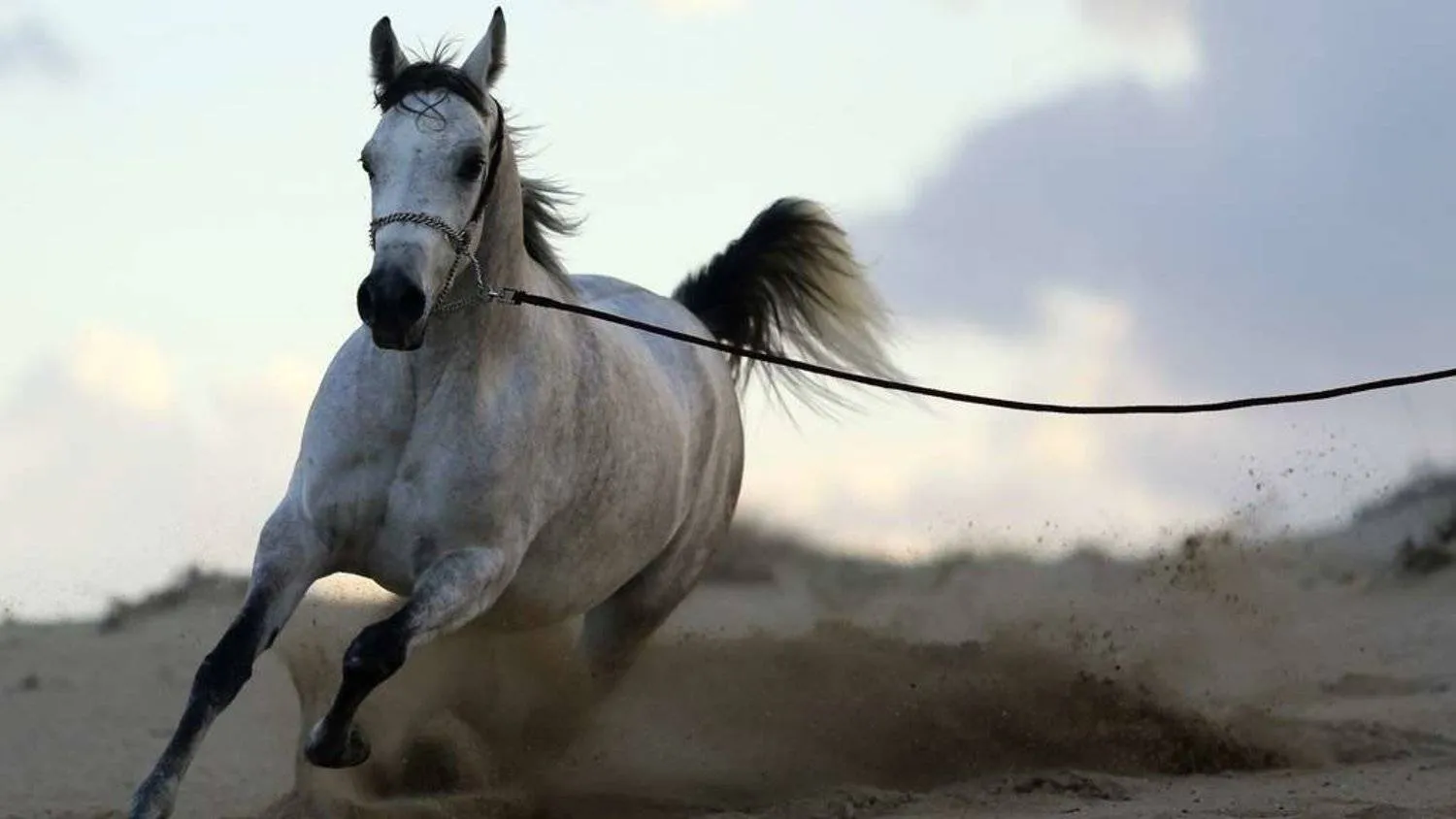
Championship for Purebred Arabian Horses to Kick Off on January 25 in Riyadh

File photo: The first session of the Saudi Arabian Horse Festival will be held in late January. (Reuters)
TT

Championship for Purebred Arabian Horses to Kick Off on January 25 in Riyadh

File photo: The first session of the Saudi Arabian Horse Festival will be held in late January. (Reuters)

The beauty championship for purebred Arabian horses starts on January 25 at the Prince Sultan bin Abdulaziz International Arabian Horse Festival in Riyadh, SPA said on Saturday.

The event, which is sponsored by the Sultan bin Abdulaziz Al-Saud Foundation, features more than 200 elite Arabian horses.

The horses and their 111 owners, from nine different countries, will participate in the three-day event at the King Abdulaziz Arabian Horse Center in Riyadh.

A chosen group of horses will vie for championship titles in the international festival, recognized as the highest-ranking Arabian horse beauty show globally (Title Show), featuring substantial monetary prizes.

Salah Al-Ali, the festival's general director, has affirmed the administration's readiness to welcome the participating horses. He has also conveyed a strong commitment to preparing the festival in a manner that aligns with the stature of Saudi Arabia and mirrors the values and traditions of the Kingdom.

The championship is one of the activities of Prince Sultan bin Abdulaziz International Arabian Horse Festival and a prestigious international event through which purebred Arabian horses are showcased, which is held under the supervision and umbrella of the King Abdulaziz Center for Purebred Arabian Horses.


US Man Ends Fight to Reclaim his 12-foot Alligator Seized in 2024

FILE - Tony Cavallaro holds a photo of his pet alligator, Albert, on March 19, 2024, in Hamburg, N.Y. (AP Photo/Carolyn Thompson, File)
TT

US Man Ends Fight to Reclaim his 12-foot Alligator Seized in 2024

FILE - Tony Cavallaro holds a photo of his pet alligator, Albert, on March 19, 2024, in Hamburg, N.Y. (AP Photo/Carolyn Thompson, File)

An upstate New York man who had his alligator seized after sharing a home for more than three decades has given up his court fight to get back the reptile he affectionately named Albert.

Tony Cavallaro sued the state Department of Environmental Conservation after officers met him with a warrant in the driveway of his home in the Buffalo suburb of Hamburg in March 2024. The officers sedated the 12-foot (3.6-meter), 750-pound (340-kilogram) alligator and drove him away in a van.

Albert, who lived in an indoor swimming pool, eventually ended up in a sanctuary in Texas.

Cavallaro sued over the state's denial of a license to keep Albert. But the 66-year-old said Thursday that the legal action had consumed his life for two years. With no quick end in sight, he decided last month that he couldn't deal with the exhausting battle anymore, The Associated Press reported.

“They were never going to give me this alligator back, and it was going to cost me a ton more money. Another year and a half — at least — of stress,” Cavallaro said in a phone interview.

Cavallaro’s license to keep Albert had expired in 2021, according to the department. But even if it had been renewed, Cavallaro had let other people pet the alligator and even get in the pool with him, providing grounds for the removal under the rules for keeping animals classified as dangerous, the agency said after the seizure.

The seized alligator had blindness in both eyes and spinal complications, among other health issues, according to the state.

Cavallaro has insisted that Albert was “just a big baby” who had never shown signs of aggression. He bought the alligator at an Ohio reptile show when it was two months old and considered him an “emotional support animal.”

Cavallaro said he has not seen Albert since the animal was taken away, though he has seen photographs.

“I’m not at peace. I don’t think I ever will be,” he said. “I’m very angry about the whole thing.”


IUCN: Emperor Penguins Listed as Endangered Species

This handout photograph released by The British Antarctic Survey on April 8, 2026, shows Emperor Penguins on Antarctica on November 13, 2010. (Photo by PETER BUCKTROUT / BRITISH ANTARCTIC SURVEY / AFP)
TT

IUCN: Emperor Penguins Listed as Endangered Species

This handout photograph released by The British Antarctic Survey on April 8, 2026, shows Emperor Penguins on Antarctica on November 13, 2010. (Photo by PETER BUCKTROUT / BRITISH ANTARCTIC SURVEY / AFP)

The emperor penguin has been declared an endangered species as climate change pushes the icon of Antarctica a step closer to extinction, the global authority on threatened wildlife announced on Thursday.

Its change of status from "near threatened" to "endangered", made by the International Union for Conservation of Nature (IUCN), underscores the existential threat for ice-dependent species as global warming profoundly reshapes the frozen continent.

Emperor penguins rely on stable sea ice -- essentially platforms of frozen ocean water -- to live, hunt and breed.

Their numbers have plummeted as warming driven by greenhouse gas emissions has caused sea ice to break up earlier in the year.

The IUCN -- a global network of scientists, governments and conservation groups -- said changes in sea ice were expected to halve the emperor penguin population by the 2080s.

They "concluded that human-induced climate change poses the most significant threat to emperor penguins", Philip Trathan, part of the IUCN expert group who worked on the Red List assessment, said in a statement.

The Red List of Threatened Species is maintained by the IUCN and is the global reference on the extinction status of plants, animals and fungi.

There are six classifications from "least concern" to "extinct".

Emperor penguins now rank two steps below "extinction in the wild" -- a species surviving in captivity only, and not in nature.

The Antarctic fur seal -- once hunted to near extinction for their pelts -- was also moved to "endangered", their numbers having dropped more than 50 percent since 1999.

"The ongoing decline is due to climate change, as rising ocean temperatures and shrinking sea ice are pushing krill to greater ocean depths in search of colder water, reducing the availability of food for seals," the IUCN said.

The largest and heaviest of the penguin species, boasting a brilliant golden-orange streak on the neck, emperor penguins have become symbolic of the fight to survive in Antarctica's harsh climes.

They breed on the sea ice in the dead of winter, the males keeping their eggs warm beneath their feet.

The frozen surface also provides a habitat for their chicks during moulting season before they are waterproof.

Antarctic sea ice undergoes huge seasonal changes, expanding during winter and shrinking in summer.

But as global temperatures have reached new highs, sea ice has retreated earlier in the spring and become less stable.

Sea ice has been at record low levels since 2016 and the impact on emperor penguins has been well documented.

Satellite imagery indicates around 20,000 adults -- some 10 percent of the population -- disappeared between 2009 and 2018 alone, the IUCN said.

"This species is closely associated with sea ice and ice packs," Christophe Barbraud, a scientist at French research institute CNRS, told AFP.

"However, since 2016-2017, there has been a significant decrease in the extent of sea ice around Antarctica, and therefore without sea ice, it will have great difficulty surviving."

"The fate of these magnificent birds is in our hands," Rod Downie from conservation group WWF said in a statement.

"With the shocking decline in Antarctic sea ice that we are currently witnessing, these icons on ice may well be heading down the slippery slope towards extinction by the end of this century -- unless we act now."

The IUCN also moved the southern elephant seal from "least concern" to "vulnerable" following sharp population declines caused by a deadly contagious pathogen.


UK Animal Charity Rescues Over 250 Dogs from Single Home

This undated handout photo released to AFP on April 9, 2026 from the Royal Society for the Prevention of Cruelty to Animals (RSPCA) shows an image of poodle-cross dogs being kept in one home, at an undisclosed location in Britain. (Photo by Handout / ROYAL SOCIETY FOR THE PREVENTION OF CRUELTY TO ANIMALS (RSPCA / AFP)
TT

UK Animal Charity Rescues Over 250 Dogs from Single Home

This undated handout photo released to AFP on April 9, 2026 from the Royal Society for the Prevention of Cruelty to Animals (RSPCA) shows an image of poodle-cross dogs being kept in one home, at an undisclosed location in Britain. (Photo by Handout / ROYAL SOCIETY FOR THE PREVENTION OF CRUELTY TO ANIMALS (RSPCA / AFP)

An animal welfare charity has revealed it rescued more than 250 dogs from one UK home, with a photo of the scene prompting "disbelief" and false claims that the image was generated by artificial intelligence.

The Royal Society for the Prevention of Cruelty to Animals (RSPCA) said the more than 250 poodle-cross breeds were found at the property in an undisclosed location earlier this year.

The world's oldest animal welfare organization, the RSPCA took in 87 of the rescued canines, while the remainder went to another charity, the Dogs Trust.

The RSPCA said the "shocking" case was just the latest example of its staff discovering large numbers of pets needing rescuing from a single home.

It responded to 4,200 incidents last year across England and Wales that involved at least 10 animals at the same address -- a 70-percent rise since 2021.

Cases involving dozens and even hundreds of animals were "on the rise", and can be linked to mental health struggles, the cost-of-living crisis, or breeders operating with poor practices, the charity said.

According to AFP, the RSPCA said people had incorrectly suggested the image of the rescued poodle-cross dogs was fake, after it was posted on social media and caused "disbelief among the general public".

It showed dozens of the dogs, many in poor physical condition, crammed into the dilapidated living room of the home.

The charity has had to respond to dozens of comments from concerned people.

"This shocking image is the reality of many multi-animal cases and the situation our frontline officers seem to be confronting more and more," RSPCA Superintendent Jo Hirst said Wednesday after the photo went viral.

"We understand that people are so aghast they don't believe what they are seeing," she added in a statement. "But this photo is not AI -- it's real."

The RSPCA has not revealed further details about the case, including the location of the home, because the people involved were considered "extremely vulnerable", it said.

The numbers and living conditions of the dogs had rapidly grown out of control amid extenuating family circumstances, according to the charity.

Hirst said it was "the staggering reality of what can happen when even well-meaning owners become overwhelmed".

"Over-breeding can take over, and conditions can spiral out of control," she added.