Study of Polyglots Offers Insight on Brain’s Language Processing

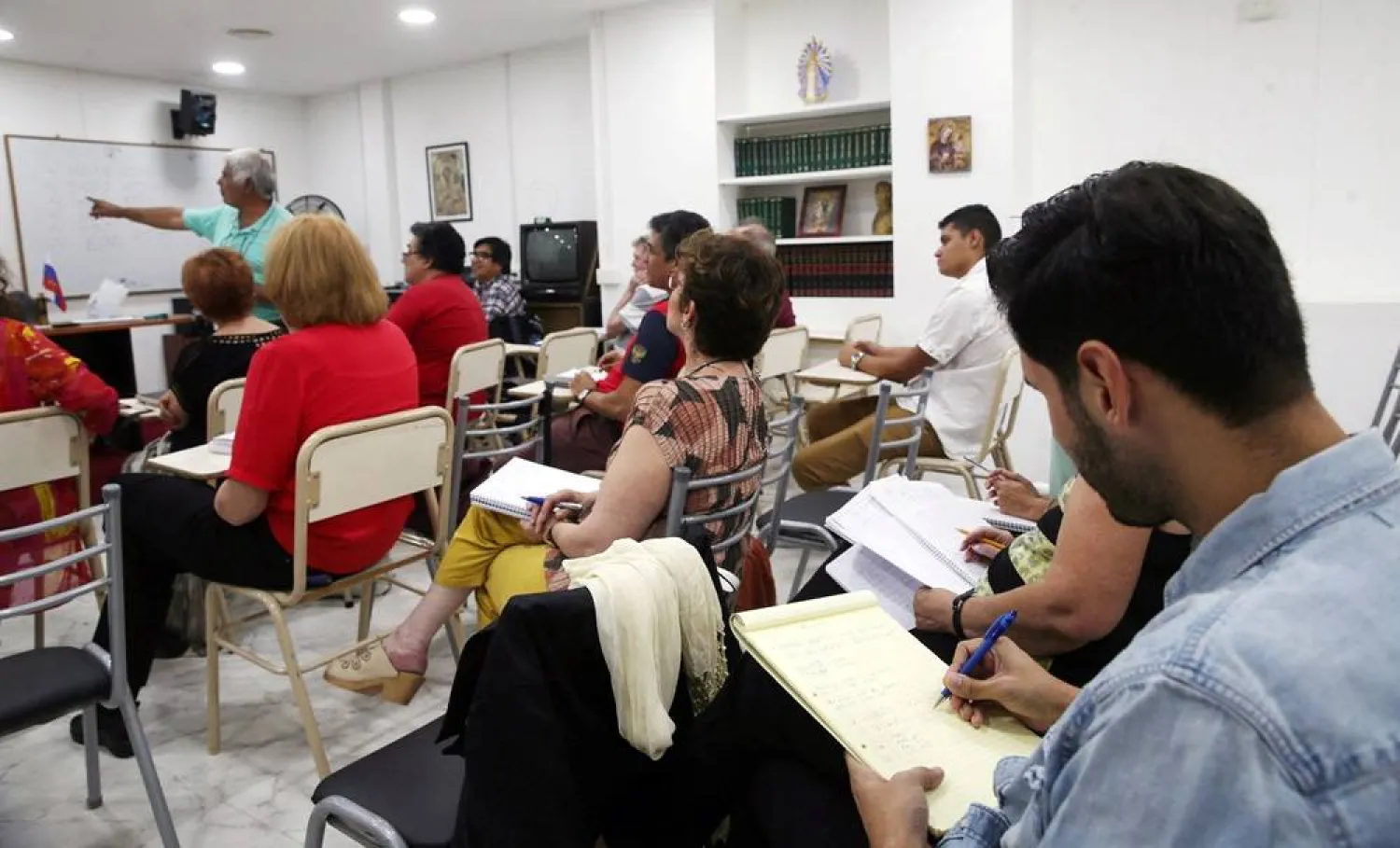
Student Jose Rodriguez Ramos of Peru takes notes during a Russian language class in Buenos Aires, Argentina, March 6, 2018. (Reuters)
TT

Study of Polyglots Offers Insight on Brain’s Language Processing

Student Jose Rodriguez Ramos of Peru takes notes during a Russian language class in Buenos Aires, Argentina, March 6, 2018. (Reuters)

While most people speak only one language or perhaps two, some are proficient in many. These people are called polyglots. And they are helping to provide insight into how the brain deals with language, the principal method of human communication.

In a new study involving a group of polyglots, the brain activity of the participants was monitored using a method called functional magnetic resonance imaging as they listened to passages read in various languages.

With one intriguing exception, activity increased in the areas of the cerebral cortex involved in the brain's language-processing network when these polyglots - who spoke between five and 54 languages - heard languages in which they were the most proficient compared to ones of lesser or no proficiency.

"We think this is because when you process a language that you know well, you can engage the full suite of linguistic operations - the operations that the language system in your brain supports," said Massachusetts Institute of Technology neuroscientist Evelina Fedorenko, a member of MIT's McGovern Institute for Brain Research and senior author of the study published on Monday in the journal Cerebral Cortex.

"You can access all the word meanings from memory, you can build phrases and clauses out of the individual words, and you can access complex, sentence-level meanings," Fedorenko added.

But an exception caught the attention of the researchers. In many of the participants, listening to their native language elicited a lesser brain response compared to hearing other languages they knew - on average down about 25%. And in some of the polyglots, listening to their native language activated only a part of the brain's language network, not the whole thing.

"Polyglots become experts in their native language from the point of view of efficiency of neural processes that are required to process it. Therefore, the language network in the brain does not activate as much when they do native versus non-native language processing," said neuroscientist and study co-lead author Olessia Jouravlev of Carleton University in Canada.

"One's native language may hold a privileged status, at least in this population," Fedorenko added, referring to the study's polyglot participants.

The brain's language network involves a few areas situated in its frontal and temporal lobes.

"The language network supports comprehension and production across modalities - spoken, written, signed, etc. - and helps us encode our thoughts into word sequences and decode others' thoughts from their utterances," Fedorenko said.

Study co-lead author Saima Malik-Moraleda, a doctoral student at the Harvard/MIT Program in Speech and Hearing Bioscience and Technology, said the findings suggest that the distillation of meaning governs brain response to language.

"The more meaning you can extract from the language input you are receiving, the greater the response in language regions - except for the native language, presumably because the speaker is more efficient in extracting meaning from the linguistic input," Malik-Moraleda said.

The 34 study participants, 20 men and 14 women, ranged in age from 19 to 71. Twenty-one were native English speakers, with the rest native speakers of French, Russian, Spanish, Dutch, German, Hungarian and Mandarin Chinese.

Their brain activity was monitored when they listened to recordings of passages in eight languages: their native language, three others in which they were highly proficient, moderately proficient and minimally proficient, and then four they did not know. Half heard recordings of Lewis Carroll's "Alice in Wonderland." The other half heard recordings of biblical stories.

The lesser brain response to hearing one's native language was most pronounced among the study participants who heard the biblical stories - linguistically simpler, according to Fedorenko, than Carroll's writing.

"A lot of work in language research," Fedorenko said, "has focused on individuals with linguistic difficulties - developmental or acquired. But we can also learn a lot about cognitive and neural infrastructure of some function by looking at individuals who are 'experts' in that function. Polyglots are one kind of language 'experts.'"


Royal Commission for AlUla Launches 2026–2027 Archaeology Season in AlUla and Khaybar

The season further reflects RCU’s commitment to developing Saudi capabilities in archaeology and heritage through fieldwork - SPA
TT

Royal Commission for AlUla Launches 2026–2027 Archaeology Season in AlUla and Khaybar

The season further reflects RCU’s commitment to developing Saudi capabilities in archaeology and heritage through fieldwork - SPA

As part of its ongoing efforts to preserve AlUla’s cultural heritage and strengthen its position as a global center for archaeological research and knowledge, the Royal Commission for AlUla (RCU) has announced the launch of the 2026–2027 Archaeology Season across AlUla and Khaybar.

The season builds on previous years of archaeological research, excavation, documentation and conservation, reflecting RCU’s long-term commitment to studying one of northwest Arabia’s most significant archaeological landscapes, SPA reported.

This year’s program focuses on several key research themes, including early human presence, ancient Arabian kingdoms and oasis societies, routes of movement and pilgrimage, environmental history and water management, inscriptions and written heritage, and material culture and ways of life. These themes help connect archaeological evidence across sites, periods and disciplines, deepening understanding of how communities and civilizations lived over different historical periods.

At Hegra, research focuses on the ancient settlement center, including specialist studies of plant and animal remains and archaeological finds, supporting a deeper understanding of life at the site across multiple historical periods. In Dadan, the second phase of the Dadan Archaeological Project builds on the results of the preceding five-year project, focusing on funerary and residential areas to better understand the development of one of AlUla’s most important ancient centers over time.

In Khaybar, research examines the relationship between people and the oasis across different periods, including studies of the Neolithic (New Stone Age), a prehistoric period, the history of Khaybar during Islamic periods, sedimentary records, ancient environments and the natural resources that shaped human presence and cultural change.

Research into historic routes of movement in South AlUla also supports understanding of the pilgrimage and trade route landscape, including forts, railway stations and associated archaeological remains, and the travel networks that connected the region with its surroundings over time.

AlUla’s written heritage remains one of the key areas of archaeological research. More than 25,000 inscriptions have been recorded in AlUla, forming an important record of northwest Arabia’s history, languages and cultural interactions. Specialist studies also examine animal remains, ceramics, qanat water systems, oasis water management and material culture, moving beyond archaeological discoveries to develop a deeper understanding of aspects of daily life.

The season further reflects RCU’s commitment to developing Saudi capabilities in archaeology and heritage through fieldwork, laboratory analysis, specialist studies, digital documentation, community engagement and collaboration with international research institutions.

These efforts support knowledge transfer and the development of Saudi expertise in archaeology and heritage. University students actively participate in fieldwork, laboratory work, specialist studies and digital documentation, mentored by Saudi and international experts from collaborating institutions. The program also includes community activities that connect archaeological research with local knowledge through practical activities, museum and laboratory experiences, and site visits involving teachers, students, Rawis and rangers.

RCU’s archaeology program forms part of its wider commitment to preserving AlUla’s cultural heritage, advancing research and knowledge, and reinforcing the position of AlUla and Khaybar as areas of rich archaeological and historical significance and centers for archaeological research, cultural exchange and heritage-led development. These efforts align with Saudi Vision 2030’s objectives to safeguard Saudi Arabia’s national heritage, promote its cultural identity and share its heritage with the world.


Indonesia Fires Burned Over 1.9 Mn Hectares Through September, Says Monitor

 A drone view of a palm oil plantation area shrouded in haze from wildfires in South Arut, West Kotawaringin Regency, Central Kalimantan province, Indonesia, October 18, 2026. (Reuters)
A drone view of a palm oil plantation area shrouded in haze from wildfires in South Arut, West Kotawaringin Regency, Central Kalimantan province, Indonesia, October 18, 2026. (Reuters)
TT

Indonesia Fires Burned Over 1.9 Mn Hectares Through September, Says Monitor

 A drone view of a palm oil plantation area shrouded in haze from wildfires in South Arut, West Kotawaringin Regency, Central Kalimantan province, Indonesia, October 18, 2026. (Reuters)
A drone view of a palm oil plantation area shrouded in haze from wildfires in South Arut, West Kotawaringin Regency, Central Kalimantan province, Indonesia, October 18, 2026. (Reuters)

Fires in Indonesia burned through over 1.9 million hectares between January and the end of September this year, a monitor analyzing satellite imagery said on Monday.

The figure, an area nearly 12 times larger than London, is a conservative estimate in part because haze has complicated satellite verification, said David Gaveau, founder of deforestation monitoring site Nusantara Atlas.

Indonesia's government has not provided official figures for areas burned since announcing 202,000 hectares had been razed by the end of July.

Gaveau said the true scale of the burning was likely to be even higher than the 1,916,588 hectares his organization has detected so far.

"Our burned-area estimates are conservative for two reasons. First, we exclude individual burn scars smaller than 6.25 hectares... Second, we prioritize avoiding false detections," he said.

This year, the calculation has also been impacted by heavy haze, which has obscured satellite images at times.

"The total reported burned area therefore underestimates the true area burned," he said.

Even so, Nusantara Atlas data shows the area burned by the end of September this year was 38 percent higher than the same point in 2019.

The satellites the monitor uses were not available during severe fires in 2015, so comparable data is not available.

But Gaveau said it was likely this year would be similarly bad.

"My intuition is that it probably is as bad. If you look at the sheer number of hotspots, it's still trending up and up," he said.


Beijing’s Population Expected to Become Super-Aged by 2035

People cross the street at a busy intersection in Beijing, China, 19 October 2026. (EPA)
TT

Beijing’s Population Expected to Become Super-Aged by 2035

People cross the street at a busy intersection in Beijing, China, 19 October 2026. (EPA)

The ‌Chinese capital Beijing is expected to become "super-aged" by 2035, with around one-third of its population aged 60 and above, the official Beijing Daily reported.

Chinese policymakers have made population planning a key part of the country's economic strategy, and this year the government faces a total potential ‌cost of around ‌180 billion yuan ($26.92 billion) ‌to ⁠boost births, according ⁠to Reuters estimates.

One in every three residents of the Chinese capital will be aged 60 or above by 2035, the Beijing Daily reported on Saturday.

Beijing had ⁠5.29 million permanent residents aged ‌60 and above ‌at the end of last year, ‌almost one-quarter of its population, the ‌newspaper said.

The city's government is stepping up support for elderly residents, including raising the basic pension, the report added.

China's population has been shrinking since 2022 and is ageing ⁠rapidly, ⁠complicating government plans to boost domestic consumption and rein in debt, with hundreds of millions of people set to leave the workforce at a time when pension budgets are already stretched.

Demographers and economists argue that fewer children today could mean fewer households and slower consumption growth over time.