


In Japan Grand Prix town, Artist Hopes F1 can Revive Ancient Craft

Formula One paper model made with Ise Katagami by Kenji Tanaka is pictured at his house in Suzuka, Japan March 27, 2024. REUTERS/Irene Wang Purchase Licensing Rights
TT

In Japan Grand Prix town, Artist Hopes F1 can Revive Ancient Craft

Formula One paper model made with Ise Katagami by Kenji Tanaka is pictured at his house in Suzuka, Japan March 27, 2024. REUTERS/Irene Wang Purchase Licensing Rights

Across town from Japan's Suzuka Circuit, host to this week's Grand Prix, Kenji Tanaka has been perfecting his latest Formula One paper model that he hopes will draw international interest to a centuries-old craft.

Born in the town of Suzuka, where the racing event was first held in 1987, Tanaka has for the last nine years been making intricate models of cars, steering wheels and trophies, and giving some of them to drivers.

He uses a method of paper stencilling called Ise Katagami that began in the region more than 1,000 years ago as a way to print elaborate patterns on kimonos, the national dress of Japan.

New technology and waning demand for kimonos mean the few craftsmen who practise the traditional methods are seeking new ways to promote the art form, Reuters reported.

"I always go to see F1 every year. In 2015 I wanted to carve portraits into Ise Katagami and give them to F1 drivers as gifts. That’s how I started it," said Tanaka from his home, a few kilometres from the famous track.

Some of his artwork and a picture of former world champion Sebastian Vettel clutching one of his model trophies are on display in the town hall. This year, he plans to give a model steering wheel to Alpine driver Esteban Ocon.

Other local craftsmen have been trying different ways to promote Ise Katagami, such as making patterned light fittings.

"While we value the technique itself, we also need to think of new ways to use it, otherwise it will not survive," said Mitsuru Kobayashi, head of the Ise Katagami Cooperative Association.


Two Holy Mosques Exhibition Welcomes Visitors for Founding Day Celebrations

The exhibition is open daily from 10:00 a.m. to 1:30 a.m - SPA
TT

Two Holy Mosques Exhibition Welcomes Visitors for Founding Day Celebrations

The exhibition is open daily from 10:00 a.m. to 1:30 a.m - SPA

In celebration of the Kingdom’s Founding Day, the Exhibition of the Two Holy Mosques Architecture in Makkah is welcoming visitors to explore a comprehensive historical journey.

The exhibition presents the evolution of the Two Holy Mosques through rare artifacts, historical photographs, and documentation of successive Saudi expansions, according to SPA.

The halls highlight the Kingdom’s long-standing dedication to serving the Two Holy Mosques. They combine heritage and modern technology to present the architectural development of Islam’s holiest sites.

The exhibition is open daily from 10:00 a.m. to 1:30 a.m.


Photos Show Filming of Ramadan TV Drama Series on the War-scarred Streets of Syria's Aleppo

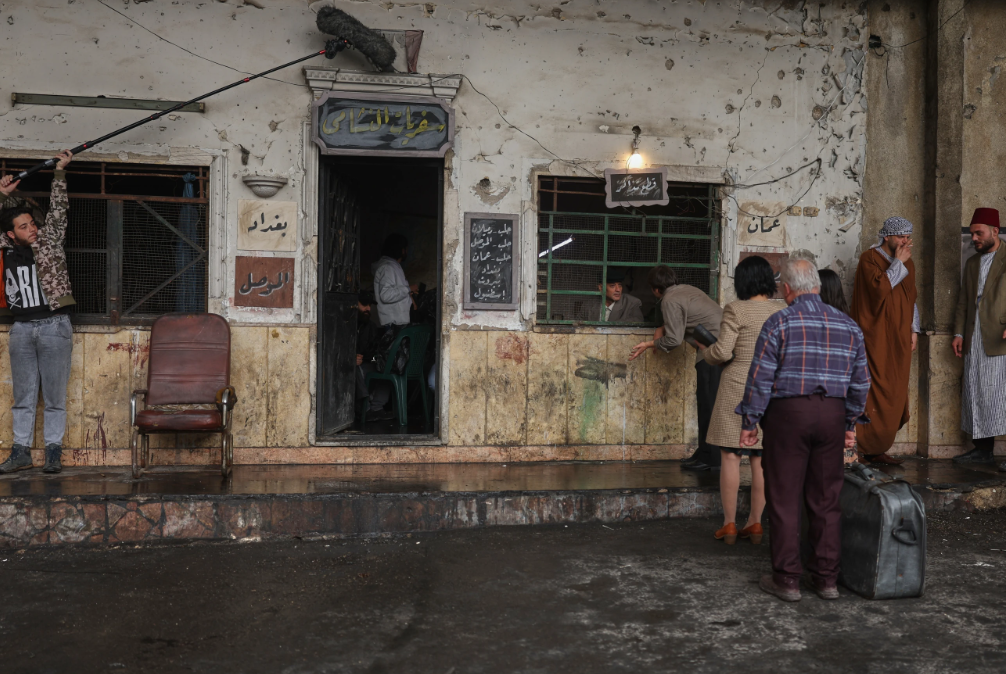
Extras stand by as a television crew films an episode of the TV series “Al-Souriyoun al-Aada” (“The Syrian Enemies”), based on a novel of the same name that was banned under Bashar Assad, along a transformed street in central Aleppo, Syria, Friday, Feb. 13, 2026. (AP Photo/Ghaith Alsayed)
TT

Photos Show Filming of Ramadan TV Drama Series on the War-scarred Streets of Syria's Aleppo

Extras stand by as a television crew films an episode of the TV series “Al-Souriyoun al-Aada” (“The Syrian Enemies”), based on a novel of the same name that was banned under Bashar Assad, along a transformed street in central Aleppo, Syria, Friday, Feb. 13, 2026. (AP Photo/Ghaith Alsayed)

Ramadan in the Arab world is a month of fasting and prayer by day — and television by night. For decades, families have gathered after the iftar, the evening meal that breaks the daytime fast, to follow the season’s highly anticipated drama series, produced specially to air during the Islamic holy month.

In the week before Ramadan, a television crew in central Aleppo was busy preparing one of those productions, with a battered street in the historic city transformed into a scene from decades past.

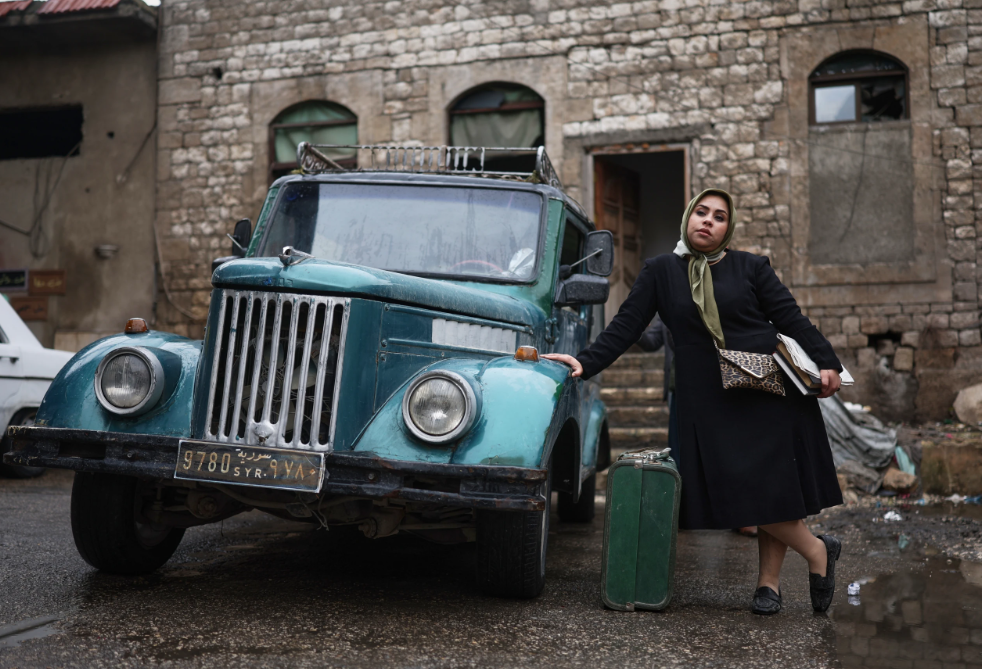
Lamees Al-Ali, an extra in the series, poses for a photograph during the filming of an episode of the TV series “Al-Souriyoun al-Aada” (“The Syrian Enemies”), based on a novel of the same name that was banned under Bashar Assad, along a transformed street in central Aleppo, Syria, Friday, Feb. 13, 2026. (AP Photo/Ghaith Alsayed)

Classic 1970s cars lined the curb. A horse-drawn cart rolled through the frame. A vendor in a red tarboush, a brimless cone-shaped hat, stood beside steaming pots of sahlep — a sweet, thickened milk drink flavored with spices and associated with winter evenings.

Just outside the camera’s view stood a stark reminder of Syria's more recent history. Collapsed buildings and damaged facades testified to Aleppo’s role as a major battleground during the country's civil war. However, with costumes, props and careful framing, the production temporarily carried the street back to what it portrays as a more innocent era, according to The AP news.

A television crew films an episode of the TV series “Al-Souriyoun al-Aada” (“The Syrian Enemies”), based on a novel of the same name that was banned under Bashar Assad, along a transformed street in central Aleppo, Syria, Friday, Feb. 13, 2026.(AP Photo/Ghaith Alsayed)

The series being filmed — “Al-Souriyoun al-Aada,” or “The Syrian Enemies” — is based on a novel that was banned during the rule of former President Bashar Assad. The story examines painful chapters of Syria’s past, including the 1982 events in Hama, when government forces crushed an uprising led by the Muslim Brotherhood, killing or disappearing an estimated 10,000 to 40,000 people and leaving the city in ruins.

As filming continues into Ramadan, the production reflects both a cherished seasonal tradition and Syria’s complex, layered history.


How Bomb Cyclones Form and Create Dangerous Conditions 

A man works in a snowstorm, Sunday, Feb. 22, 2026, in New York. (AP)
TT

How Bomb Cyclones Form and Create Dangerous Conditions 

A man works in a snowstorm, Sunday, Feb. 22, 2026, in New York. (AP)

When turbulent weather with whipping winds and heavy snow is in the forecast, meteorologists sometimes warn that a storm could “bomb out” or become a bomb cyclone. But what exactly does this mean?

According to the US National Oceanic and Atmospheric Administration, certain storms undergo bombogenesis, which happens when a storm’s central pressure drops at least 24 millibars in 24 hours. These storms are sometimes called bomb cyclones. Storm intensity is measured by central pressure, so the lower the pressure, the stronger the storm.

Such rapidly strengthening storms are capable of producing heavy rain, blizzard conditions and intense winds that can create dangerous conditions such as downed trees and power outages.

“If you’re watching TV at night and the weather report comes on and you’re hearing ‘bomb cyclone’ being used, that usually means there’s quite a bit of active weather going on,” said Andrew Orrison, a meteorologist with the National Weather Service in College Park, Maryland.

Bomb cyclones can happen in any season, but mainly occur during fall and winter when frigid air from the Arctic can creep south and clash with warmer air masses.

“It’s really the clash of those air masses that really kind of helps to generate the areas of low pressure in the first place,” said Orrison.

Regions in North America that are prone to seeing bomb cyclones include Alaska, the Pacific Northwest and the Great Lakes region.
