


More than 2,100 People Are Evacuated as an Indonesian Volcano Spews Clouds of Ash

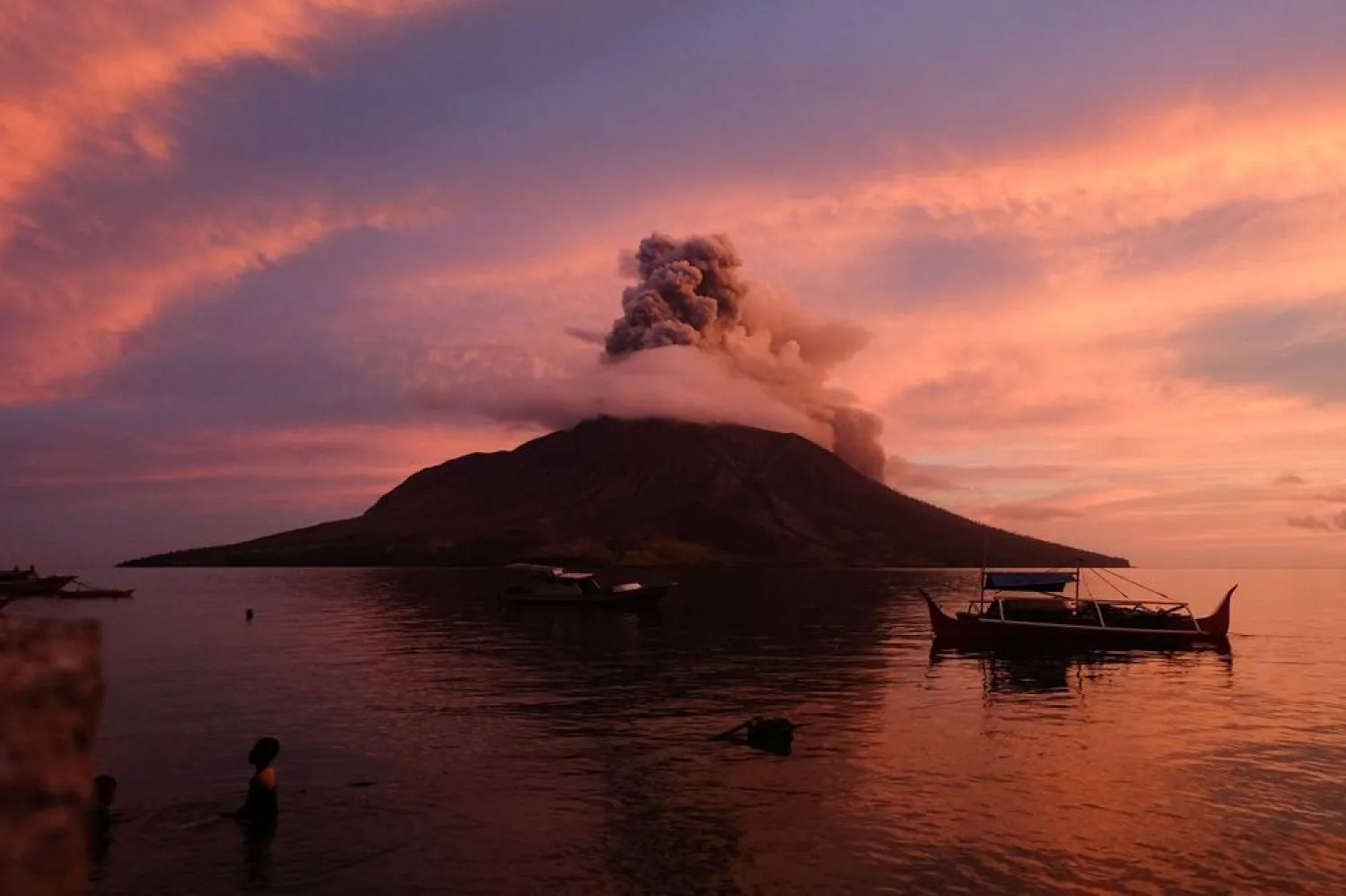
Mount Ruang volcano erupts in Sitaro, North Sulawesi, on April 19, 2024. (AFP)
TT

More than 2,100 People Are Evacuated as an Indonesian Volcano Spews Clouds of Ash

Mount Ruang volcano erupts in Sitaro, North Sulawesi, on April 19, 2024. (AFP)

More than 2,100 people living near an erupting volcano on Indonesia's Sulawesi Island were evacuated Friday due to the dangers of spreading ash, falling rocks, hot volcanic clouds and the possibility of a tsunami.

Indonesia's Center for Volcanology and Geological Hazard Mitigation recorded at least three eruptions since Friday afternoon, with the maximum height of the eruption column reaching 1,200 meters (3,900 feet).

An international airport in Manado city, less than 100 kilometers (60 miles) from the erupting Mount Ruang, is still temporarily closed as volcanic ash was spewed into the air.

Satellite imagery from the Meteorology, Climatology and Geophysics Agency shows the ash has spread to the west, northwest, northeast and southeast, covering Manado and North Minahasa, according to a statement from Indonesia’s Transportation Ministry.

“We are still monitoring developments in the eruption of Mount Ruang and coordinating with relevant stakeholders ... to anticipate the necessary actions to ensure flight safety, security and comfort,” said Ambar Suryoko, head of the regional airport authority.

More than 11,000 people were told to leave their homes that were located in the affected area. A joint team from the local authorities combed the villages surrounding the volcano and evacuated residents to safer areas by boat.

Officials worry that part of the volcano could collapse into the sea and cause a tsunami, as happened in an eruption there in 1871.

Houses, roads and other buildings were covered by gray volcanic ash, and many roofs were broken by debris spewed from the eruption.

Mount Ruang saw at least five large eruptions Wednesday, causing the Center for Volcanology and Geological Hazard Mitigation to issue its highest level of alert. People were ordered to stay at least 6 kilometers (3.7 miles) from the 725-meter (2,378-foot) mountain.

The observation from the agency on Friday said white smoke was rising from the main crater with medium to thick intensity.

East of the volcano, Tagulandang Island could be at risk if a collapse occurred. Its residents were among those being told to evacuate. Indonesia’s National Disaster Mitigation Agency said residents would be relocated to Manado, a journey of 6 hours by boat.

Indonesia, an archipelago of 270 million people, has 120 active volcanoes. It is prone to volcanic activity because it sits along the “Ring of Fire,” a horseshoe-shaped series of seismic fault lines around the Pacific Ocean.

Questions over Machado's Whereabouts as Nobel Event Postponed

It remains unclear whether Nobel Peace Prize laureate Maria Corina Machado will be able to attend the ceremony in person. Odd ANDERSEN / AFP
TT

Questions over Machado's Whereabouts as Nobel Event Postponed

It remains unclear whether Nobel Peace Prize laureate Maria Corina Machado will be able to attend the ceremony in person. Odd ANDERSEN / AFP

Nobel officials delayed a press conference with Peace Prize laureate Maria Corina Machado in Oslo Tuesday, but said they remained confident Venezuela's elusive opposition leader would collect her award in person.

It was not known whether Machado, who has been in hiding since August 2024, was in the city. The Venezuelan government has said it would declare her a "fugitive" if she attends, putting her at risk of arrest if she tries to re-enter the country, AFP reported.

Her family is already in the Norwegian capital and said they hoped she would attend.

The press conference, traditionally held by the prizewinner on the eve of the December 10 award ceremony in Oslo, was expected to be the 58-year-old's first public appearance in 11 months.

In a message to the media early Tuesday, the institute said the press conference was "postponed", without giving a reason for the delay.

"Everything suggests that we will manage to organize a press conference today," Nobel Institute spokesman Erik Aasheim told AFP.

It remained however unclear whether Machado had arrived in Oslo and would be able to accept her award in person on Wednesday.

The chairman of the Norwegian Nobel Committee, Jorgen Watnes Frydnes, told AFP early Tuesday that her presence was "more or less" confirmed.

Machado has accused Venezuelan President Nicolas Maduro of stealing the July 2024 election she was banned from standing in, a claim backed by much of the international community.

She has lived in hiding in Venezuela since August 2024.

She last appeared in public at a demonstration in Caracas on January 9, protesting against Maduro's inauguration for his third term.

The Nobel Peace Prize was awarded to Machado on October 10 for her efforts to bring democracy to Venezuela, challenging the iron-fisted rule of Maduro, who has been president since 2013.

'Fugitive'

Venezuela's attorney general, Tarek William Saab, said last month the opposition leader would be considered a "fugitive" if she travelled to Norway to accept the prize.

"By being outside Venezuela and having numerous criminal investigations, she is considered a fugitive," Saab told AFP, adding she is accused of "acts of conspiracy, incitement of hatred, terrorism."

Venezuelan Interior Minister Diosdado Cabello said Monday he did not know if she would travel to Oslo.

The Nobel prize ceremony will take place on Wednesday at 1:00 pm (1200 GMT) at Oslo's City Hall.

Several members of Machado's family, including her mother, three sisters and daughter, were already in Oslo for the event.

"I would never have imagined it. I had heard and read that she had been nominated" for the award, her mother Corina Parisca de Machado told AFP on Monday, recalling the day her daughter won.

"I thought: 'Caramba! (Wow!) What a wonderful day that would be'," the 84-year-old added.

Several Latin American leaders, including Argentine President Javier Milei -- like Machado, an ally of US President Donald Trump -- were also expected to attend the ceremony.

Seen in Oslo on Monday was Panama's President Jose Raul Mulino, who said he came to "congratulate the hero of democracy and the struggling Venezuelan people" and voiced hope for a "return to democracy in Venezuela as soon as possible".

A large police presence has meanwhile stood guard since Monday outside the Grand Hotel in central Oslo, which traditionally hosts the Nobel Peace Prize laureates, AFP journalists said.

While Machado has been hailed by many for her efforts to bring democracy to Venezuela, she has also been criticized by others for aligning herself with Trump, to whom she has dedicated her Nobel Prize.

The Oslo ceremony coincides with a large US military build-up in the Caribbean in recent weeks and deadly strikes on what Washington says are drug smuggling boats.

Maduro insists that the real goal of the US operations -- which Machado has said are justified -- is to topple the government and seize Venezuela's oil reserves.

If Machado does come to Norway to accept her prize, the question then arises of how she would re-enter Venezuela.


Beware: Your Morning Coffee Could Lead to Chronic Pain

Greater coffee consumption could lead to higher pain (AFP) 
TT

Beware: Your Morning Coffee Could Lead to Chronic Pain

Greater coffee consumption could lead to higher pain (AFP) 

A new research has suggested that while starting the morning with a cup of coffee is essential to help kickstart your day, it could also be worsening chronic pain.

A study by academics at Nicolaus Copernicus university in Poland has linked greater coffee consumption to higher pain levels in older adults, the Independent reported.

The research, which surveyed 205 healthy adults aged between 60 and 88 across two years, asked participants to track their fish and coffee intakes and pain levels using a ten-point scale.

Scientists found an increased coffee intake was linked to a 6.56-point rise in pain intensity when compared with those who decreased their coffee intake.

However, an increased oily fish intake was associated with a 4.45-point reduction in pain intensity. Researchers said this may be linked to the anti-inflammatory properties of omega-3 polyunsaturated fatty acids (PUFAs) in the fish.

“Participants who increased their frequency of fish consumption over two years experienced a significant reduction in pain intensity compared to those who decreased or maintained their intake, independent of multiple covariates,” the authors wrote.

“Conversely, those who increased coffee consumption reported elevated pain scores relative to those with decreased or unchanged intake.”

However, researchers said “caution” was needed in interpreting the conclusions of the study, saying future research was needed to confirm the associations.

A study published in 2020 found that having a cup of coffee before breakfast could lead to digestive pain and uncomfortable heartburn.

Scientists at the University of Bath found that, while one night of poor sleep had a limited impact on metabolism, drinking coffee could have a negative effect on blood glucose control.


2025 Will Be World’s Second or Third-Hottest Year on Record, EU Scientists Say

Last year was the planet's hottest on record. (AFP)
TT

2025 Will Be World’s Second or Third-Hottest Year on Record, EU Scientists Say

Last year was the planet's hottest on record. (AFP)

This year is set to be the world's second or third-warmest on record, potentially surpassed only by 2024's record-breaking heat, the European Union's Copernicus Climate Change Service (C3S) said on Tuesday.

The data is the latest from C3S following last month's COP30 climate summit, where governments failed to agree to substantial new measures to reduce greenhouse gas emissions, reflecting strained geopolitics as the US rolls back its efforts, and some countries seek to weaken CO2-cutting measures.

This year will also likely round out the first three-year period in which the average global temperature exceeded 1.5 degrees Celsius (2.7 degrees Fahrenheit) above the 1850-1900 pre-industrial period, when humans began burning fossil fuels on an industrial scale, C3S said in a monthly bulletin.

"These milestones are not abstract – they reflect the accelerating pace of climate change," said Samantha Burgess, strategic lead for climate at C3S.

Extreme weather continued to hit regions around the globe this year. Typhoon Kalmaegi killed more than 200 people in the Philippines last month. Spain suffered its worst wildfires for three decades because of weather conditions that scientists confirmed were made more likely by climate change.

Last year was the planet's hottest on record.

While natural weather patterns mean temperatures fluctuate year to year, scientists have documented a clear warming trend in global temperatures over time, and confirmed that the main cause of this warming is greenhouse gas emissions from burning fossil fuels.

The last 10 years have been the 10 warmest years since records began, the World Meteorological Organization said earlier this year.

The global threshold of 1.5 Celsius is the limit of warming which countries vowed under the 2015 Paris climate agreement to try to prevent, to avoid the worst consequences of warming.

The world has not yet technically breached that target - which refers to an average global temperature of 1.5 Celsius over decades. But the UN said this year that the 1.5 Celsius goal can no longer realistically be met and urged governments to cut CO2 emissions faster, to limit overshooting the target.

C3S's records go back to 1940, and are cross-checked with global temperature records going back to 1850.