


April Temperatures in Bangladesh Hottest on Record

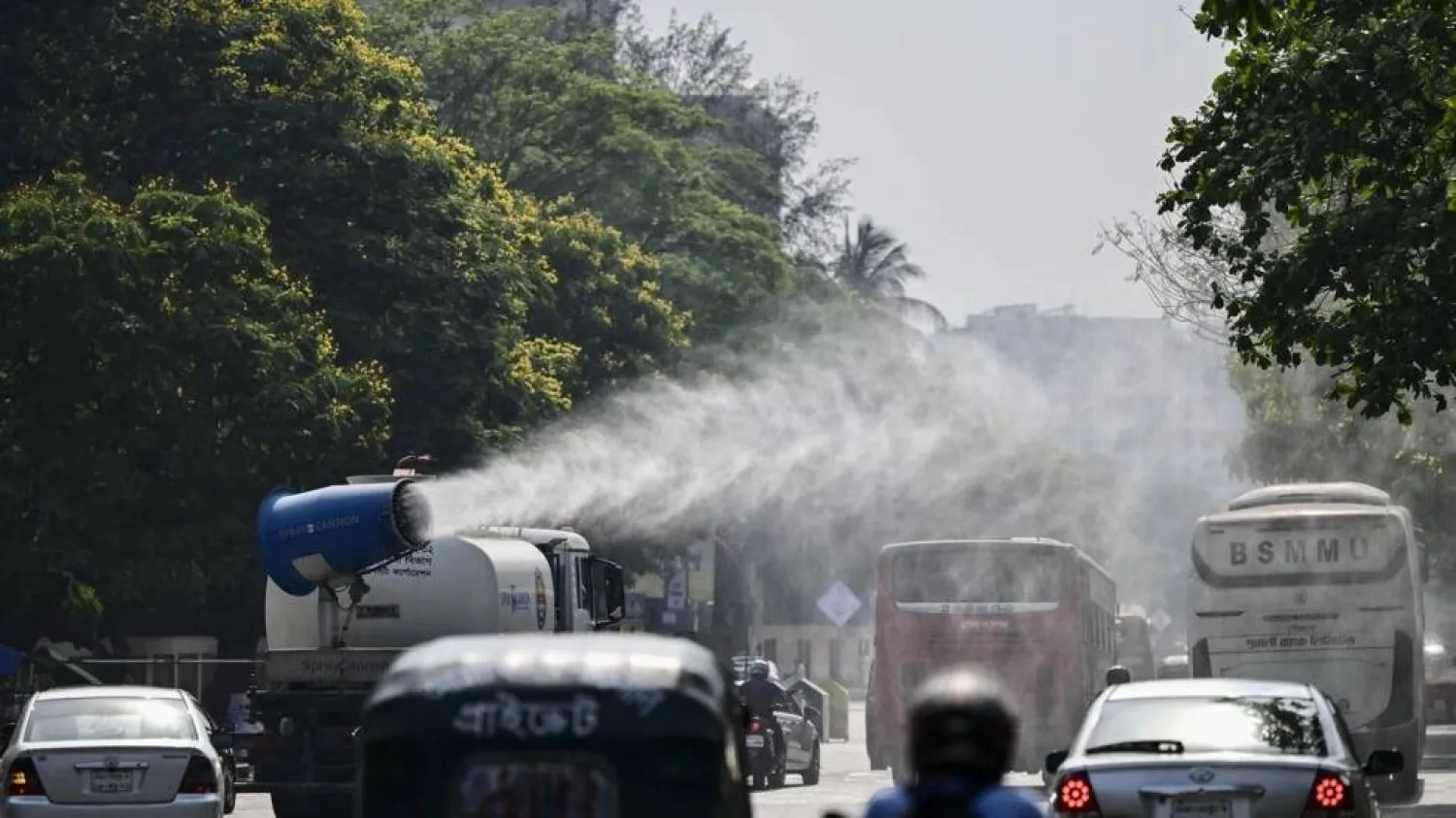
A vehicle of the Dhaka North City Corporation sprays water along a busy road to lower the temperature amidst a heatwave. MUNIR UZ ZAMAN / AFP
TT

April Temperatures in Bangladesh Hottest on Record

A vehicle of the Dhaka North City Corporation sprays water along a busy road to lower the temperature amidst a heatwave. MUNIR UZ ZAMAN / AFP

Bangladesh's weather bureau said Wednesday that last month was the hottest April on record, with the South Asian nation and much of the region still enduring a suffocating heatwave.
Extensive scientific research has found climate change is causing heatwaves to become longer, more frequent and more intense.
Punishing heat last month prompted Bangladesh's government to close schools across the country, keeping an estimated 32 million students at home.
"This year the heatwave covered around 80 percent of the country. We've not seen such unbroken and expansive heatwaves before," Bangladesh Meteorological Department senior forecaster Muhammad Abul Kalam Mallik told AFP.
He said last month was the hottest April in Bangladesh since records began in 1948 "in terms of hot days and area coverage in the country".
Weather stations around Bangladesh had recorded temperatures between two and eight degrees higher than the 33.2 degrees Celsius (91.8 degrees Fahrenheit) average daily temperature for April between 1981 and 2010, he added.
Health department spokesman Selim Raihan told AFP the government had confirmed at least 11 heat stroke-related deaths in the past 10 days.
Rains are expected to bring some relief to Bangladesh from Thursday after a week of sweltering temperatures, with the capital Dhaka recording several days over 40C (104F).
Mallik said the severity of the heat had been worsened by the absence of the usual pre-monsoon April thunderstorms which normally cool the South Asian nation ahead of summer.
"Bangladesh gets an average of 130.2 millimeters of rain in April. But this April we got an average of one millimeter of rain," he said.
Mallik said the bureau was checking data to confirm whether this year marked record low rainfalls for April.
Schools in Bangladesh will remain closed until Sunday.
The government ordered classrooms reopened last weekend, but a top Bangladeshi court directed them to be shut them again on Monday after taking into consideration reports that several teachers had died in the heatwave.
'Life has become unbearable'
Thousands gathered at mosques and in open fields around the Muslim-majority nation last week to pray for rain.
"Life has become unbearable due to lack of rains," Muhammad Abu Yusuf, an Islamic cleric who led one such service, told AFP last week.
"Poor people are suffering immensely."
Large swaths of South and Southeast Asia are sweltering through a heatwave that has topped temperature records from Myanmar to the Philippines, with the El Nino phenomenon also driving this year's exceptionally warm weather.
Weather bureaus in Cambodia, Myanmar, Vietnam and India have also all forecast temperatures above 40C (104F).
The months preceding the region's monsoon, or rainy season, are usually hot but temperatures this year are well above average in many countries.
Asia is also warming faster than the global average, according to the World Meteorological Organization, a UN agency.




Jazan Festival 2026 Kicks Off Thursday with Grand Parade

his year’s festival offers an unprecedented experience that brings together the charm of the region’s unique geographic diversity - SPA
TT

Jazan Festival 2026 Kicks Off Thursday with Grand Parade

his year’s festival offers an unprecedented experience that brings together the charm of the region’s unique geographic diversity - SPA

The Jazan Festival 2026 will launch on Thursday in a carnival anticipated by thousands of visitors from within the region and beyond.

The festival will open with a grand celebratory parade starting at 3:45 p.m. along the Jazan city waterfront, signaling the start of an entertainment and cultural season that will extend for several months, according to SPA.

This year’s festival offers an unprecedented experience that brings together the charm of the region’s unique geographic diversity, from its towering green mountains and golden beaches to its picturesque islands, alongside the authenticity of its rich heritage, complemented by modern touches in entertainment programs designed to meet the aspirations of all age groups.

Performing arts inspired by local folklore will add an authentic dimension, while moving installations will flow in harmonious rhythm.

Completing the visual spectacle, integrated light and sound shows will create an enchanting atmosphere before the festivities conclude with a dazzling fireworks display lighting up the Jazan sky in vibrant colors.


Russia Plans a Nuclear Power Plant on the Moon within a Decade

November's full moon, also known as Beaver Moon, rises over Fort-de-France in the French overseas island of Martinique, on November 5, 2025. (AFP)
TT

Russia Plans a Nuclear Power Plant on the Moon within a Decade

November's full moon, also known as Beaver Moon, rises over Fort-de-France in the French overseas island of Martinique, on November 5, 2025. (AFP)

Russia plans to put ​a nuclear power plant on the moon in the next decade to supply its lunar space program and a joint Russian-Chinese research station as major powers rush to explore the earth's only natural satellite.

Ever since Soviet cosmonaut Yuri Gagarin became the first human to go into space in 1961, Russia has prided itself as ‌a leading power in ‌space exploration, but in recent ‌decades ⁠it ​has fallen ‌behind the United States and increasingly China.

Russia's ambitions suffered a massive blow in August 2023 when its unmanned Luna-25 mission smashed into the surface of the moon while attempting to land, and Elon Musk has revolutionized the launch of space vehicles - once a Russian specialty.

Russia's state space corporation, Roscosmos, ⁠said in a statement that it planned to build a lunar power ‌plant by 2036 and signed a contract ‍with the Lavochkin Association ‍aerospace company to do it.

Roscosmos said the purpose of ‍the plant was to power Russia's lunar program, including rovers, an observatory and the infrastructure of the joint Russian-Chinese International Lunar Research Station.

"The project is an important step towards the creation of ​a permanently functioning scientific lunar station and the transition from one-time missions to a long-term lunar exploration program," ⁠Roscosmos said.

Roscosmos did not say explicitly that the plant would be nuclear but it said the participants included Russian state nuclear corporation Rosatom and the Kurchatov Institute, Russia's leading nuclear research institute.

The head of Roscosmos, Dmitry Bakanov, said in June that one of the corporation's aims was to put a nuclear power plant on the moon and to explore Venus, known as earth's "sister" planet.

The moon, which is 384,400 km (238,855 miles) from our planet, moderates the earth's wobble ‌on its axis, which ensures a more stable climate. It also causes tides in the world's oceans.


Seasonal Rains Transform Saudi Arabia’s Rawdat Muhanna into Natural Lake

People visit Rawdat Muhanna after recent rainfall. (SPA)
TT

Seasonal Rains Transform Saudi Arabia’s Rawdat Muhanna into Natural Lake

People visit Rawdat Muhanna after recent rainfall. (SPA)

Rawdat Muhanna, or Muhanna's Garden, located near the town of Al-Nabqiyah in the eastern part of Saudi Arabia’s Qassim region, has witnessed a notable influx of visitors and picnickers in recent days following rainfall that filled the Rawdat with water, transforming it into a vast natural lake.

The rare and striking scene has drawn residents and visitors from within and outside the region, reported the Saudi Press Agency on Tuesday.

Stretching over more than 10 kilometers, Rawdat Muhanna has become a breathtaking natural landscape amid the sands of Al-Thuwairat. The contrast between the blue waters and the red desert sand has created a picturesque panorama, making the site a favored destination for nature enthusiasts and photographers.

Rawdat Muhanna is one of the region’s prominent seasonal parks, as several valleys flow into it, most notably Wadi Al-Mustawi. These valleys contribute to the accumulation of large volumes of water, which in some seasons can remain for nearly a year, boosting the site’s ecological value and making it one of the most beautiful natural areas in the Qassim desert.

Visitors said Rawdat Muhanna has become an ideal destination for outdoor recreation and relaxation.