

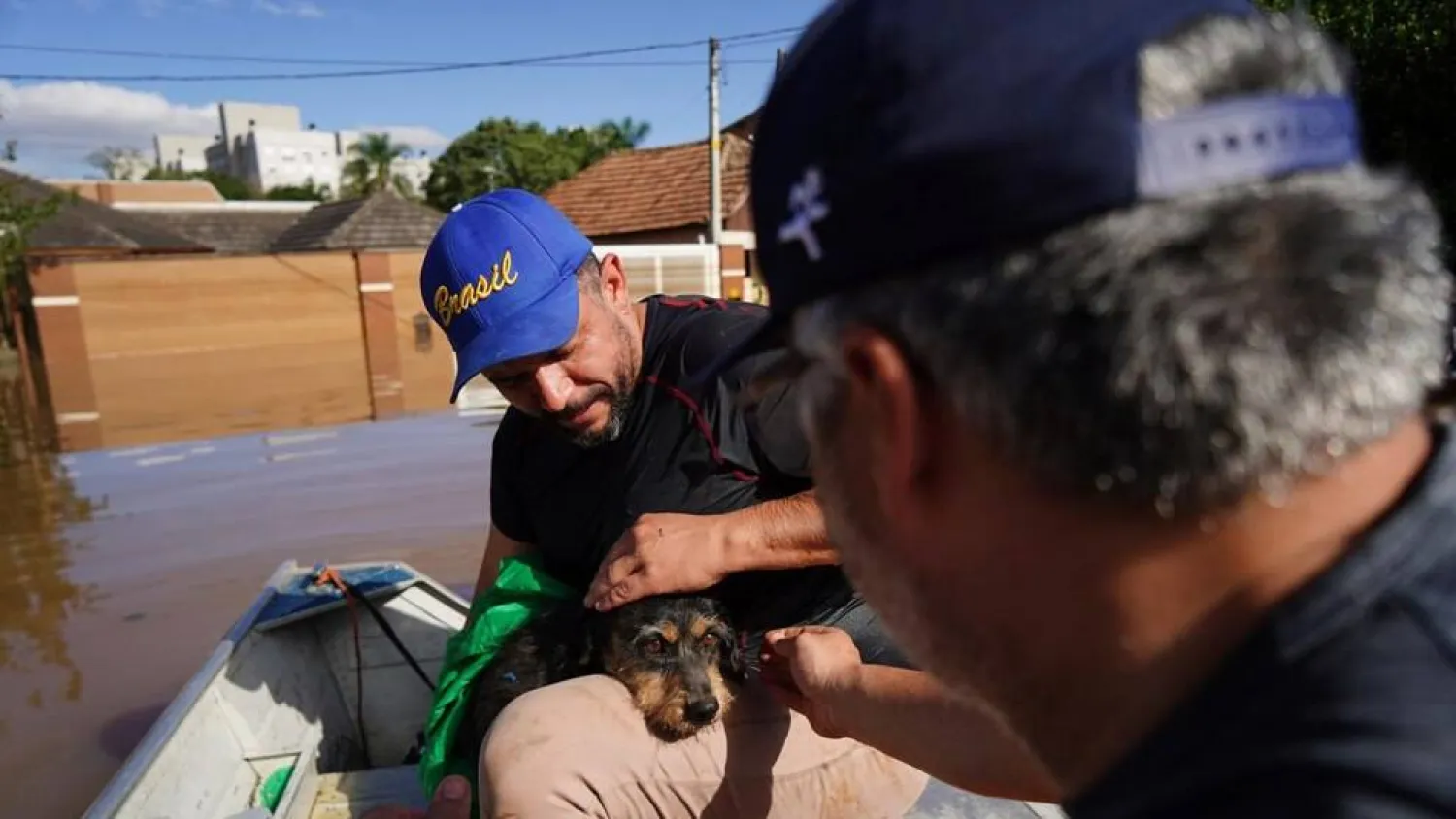

Makeshift Shelter Saves Hundreds of Dogs Amid Floods in Southern Brazil

People rescue a dog named Maia from a flooded area after heavy rain in Canoas, Rio Grande do Sul state, Brazil, Thursday, May 9, 2024. (AP Photo/Carlos Macedo)
TT

Makeshift Shelter Saves Hundreds of Dogs Amid Floods in Southern Brazil

People rescue a dog named Maia from a flooded area after heavy rain in Canoas, Rio Grande do Sul state, Brazil, Thursday, May 9, 2024. (AP Photo/Carlos Macedo)

Hundreds of volunteers have set up a makeshift dog shelter in an abandoned, roofless warehouse in the Brazilian city of Canoas, one of the hardest hit by floods since last week. They treat and feed sick, hungry or injured dogs, hoping to reunite them with their owners.

Their work was at full speed Friday morning as heavy rains are expected again in the region for the weekend.

Floods in Rio Grande do Sul have killed at least 107 people. Another 136 are reported missing and more than 230,000 have been displaced, according to state authorities. There is no official tally for the number of animals that have died or are missing, but local media estimated the number to be in the thousands, The AP reported.

Since Sunday, the makeshift shelter, about the size of a football pitch, has welcomed hundreds of ill and agitated canines from inundated areas. Every hour, between 20 and 30 dogs arrive, many of them injured after having been run over or nearly drowned. The shelter sends some to veterinary hospitals, but others in need of medical attention are too frail to be transported.

Hairdresser Gabriel Cardoso da Silva, 28, is one of the main organizers of the improvised facilities. He came from neighboring city of Gravatai, which was not hit by the heavy rains.

“We came here on Saturday to help rescue people. When we were about to leave, we heard the barking. I and my wife felt so moved, we just cried; we have two dogs,” said Silva.

With no government coordination for the displaced animals, many were drawn to the movement following a social media campaign.

“Sunday we had 10 volunteers, now we have 200. We have tons of food. Our community chose to embrace this, but days ago we felt so alone.”

Whenever a dog is reunited with family, the hairdresser shouts “One less!” so other volunteers can stop and applaud throughout the shelter, which is covered in dog food, chains to stop them from fighting with each other and donations.

Cardoso's cry often mixes with loud barks of small and jittery dogs, fights between distraught homeless pets and frantic movement by desperate families trying to locate one or more of their members.

Éder Luis da Silva Camargo, a garbage collector in Canoas, found two of his six dogs at the center after searching for two days. Hunter and Preta were separated from him on Tuesday, as they boarded different boats during a rescue operation.

“They were so scared then, they ran to the side and we couldn’t run after them. Now, thank God, we found them here,” Camargo said.

He and his wife Jenifer Gabriela, 21, want to find their four dogs that are still missing: Bob, Meg, Polaca and Ravena.

“This is the third place we came to look for them. This is great, but we still want to find the others,” Gabriela said.

Animal protection groups and volunteers have shared images of difficult rescues and heartwarming scenes of pets reuniting with their owners on social media, which has spurred Brazilians to send donations and brought veterinarians to the region.

One video that went viral showed a man crying inside a boat, hugging his four dogs after rescuers went back to his home to save them.

The tough situation of animals in southern Brazil became national news this week after a horse nicknamed Caramelo garnered attention for spending days stranded on a rooftop in Canoas, not far from the shelter.

About 24 hours after he was first spotted and with people clamoring for his rescue, a team in Brazil’s Rio Grande do Sul state on Thursday successfully removed Caramelo, providing a dose of hope to a beleaguered region.

Carla Sassi, chairwoman of Grad, a Brazilian nonprofit that rescues animals after disasters, said she met with state government officials in Canoas to discuss emergency measures to rescue pets. So far, according to volunteers, only business leaders and local residents have acted to save pets in flooded areas.



New York Subway Ends its MetroCard Era and Switches Fully to Tap-and-go Fares

Lev Radin, a MetroCard collector, shows his collection of Inaugural Limited Edition MetroCards, Dec. 10, 2025, in New York. (AP Photo/Yuki Iwamura)
TT

New York Subway Ends its MetroCard Era and Switches Fully to Tap-and-go Fares

Lev Radin, a MetroCard collector, shows his collection of Inaugural Limited Edition MetroCards, Dec. 10, 2025, in New York. (AP Photo/Yuki Iwamura)

When the MetroCard replaced the New York City subway token in 1994, the swipeable plastic card infused much-needed modernity into one of the world’s oldest and largest transit systems.

Now, more than three decades later, the gold-hued fare card and its notoriously finicky magnetic strip are following the token into retirement, The Associated Press reported.

The last day to buy or refill a MetroCard is Dec. 31, 2025, as the transit system fully transitions to OMNY, a contactless payment system that allows riders to tap their credit card, phone or other smart device to pay fares, much like they do for other everyday purchases.

Transit officials say more than 90% of subway and bus trips are now paid using the tap-and-go system, introduced in 2019.

Major cities around the world, including London and Singapore, have long used similar contactless systems. In the US, San Francisco launched a pay-go system earlier this year, joining Chicago and others.

MetroCards upended how New Yorkers commute The humble MetroCard may have outlasted its useful life, but in its day it was revolutionary, says Jodi Shapiro, curator at the New York Transit Museum in Brooklyn, which opened an exhibit earlier this month reflecting on the MetroCard’s legacy.

Before MetroCards, bus and subway riders relied on tokens, the brass-colored coins introduced in 1953 that were purchased from station booths. When the subway opened in 1904, paper tickets cost just a nickel, or about $1.82 in today’s dollars.

“There was a resistance to change from tokens to something else because tokens work,” Shapiro said on a recent visit to the museum, housed underground in a decommissioned subway station. “MetroCards introduced a whole other level of thinking for New Yorkers.”

The Metropolitan Transportation Authority launched public campaigns to teach commuters how to swipe the originally blue-colored cards correctly, hoping to avoid the dreaded error message or lost fares. Officials even briefly toyed with the idea of a quirky mascot, the Cardvaark, before coming to their senses.

The cards quickly became collectors items as the transit system rolled out special commemorative editions marking major events, such as the “Subway Series” between baseball’s New York Mets and the New York Yankees in the 2000 World Series. At the time, a fare cost $1.50.

Artists from David Bowie and Olivia Rodrigo to seminal New York hip hop acts, such as the Wu-Tang Clan, the Notorious B.I.G. and LL Cool J, have also graced the plastic card over the years, as have iconic New York shows like Seinfeld and Law & Order.

“For me, the most special cards are cards which present New York City to the world,” said Lev Radin, a collector in the Bronx. “Not only photos of landmarks, skylines, but also about people who live and make New York special.”

Perfecting the correct angle and velocity of the MetroCard swipe also became something of a point of pride separating real New Yorkers from those just visiting.

During her failed 2016 presidential campaign, Hillary Clinton, a former US Senator from New York, took an excruciating five swipes at a Bronx turnstile. In fairness, her chief Democratic opponent at the time, US Sen. Bernie Sanders of Vermont, a native Brooklynite, didn't even appear to realize tokens had been discontinued.

Cost savings and lingering concerns Unlike the MetroCard rollout, OMNY has required little adjustment.

Riders reluctant to use a credit card or smart device can purchase an OMNY card they can reload, similar to a MetroCard. Existing MetroCards will also continue to work into 2026, allowing riders to use remaining balances.

MTA spokespersons declined to comment, pointing instead to their many public statements as the deadline approaches.

The agency has said the changeover saves at least $20 million annually in MetroCard-related costs.

The new system also allows unlimited free rides within a seven-day period because the fare is capped after 12 rides. It'll max out at $35 a week once the fare rises to $3 in January.

Still, new changes come with tradeoffs, with some critics raising concerns about data collection and surveillance.

Near Times Square on a recent morning, Ronald Minor was among the dwindling group of "straphangers" still swiping MetroCards.

The 70-year-old Manhattan resident said he's sad to see them go. He has an OMNY card but found the vending machines to reload it more cumbersome.

“It’s hard for the elders,” Minor said as he caught a train to Brooklyn. “Don’t push us aside and make it like we don’t count. You push these machines away, you push us away.”

John Sacchetti, another MetroCard user at the Port Authority stop, said he likes being able to see his balance as he swipes through a turnstile so he knows how much he’s been spending on rides.

“It’s just like everything else, just something to get used to," he said as he headed uptown. "Once I get used to it, I think it’ll be okay.”


French Legend Brigitte Bardot Dead at 91

FILED - 01 April 1956, France, Cannes: Then French actress and singer Brigitte Bardot is photographed with a parrot in her hand on the beach during the Cannes Film Festival. Photo: -/AFP Intercontinentale/dpa
TT

French Legend Brigitte Bardot Dead at 91

FILED - 01 April 1956, France, Cannes: Then French actress and singer Brigitte Bardot is photographed with a parrot in her hand on the beach during the Cannes Film Festival. Photo: -/AFP Intercontinentale/dpa

French film legend Brigitte Bardot, a cinema icon of the 1950s and sixties who walked away from global stardom to become an animal rights protector, has died aged 91, her foundation said Sunday.

Bardot had rarely been seen in public in recent months but was hospitalized in October and in November released a statement denying rumors that she had died. The foundation did not say when or where she died.

"The Brigitte Bardot Foundation announces with immense sadness the death of its founder and president, Madame Brigitte Bardot, a world-renowned actress and singer, who chose to abandon her prestigious career to dedicate her life and energy to animal welfare and her foundation," it said in a statement sent to AFP.

Bardot became a global star after appearing in "And God created Woman" in 1956, and went on to appear in about 50 more movies before giving up acting.

She retired from film to settle permanently near the Riviera resort of Saint-Tropez where she devoted herself to fighting for animals.

Her calling apparently came when she encountered a goat on the set of her final film, "The Edifying and Joyous Story of Colinot.”

To save it from being killed, she bought the animal and kept it in her hotel room.


Iraqis Cover Soil with Clay to Curb Sandstorms

Excavators clear sand dunes and extract clay in the desert south of Samawah on December 21, 2025. (Photo by AHMAD AL-RUBAYE / AFP)
TT

Iraqis Cover Soil with Clay to Curb Sandstorms

Excavators clear sand dunes and extract clay in the desert south of Samawah on December 21, 2025. (Photo by AHMAD AL-RUBAYE / AFP)

Deep in Iraq's southern desert, bulldozers and earthmovers spread layers of moist clay over sand dunes as part of a broader effort to fight increasingly frequent sandstorms.

Iraq has long suffered from sand and dust storms, but in recent years they have become more frequent and intense as the country falls prey to the effects of climate change.

Sand and dust storms -- driven by severe drought, rising temperatures and deforestation -- have cloaked cities and villages in an endless ochre haze, grounded flights and filled hospitals with patients suffering from breathing difficulties.

Iraqi authorities have warned that these suffocating storms will intensify further, adding urgency to address the root of the problem.

In a relatively small area between the cities of Nasiriyah and Samawah, not far from ancient Sumerian ruins, laborers are working hard to stabilize the soil by applying a layer of moist clay 20-25 centimeters thick.

The project also includes planting heat-tolerant seedlings like Prosopis and Conocarpus to further stabilize the soil.

"The main goal is to reduce the impact of transboundary dust storms, which may reach Kuwait, Saudi Arabia and Qatar," said Udai Taha Lafta from UN-Habitat, which is leading the project to combat sandstorms with Iraqi expertise.

"It is a vital area despite its small size, and will hopefully help reduce dust storms next summer," AFP quoted Lafta as saying.

A short-term objective is to shield a southern highway where many traffic accidents have occurred due to poor visibility during dust storms.

The Ministry of Environment estimates that Iraq now faces about 243 storms per year, and the frequency is expected to increase to 300 "dust days" by 2050 unless drastic mitigation measures are adopted.

In 2023, Iraqi authorities teamed up with the UN-Habitat and the Kuwait Fund for Arab Economic Development in areas that have been identified as major sources of sandstorms.

The project has been implementing several methods in three southern areas, including digging water canals and supplying electricity to pump water from the Euphrates river, preparing barren lands for vegetation.

One of the project's ultimate goals is to increase green spaces and for farmers to eventually sustain the lands after droughts and chronic water shortages have drastically reduced agricultural areas.

Qahtan al-Mhana, from the agriculture ministry, said that stabilizing the soil gives agricultural efforts in sandy areas a chance to endure.

He added that Iraq has extensive "successful" experience in combating desertification and dust storms by stabilizing sand dunes.

Since the 1970s, the country has implemented such projects, but after decades of turmoil, environmental challenges have largely fallen by the wayside.

With the severe recent impact of climate change, "work has resumed," said Najm Abed Taresh from Dhi Qar University.

"We are making slow but steady progress," Taresh said.