

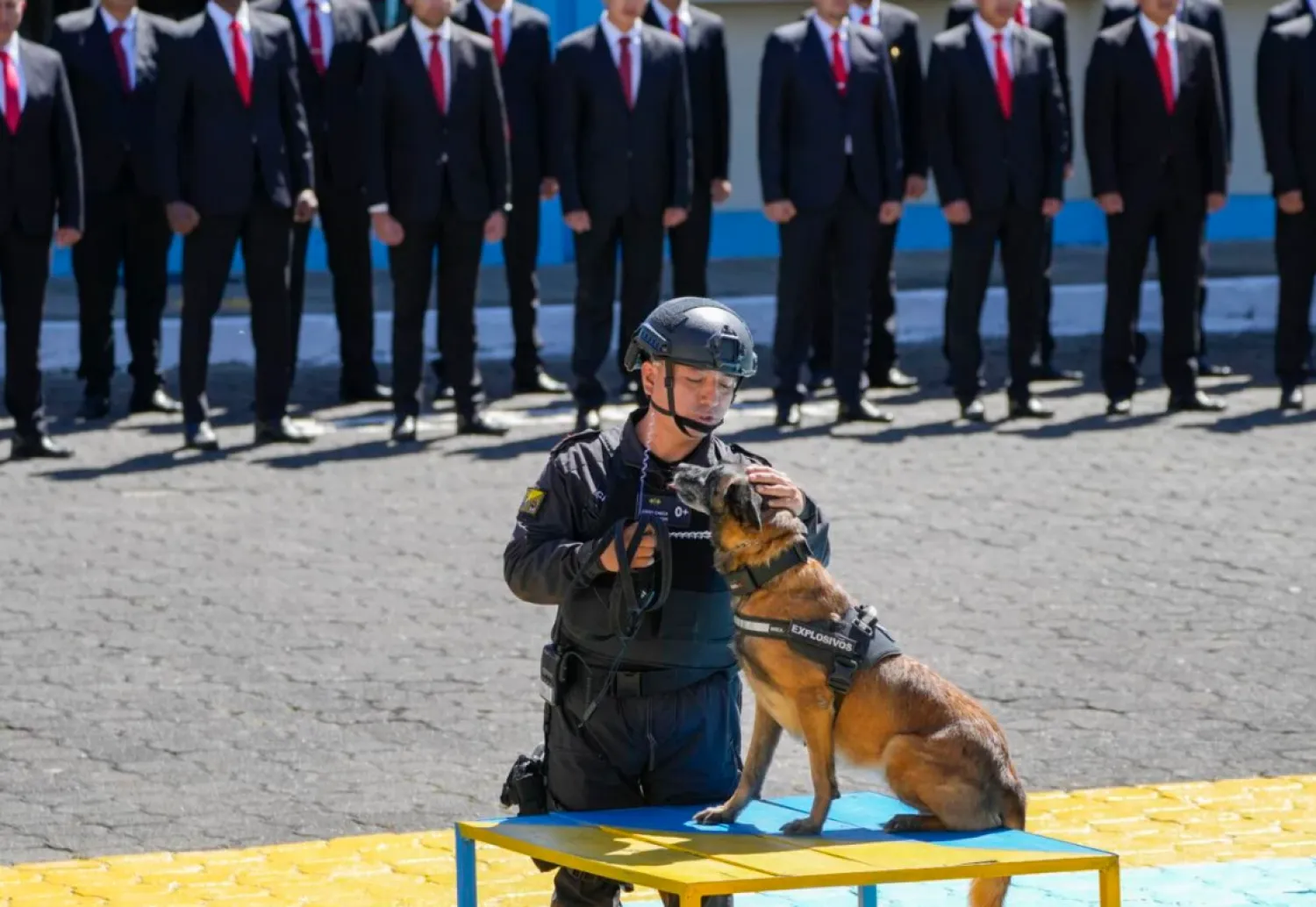

5 Dogs with Military Intelligence Unit in Ecuador Given Medals for Service

Uniformed men stood in formation as the canines received their medals (The AP)
TT

5 Dogs with Military Intelligence Unit in Ecuador Given Medals for Service

Uniformed men stood in formation as the canines received their medals (The AP)

The dogs were quick and precise. One located the drugs and neutralized the person carrying them. Another found explosives hidden under a car's tire.

The dogs — Dayco, Amanda, Apolo, Zeus and Maly — were showing their skills Monday at a military intelligence brigade ceremony south of Ecuador’s capital of Quito in which they received decorations for their service.

Uniformed men stood in formation as the canines received their medals, The AP reported.

The dogs have played “a crucial role in public security and the fight against organized crime,” said Col. Santiago Salazar, commander of the Calicuchima General Intelligence Brigade.

“We want to pay fair tribute and recognition to the dogs” for their role in the military operations that have intensified following the declaration of an internal armed conflict in response to gang violence, Salazar said.

This declaration has allowed Ecuador’s military to participate alongside police since January in tasks of controlling public order and conducting searches on the streets and in prisons.

In the demonstration, Apolo and his handler approached a group of people. A man in the group ran away at full speed. Apolo reached him in a few seconds and brought him to the ground. During a search, drugs were found on the man.

When Zeus’s turn came, his handler gave an order and the dog went to a parked vehicle, walked around it then sat next to the rear left tire. An explosive was found underneath the tire.

Salazar said the canine unit “has become a power of enormous importance and a vital resource for the security and well-being of society.”

Since the start of 2021, Ecuador has been rattled by a violent onslaught of criminal gangs linked to cartels in Colombia and Mexico fighting for control of drug trafficking routes and territory.



AlUla Ready for Eid Al-Fitr with Three Days of Cultural and Festive Events

Photo by SPA
Photo by SPA
TT

AlUla Ready for Eid Al-Fitr with Three Days of Cultural and Festive Events

Photo by SPA
Photo by SPA

The Royal Commission for AlUla has finalized preparations for a three-day Eid Al-Fitr celebration, featuring a comprehensive range of services and events across the governorate’s key heritage and leisure sites, SPA reported.

Dedicated areas for Eid prayers are also fully prepared to welcome residents and visitors, ensuring a festive environment that reflects the region's cultural traditions and enhances the quality of life during the holiday.


More Than 150,000 Uncounted COVID-19 Deaths Occurred Early in the Pandemic, Study Finds

People wait in long lines outside a center in San Diego, California, USA, for coronavirus testing during the outbreak, January 10, 2022. (Reuters)
TT

More Than 150,000 Uncounted COVID-19 Deaths Occurred Early in the Pandemic, Study Finds

People wait in long lines outside a center in San Diego, California, USA, for coronavirus testing during the outbreak, January 10, 2022. (Reuters)

The COVID-19 pandemic's early death toll was much higher than the official US count, according to a new study that spotlights dramatic disparities in the uncounted deaths.

About 840,000 COVID-19 deaths were reported on death certificates in 2020 and 2021. But a group of researchers — using a form of artificial intelligence — estimate that as many as 155,000 unrecognized additional deaths likely occurred in that time outside of hospitals. That would mean about 16% of COVID-19 deaths went uncounted in those years.

The overall findings, published Wednesday by the journal Science Advances, were close to estimates from other studies of pandemic deaths during that time. But the authors of the new study tried to determine exactly which deaths were more likely to be missing from the official tallies.

The answer: The undiagnosed dead were more likely to be Hispanic people and other people of color, who had died in the first few months of the pandemic, and who had been in certain states in the South and Southwest — including Alabama, Oklahoma and South Carolina.

Six years after the coronavirus swept through the US, barriers remain for many of the same people, said Steven Woolf, a Virginia Commonwealth University researcher not involved in the study.

“People on the margins continue to die at disproportionate rates because they can’t access care,” he said in an email.

Access to care wasn't the only challenge

While hospital patients were routinely tested for COVID-19, many who grew sick and died outside of hospitals were not tested — often because at-home testing was not readily available early in the pandemic, said one of the study's authors, the University of Minnesota's Elizabeth Wrigley-Field.

In some parts of the country, death investigations are handled by elected coroners who don't necessarily have the specialized training that medical examiners do. Some research has suggested partisan opinions could affect whether a sick person or their family members sought COVID-19 testing, and whether coroners pursued postmortem coronavirus testing. Indeed, some coroners said families had pressed them not to list COVID-19 as a cause of death.

“Our antiquated death investigation system is one key reason why we fell short of accurate counts, particularly outside of big metropolitan areas,” said Andrew Stokes of Boston University, the senior author on the paper.

Death counts were swept up in COVID politics

The Centers for Disease Control and Prevention data count more than 1.2 million COVID-19 deaths since the pandemic erupted in early 2020. More than two-thirds of those reported deaths occurred in 2020 and 2021.

The count has long been debated, as false claims on social media said the number of COVID-19 deaths was inflated. Adding to the rancor was President Donald Trump, who in August 2020 retweeted a post claiming only 6% of reported deaths were actually from COVID-19 — a post Twitter later removed.

To be sure, there were other kinds of pandemic deaths. For example, uninfected people died from other medical conditions because they could not get care at hospitals overloaded with COVID-19 patients. People with drug addictions died of overdoses as a result of social isolation and losing access to treatment. Other studies that have estimated the actual number of pandemic deaths have taken those deaths into account.

But Stokes and his collaborators wanted to focus on the deaths of people infected by the coronavirus. They used machine learning to sift through the death certificates of infected patients who died in hospitals and then used patterns observed in those records to evaluate death certificates of people who died outside hospitals and whose deaths were attributed to things like pneumonia or diabetes.

Scientists' understanding of the strengths and weaknesses of machine learning-reliant research is still evolving, but Woolf called this team's use of it “intriguing.”


Tokyo’s Dazzling Cherry Blossom Season Officially Begins

 Flowering cherry blossoms and buds from a sample cherry tree, Somei Yoshino species, for phenological observation conducted by the Tokyo Regional Headquarters of the Japan Meteorological Agency, are seen at Yasukuni Shrine in Tokyo on March 19, 2026. (AFP)
Flowering cherry blossoms and buds from a sample cherry tree, Somei Yoshino species, for phenological observation conducted by the Tokyo Regional Headquarters of the Japan Meteorological Agency, are seen at Yasukuni Shrine in Tokyo on March 19, 2026. (AFP)
TT

Tokyo’s Dazzling Cherry Blossom Season Officially Begins

 Flowering cherry blossoms and buds from a sample cherry tree, Somei Yoshino species, for phenological observation conducted by the Tokyo Regional Headquarters of the Japan Meteorological Agency, are seen at Yasukuni Shrine in Tokyo on March 19, 2026. (AFP)
Flowering cherry blossoms and buds from a sample cherry tree, Somei Yoshino species, for phenological observation conducted by the Tokyo Regional Headquarters of the Japan Meteorological Agency, are seen at Yasukuni Shrine in Tokyo on March 19, 2026. (AFP)

Tokyo's meteorologists declared the start of the much-loved cherry blossom season in the Japanese capital on Thursday, as residents prepare to host outdoor picnics under dazzling floral displays.

The cherry season for Tokyo starts when the official sample tree at Yasukuni Shrine opens at least five flowers.

"Today, the blooming of the Somei Yoshino cherry blossoms was observed," the Tokyo Regional Headquarters of the Japan Meteorological Agency (JMA) said in an eagerly-awaited statement, referring to the most common cherry variety.

Since early Thursday morning, local broadcasters had repeatedly shown dozens of open flowers on the tree.

To make it official, a duo of suit-clad officials from the weather agency stepped in front of dozens of spectators and theatrically counted and pointed to open flowers.

Then they carefully walked around the tree for a closer look and consulted among themselves in front of national media and spectators.

After a few minutes, one of them said they had found 61 open flowers.

"Tokyo's cherry trees came into bloom," he told the crowd, prompting applause.

The JMA said the blooming was five days earlier than the average, March 24, which was last year's arrival date.

The early blooming came as Tokyo experienced warmer-than-usual weather since mid-February, a weather agency official told AFP.

The earliest recorded date for cherry blossom blooming in Tokyo is March 14, which occurred three times in 2020, 2021 and 2023, the JMA said.

One spectator at Yasukuni Shrine, 30-year-old Taira Toru, a public official, said the start of the cherry season offered hope at a time of war.

"It's something that happens every year, but with the situation in Iran right now... the world is in turmoil, and with spring having come, I really hope that peace will come again."