It's Not as World-Famous as Ramen or Sushi. But The Humble Onigiri Is Soul Food in Japan

A variety of onigiri, rice balls, are seen on a plate at a Taro Tokyo Onigiri shop in Tokyo, on June 5, 2024. (AP Photo/Shuji Kajiyama)
TT

It's Not as World-Famous as Ramen or Sushi. But The Humble Onigiri Is Soul Food in Japan

A variety of onigiri, rice balls, are seen on a plate at a Taro Tokyo Onigiri shop in Tokyo, on June 5, 2024. (AP Photo/Shuji Kajiyama)

The word “onigiri” became part of the Oxford English Dictionary this year, proof that the humble sticky-rice ball and mainstay of Japanese food has entered the global lexicon.
The rice balls are stuffed with a variety of fillings and typically wrapped in seaweed. It's an everyday dish that epitomizes “washoku” — the traditional Japanese cuisine that was designated a UNESCO Intangible Cultural Heritage a decade ago, The Associated Press said.
Onigiri is “fast food, slow food and soul food,” says Yusuke Nakamura, who heads the Onigiri Society, a trade group in Tokyo.
Fast because you can find it even at convenience stores. Slow because it uses ingredients from the sea and mountains, he said. And soul food because it's often made and consumed among family and friends. No tools are needed, just gently cupped hands.
“It’s also mobile, food on the move,” he said.
Onigiri in its earliest form is believed to go back at least as far as the early 11th Century; it's mentioned in Murasaki Shikibu’s “The Tale of Genji.” It appears in Akira Kurosawa’s classic 1954 film “Seven Samurai” as the ultimate gift of gratitude from the farmers.
What exactly goes into onigiri? The sticky characteristic of Japanese rice is key.
What's placed inside is called “gu,” or filling. A perennial favorite is umeboshi, or salted plum. Or perhaps mentaiko, which is hot, spicy roe. But in principle, anything can be placed inside onigiri, even sausages or cheese.
Then the ball is wrapped with seaweed. Even one nice big onigiri would make a meal, although many people would eat more.
Some stand by the classic onigiri Yosuke Miura runs Onigiri Asakusa Yadoroku, a restaurant founded in 1954 by his grandmother. Yadoroku, which roughly translates to “good-for-nothing,” is named for her husband, Miura's grandfather. It claims to be the oldest onigiri restaurant in Tokyo.
There are just two tables. The counter has eight chairs. Takeout is an option, but you still have to stand in line.
“Nobody dislikes onigiri,” said Miura, smiling behind a wooden counter. In a display case before him are bowls of gu, including salmon, shrimp and miso-flavored ginger. “It’s nothing special basically. Every Japanese has 100% eaten it."
Also a classical flautist, Miura sees onigiri as a score handed down from his grandmother, one which he will reproduce faithfully.
“In classical music, you play what’s written on the music sheet. Onigiri is the same,” he says. “You don’t try to do something new.”
Yadoruku is tucked away in the quaint old part of Tokyo called Asakusa. It opens at 11:30 a.m. and closes when it runs out of rice, usually within the hour. Then it opens again for dinner. The most expensive onigiri costs 770 yen ($4.90), with salmon roe, while the cheapest is 319 yen ($2). That includes miso soup. No reservations are taken.
Although onigiri can be round or square, animal or star-shaped, Miura’s standard is the triangular ones. He makes them to order, right before your eyes, taking just 30 seconds for each.
He places the hot rice in triangular molds that look like cookie cutters, rubs salt on his hands and then cups the rice — three times to gently firm the sides. The crisp nori, or seaweed, is wrapped like a kerchief around the rice, with one end up so it stays crunchy.
The first bite is just nori and rice. The gu comes with your second bite.
“The Yadoroku onigiri will not change until the end of Earth,” Miura said with a grin.
Others want to experiment Miyuki Kawarada runs Taro Tokyo Onigiri, which has four outlets in Japan. She is eyeing Los Angeles, too, and then Paris. Her vision: to make onigiri “the world’s fast food.”
The name Taro was chosen because it’s common, the Japanese equivalent of John or Michael. Onigiri, she says, has mass appeal because it's simple to make, is gluten-free and is versatile.
And other Japanese foods like ramen and sushi have found worldwide popularity, she notes.
At her cheerful, modern shop, workers wearing khaki-colored company T-shirts busily prepare the gu and rice balls in a kitchen visible behind the cash register. The shop only serves takeout.
Kawarada’s onigiri has lots of gu on top, for colorful toppings, instead of inside. Each one comes with a separately wrapped piece of nori to be placed around it right before you eat.
Her gu gets adventurous. Cream cheese is mixed with a pungent Japanese pickle called "iburigakko,” for instance, and each onigiri costs 250 yen ($1.60). Spam and egg onigiri costs 300 yen ($1.90); the one adorned with several types of “kombu,” or edible kelp, called “Dashi Punch X3,” costs 280 yen ($1.80).
“Onigiri is the infinite universe. We don’t get tied down in tradition,” said Kawarada.
The customers Asami Hirano, who stopped in while walking her dog, took a long time choosing her meal at Taro Tokyo Onigiri on a recent day.
“I’ve always loved onigiri since I was a kid. My mother made them,” she said.
Nicolas Foo Cheung, a Frenchman who works nearby as an intern, had been to Taro Tokyo Onigiri a few times before and thinks it’s a good deal. “It’s simple food,” he said.
Miki Yamada, a food promoter, intentionally calls onigiri “omusubi,” the other common word for rice balls, because the latter more clearly refers to the idea of connections. She says her life's mission is to bring people together, especially since the triple earthquake, tsunami and nuclear disasters hit her family's rice farm in Fukushima, northeastern Japan, in 2011.
“By facing up to omusubi, I have encountered a spirituality, a basic Japanese-ness of sorts,” she said.
There is nothing better, she said, than plain Aizu rice omusubi with a pinch of salt and utterly nothing inside.
“It energizes you. It’s that ultimate comfort food,” she said.



Two Holy Mosques Exhibition Welcomes Visitors for Founding Day Celebrations

The exhibition is open daily from 10:00 a.m. to 1:30 a.m - SPA
TT

Two Holy Mosques Exhibition Welcomes Visitors for Founding Day Celebrations

The exhibition is open daily from 10:00 a.m. to 1:30 a.m - SPA

In celebration of the Kingdom’s Founding Day, the Exhibition of the Two Holy Mosques Architecture in Makkah is welcoming visitors to explore a comprehensive historical journey.

The exhibition presents the evolution of the Two Holy Mosques through rare artifacts, historical photographs, and documentation of successive Saudi expansions, according to SPA.

The halls highlight the Kingdom’s long-standing dedication to serving the Two Holy Mosques. They combine heritage and modern technology to present the architectural development of Islam’s holiest sites.

The exhibition is open daily from 10:00 a.m. to 1:30 a.m.


Photos Show Filming of Ramadan TV Drama Series on the War-scarred Streets of Syria's Aleppo

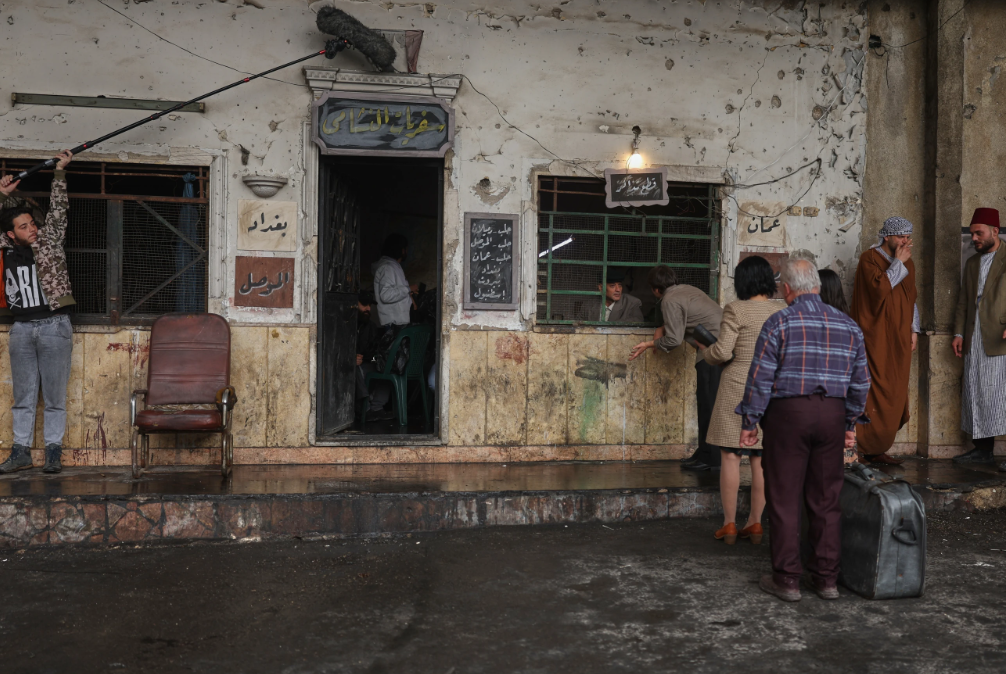
Extras stand by as a television crew films an episode of the TV series “Al-Souriyoun al-Aada” (“The Syrian Enemies”), based on a novel of the same name that was banned under Bashar Assad, along a transformed street in central Aleppo, Syria, Friday, Feb. 13, 2026. (AP Photo/Ghaith Alsayed)
TT

Photos Show Filming of Ramadan TV Drama Series on the War-scarred Streets of Syria's Aleppo

Extras stand by as a television crew films an episode of the TV series “Al-Souriyoun al-Aada” (“The Syrian Enemies”), based on a novel of the same name that was banned under Bashar Assad, along a transformed street in central Aleppo, Syria, Friday, Feb. 13, 2026. (AP Photo/Ghaith Alsayed)

Ramadan in the Arab world is a month of fasting and prayer by day — and television by night. For decades, families have gathered after the iftar, the evening meal that breaks the daytime fast, to follow the season’s highly anticipated drama series, produced specially to air during the Islamic holy month.

In the week before Ramadan, a television crew in central Aleppo was busy preparing one of those productions, with a battered street in the historic city transformed into a scene from decades past.

Lamees Al-Ali, an extra in the series, poses for a photograph during the filming of an episode of the TV series “Al-Souriyoun al-Aada” (“The Syrian Enemies”), based on a novel of the same name that was banned under Bashar Assad, along a transformed street in central Aleppo, Syria, Friday, Feb. 13, 2026. (AP Photo/Ghaith Alsayed)

Classic 1970s cars lined the curb. A horse-drawn cart rolled through the frame. A vendor in a red tarboush, a brimless cone-shaped hat, stood beside steaming pots of sahlep — a sweet, thickened milk drink flavored with spices and associated with winter evenings.

Just outside the camera’s view stood a stark reminder of Syria's more recent history. Collapsed buildings and damaged facades testified to Aleppo’s role as a major battleground during the country's civil war. However, with costumes, props and careful framing, the production temporarily carried the street back to what it portrays as a more innocent era, according to The AP news.

A television crew films an episode of the TV series “Al-Souriyoun al-Aada” (“The Syrian Enemies”), based on a novel of the same name that was banned under Bashar Assad, along a transformed street in central Aleppo, Syria, Friday, Feb. 13, 2026.(AP Photo/Ghaith Alsayed)

The series being filmed — “Al-Souriyoun al-Aada,” or “The Syrian Enemies” — is based on a novel that was banned during the rule of former President Bashar Assad. The story examines painful chapters of Syria’s past, including the 1982 events in Hama, when government forces crushed an uprising led by the Muslim Brotherhood, killing or disappearing an estimated 10,000 to 40,000 people and leaving the city in ruins.

As filming continues into Ramadan, the production reflects both a cherished seasonal tradition and Syria’s complex, layered history.


How Bomb Cyclones Form and Create Dangerous Conditions 

A man works in a snowstorm, Sunday, Feb. 22, 2026, in New York. (AP)
TT

How Bomb Cyclones Form and Create Dangerous Conditions 

A man works in a snowstorm, Sunday, Feb. 22, 2026, in New York. (AP)

When turbulent weather with whipping winds and heavy snow is in the forecast, meteorologists sometimes warn that a storm could “bomb out” or become a bomb cyclone. But what exactly does this mean?

According to the US National Oceanic and Atmospheric Administration, certain storms undergo bombogenesis, which happens when a storm’s central pressure drops at least 24 millibars in 24 hours. These storms are sometimes called bomb cyclones. Storm intensity is measured by central pressure, so the lower the pressure, the stronger the storm.

Such rapidly strengthening storms are capable of producing heavy rain, blizzard conditions and intense winds that can create dangerous conditions such as downed trees and power outages.

“If you’re watching TV at night and the weather report comes on and you’re hearing ‘bomb cyclone’ being used, that usually means there’s quite a bit of active weather going on,” said Andrew Orrison, a meteorologist with the National Weather Service in College Park, Maryland.

Bomb cyclones can happen in any season, but mainly occur during fall and winter when frigid air from the Arctic can creep south and clash with warmer air masses.

“It’s really the clash of those air masses that really kind of helps to generate the areas of low pressure in the first place,” said Orrison.

Regions in North America that are prone to seeing bomb cyclones include Alaska, the Pacific Northwest and the Great Lakes region.