


Canada’s 2023 Wildfires Burned Huge Chunks of Forest, Spewing Far More Heat-Trapping Gas Than Planes 

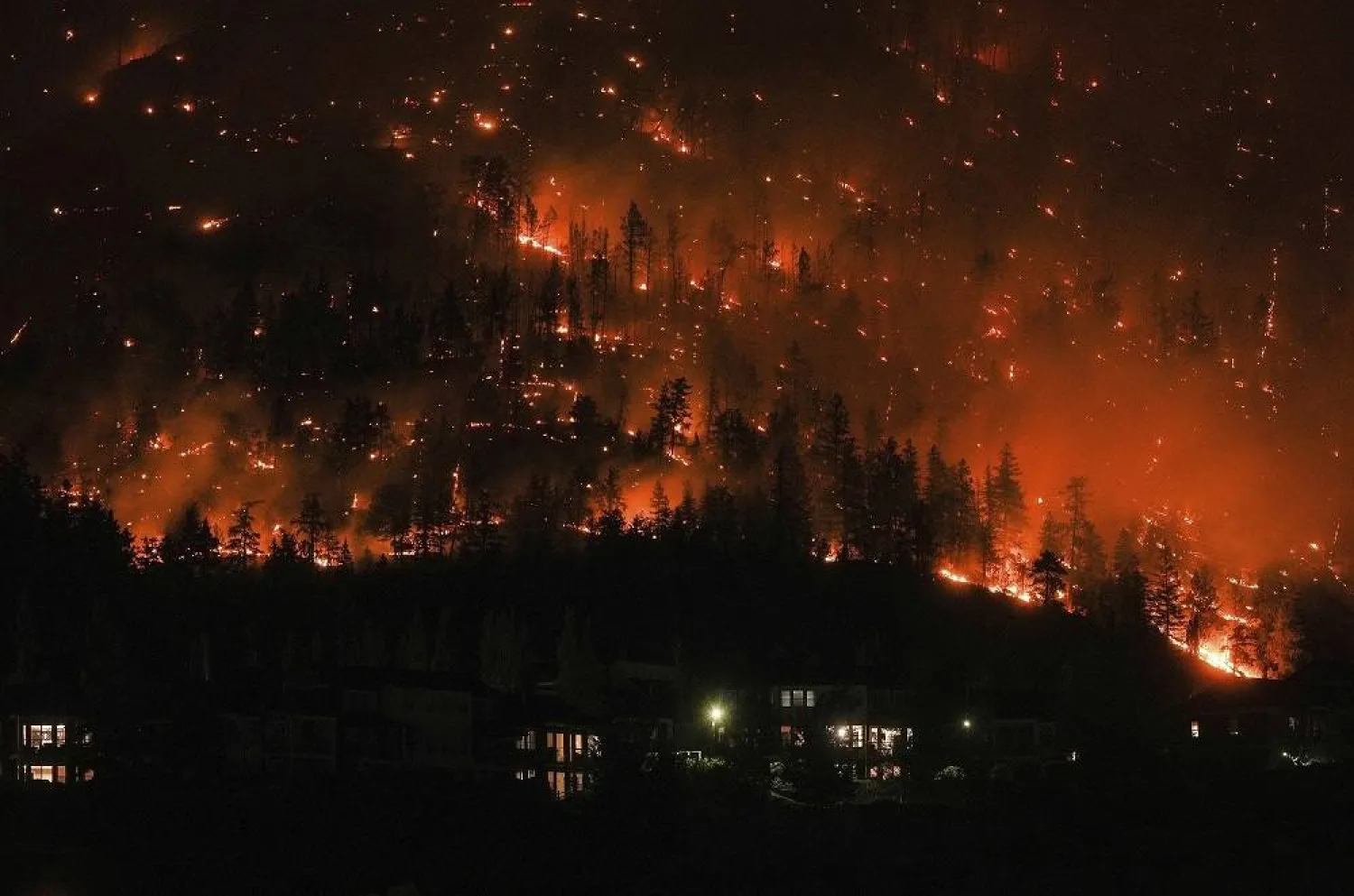
The McDougall Creek wildfire burns on the mountainside above houses in West Kelowna, British Columbia, Aug. 18, 2023. (Darryl Dyck/The Canadian Press via AP, File)
TT

Canada’s 2023 Wildfires Burned Huge Chunks of Forest, Spewing Far More Heat-Trapping Gas Than Planes 

The McDougall Creek wildfire burns on the mountainside above houses in West Kelowna, British Columbia, Aug. 18, 2023. (Darryl Dyck/The Canadian Press via AP, File)

Catastrophic Canadian warming-fueled wildfires last year pumped more heat-trapping carbon dioxide into the air than India did by burning fossil fuels, setting ablaze an area of forest larger than West Virginia, new research found.

Scientists at the World Resources Institute and the University of Maryland calculated how devastating the impacts of the months-long fires in Canada in 2023 that sullied the air around large parts of the globe. They figured it put 3.28 billion tons (2.98 billion metric tons) of heat-trapping carbon dioxide into the air, according to a study update published in Thursday's Global Change Biology. The update is not peer-reviewed, but the original study was.

The fire spewed nearly four times the carbon emissions as airplanes do in a year, study authors said. It's about the same amount of carbon dioxide that 647 million cars put in the air in a year, based on US Environmental Protection Agency data.

Forests “remove a lot of carbon from the atmosphere and that gets stored in their branches, their trunks, their leaves and kind of in the ground as well. So, when they burn all the carbon that's stored within them gets released back into the atmosphere,” said study lead author James MacCarthy, a research associate with WRI's Global Forest Watch.

When and if trees grow back much of that can be recovered, MacCarthy said, adding “it definitely does have an impact on the global scale in terms of the amount of emissions that were produced in 2023.”

MacCarthy and colleagues calculated that the forest burned totaled 29,951 square miles (77,574 square kilometers), which is six times more than the average from 2001 to 2022. The wildfires in Canada made up 27% of global tree cover loss last year, usually it's closer to 6%, MacCarthy's figures show.

These are far more than regular forest fires, but researchers focused only on tree cover loss, which is a bigger effect, said study co-author Alexandra Tyukavina, a geography professor at the University of Maryland.

“The loss of that much forest is a very big deal, and very worrisome,” said Syracuse University geography and environment professor Jacob Bendix, who wasn't part of the study.

“Although the forest will eventually grow back and sequester carbon in doing so, that is a process that will take decades at a minimum, so that there is a quite substantial lag between addition of atmospheric carbon due to wildfire and the eventual removal of at least some of it by the regrowing forest. So, over the course of those decades, the net impact of the fires is a contribution to climate warming.”

It's more than just adding to heat-trapping gases and losing forests, there were health consequences as well, Tyukavina said.

“Because of these catastrophic fires, air quality in populated areas and cities was affected last year,” she said, mentioning New York City's smog-choked summer. More than 200 communities with about 232,000 residents had to be evacuated, according to another not-yet-published or peer-reviewed study by Canadian forest and fire experts.

One of the authors of the Canadian study, fire expert Mike Flannigan at Thompson Rivers University in Kamloops, British Columbia, puts the acreage burned at twice what MacCarthy and Tyukavina do.

“The 2023 fire season in Canada was (an) exceptional year in any time period,” Flannigan, who wasn't part of the WRI study, said in an email. “I expect more fire in our future, but years like 2023 will be rare.”

Flannigan, Bendix, Tyukavina and MacCarthy all said climate change played a role in Canada's big burn. A warmer world means more fire season, more lightning-caused fires and especially drier wood and brush to catch fire “associated with increased temperature,” Flannigan wrote.

The average May to October temperature in Canada last year was almost 4 degrees (2.2 degrees Celsius) warmer than normal, his study found. Some parts of Canada were 14 to 18 degrees (8 to 10 degrees Celsius) hotter than average in May and June, MaCarthy said.

There's short-term variability within trends, so it's hard to blame one specific year and area burned on climate change and geographic factors play a role, still “there is no doubt that climate change is the principal driver of the global increases in wildfire,” Bendix said in an email.

With the world warming from climate change, Tyukavina said, “the catastrophic years are probably going to be happening more often and we are going to see those spikier years more often.”



Coffee Regions Hit by Extra Days of Extreme Heat, Say Scientists 

17 April 2012, North Rhine-Westphalia, Vluyn: A general view of Arabica Coffee beans. (dpa)
TT

Coffee Regions Hit by Extra Days of Extreme Heat, Say Scientists 

17 April 2012, North Rhine-Westphalia, Vluyn: A general view of Arabica Coffee beans. (dpa)

The world's main coffee-growing regions are roasting under additional days of climate change-driven heat every year, threatening harvests and contributing to higher prices, researchers said Wednesday.

An analysis found that there were 47 extra days of harmful heat per year on average in 25 countries representing nearly all global coffee production between 2021 and 2025, according to independent research group Climate Central.

Brazil, Vietnam, Colombia, Ethiopia and Indonesia -- which supply 75 percent of the world's coffee -- experienced on average 57 additional days of temperatures exceeding the threshold of 30C.

"Climate change is coming for our coffee. Nearly every major coffee-producing country is now experiencing more days of extreme heat that can harm coffee plants, reduce yields, and affect quality," said Kristina Dahl, Climate Central's vice president for science.

"In time, these impacts may ripple outward from farms to consumers, right into the quality and cost of your daily brew," Dahl said in a statement.

US tariffs on imports from Brazil, which supplies a third of coffee consumed in the United States, contributed to higher prices this past year, Climate Central said.

But extreme weather in the world's coffee-growing regions is "at least partly to blame" for the recent surge in prices, it added.

Coffee cultivation needs optimal temperatures and rainfall to thrive.

Temperatures above 30C are "extremely harmful" to arabica coffee plants and "suboptimal" for the robusta variety, Climate Central said. Those two plant species produce the majority of the global coffee supply.

For its analysis, Climate Central estimated how many days each year would have stayed below 30C in a world without carbon pollution but instead exceeded that level in reality -- revealing the number of hot days added by climate change.

The last three years have been the hottest on record, according to climate monitors.


Dog Gives Olympics Organizers Paws for Thought

A dog wanders on the ski trail during the women's team cross country free sprint qualification event of the Milano Cortina 2026 Winter Olympic Games at Tesero Cross-Country Skiing Stadium in Lago di Tesero (Val di Fiemme), on February 18, 2026. (Photo by Anne-Christine POUJOULAT / AFP)
TT

Dog Gives Olympics Organizers Paws for Thought

A dog wanders on the ski trail during the women's team cross country free sprint qualification event of the Milano Cortina 2026 Winter Olympic Games at Tesero Cross-Country Skiing Stadium in Lago di Tesero (Val di Fiemme), on February 18, 2026. (Photo by Anne-Christine POUJOULAT / AFP)

A dog decided he would bid for an unlikely Olympic medal on Wednesday as he joined the women's cross country team free sprint in the Milan-Cortina Games.

The dog ran onto the piste in Tesero in northern Italy and gamely, even without skis, ran behind two of the competitors, Greece's Konstantina Charalampidou and Tena Hadzic of Croatia.

He crossed the finishing line, his moment of glory curtailed as he was collared by the organizers and led away -- his owner no doubt will have a bone to pick with him when they are reunited.


Olives, Opera and a Climate-Neutral Goal: How a Mural in Greece Won ‘Best in the World’ 

A building with the mural entitled “Kalamata” depicting opera legend Maria Callas by artist Kleomenis Kostopoulos is seen in Kalamata town, about 240 kilometers (150 miles) southwest of Athens, Monday, Feb. 9, 2026. (AP) 
TT

Olives, Opera and a Climate-Neutral Goal: How a Mural in Greece Won ‘Best in the World’ 

A building with the mural entitled “Kalamata” depicting opera legend Maria Callas by artist Kleomenis Kostopoulos is seen in Kalamata town, about 240 kilometers (150 miles) southwest of Athens, Monday, Feb. 9, 2026. (AP) 

Long known for its olives and seaside charm, the southern Greek city of Kalamata has found itself in the spotlight thanks to a towering mural that reimagines legendary soprano Maria Callas as an allegory for the city itself.

The massive artwork on the side of a prominent building in the city center has been named 2025’s “Best Mural of the World” by Street Art Cities, a global platform celebrating street art.

Residents of Kalamata, approximately 240 kilometers (150 miles) southwest of Athens, cultivate the world-renowned olives, figs and grapes that feature prominently on the mural.

That was precisely the point.

Vassilis Papaefstathiou, deputy mayor of strategic planning and climate neutrality, explained Kalamata is one of the few Greek cities with the ambitious goal of becoming climate-neutral by 2030. He and other city leaders wanted a way to make abstract concepts, including sustainable development, agri-food initiatives, and local economic growth, more tangible for the city’s nearly 73,000 residents.

That’s how the idea of a massive mural in a public space was born.

“We wanted it to reflect a very clear and distinct message of what sustainable development means for a regional city such as Kalamata,” Papaefstathiou said. “We wanted to create an image that combines the humble products of the land, such as olives and olive oil — which, let’s be honest, are famous all over the world and have put Kalamata on the map — with the high-level art.”

“By bringing together what is very elevated with ... the humbleness of the land, our aim was to empower the people and, in doing so, strengthen their identity. We want them to be proud to be Kalamatians.”

Southern Greece has faced heatwaves, droughts and wildfires in recent years, all of which affect the olive groves on which the region’s economy is hugely dependent.

The image chosen to represent the city was Maria Callas, widely hailed as one of the greatest opera singers of the 20th century and revered in Greece as a national cultural symbol. She may have been born in New York to Greek immigrant parents, but her father came from a village south of Kalamata. For locals, she is one of their own.

This connection is also reflected in practice: the alumni association at Kalamata’s music school is named for Callas, and the cultural center houses an exhibition dedicated to her, which includes letters from her personal archive.

Artist Kleomenis Kostopoulos, 52, said the mural “is not actually called ‘Maria Callas,’ but ‘Kalamata’ and my attempt was to paint Kalamata (the city) allegorically.”

Rather than portraying a stylized image of the diva, Kostopoulos said he aimed for a more grounded and human depiction. He incorporated elements that connect the people to their land: tree branches — which he considers the above-ground extension of roots — birds native to the area, and the well-known agricultural products.

“The dress I create on Maria Callas in ‘Kalamata’ is essentially all of this, all of this bloom, all of this fruition,” he said. “The blessed land that Kalamata itself has ... is where all of these elements of nature come from.”

Creating the mural was no small feat. Kostopoulos said it took around two weeks of actual work spread over a month due to bad weather. He primarily used brushes but also incorporated spray paint and a cherry-picker to reach all edges of the massive wall.

Papaefstathiou, the deputy mayor, said the mural has become a focal point.

“We believe this mural has helped us significantly in many ways, including in strengthening the city’s promotion as a tourist destination,” he said.

Beyond tourism, the mural has sparked conversations about art in public spaces. More building owners in Kalamata have already expressed interest in hosting murals.

“All of us — residents, and I personally — feel immense pride,” said tourism educator Dimitra Kourmouli.

Kostopoulos said he hopes the award will have a wider impact on the art community and make public art more visible in Greece.

“We see that such modern interventions in public space bring tremendous cultural, social, educational and economic benefits to a place,” he said. “These are good springboards to start nice conversations that I hope someday will happen in our country, as well.”