Marilyn Monroe's Former LA Home Declared Historic Monument to Save it from Demolition

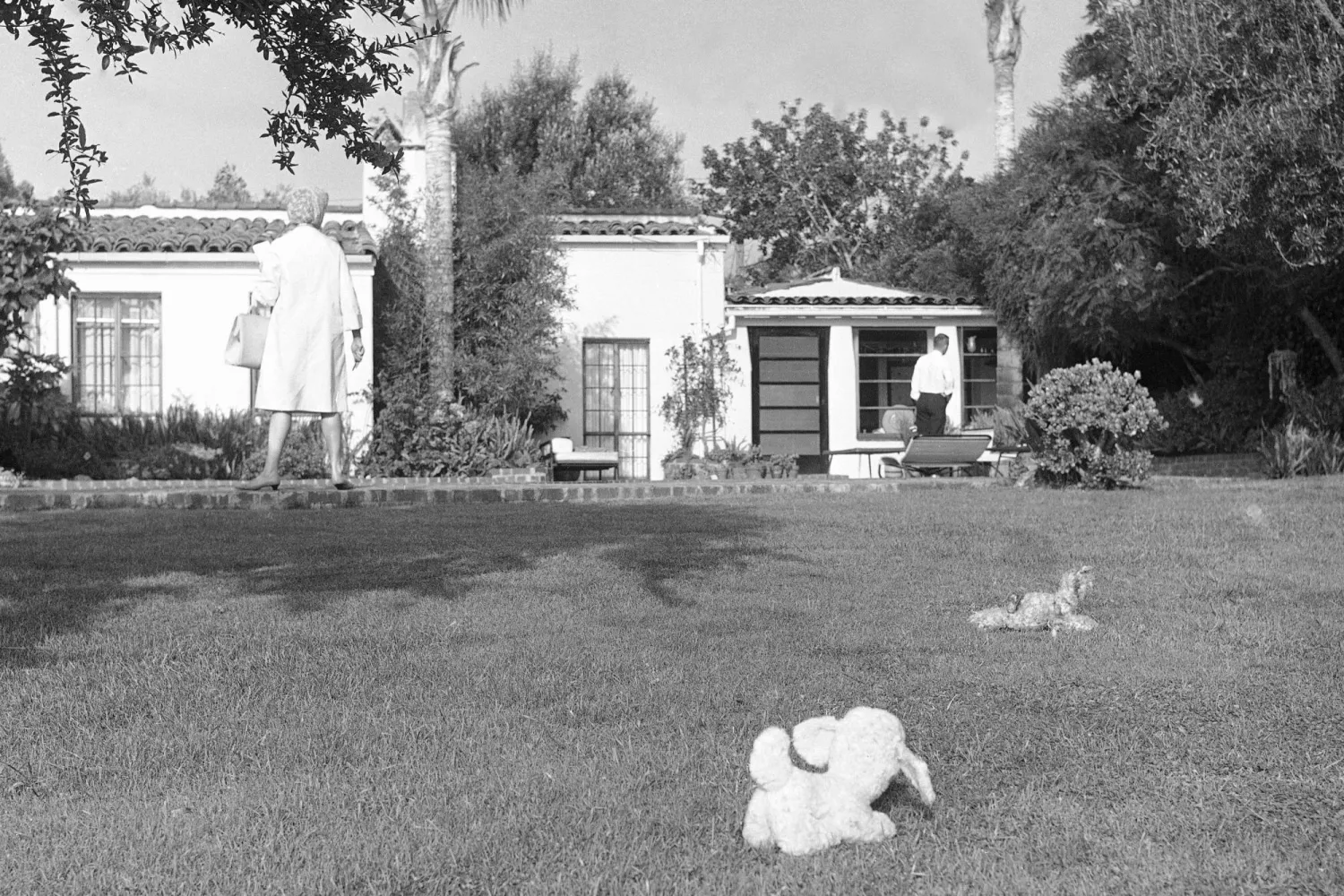
FILE - The backyard of the home where Marilyn Monroe lived is shown after she was found dead in Hollywood, August 5, 1962. (AP Photo/Harold Filan, File)
TT

Marilyn Monroe's Former LA Home Declared Historic Monument to Save it from Demolition

FILE - The backyard of the home where Marilyn Monroe lived is shown after she was found dead in Hollywood, August 5, 1962. (AP Photo/Harold Filan, File)

Fans of Marilyn Monroe have won a battle to preserve her mark on Los Angeles and are a step closer to seeing a towering statue of the silver screen icon remain in Palm Springs.
The Los Angeles home where Monroe briefly lived and died has been declared a historic cultural monument, while a Palm Springs planning commission decision boosted chances that a 26-foot (8-meter) statue called “Forever Marilyn” will stay in place.
The Los Angeles City Council voted for the historic designation Wednesday after a lengthy battle over whether the home in the tony Brentwood neighborhood would be demolished, the Los Angeles Times reported.
The current owners live next door and wanted to raze the house in order to expand their estate. The council, however, was unanimous in moving to save it.
"There’s no other person or place in the city of Los Angeles as iconic as Marilyn Monroe and her Brentwood home,” Traci Park, the area's council representative, said before the vote.
Monroe bought the house for $75,000 and died there just months later on Aug. 4, 1962, from an apparent overdose. The current owners, Brinah Milstein and Roy Bank, bought the house for $8.35 million and obtained a demolition permit but ran into opposition.
According to The Associated Press, they contend the house has been changed so much over the years that it no longer is historic, and that it has become a neighborhood nuisance due to tourist traffic.
The process that led to the designation was “biased, unconstitutional and rigged,” Peter C. Sheridan, an attorney for Milstein and Bank, said in a statement to AP.
Sheridan asserted that Park and her staff were not responsive to the owners' efforts to find a solution and ignored opposition by civic and homeowners' groups.
The attorney also said the city had “granted dozens of permits to over 14 different prior owners to change the home through numerous remodels, resulting in there being nothing left reflecting Ms. Monroe’s brief time there 60 years ago.”
In Palm Springs, the “Forever Marilyn” statute depicts Monroe in the famous billowing dress scene from “The Seven Year Itch.” It has been moved around the US and elsewhere, including a previous stint in Palm Springs, and is now back. A hotel industry group that owns the statue wants it to remain permanently, but some residents oppose it.
A technical decision about the location by the planning commission on Wednesday marked a step toward keeping the statue, The Desert Sun reported. The matter continues before the Palm Springs City Council in the future.



Turkmenistan's Battle against Desert Sand

For Bokurdak residents, cultivating every square meter is a constant battle with nature. Nikolay Vavilov / AFP
TT

Turkmenistan's Battle against Desert Sand

For Bokurdak residents, cultivating every square meter is a constant battle with nature. Nikolay Vavilov / AFP

Residents in the remote Turkmen village of Bokurdak have long depended on the Karakum Desert for their livelihoods, cultivating every square meter they can in a constant battle with nature.

It is a battle that some fear they are now losing.

Over recent years, large dunes have started encroaching on the land in the village, while rolling desert sands have forced residents to shift further downhill, local pensioner Kakabai Baimedov told AFP.

For those who live in the desert -- known as "gumli" in Turkmen -- this has been "very difficult", Baimedov said.

"The village of Bokurdak used to be on a hill north of this place. Then, due to the advancing desert, we had to move lower and lower," Baimedov told AFP.

While sand and the steppe have always been part of life in Central Asia, scientists warn climate change and other human activities are accelerating desertification and the degradation of the land.

In addition to being an ecological and social problem, desertification is also an economic burden, costing an estimated six percent of Central Asia's GDP annually, according to the World Bank.

The Karakum Desert covers more than 80 percent of Turkmenistan, a former Soviet republic bordering Iran and Afghanistan.

"If its vegetation and soil cover are not properly managed, the surface is easily subject to erosion, degrading farmland and forming sand dunes," Turkmen scientist Mukhammet Durikov told AFP.

Deforestation is another key culprit, while severe droughts and dry winds fueled by climate change are making the problem worse, he said.

Tree-planting campaign

Central Asia is especially vulnerable to climate change: average temperatures in the region have risen by about twice the global average since 1991, according to UN data.

Authorities in Turkmenistan -- a politically isolated country of seven million people -- have sought to curb desertification through a massive tree-planting campaign.

The government announced in the summer that 162 million trees had been planted over the past 20 years.

"The president himself actively participates in the fight against desertification," an official from the environmental ministry told AFP.

The ministry and regional officials are responsible for planting sites for the trees, overseeing their planting and care, the official said.

AFP was not able to immediately verify the government's claims.

The country bordering the Caspian Sea restricts independent reporting and keeps information about government activities largely secret.

Turkmenistan's two leaders, father-and-son duo Gurbanguly and Serdar Berdymukhamedov, have been keen to show they are taking action in combating desertification.

State media shows Serdar regularly appearing with a shovel in hand planting trees.

"Previously, it was spruces or cedars, but today, we find endemic species better adapted to the climate," Merdan Arazmedov, a member of Turkmenistan's Nature Protection Society, told AFP.

Keeping water in the soil

In Bokurdak, scientists have mainly planted saxauls -- a hardy desert shrub whose roots penetrate as much as 15 meters (49 feet) underground to capture water, Arazmedov said.

The saxaul -- which is also being used in Uzbekistan and Kazakhstan -- helps retain sand, improves soil moisture, and also serves as a natural barrier for homes.

Baimedov, who has become an amateur botanist, tends to about 15,000 saplings, which are aimed at forming a green wall against the sand.

"It takes 15-20 years to grow a tree like this," he said, pointing to an eight-meter- (26-foot-) high saxaul.

The saxaul is also being used to protect the capital Ashgabat, where "environmental activists have planted more than 50 hectares of saxaul on the edge of the desert," Arazmedov said.

"Now, the road to the capital is no longer covered in sand, traffic flows smoothly, and the number of accidents has decreased," he added.

But for Baimedov, whose main weapon against the desert is planting trees, the battle has become all the harder due to climate change.

"In the past, it was enough to water young saxaul daily with up to 10 liters of water," he said.

"Today, due to climate change and rising temperatures, it takes up to 20 liters each day to ensure rooting."

Turkmenistan has employed other methods to beat the sand.

Last year, scientists in the country announced they had launched successful trials spraying the soil with cyanobacteria, also known as "blue-green algae" -- a method that helps retain moisture and facilitate tree rooting.

In September, Turkmenistan's president proposed creating a regional center against desertification in Central Asia.


Saudi National Center for Wildlife, Soudah Development Company Release Birds of Prey

The release comes as part of reintroduction programs aimed at enhancing ecological balance and restoring biodiversity in one of the Kingdom’s most prominent mountainous environmental zones - SPA
TT

Saudi National Center for Wildlife, Soudah Development Company Release Birds of Prey

The release comes as part of reintroduction programs aimed at enhancing ecological balance and restoring biodiversity in one of the Kingdom’s most prominent mountainous environmental zones - SPA

Saudi Arabia's National Center for Wildlife (NCW), in cooperation with Soudah Development Company, has released a number of birds of prey in Al-Soudah Park, including three griffon vultures, a black kite, an Arabian scops owl, and an Eurasian sparrowhawk, after rehabilitating them at shelter centers.


The release comes as part of reintroduction programs aimed at enhancing ecological balance and restoring biodiversity in one of the Kingdom’s most prominent mountainous environmental zones, SPA reported.

This release followed the completion of rehabilitation and environmental acclimatization stages to ensure the birds’ readiness and ability to adapt to the nature of the area, contributing to the stability of local species and boosting their ecological roles within mountain ecosystems, particularly in regulating food chains and preserving the health of natural habitats.

The NCW noted that this step falls within its ongoing programs to breed and reintroduce threatened wildlife species, rehabilitate ecosystems, and enrich biodiversity across various regions of the Kingdom, in cooperation with national partners and in line with the objectives of the Saudi Green Initiative and the National Environment Strategy, which support the environmental development goals of the Saudi Vision 2030.

Specialized teams will continue to monitor the released birds and track their movements and ecological behavior using dedicated tools and technologies, supporting the evaluation of the program’s success and the improvement of its outcomes in the future in accordance with the best global environmental practices.


Ariane 6 Lifts Off with 2 European Navigation Satellites

The European Space Agency (ESA) Ariane 6 rocket carrying two Galileo satellites for the the EU's Global Navigation Satellite System (GNSS) launches at the Guiana Space Center in Kourou, on the French overseas department of Guiana, on December 17, 2025. (Photo by Ronan LIETAR / AFP)
TT

Ariane 6 Lifts Off with 2 European Navigation Satellites

The European Space Agency (ESA) Ariane 6 rocket carrying two Galileo satellites for the the EU's Global Navigation Satellite System (GNSS) launches at the Guiana Space Center in Kourou, on the French overseas department of Guiana, on December 17, 2025. (Photo by Ronan LIETAR / AFP)

A European Ariane 6 rocket blasted off from France's Kourou space base in French Guiana early Wednesday, carrying two Galileo global navigation satellites, according to an AFP correspondent.

Lift-off was at 2:01 am local time (0501 GMT) for the fourth commercial flight of the Ariane 6 launch system since the expendable rockets came into service last year.

The rocket was carrying two more satellites of the European Union's Galileo program, a global navigation satellite system that aims to make the bloc less dependent on the US's Global Positioning System (GPS).

The two satellites were set to be placed in orbit nearly four hours after lift-off.

They will bring to 34 the number of Galileo satellites in orbit and "will improve the robustness of the Galileo system by adding spares to the constellation to guarantee the system can provide 24/7 navigation to billions of users. The satellites will join the constellation in medium Earth orbit 23, 222 km (14,429 miles) above Earth’s surface," according to the European Space Agency (ESA) which oversees the program.

Previous Galileo satellites were primarily launched by Ariane 5 and Russian Soyuz rockets from Kourou.

After Russia's invasion of Ukraine, Europe halted space cooperation with Moscow.

Before the Ariane 6 rocket entered into service in July 2024, the EU contracted with Elon Musk's SpaceX to launch two Galileo satellites aboard Falcon 9 rockets in September 2024 from the Kennedy Space Center in Florida.