


No World Records Have Been Set at the Olympic Pool

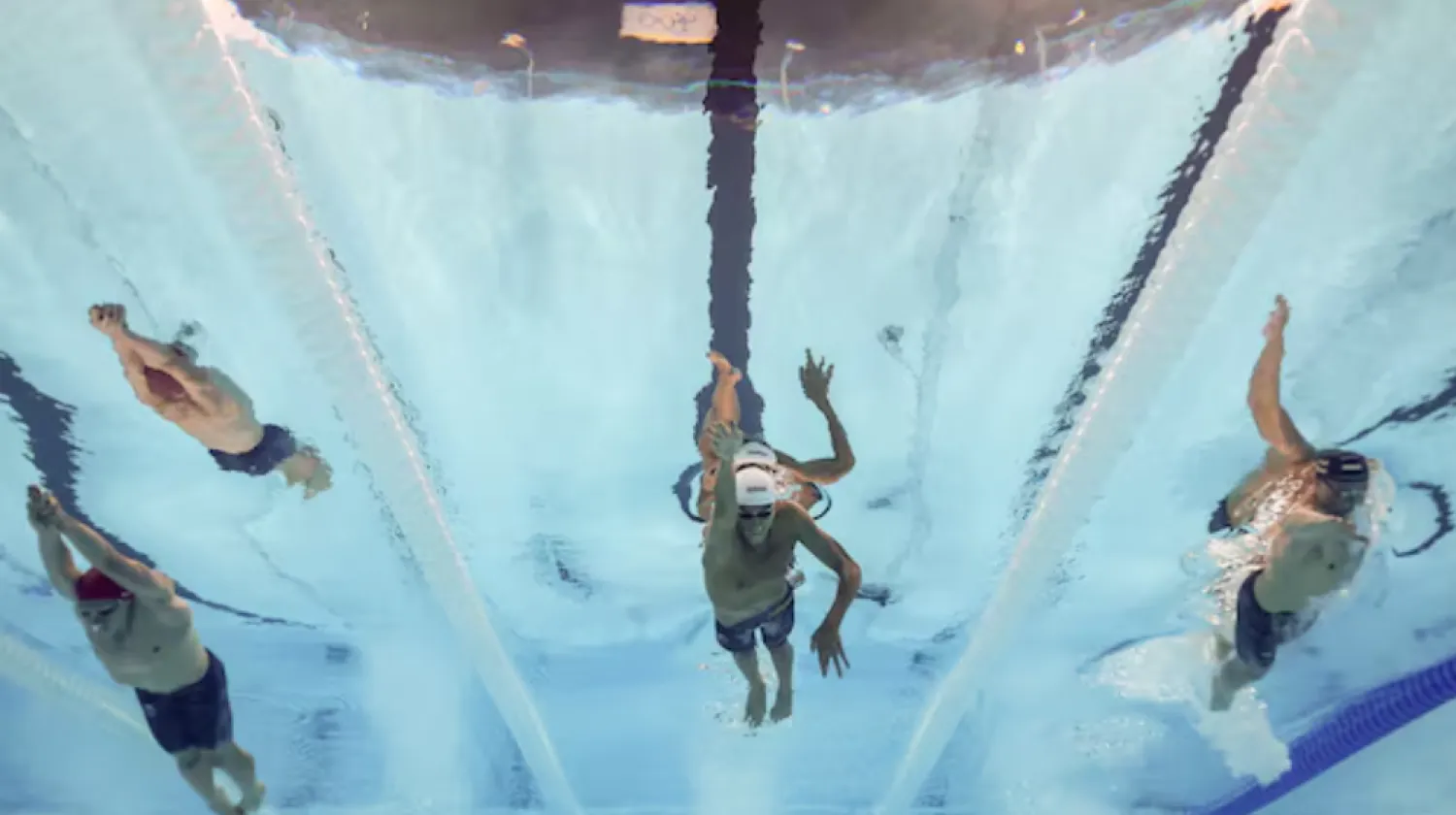
Paris 2024 Olympics - Swimming - Men's 200m Freestyle Final - Paris La Defense Arena, Nanterre, France - July 29, 2024. David Popovici of Romania, Luke Hobson of United States and Duncan Scott of Great Britain in action. REUTERS/Marko Djurica Purchase Licensing Rights
TT

No World Records Have Been Set at the Olympic Pool

Paris 2024 Olympics - Swimming - Men's 200m Freestyle Final - Paris La Defense Arena, Nanterre, France - July 29, 2024. David Popovici of Romania, Luke Hobson of United States and Duncan Scott of Great Britain in action. REUTERS/Marko Djurica Purchase Licensing Rights

The atmosphere for Olympic swimming is electrifying.

The times? Not so much.

Through the first four days of competition in the portable pool at La Defense Arena, no world records were set. It's becoming more and more apparent that a truly extraordinary performance will be required to take down an existing standard, The AP reported.

The culprit for the slower-than-expected times appears to be a pool that is slightly shallower than the optimal depth, which allows a couple of extra rows of prime deck-side seats to remain in use but creates more waves and turbulence rolling up to the surface.

“I’ve heard the rumblings, but at the end of the day we’re here to race,” American star Katie Ledecky said. “We’re all fast swimmers. We make the pool as fast as we want it to be. I’m not really thinking about it.”

Going forward, World Aquatics has mandated a minimum depth of 2.5 meters (8.2 feet) for swimming and water polo events, such as the portable pool that will be installed inside SoFi Stadium for the 2028 Los Angeles Games.

But when the Olympics were awarded to Paris, the temporary facility was approved under previous guidelines that allowed for a depth of 2.2 meters (7.2 feet).

For perspective, a 3-meter (9.8 feet) pool is considered the optimal depth. At the US trials in Indianapolis, where the portable pool installed in Lucas Oil Stadium was around 2.8 meters (9.1 feet), two world records were set.

No complaints about the atmosphere Torin Koos, a spokesman for World Aquatics, noted that five Olympic records were set through the first 15 events at La Defense Arena.

Indeed, no one is griping much. Everyone is competing under the same conditions, so it's not like anyone has an advantage. For the most part, the favored swimmers are coming out on top.

“I try not to pay attention to it just because we’re all in the same pool," said American Katie Grimes, who claimed a silver in the 400-meter individual medley. "I mean, regardless if it’s a slow pool or not, it’s not going to affect just one person. It’s affecting everybody.”

Everyone has raved about the raucous setting, more than 15,000 strong for every session in an indoor stadium that is normally used by the famed rugby club Racing 92. The crowds are loud and boisterous, especially when French star Leon Marchand dives in the water.

“It doesn’t matter whether I’m racing here in in Paris or at a local country pool in South Australia,” Aussie sprinter Kyle Chalmers said. “It’s all about winning that race in the pool. Everyone has the same opportunity. Everyone has a lane. We’re all swimming in the same pool. It’s not like some people are sending their times in from the trials or anything like that.”

Maybe it's the pressure of the moment Chalmers doesn't believe the pool is entirely to blames for the slower-than-expected races.

“There’s a lot of pressure and expectation that people put on themselves,” he said. “A lot of people haven’t swam in the Olympics before. I think the nervous energy of having like (15,000 fans) in the stadium is crazy. I personally love it, but I think people do definitely crack under that pressure.”

Many swimmers are slower at the Olympics Still, the times are a bit jarring.

Summer McIntosh blew away Grimes and the rest of the field in the 400 IM, but the 17-year-old Canadian went more than three seconds slower than her world-record showing at her country's Olympic trials in May.

David Popovici of Romania captured gold in the men's 200 freestyle with a time of 1 minute, 44.72 seconds, the slowest by an Olympic champion in that event since Pieter van den Hoogenband at the 2000 Sydney Games.

Then there's Nicolò Martinenghi of Italy, whose gold-medal time of 59.03 in the 100 breaststroke would not have been good enough to claim a medal of any color at the last two Summer Games. It was the slowest winning performance since Japan's Kosuke Kitajima two decades ago at the Athens Olympics.

A look back at previous Olympics At least one swimming world record has been set at every Olympics in the post-World War II era, and it's common for multiple marks to fall.

A whopping 23 world records were set at the 2008 Beijing Games, when the sport was in the midst of the rubber-suit revolution. The following year, at the world championships in Rome, a staggering 43 marks were established, leading the world governing body to impose strict new rules governing body coverage and fabrics.

Since then, the pace of world records has returned to more customary levels, with several marks from those 2009 worlds still on the books. But it's generally assumed that most everyone will be at their best when an Olympic year rolls around, which usually leads to a spirited assault on the record list.

Nine world records were set at London in 2012, eight more fell at the 2016 Games in Rio de Janeiro, and a half-dozen were broken at the pandemic-delayed Tokyo Games three years ago, when swimmers competed in a mostly empty arena because of COVID-19 restrictions.

The lack of fans hasn't been an issue in Paris, where the cacophony of a large arena filled to the rafters with passionate supporters has given everyone an extra push.

Not quite enough to call for a rewrite to the record book, but Chalmers and others don't really seem to mind.

“It doesn’t matter about times,” the Aussie said. “It’s about getting your hand on the wall first and winning the race. The times are never really all that remembered.”



Second Season of ‘Kings League–Middle East' to Kick off in March in Riyadh 

The second season of the Kings League-Middle East will kick off in Riyadh on March 27. (Kings League-Middle East on X)
TT

Second Season of ‘Kings League–Middle East' to Kick off in March in Riyadh 

The second season of the Kings League-Middle East will kick off in Riyadh on March 27. (Kings League-Middle East on X)

The Kings League-Middle East announced that its second season will kick off in Riyadh on March 27.

The season will feature 10 teams, compared to eight in the inaugural edition, under a format that combines sporting competition with digital engagement and includes the participation of several content creators from across the region.

The Kings League-Middle East is organized in partnership with SURJ Sports Investments, a subsidiary of the Public Investment Fund (PIF), as part of efforts to support the development of innovative sports models that integrate football with digital entertainment.

Seven teams will return for the second season: DR7, ABO FC, FWZ, Red Zone, Turbo, Ultra Chmicha, and 3BS. Three additional teams are set to be announced before the start of the competition.

Matches of the second season will be held at Cool Arena in Riyadh under a single round-robin format, with the top-ranked teams advancing to the knockout stages, culminating in the final match.

The inaugural edition recorded strong attendance and wide digital engagement, with approximately a million viewers following the live broadcasts on television and digital platforms.


Shakhtar Boss Pays Ukrainian Racer $200,000 After Games Disqualification

Ukrainian President Volodymyr Zelenskiy holds helmet as he meets with a Ukrainian skeleton racer Vladyslav Heraskevych , who was disqualified from the Olympic skeleton competition over his "helmet of remembrance" depicting athletes killed since Russia's invasion and his father and coach, Mykhailo Heraskevych, amid Russia's attack on Ukraine, in Munich, Germany February 13, 2026. (Ukrainian Presidential Press Service/Handout via Reuters)
TT

Shakhtar Boss Pays Ukrainian Racer $200,000 After Games Disqualification

Ukrainian President Volodymyr Zelenskiy holds helmet as he meets with a Ukrainian skeleton racer Vladyslav Heraskevych , who was disqualified from the Olympic skeleton competition over his "helmet of remembrance" depicting athletes killed since Russia's invasion and his father and coach, Mykhailo Heraskevych, amid Russia's attack on Ukraine, in Munich, Germany February 13, 2026. (Ukrainian Presidential Press Service/Handout via Reuters)

The owner of ‌Ukrainian football club Shakhtar Donetsk has donated more than $200,000 to skeleton racer Vladyslav Heraskevych after the athlete was disqualified from the Milano Cortina Winter Games before competing over the use of a helmet depicting Ukrainian athletes killed in the war with Russia, the club said on Tuesday.

The 27-year-old Heraskevych was disqualified last week when the International Bobsleigh and Skeleton Federation jury ruled that imagery on the helmet — depicting athletes killed since Russia invaded Ukraine in 2022 — breached rules on athletes' expression at ‌the Games.

He ‌then lost an appeal at the Court ‌of ⁠Arbitration for Sport hours ⁠before the final two runs of his competition, having missed the first two runs due to his disqualification.

Heraskevych had been allowed to train with the helmet that displayed the faces of 24 dead Ukrainian athletes for several days in Cortina d'Ampezzo where the sliding center is, but the International Olympic Committee then ⁠warned him a day before his competition ‌started that he could not wear ‌it there.

“Vlad Heraskevych was denied the opportunity to compete for victory ‌at the Olympic Games, yet he returns to Ukraine a ‌true winner," Shakhtar President Rinat Akhmetov said in a club statement.

"The respect and pride he has earned among Ukrainians through his actions are the highest reward. At the same time, I want him to ‌have enough energy and resources to continue his sporting career, as well as to fight ⁠for truth, freedom ⁠and the remembrance of those who gave their lives for Ukraine," he said.

The amount is equal to the prize money Ukraine pays athletes who win a gold medal at the Games.

The case dominated headlines early on at the Olympics, with IOC President Kirsty Coventry meeting Heraskevych on Thursday morning at the sliding venue in a failed last-minute attempt to broker a compromise.

The IOC suggested he wear a black armband and display the helmet before and after the race, but said using it in competition breached rules on keeping politics off fields of play. Heraskevych also earned praise from Ukraine President Volodymyr Zelenskiy.


Speed Skating-Italy Clinch Shock Men’s Team Pursuit Gold, Canada Successfully Defend Women’s Title

 Team Italy with Davide Ghiotto, Andrea Giovannini, Michele Malfatti, celebrate winning the gold medal on the podium of the men's team pursuit speed skating race at the 2026 Winter Olympics, in Milan, Italy, Tuesday, Feb. 17, 2026. (AP)
Team Italy with Davide Ghiotto, Andrea Giovannini, Michele Malfatti, celebrate winning the gold medal on the podium of the men's team pursuit speed skating race at the 2026 Winter Olympics, in Milan, Italy, Tuesday, Feb. 17, 2026. (AP)
TT

Speed Skating-Italy Clinch Shock Men’s Team Pursuit Gold, Canada Successfully Defend Women’s Title

 Team Italy with Davide Ghiotto, Andrea Giovannini, Michele Malfatti, celebrate winning the gold medal on the podium of the men's team pursuit speed skating race at the 2026 Winter Olympics, in Milan, Italy, Tuesday, Feb. 17, 2026. (AP)
Team Italy with Davide Ghiotto, Andrea Giovannini, Michele Malfatti, celebrate winning the gold medal on the podium of the men's team pursuit speed skating race at the 2026 Winter Olympics, in Milan, Italy, Tuesday, Feb. 17, 2026. (AP)

An inspired Italy delighted the home crowd with a stunning victory in the Olympic men's team pursuit final as

Canada's Ivanie Blondin, Valerie Maltais and Isabelle Weidemann delivered another seamless performance to beat the Netherlands in the women's event and retain their title ‌on Tuesday.

Italy's ‌men upset the US who ‌arrived ⁠at the Games ⁠as world champions and gold medal favorites.

Spurred on by double Olympic champion Francesca Lollobrigida, the Italian team of Davide Ghiotto, Andrea Giovannini and Michele Malfatti electrified a frenzied arena as they stormed ⁠to a time of three ‌minutes 39.20 seconds - ‌a commanding 4.51 seconds clear of the ‌Americans with China taking bronze.

The roar inside ‌the venue as Italy powered home was thunderous as the crowd rose to their feet, cheering the host nation to one ‌of their most special golds of a highly successful Games.

Canada's women ⁠crossed ⁠the line 0.96 seconds ahead of the Netherlands, stopping the clock at two minutes 55.81 seconds, and

Japan rounded out the women's podium by beating the US in the Final B.

It was only Canada's third gold medal of the Games, following Mikael Kingsbury's win in men's dual moguls and Megan Oldham's victory in women's freeski big air.