


How Missed Warnings 'Over-tourism' Aggravated Deadly India Landslides

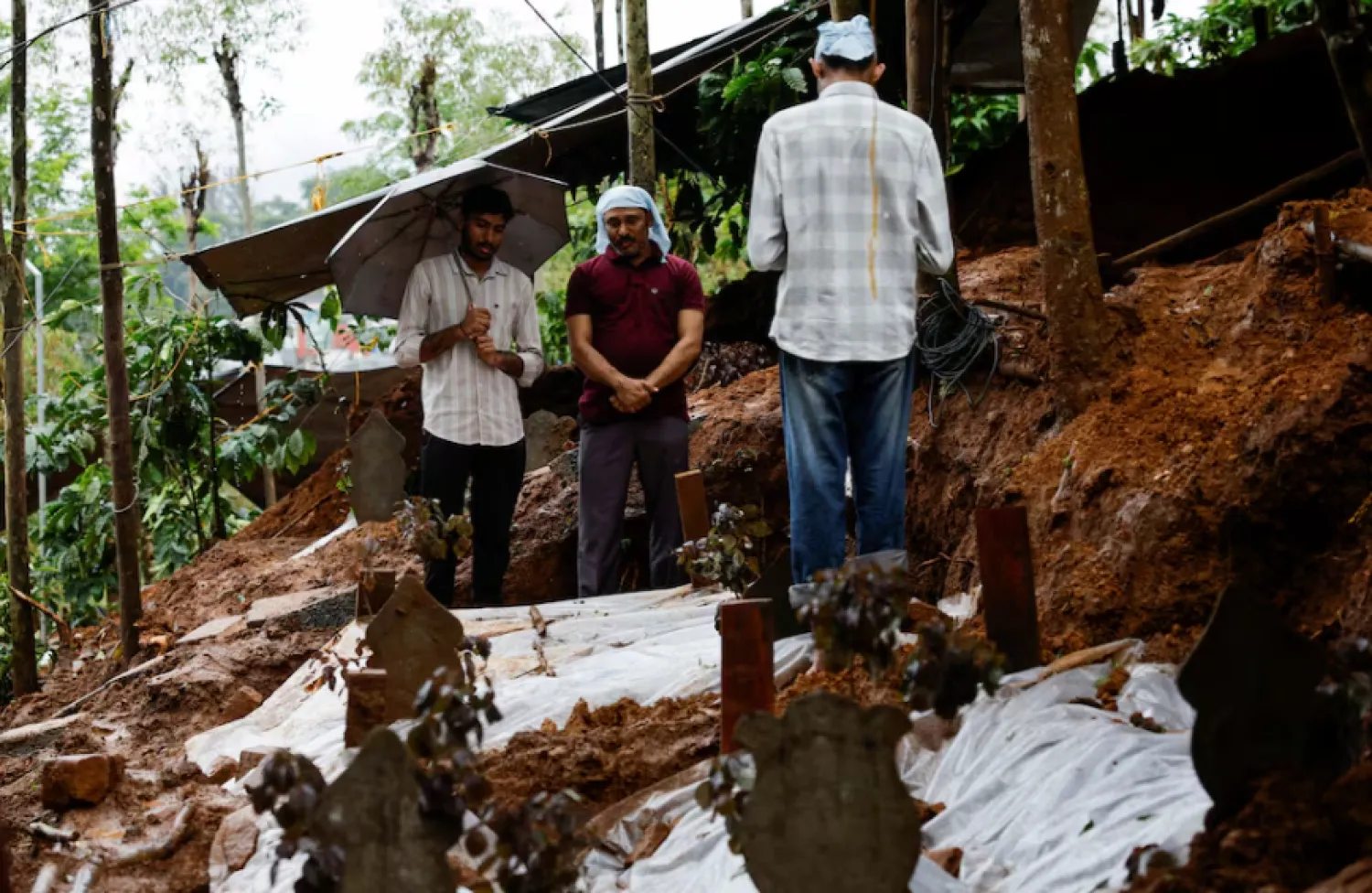
People pray for a departed family member at their grave at a graveyard, after landslides hit several villages in Wayanad district, in Meppadi, in the southern state of Kerala, India, August 2, 2024. REUTERS/Francis Mascarenhas Purchase Licensing Rights
TT

How Missed Warnings 'Over-tourism' Aggravated Deadly India Landslides

People pray for a departed family member at their grave at a graveyard, after landslides hit several villages in Wayanad district, in Meppadi, in the southern state of Kerala, India, August 2, 2024. REUTERS/Francis Mascarenhas Purchase Licensing Rights

With a steeply pitched tiled roof piercing misty green hills in southern India and a stream gushing through rocks nearby, the Stone House Bungalow was one of the most popular resorts in the Wayanad area of Kerala state.

It was empty when two landslides early on Tuesday washed away the 30-year-old stone building: staff and tourists had left after rain flooded its kitchen a few days earlier.

But neighbouring dwellings in Mundakkai village were occupied and 205 people, almost all locals, were killed and scores are missing. Tourists had been warned to leave the day earlier because of the rain,

Local authorities are now counting the cost of the disaster and questioning whether the rapid development of a tourism industry was to blame for the tragedy. Weather-related disasters are not unusual in India, but the landslides in Kerala state this week were the worst since about 400 people were killed in floods there in 2018.

Mundakkai, the area worst affected by the landslides, was home to some 500 local families. It and neighbouring villages housed nearly 700 resorts, homestays and zip-lining stations attracting trekkers, honeymooners and tourists looking to be close to nature, a local official said. Cardamom and tea estates dotted the hills.

Experts said they had seen Tuesday's disaster coming for years and several government reports in the past 13 years had warned that over-development in the ecologically sensitive areas would increase the risk of landslides and other environmental disasters such as floods by blocking natural water flows. The warnings were largely ignored or lost in bureaucratic wrangling.

A fast-growing India is rapidly building infrastructure across the country, especially in its tourist destinations, including the ecologically fragile Himalayan foothills in the north where there has been a rise in cave-ins and landslides.

Just three weeks before the latest disaster, Kerala state Tourism Minister P. A. Mohammed Riyas said in the local legislature in answer to a question that Wayanad was "dealing with an influx of more people than it can handle, a classic example of a place facing the problem of over-tourism".

The area is just six hours by road from Bengaluru, India's tech hub, and is a favoured weekend destination for the city's wealthy IT professionals.

However, officials were unable to share any documentary evidence with Reuters of resorts and tourist facilities flouting building regulations, although they said some had done so.

Noorudheen, part of Stone House's managing staff who goes by one name, said no government or village authority had warned the management against building or operating a resort there, Reuters reported.

There was no sign that the landslides were directly caused by over-development. Residents said regions higher up in the hills were loosened by weeks of heavy rain and an unusually heavy downpour on Monday night led to rivers of mud, water and boulders crashing downhill, sweeping away settlements and people.

But experts said the unbridled development had worsened the situation by removing forest cover that absorbs rain and blocking natural runoffs.

"Wayanad is no stranger to such downpours," said N. Badusha, head of Wayanad Prakruthi Samrakshana Samiti, a local environment protection NGO.

"Unchecked tourism activity in Wayanad is the biggest factor behind worsening such calamities. Tourism has entered ecologically sensitive fragile areas where it was not supposed to be."

SURGE IN TOURISM

Wayanad received more than 1 million domestic and foreign tourists last year, nearly triple the number in 2011 when a federal government report warned against over-development in the broader mountain range the district lies in, without clearly spelling out the consequences.

"The geography is really too fragile to accommodate all that," K. Babu, a senior village council official in Mundakkai, said in his office this week as he coordinated rescue efforts. "Tourism is doing no good to the area...the tourism sector was never this active."

A Wayanad district disaster management report in 2019 warned against "mindless development carried out in recent decades by destroying hills, forests, water bodies and wetlands".

"Deforestation and reckless commercial interventions on land have destabilised the environment," Wayanad's then top official, Ajay Kumar, wrote after landslides in the district that year killed at least 14 people.

Reuters reached out to the Wayanad district head, its disaster management authority, Kerala Chief Minister Pinarayi Vijayan's office and the federal environment ministry seeking comment but there were no responses.

Mundakkai used to be a small village sitting on the eastern slope of one of the forested green hills of the Western Ghats mountain range that runs parallel to nearly the entire length of India's western coast for 1,600 km (1,000 miles).

Rashid Padikkalparamban, a 30-year-old Mundakkai native who lost six family members including his father to the landslides, said that the place came to the attention of outsiders mainly after 2019 and turned it into a major tourist attraction.

"They discovered a beautiful region full of tea and cardamom plantations, and a river that swept through it," he said at a school-turned-relief camp.

Many locals sold their lands to outsiders, who then built tourist retreats in the area, he said.

'GOD'S OWN COUNTRY'

Kerala, a sliver of land between the Western Ghat mountains to the east and the Arabian Sea to the west, is one of the most scenic states in India, and is advertised as "God's Own Country".

But it has witnessed nearly 60% of the 3,782 landslides in India between 2015 and 2022, the federal government told parliament in July 2022.

Studying the ecological sensitivity of the Western Ghats, a federal government-appointed committee said in 2011: "It has been torn asunder by the greed of the elite and gnawed at by the poor, striving to eke out a subsistence. This is a great tragedy, for this hill range is the backbone of the ecology and economy of south India."

The committee, headed by ecologist Madhav Gadgil, recommended barring mining, no new rail lines or major roads or highways in such areas, and restrictions on development in protected areas that it mapped out. For tourism, it said only minimal impact tourism should be promoted with strict waste management, traffic and water use regulations.

State governments, including Kerala, did not accept the report, and a new committee was set up, which in 2013 reduced the overall protected area from 60% of the mountain range to 37%.

But all the states along the mountain range wanted to reduce the protected area even further, minutes of successive meetings until 2019 show. The federal government issued drafts to implement the recommendations for all stakeholders, but is yet to issue a final order.

Gadgil told Reuters his committee had "specifically recommended that in ecologically highly sensitive areas there should be no further human interventions, such as reconstruction".

"The government, of course, decided to ignore our report," he said, because tourism is a cash cow.

Kerala Chief Minister Vijayan dismissed questions about the Gadgil recommendations, telling reporters his focus was on relief and rehabilitation and asking people to not "raise inappropriate propaganda in the face of this tragedy".

While experts bemoan tourism-led development, locals like Mundakkai's Padikkalparamban said it brought jobs to an area that did not have many options earlier.

"After the plantation estates, resorts are the second biggest job-generating sector in the area now," he said.

But K.R. Vancheeswaran, president of the Wayanad Tourism Organisation that has some 60 resorts and homestays as members but none in the vicinity of the landslides, said the industry needed to take some of the blame.

"If human activities are going to be unbearable to nature, nature will unleash its power and we will not be able to withstand it," Vancheeswaran said. "We have had to pay a very, very high price, so let us try to learn from it."



Japan City Gets $3.6 Mn Donation in Gold to Fix Water System

FILE PHOTO: Factories line the port of Osaka, western Japan October 23, 2017. REUTERS/Thomas White/File Photo
TT

Japan City Gets $3.6 Mn Donation in Gold to Fix Water System

FILE PHOTO: Factories line the port of Osaka, western Japan October 23, 2017. REUTERS/Thomas White/File Photo

Osaka has received an unusual donation -- 21 kilograms of gold -- to pay for the maintenance of its ageing water system, the Japanese commercial hub announced Thursday.

The donation worth $3.6 million was made in November by a person who a month earlier had already given $3,300 in cash for the municipal waterworks, Osaka Mayor Hideyuki Yokoyama told a press conference.

"It's an absolutely staggering amount," said Yokoyama, adding that he was lost for words to express his gratitude.

"I was shocked."

The donor wished to remain anonymous, AFP quoted the mayor as saying.

Work to replace water pipes in Osaka, a city of 2.8 million residents, has hit a snag as the actual cost exceeded the planned budget, according to local media.


Thai Cops Go Undercover as Lion Dancers to Nab Suspected Thief

People gather to watch performers outside Emsphere shopping mall on the first day of the Lunar New Year of the Horse, in Bangkok on February 17, 2026. (Photo by Lillian SUWANRUMPHA / AFP)
TT

Thai Cops Go Undercover as Lion Dancers to Nab Suspected Thief

People gather to watch performers outside Emsphere shopping mall on the first day of the Lunar New Year of the Horse, in Bangkok on February 17, 2026. (Photo by Lillian SUWANRUMPHA / AFP)

Thai police donned a lion dance costume during this week's Lunar New Year festivities to arrest a suspect accused of stealing about $64,000 worth of Buddhist artifacts, police said Thursday.

Officers dressed as a red-and-yellow lion made the arrest on Wednesday evening after receiving a report earlier this month of a home burglary in the suburbs of the capital, Bangkok, AFP reported.

Capital police said the reported break-in involved "numerous Buddhist objects and two 12-inch Buddha statues", along with evidence of repeated attempts to enter the house, according to a statement.

With few leads, police kept watch for weeks before hatching an unusual plan to join a lion dance procession at a nearby Buddhist temple.

"Officers gradually moved closer to the suspect before arresting him," police said.

A video released by police showed the festive lion dancers approaching the suspect before an officer suddenly emerged from the head of the costume and, with help from colleagues, pinned him to the ground.

Police estimated the value of the stolen items at around two million baht ($64,000).

The suspect, a 33-year-old man, has a criminal record involving drug offences and theft, police added.


Sudan's Historic Acacia Forest Devastated as War Fuels Logging

Little is left of the once sprawling acacia forest south of Sudan's capital. Ebrahim Hamid / AFP
TT

Sudan's Historic Acacia Forest Devastated as War Fuels Logging

Little is left of the once sprawling acacia forest south of Sudan's capital. Ebrahim Hamid / AFP

Vast stretches of a once-verdant acacia forest south of Sudan's capital Khartoum have been reduced to little more than fields of stumps as nearly three years of conflict have fueled deforestation.

What was once a 1,500-hectare natural reserve has been "completely wiped out", Boushra Hamed, head of environmental affairs for Khartoum state, told AFP.

Al-Sunut forest had long served as a haven for migratory birds and a vital green shield against the Nile's seasonal floods.

"During the war, Khartoum state has lost 60 percent of its green cover," Hamed said, describing how century-old trees "were cut down with electric saws" for commercial timber and charcoal production.

Where tall acacias once cast cool shade over a wetland just upstream from the confluence of the Blue and White Nile, barren ground now lies exposed, criss-crossed by people gathering whatever wood remains.

Hamed called it "methodical destruction", though the perpetrators remain unknown and there has been no investigation.

Similar devastation is unfolding across several regions -- including western Darfur, neighboring Kordofan and the central states of Sennar and Al-Jazirah -- as insecurity and economic collapse drive unchecked logging, according to Sudan's Forests National Corporation.

According to a 2019 study by the Nairobi-based African Forest Forum, Sudan had already lost nearly half of its forested land since 1960 due to agricultural expansion, firewood collection and overgrazing.

By 2015, the country ranked among Africa's least forested nations, with around 10 percent of its territory still covered by woodland, the study said.

The report had also warned of further degradation if reforestation and sustainable management efforts were not implemented -- concerns now compounded by the ongoing conflict.

- 'Barrier' -

Aboubakr Al-Tayeb, who oversees Khartoum's forestry administration, said the damage "affects not only Khartoum, but Sudan and the wider African continent."

"The forest was home to several migratory species from Europe," he told AFP.

More than a hundred bird species, including ducks, geese, terns, ibis, herons, eagles and vultures, had been recorded in the area, alongside monkeys and small mammals.

Al-Nazir Ali Babiker, an agronomist, said the loss of tree cover could cause more severe seasonal flooding because the "forest acted as a barrier" against rising waters.

Flooding strikes Sudan every year, destroying homes, farmland and infrastructure and leaving many families with no choice but to flee to safer areas.

The war in Sudan, which erupted in April 2023, has already killed tens of thousands, displaced 11 million and shattered critical infrastructure.

Before the fighting, forests supplied roughly 70 percent of Sudan's energy consumption, primarily through charcoal and firewood, according to data from the African Forest Forum.

Al-Sunut had also been a popular leisure spot for Khartoum residents.

"We used to come in groups to study and have a good time," recalls Adam Hafiz Ibrahim, a student at Omdurman Islamic University.

Today, wood gatherers have supplanted the usual walkers. Disregarding army notices alerting them to landmines, men and women traverse the dry, open ground that now stands where the ancient forest once grew.

"We're not cutting the trees. We just pick up whatever wood's already on the ground to use for the fire," said Nafisa, a woman in her forties navigating the dry grasslands.

"We found the trees down. We collect the wood to sell to bakeries and families," said Mohamed Zakaria, a construction worker who lost his job because of the war.

Experts say that the economic hardship caused by the war combined with a lack of enforcement has encouraged logging.

"The logging continues, because those responsible for forest protection cannot access many areas," said Mousa el-Sofori, head of Sudan's Forests National Corporation.

Efforts to replant acacias are underway, Tayeb of the Khartoum forestry administration said, but seedlings grow slowly and can take years to mature.

Restoring the lost woodlands would be "long and costly", said Sofori.

"Some of these forests were centuries old," he added.