


Panda Twins Are Born in Hong Kong to Ying Ying, World’s Oldest First-Time Mom 

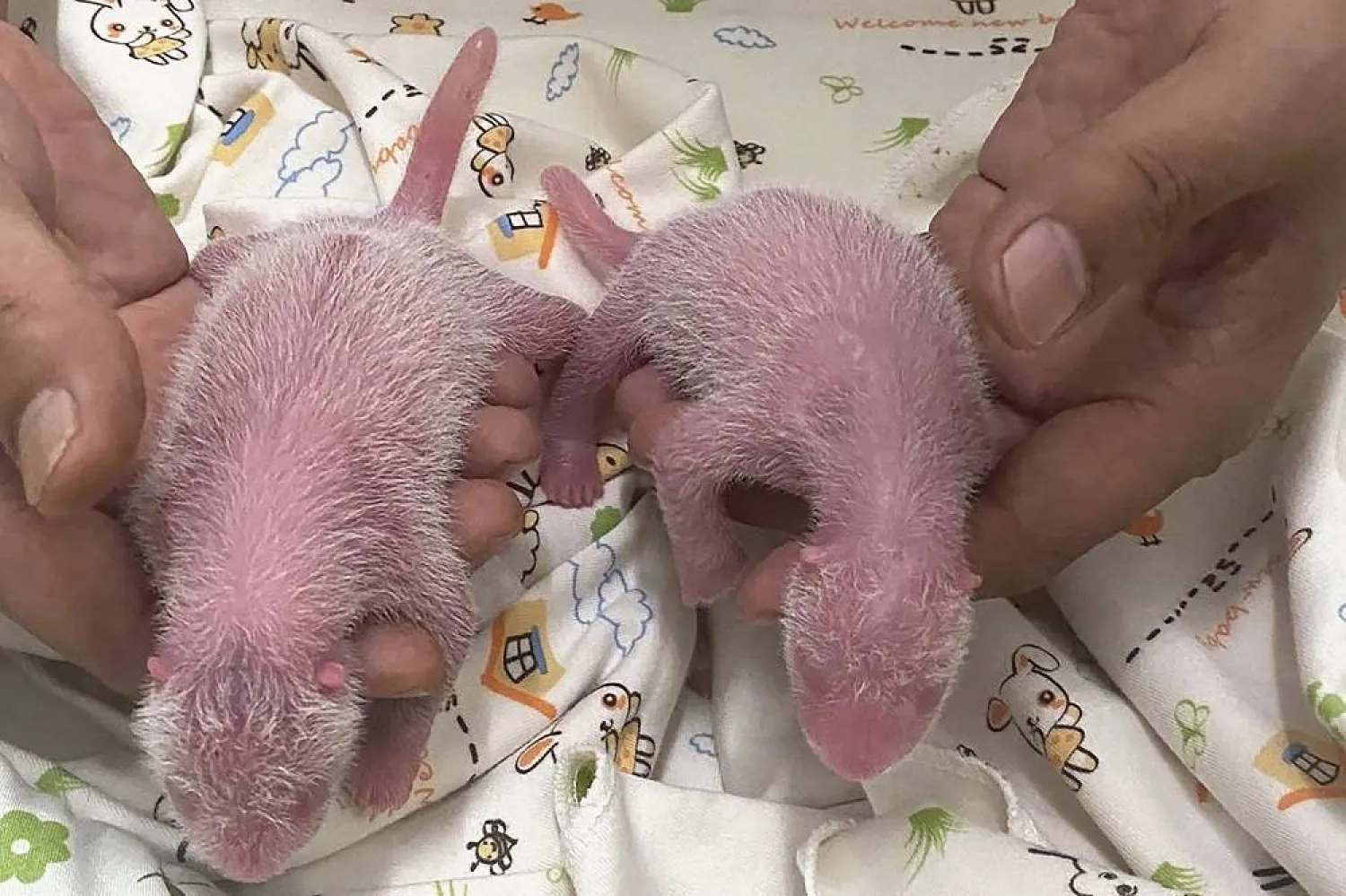
In this photo released and taken on Aug. 15, 2024 by Ocean Park Hong Kong, a photo of twin panda babies, female at left and male at right, at Ocean Park Hong Kong marking the first-ever locally born panda cubs. (Ocean Park Hong Kong via AP)
TT

Panda Twins Are Born in Hong Kong to Ying Ying, World’s Oldest First-Time Mom 

In this photo released and taken on Aug. 15, 2024 by Ocean Park Hong Kong, a photo of twin panda babies, female at left and male at right, at Ocean Park Hong Kong marking the first-ever locally born panda cubs. (Ocean Park Hong Kong via AP)

Hong Kong welcomed the birth of its first locally born giant pandas on Thursday, with their mother becoming the world’s oldest first-time mother of its kind on record, the theme park that houses them announced.

Ying Ying, the mother, gave birth to the twins — one male and one female — at Ocean Park just a day before she turned 19 years old, the park said in a statement.

She and her partner Le Le are the second pair of pandas gifted by China to Hong Kong since the former British colony returned to China's rule in 1997.

Pandas are widely considered as the country's unofficial national mascot and China’s giant panda loan program with overseas zoos has long been known as a tool of Beijing’s soft-power diplomacy.

Ocean Park said in the statement that giant pandas have a “notoriously difficult time reproducing, especially as they age” and panda pregnancy is not readily detectable.

Although Ying Ying started showing symptoms including decreased appetite, increased need for rest time and changes in hormonal levels in late July, her pregnancy was only confirmed on Sunday. On Wednesday, her care team noticed Ying Ying's labor symptoms and her amniotic fluid broke at night. After over five hours of labor, the babies were safely delivered Thursday morning, the park said.

“Both cubs are currently very fragile and need time to stabilize, especially the female cub who has a lower body temperature, weaker cries, and lower food intake after birth,” the park said. Visitors will have to wait for a few months for their public debut.

Ocean Park Corp. chairman Paulo Pong thanked the local animal care team, as well as experts from mainland China for their partnership and assistance over the years.

“The birth is a true rarity, especially considering Ying Ying is the oldest giant panda on record to have successfully given birth for the first time,” Pong said.

Hong Kong leader John Lee also expressed his gratitude to the central government for gifting the pandas to the financial hub in 2007, saying it showed Beijing's care and support for the city.

Hong Kong has its own governing and judicial system and China authored a 2020 national security law that has been used to prosecute pro-democracy activists.

In July, Lee announced that Hong Kong would receive a third pair of pandas from China. The pair is expected to arrive this year.

The late first pair, An An and Jia Jia, arrived in 1999. Jia Jia, who died at 38 in 2016, is the world’s oldest-ever panda to have lived in captivity. The average lifespan for a panda in the wild is 18 to 20 years, while in captivity it’s 30 years, according to Guinness World Records.



Rocket Re-entry Pollution Measured in Atmosphere for 1st Time

A SpaceX Falcon 9 rocket with the company's Dragon spacecraft on top launches from Space Launch Complex 40 for the Crew-12 mission at Cape Canaveral Space Force Station in Florida on February 13, 2026. (Photo by Jim WATSON / AFP)
TT

Rocket Re-entry Pollution Measured in Atmosphere for 1st Time

A SpaceX Falcon 9 rocket with the company's Dragon spacecraft on top launches from Space Launch Complex 40 for the Crew-12 mission at Cape Canaveral Space Force Station in Florida on February 13, 2026. (Photo by Jim WATSON / AFP)

When part of a SpaceX rocket re-entered Earth's atmosphere exactly a year ago, it created a spectacular fireball that streaked across Europe's skies, delighting stargazers and sending a team of scientists rushing towards their instruments.

The German team managed to measure the pollution the rocket's upper stage emitted in our planet's difficult-to-study upper atmosphere -- the first time this has been achieved, according to a study published on Thursday.

It is vital to learn more about this little-understood form of pollution because of the huge number of satellites that are planned to be launched in the coming years, the scientists emphasized.

In the early hours of February 19, 2025, the upper stage of a Falcon 9 rocket was tumbling back to Earth when it exploded into a fireball that made headlines from the UK to Poland.

"We were excited to try and test our equipment and hopefully measure the debris trail," the team led by Robin Wing and Gerd Baumgarten of the Leibniz Institute of Atmospheric Physics in Germany told AFP via email.

In particular, the scientists wanted to measure how the rocket polluted what they call the "ignorosphere" -- because it is so difficult to study.

This region between 50 to 100 kilometers (31 to 62 miles) above Earth includes the mesosphere and part of the lower thermosphere.

- 'Harbinger' -

The team used technology called LIDAR, which measures pollution in the atmosphere by shooting out lots of laser pulses and seeing which bounce back off something.

They detected a sudden spike in the metal lithium in an area nearly 100 kilometers above Earth. This plume had 10 times more lithium than is normal in this part of the atmosphere.

The team then traced the plume back to where the rocket re-entered the atmosphere, west of Ireland.

For the first time, this proves it is possible to study pollution from re-entering rockets at such heights before it disperses, the scientists said.

But the impact from this rocket pollution remains unknown.

"What we do know is that one ton of emissions at 75 kilometers (altitude) is equivalent to 100,000 tons at the surface," they said.

The study warned the case was a "harbinger" of the pollution to come, given how many rockets will be needed to launch all the satellites that Earth is planning to blast into space.

Currently, there are around 14,000 active satellites orbiting our planet.
In the middle of last month, China applied for permission to launch around 200,000 satellites into orbit.

Then at the end of January, billionaire Elon Musk's SpaceX applied for permission to launch one million more.

Eloise Marais, a professor of atmospheric chemistry at University College London not involved in the new study, told AFP the research was "really important".

"There is currently no suitable regulation targeting pollution input into the upper layers of the atmosphere," she explained.

"Even though these portions of the atmosphere are far from us, they have potentially consequential impacts to life on Earth if the pollutants produced are able to affect Earth's climate and deplete ozone in the layer protecting us from harmful UV radiation."

The study was published in the journal Communications Earth & Environment.


Deep-sea Fish Break the Mold with Novel Visual System

A close-up showing the shiny silver-green photophores (light organs) on the lower head of the deep-sea fish Maurolicus muelleri from the Red Sea, seen in this photograph released on February 11, 2026. Dr. Wen-Sung Chung/Handout via REUTERS
TT

Deep-sea Fish Break the Mold with Novel Visual System

A close-up showing the shiny silver-green photophores (light organs) on the lower head of the deep-sea fish Maurolicus muelleri from the Red Sea, seen in this photograph released on February 11, 2026. Dr. Wen-Sung Chung/Handout via REUTERS

For more than a century, biology textbooks have stated that vision among vertebrates - people included - is built from two clearly defined cell types: rods for processing dim light and cones for bright light and color. New research involving deep-sea fish shows this tidy division is, in reality, not so tidy.

Scientists have identified a new type of visual cell in deep-sea fish that blends the shape and form of rods with the molecular machinery and genes of cones. This hybrid type of cell, adapted for sight in gloomy light conditions, was found in larvae of three deep-sea fish species in the Red Sea, Reuters reported.

The species studied were: a hatchetfish, with the scientific name Maurolicus mucronatus; a lightfish, named Vinciguerria mabahiss; and a lanternfish, named Benthosema pterotum. The hatchetfish retained the hybrid cells throughout its life. The other two shifted to the usual rod-cone dichotomy in adulthood.

All three are small, with adults measuring roughly 1-3 inches (3-7 cm) long and the larvae much littler. They inhabit a marine realm of twilight conditions, with sunlight struggling to penetrate into the watery depths.

The vertebrate retina, a sensory membrane at the back of the eye that detects light and converts it into signals to the brain, possesses two main types of light-sensitive visual cells, called photoreceptors. They are named for their shape: rods and cones.

"The rods and cones slowly change position inside the retina when moving between dim and bright conditions, which is why our eyes take time to adjust when we flick on the light switch on our way to the restroom at night," said Lily Fogg, a postdoctoral researcher in marine biology at the University of Helsinki in Finland and lead author of the research published in the journal Science Advances.

"We found that, as larvae, these deep-sea fish mostly use a mix-and-match type of hybrid photoreceptor. These cells look like rods - long, cylindrical and optimized to catch as many light particles - photons - as possible. But they use the molecular machinery of cones, switching on genes usually found only in cones," Fogg said.

The researchers examined the retinas of fish larvae caught at depths from 65 to 650 feet (20 to 200 meters). In the type of dim environment they inhabit, rod and cone cells both are usually engaged in the vertebrate retina, but neither works very well. These fish display an evolutionary remedy.

"Our results challenge the longstanding idea that rods and cones are two fixed, clearly separated cell types. Instead, we show that photoreceptors can blend structural and molecular features in unexpected ways. This suggests that vertebrate visual systems are more flexible and evolutionarily adaptable than previously thought," Fogg said.

"It is a very cool finding that shows that biology does not fit neatly into boxes," said study senior author Fabio Cortesi, a marine biologist and neuroscientist at the University of Queensland in Australia. "I wouldn't be surprised if we find these cells are much more common across all vertebrates, including terrestrial species."

All three species emit bioluminescence using small light-emitting organs on their bodies, mostly located on the belly. They produce blue-green light that blends with the faint background light from the sun above. This strategy, called counterillumination, is a common form of camouflage in the deep sea to avoid predators.

"Small fish like these fuel the open ocean. They are plentiful and serve as food for many larger predatory fishes, including tuna and marlin, marine mammals such as dolphins and whales, and marine birds," Cortesi said.

These kinds of fish also engage in one of the biggest daily migrations in the animal kingdom. They swim near the surface at night to feed in plankton-rich waters, then return to the depths - 650 to 3,280 feet (200 to 1,000 meters) - during daytime to avoid predation.

"The deep sea remains a frontier for human exploration, a mystery box with the potential for significant discoveries," Cortesi said. "We should look after this habitat with the utmost care to make sure future generations can continue to marvel at its wonders."


Japan City Gets $3.6 Mn Donation in Gold to Fix Water System

FILE PHOTO: Factories line the port of Osaka, western Japan October 23, 2017. REUTERS/Thomas White/File Photo
TT

Japan City Gets $3.6 Mn Donation in Gold to Fix Water System

FILE PHOTO: Factories line the port of Osaka, western Japan October 23, 2017. REUTERS/Thomas White/File Photo

Osaka has received an unusual donation -- 21 kilograms of gold -- to pay for the maintenance of its ageing water system, the Japanese commercial hub announced Thursday.

The donation worth $3.6 million was made in November by a person who a month earlier had already given $3,300 in cash for the municipal waterworks, Osaka Mayor Hideyuki Yokoyama told a press conference.

"It's an absolutely staggering amount," said Yokoyama, adding that he was lost for words to express his gratitude.

"I was shocked."

The donor wished to remain anonymous, AFP quoted the mayor as saying.

Work to replace water pipes in Osaka, a city of 2.8 million residents, has hit a snag as the actual cost exceeded the planned budget, according to local media.