

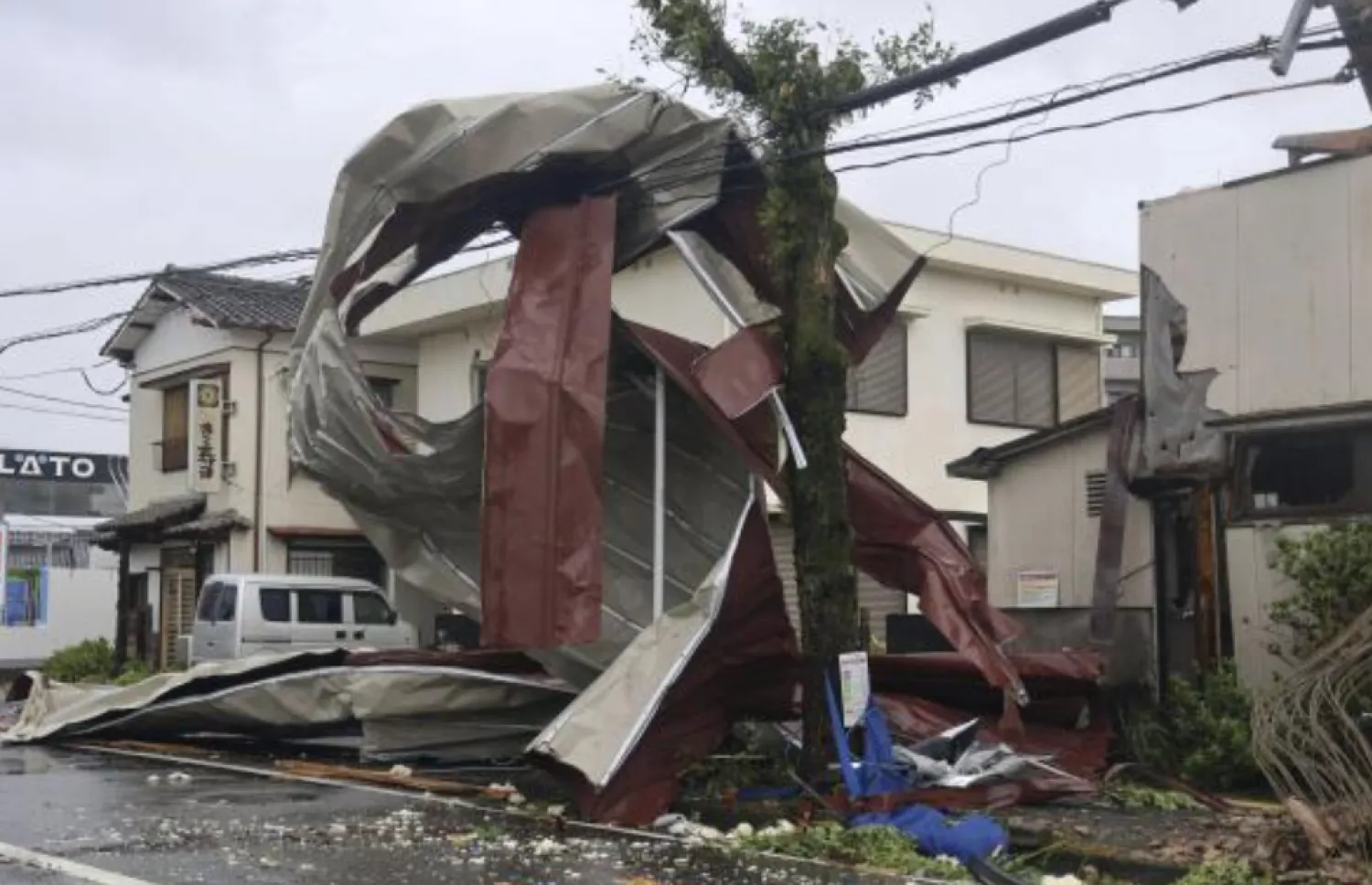

Strong Storm Lashes Northeast Japan with Torrential Rains, Strong Winds

As disaster risks in the Kyushu region subsided later Thursday, Shanshan started dumping heavy rain on neighboring Shikoku island - (The AP) 
TT

Strong Storm Lashes Northeast Japan with Torrential Rains, Strong Winds

As disaster risks in the Kyushu region subsided later Thursday, Shanshan started dumping heavy rain on neighboring Shikoku island - (The AP) 

A strong storm lashed southern Japan with torrential rain and strong winds Thursday, killing severals as it started a crawl up the length of the archipelago and raised concerns of flooding, landslides and extensive damage.

Tropical storm Shanshan made landfall Thursday morning as a powerful typhoon on the southern island of Kyushu and then gradually lost strength, though it was still forecast to bring strong winds, high waves and significant rainfall to most of the country, particularly on Kyushu.

About 60 centimeters (nearly 2 feet) of rain fell in parts of Miyazaki prefecture on Kyushu, swelling rivers and threatening floods, the Japan Meteorological Agency said. That 24-hour total was more than the average rainfall for all of August, it said.

By late afternoon Thursday, the storm was moving north at 15 kph (9 mph) and its winds had weakened to 108 kph (67 mph). It is “no longer a powerful typhoon,” the agency said.

As disaster risks in the Kyushu region subsided later Thursday, Shanshan started dumping heavy rain on neighboring Shikoku island, The AP reported.

The storm ripped through downtown Miyazaki city on Kyushu, knocking down trees, throwing cars to the side in parking lots and shattering windows of some buildings. The prefectural disaster management task force said about 50 buildings were damaged.

NHK public television showed a swollen river in the popular hot spring town of Yufu in Oita prefecture, just north of Miyazaki, with muddy water splashing against a bridge.

More than 70 people were injured across Kyushu, mostly in Miyazaki and Kagoshima. Some were injured by being thrown to the ground by the storm on their way to shelters, the Fire and Disaster Management Agency said.

About 168,000 households were without power across Kyushu, most of them in Kagoshima prefecture, Kyushu Electric Power Co. said.

About 20,000 people took shelter at municipal community centers, school gymnasiums and other facilities across Kyushu, according to prefectural reports.

Ahead of the storm's arrival, heavy rain triggered a landslide that buried a house in the central city of Gamagori, killing three residents and injuring two others, the city’s disaster management department said. On the southern island of Amami, which Shanshan passed, one person was injured by being knocked down by a wind gust while riding a motorcycle, the fire agency said.

Weather and government officials are concerned about extensive damage as the storm slowly sweeps up the Japanese archipelago to the northeast over the next few days, threatening more floods and landslides.

In the Tokyo region, Shinkansen bullet trains connecting Tokyo and Osaka were suspended starting Thursday evening due to heavy rain in the central region. Bullet train service also was to be suspended in parts of the western and central regions on Friday.

Disaster Management Minister Yoshifumi Matsumura said Shanshan could cause “unprecedented” levels of violent winds, high waves, storm surges and heavy rain. At a task force meeting on Wednesday, he urged people, especially older adults, not to hesitate and take shelter whenever there is any safety concern.

Hundreds of domestic flights connecting southwestern cities and islands were canceled Thursday, and bullet trains and some local train services were suspended. As the storm headed northeast, similar steps were taken in parts of the main island of Honshu that were experiencing heavy rain. Postal and delivery services were suspended in the Kyushu region, and supermarkets and other stores planned to close.



Deep-sea Fish Break the Mold with Novel Visual System

A close-up showing the shiny silver-green photophores (light organs) on the lower head of the deep-sea fish Maurolicus muelleri from the Red Sea, seen in this photograph released on February 11, 2026. Dr. Wen-Sung Chung/Handout via REUTERS
TT

Deep-sea Fish Break the Mold with Novel Visual System

A close-up showing the shiny silver-green photophores (light organs) on the lower head of the deep-sea fish Maurolicus muelleri from the Red Sea, seen in this photograph released on February 11, 2026. Dr. Wen-Sung Chung/Handout via REUTERS

For more than a century, biology textbooks have stated that vision among vertebrates - people included - is built from two clearly defined cell types: rods for processing dim light and cones for bright light and color. New research involving deep-sea fish shows this tidy division is, in reality, not so tidy.

Scientists have identified a new type of visual cell in deep-sea fish that blends the shape and form of rods with the molecular machinery and genes of cones. This hybrid type of cell, adapted for sight in gloomy light conditions, was found in larvae of three deep-sea fish species in the Red Sea, Reuters reported.

The species studied were: a hatchetfish, with the scientific name Maurolicus mucronatus; a lightfish, named Vinciguerria mabahiss; and a lanternfish, named Benthosema pterotum. The hatchetfish retained the hybrid cells throughout its life. The other two shifted to the usual rod-cone dichotomy in adulthood.

All three are small, with adults measuring roughly 1-3 inches (3-7 cm) long and the larvae much littler. They inhabit a marine realm of twilight conditions, with sunlight struggling to penetrate into the watery depths.

The vertebrate retina, a sensory membrane at the back of the eye that detects light and converts it into signals to the brain, possesses two main types of light-sensitive visual cells, called photoreceptors. They are named for their shape: rods and cones.

"The rods and cones slowly change position inside the retina when moving between dim and bright conditions, which is why our eyes take time to adjust when we flick on the light switch on our way to the restroom at night," said Lily Fogg, a postdoctoral researcher in marine biology at the University of Helsinki in Finland and lead author of the research published in the journal Science Advances.

"We found that, as larvae, these deep-sea fish mostly use a mix-and-match type of hybrid photoreceptor. These cells look like rods - long, cylindrical and optimized to catch as many light particles - photons - as possible. But they use the molecular machinery of cones, switching on genes usually found only in cones," Fogg said.

The researchers examined the retinas of fish larvae caught at depths from 65 to 650 feet (20 to 200 meters). In the type of dim environment they inhabit, rod and cone cells both are usually engaged in the vertebrate retina, but neither works very well. These fish display an evolutionary remedy.

"Our results challenge the longstanding idea that rods and cones are two fixed, clearly separated cell types. Instead, we show that photoreceptors can blend structural and molecular features in unexpected ways. This suggests that vertebrate visual systems are more flexible and evolutionarily adaptable than previously thought," Fogg said.

"It is a very cool finding that shows that biology does not fit neatly into boxes," said study senior author Fabio Cortesi, a marine biologist and neuroscientist at the University of Queensland in Australia. "I wouldn't be surprised if we find these cells are much more common across all vertebrates, including terrestrial species."

All three species emit bioluminescence using small light-emitting organs on their bodies, mostly located on the belly. They produce blue-green light that blends with the faint background light from the sun above. This strategy, called counterillumination, is a common form of camouflage in the deep sea to avoid predators.

"Small fish like these fuel the open ocean. They are plentiful and serve as food for many larger predatory fishes, including tuna and marlin, marine mammals such as dolphins and whales, and marine birds," Cortesi said.

These kinds of fish also engage in one of the biggest daily migrations in the animal kingdom. They swim near the surface at night to feed in plankton-rich waters, then return to the depths - 650 to 3,280 feet (200 to 1,000 meters) - during daytime to avoid predation.

"The deep sea remains a frontier for human exploration, a mystery box with the potential for significant discoveries," Cortesi said. "We should look after this habitat with the utmost care to make sure future generations can continue to marvel at its wonders."


Japan City Gets $3.6 Mn Donation in Gold to Fix Water System

FILE PHOTO: Factories line the port of Osaka, western Japan October 23, 2017. REUTERS/Thomas White/File Photo
TT

Japan City Gets $3.6 Mn Donation in Gold to Fix Water System

FILE PHOTO: Factories line the port of Osaka, western Japan October 23, 2017. REUTERS/Thomas White/File Photo

Osaka has received an unusual donation -- 21 kilograms of gold -- to pay for the maintenance of its ageing water system, the Japanese commercial hub announced Thursday.

The donation worth $3.6 million was made in November by a person who a month earlier had already given $3,300 in cash for the municipal waterworks, Osaka Mayor Hideyuki Yokoyama told a press conference.

"It's an absolutely staggering amount," said Yokoyama, adding that he was lost for words to express his gratitude.

"I was shocked."

The donor wished to remain anonymous, AFP quoted the mayor as saying.

Work to replace water pipes in Osaka, a city of 2.8 million residents, has hit a snag as the actual cost exceeded the planned budget, according to local media.


Thai Cops Go Undercover as Lion Dancers to Nab Suspected Thief

People gather to watch performers outside Emsphere shopping mall on the first day of the Lunar New Year of the Horse, in Bangkok on February 17, 2026. (Photo by Lillian SUWANRUMPHA / AFP)
TT

Thai Cops Go Undercover as Lion Dancers to Nab Suspected Thief

People gather to watch performers outside Emsphere shopping mall on the first day of the Lunar New Year of the Horse, in Bangkok on February 17, 2026. (Photo by Lillian SUWANRUMPHA / AFP)

Thai police donned a lion dance costume during this week's Lunar New Year festivities to arrest a suspect accused of stealing about $64,000 worth of Buddhist artifacts, police said Thursday.

Officers dressed as a red-and-yellow lion made the arrest on Wednesday evening after receiving a report earlier this month of a home burglary in the suburbs of the capital, Bangkok, AFP reported.

Capital police said the reported break-in involved "numerous Buddhist objects and two 12-inch Buddha statues", along with evidence of repeated attempts to enter the house, according to a statement.

With few leads, police kept watch for weeks before hatching an unusual plan to join a lion dance procession at a nearby Buddhist temple.

"Officers gradually moved closer to the suspect before arresting him," police said.

A video released by police showed the festive lion dancers approaching the suspect before an officer suddenly emerged from the head of the costume and, with help from colleagues, pinned him to the ground.

Police estimated the value of the stolen items at around two million baht ($64,000).

The suspect, a 33-year-old man, has a criminal record involving drug offences and theft, police added.