


Russia’s Putin Says His Young Family Members Speak Fluent Mandarin Chinese 

Russian President Vladimir Putin holds an open lesson “Talking of What Matters” at the secondary school No 20 named after Heroes of the Fatherland in Kyzyl, Republic of Tuva, Russia, 02 September 2024. (EPA/ Vyacheslav Prokofyev / Sputnik / Kremlin Pool)
TT

Russia’s Putin Says His Young Family Members Speak Fluent Mandarin Chinese 

Russian President Vladimir Putin holds an open lesson “Talking of What Matters” at the secondary school No 20 named after Heroes of the Fatherland in Kyzyl, Republic of Tuva, Russia, 02 September 2024. (EPA/ Vyacheslav Prokofyev / Sputnik / Kremlin Pool)

Russian President Vladimir Putin said on Monday that young members of his family speak fluent Mandarin, though he told school children they should not forget the importance of English too despite the growing popularity of Chinese.

Putin has two daughters with his ex-wife Lyudmila and they speak Russian, English, German, and French. Putin, who divorced his wife in 2014, rarely speaks about his family but has at least three grandchildren, according to Russian media.

"Some of my family members, the little ones, speak Chinese too - they speak it fluently," Putin told pupils of Secondary School No. 20 in Kyzyl, Tuva, about 4,500 km (2,800 miles) east of Moscow.

Amid a growing partnership between China and Russia, Mandarin has been growing in popularity across Russia as a foreign language of choice, a trend Putin said was due to developing contacts across economics, politics and society.

Putin, who speaks fluent German but has also taken lessons to improve his English, said that pupils should not forget the importance of English.

"English is a great language, it has given humanity a great deal in terms of combining knowledge and uniting people in the field of culture, and so on," Putin said.

Russian, English, Tatar, German and Chechen are the most widely spoken languages in Russia, according to the 2022 census. While Mandarin is spoken far less, it has been growing swiftly in popularity in recent years as a foreign language.

Putin and China's President Xi Jinping in May pledged a "new era" of partnership between the two most powerful rivals of the United States, which they cast as an aggressive Cold War hegemon sowing chaos across the world.

China and Russia declared a "no limits" partnership in February 2022 when Putin visited Beijing just days before he sent tens of thousands of troops into Ukraine, triggering the deadliest land war in Europe since World War Two.

English is the world's most spoken language with about 1.5 billion speakers, followed by Mandarin Chinese with about 1.1 billion speakers, and then Hindi, Spanish, Arabic, French, Bengali, Portuguese, Russian and Urdu, according to Ethnologue, a language research center.


Two Holy Mosques Exhibition Welcomes Visitors for Founding Day Celebrations

The exhibition is open daily from 10:00 a.m. to 1:30 a.m - SPA
TT

Two Holy Mosques Exhibition Welcomes Visitors for Founding Day Celebrations

The exhibition is open daily from 10:00 a.m. to 1:30 a.m - SPA

In celebration of the Kingdom’s Founding Day, the Exhibition of the Two Holy Mosques Architecture in Makkah is welcoming visitors to explore a comprehensive historical journey.

The exhibition presents the evolution of the Two Holy Mosques through rare artifacts, historical photographs, and documentation of successive Saudi expansions, according to SPA.

The halls highlight the Kingdom’s long-standing dedication to serving the Two Holy Mosques. They combine heritage and modern technology to present the architectural development of Islam’s holiest sites.

The exhibition is open daily from 10:00 a.m. to 1:30 a.m.


Photos Show Filming of Ramadan TV Drama Series on the War-scarred Streets of Syria's Aleppo

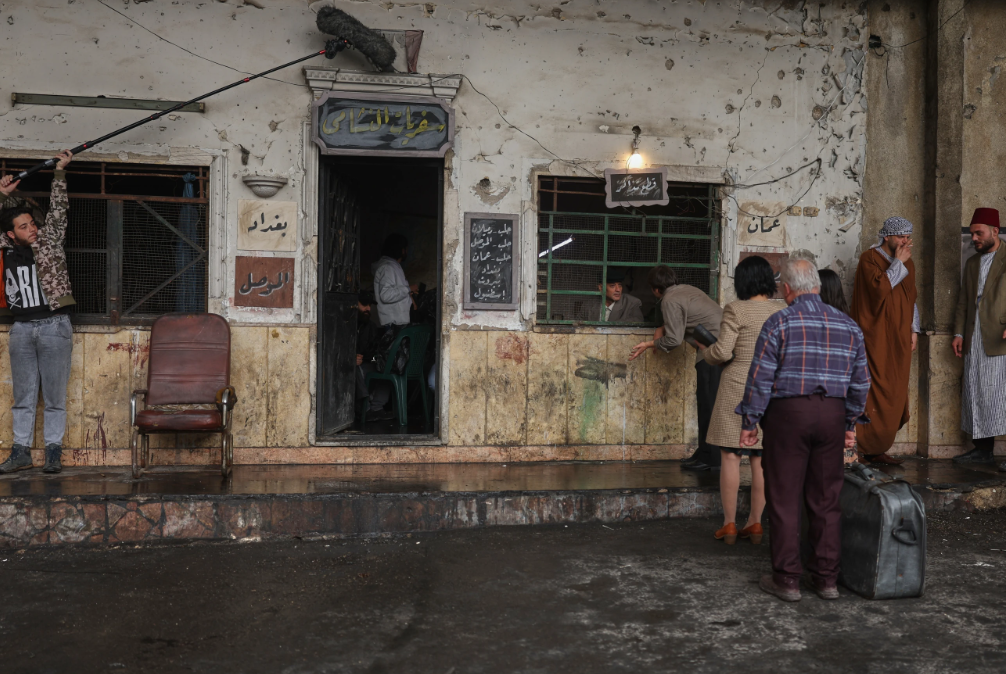
Extras stand by as a television crew films an episode of the TV series “Al-Souriyoun al-Aada” (“The Syrian Enemies”), based on a novel of the same name that was banned under Bashar Assad, along a transformed street in central Aleppo, Syria, Friday, Feb. 13, 2026. (AP Photo/Ghaith Alsayed)
TT

Photos Show Filming of Ramadan TV Drama Series on the War-scarred Streets of Syria's Aleppo

Extras stand by as a television crew films an episode of the TV series “Al-Souriyoun al-Aada” (“The Syrian Enemies”), based on a novel of the same name that was banned under Bashar Assad, along a transformed street in central Aleppo, Syria, Friday, Feb. 13, 2026. (AP Photo/Ghaith Alsayed)

Ramadan in the Arab world is a month of fasting and prayer by day — and television by night. For decades, families have gathered after the iftar, the evening meal that breaks the daytime fast, to follow the season’s highly anticipated drama series, produced specially to air during the Islamic holy month.

In the week before Ramadan, a television crew in central Aleppo was busy preparing one of those productions, with a battered street in the historic city transformed into a scene from decades past.

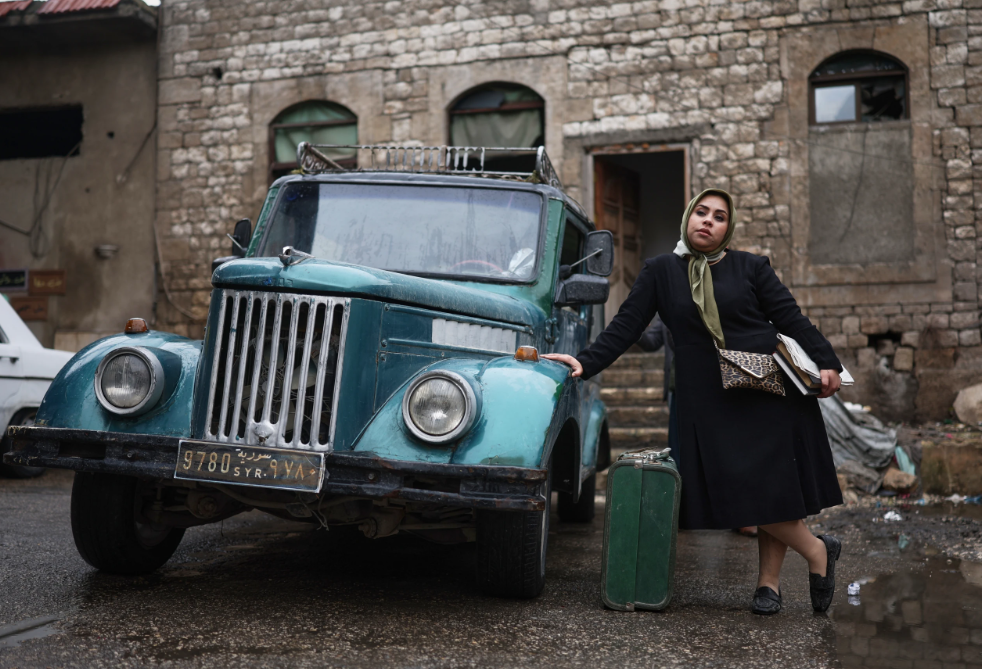
Lamees Al-Ali, an extra in the series, poses for a photograph during the filming of an episode of the TV series “Al-Souriyoun al-Aada” (“The Syrian Enemies”), based on a novel of the same name that was banned under Bashar Assad, along a transformed street in central Aleppo, Syria, Friday, Feb. 13, 2026. (AP Photo/Ghaith Alsayed)

Classic 1970s cars lined the curb. A horse-drawn cart rolled through the frame. A vendor in a red tarboush, a brimless cone-shaped hat, stood beside steaming pots of sahlep — a sweet, thickened milk drink flavored with spices and associated with winter evenings.

Just outside the camera’s view stood a stark reminder of Syria's more recent history. Collapsed buildings and damaged facades testified to Aleppo’s role as a major battleground during the country's civil war. However, with costumes, props and careful framing, the production temporarily carried the street back to what it portrays as a more innocent era, according to The AP news.

A television crew films an episode of the TV series “Al-Souriyoun al-Aada” (“The Syrian Enemies”), based on a novel of the same name that was banned under Bashar Assad, along a transformed street in central Aleppo, Syria, Friday, Feb. 13, 2026.(AP Photo/Ghaith Alsayed)

The series being filmed — “Al-Souriyoun al-Aada,” or “The Syrian Enemies” — is based on a novel that was banned during the rule of former President Bashar Assad. The story examines painful chapters of Syria’s past, including the 1982 events in Hama, when government forces crushed an uprising led by the Muslim Brotherhood, killing or disappearing an estimated 10,000 to 40,000 people and leaving the city in ruins.

As filming continues into Ramadan, the production reflects both a cherished seasonal tradition and Syria’s complex, layered history.


How Bomb Cyclones Form and Create Dangerous Conditions 

A man works in a snowstorm, Sunday, Feb. 22, 2026, in New York. (AP)
TT

How Bomb Cyclones Form and Create Dangerous Conditions 

A man works in a snowstorm, Sunday, Feb. 22, 2026, in New York. (AP)

When turbulent weather with whipping winds and heavy snow is in the forecast, meteorologists sometimes warn that a storm could “bomb out” or become a bomb cyclone. But what exactly does this mean?

According to the US National Oceanic and Atmospheric Administration, certain storms undergo bombogenesis, which happens when a storm’s central pressure drops at least 24 millibars in 24 hours. These storms are sometimes called bomb cyclones. Storm intensity is measured by central pressure, so the lower the pressure, the stronger the storm.

Such rapidly strengthening storms are capable of producing heavy rain, blizzard conditions and intense winds that can create dangerous conditions such as downed trees and power outages.

“If you’re watching TV at night and the weather report comes on and you’re hearing ‘bomb cyclone’ being used, that usually means there’s quite a bit of active weather going on,” said Andrew Orrison, a meteorologist with the National Weather Service in College Park, Maryland.

Bomb cyclones can happen in any season, but mainly occur during fall and winter when frigid air from the Arctic can creep south and clash with warmer air masses.

“It’s really the clash of those air masses that really kind of helps to generate the areas of low pressure in the first place,” said Orrison.

Regions in North America that are prone to seeing bomb cyclones include Alaska, the Pacific Northwest and the Great Lakes region.
