


Türkiye Wants to Regulate Germany’s Beloved Döner Kebab Street Food 

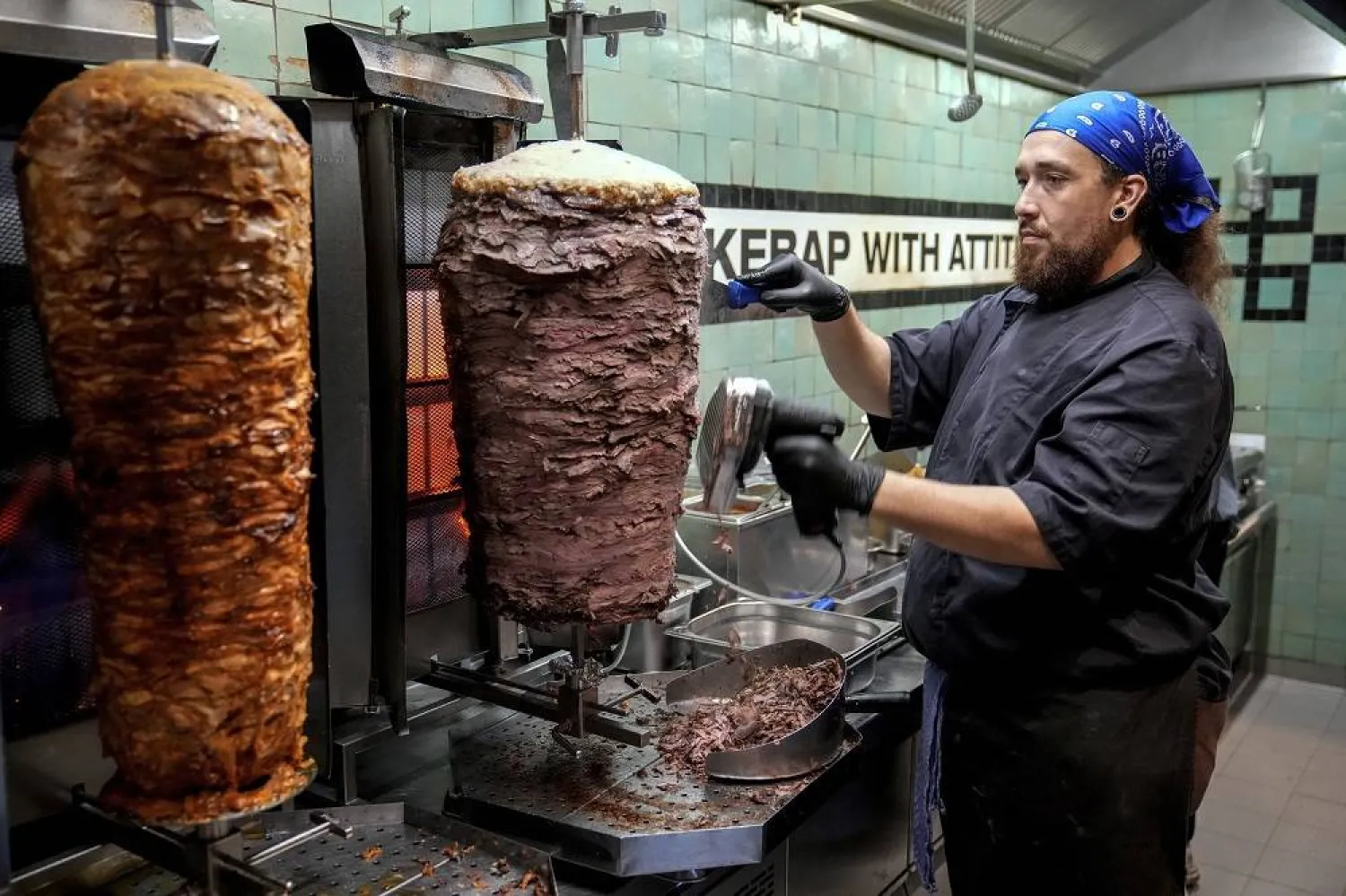
Döner chef Hvesley Silva cuts döner kebab in a döner kebab restaurant in Berlin, Germany, Monday, Sept. 16, 2024. (AP)
TT

Türkiye Wants to Regulate Germany’s Beloved Döner Kebab Street Food 

Döner chef Hvesley Silva cuts döner kebab in a döner kebab restaurant in Berlin, Germany, Monday, Sept. 16, 2024. (AP)

Beef and chicken glisten as they rotate slowly on vertical spits before they are carved off in razor-thin strips. Two cooks slide from a sizzling griddle to a warm toaster in a practiced dance. Mounds of fresh tomatoes, cabbage and red onions shine in a colorful tableau.

The scene at Kebap With Attitude in Berlin’s trendy Mitte neighborhood is typical of any street-side stand or restaurant where cooks pile the ingredients into pita bread to create the city’s beloved döner kebab.

But the snack's status could be in jeopardy if the European Commission approves a bid by Türkiye to regulate what can legally take the döner kebab name.

In the balance is an industry that generates annual sales of roughly 2.3 billion euros (nearly $2.6 billion) in Germany alone, and 3.5 billion euros (nearly $3.9 billion) across Europe, according to the Berlin-based Association of Turkish Döner Producers in Europe.

“From the government to the streets, everyone is eating döner kebab,” Deniz Buchholz, the owner of Kebap With Attitude, said as waiters ferried steaming orders from the kitchen to hungry lunchtime customers on a rainy Monday afternoon.

The word “döner” is derived from the Turkish verb “dönmek,” which means “to turn.” The meat is grilled for hours on a spit and sliced off when the meat becomes crisp and brown. In Türkiye, the dish originally was made of lamb and sold only on a plate. But in the 1970s, Turkish immigrants in Berlin opted to serve it in a pita and tweak the recipe to make it special for Berliners.

“They realized that the Germans like everything in the bread,” said Buchholz, who was raised in Berlin and has Turkish roots. “And then they said, ‘OK, let’s put this dish into a bread’ and this is how it came to döner kebab Berlin-style.”

In April, Türkiye applied to have döner kebab protected under a status called “traditional specialty guaranteed.” It’s below the vaunted “protected designation of origin” that applies to geographic region-specific products, but could still impact kebab-shop owners, their individual recipes and their customers throughout Germany.

Under Türkiye’s proposal, beef would be required to come from cattle that is at least 16 months old. It would be marinated with specific amounts of animal fat, yogurt or milk, onion, salt, and thyme, as well as black, red and white peppers. The final product must be sliced off the vertical spit into pieces that are 3 to 5 millimeters (0.1 to 0.2 inches) thick. Chicken would be similarly regulated.

The European Commission must decide by Sept. 24 whether 11 objections to the application, including from Germany’s Federal Ministry of Food and Agriculture, have merit. If they do, Germany and Türkiye will have up to six months to hammer out a compromise. The European Commission has the final say.

“We have taken note of the application from Türkiye with some astonishment,” Germany’s Federal Ministry of Food and Agriculture said in a statement to The Associated Press.

“The kebab is part of Germany, and the diversity of its preparation methods reflects the diversity of our country — this must be preserved. In the interests of the many fans in Germany, we are committed to ensuring that the doner kebab can remain as it is prepared and eaten here," the ministry said.

It appears that vegetables, turkey and some veal kebabs — all of which are popular in Germany — would no longer be allowed under Türkiye’s application because it does not specifically mention them, causing confusion in the German food industry.

“The kebab belongs to Germany. Everyone should be allowed to decide for themselves how it is prepared and eaten here. There’s no need for guidelines from Ankara,” Cem Özdemir, Germany’s federal food and agriculture minister who also has Turkish roots, wrote on social platform X.

Buchholz of Kebap With Attitude said he isn’t worried about possible regulations.

Although he said it might be a way to keep the quality high for the traditional döner kebab — he believes it has lapsed in some places — he added that shop owners might have to harness Berlin’s legacy of creative solutions to keep their expanded menus.

“We will go the Berlin way and we’ll find a solution to name it different,” he said, like calling it a “veggie sandwich.”

Döner kebab impacts the political sphere, too. Anger over kebab costs that have risen into the double-digits led the Die Linke, the Left party, to ask German Chancellor Olaf Scholz for a “price break” that would have subsidized the street food and set a maximum price for customers. Scholz declined, but took to social media to explain that increasing food costs come in part from soaring energy costs — which are fueled by Russia’s war on Ukraine.

And German President Frank-Walter Steinmeier engaged in “döner diplomacy” when he brought a third-generation kebab-shop owner, as well as a full skewer of meat, to Türkiye in April. The trip was the first official visit there by a German president in a decade, even as Türkiye’s populist president, Recep Tayyip Erdogan, is seen as having increasingly authoritarian instincts. Erdogan's reputation has made some Turkish citizens who own kebab shops in Germany fearful of speaking out against the proposed regulations for fear of facing reprisals when they go home.

In its objection, the German Hotel and Restaurant Association wrote that Türkiye’s proposals differ from typical German preparations for döner, and that the regulations could lead to economic problems for kebab shops — as well as potential legal challenges.

The German döner kebab economy should not be held to Turkish rules, the association said in a statement.

“The diversity of the kebab must be preserved,” the association said.


Snowstorm Paralyzes Vienna Airport

People wait at a tram stop after heavy snowfalls in Vienna, Austria, February 20, 2026. REUTERS/Elisabeth Mandl
TT

Snowstorm Paralyzes Vienna Airport

People wait at a tram stop after heavy snowfalls in Vienna, Austria, February 20, 2026. REUTERS/Elisabeth Mandl

Massive snowstorms caused power outages and transport chaos in Austria on Friday, forcing the Vienna airport to temporarily halt all flights.

Flights departing from the capital, a major European hub, were cancelled or delayed, and more than 230 arrivals were similarly disrupted or rerouted.

"Passengers whose flights have been delayed are asked not to come to the airport," the facility said in a statement.

The area received 20 centimeters (nearly eight inches) of snow, national news agency APA reported.

The main highway south of Vienna was closed for several hours, and other sections of highway were temporarily inaccessible because of snowdrift, stranded lorries or poor visibility, said the national automobile association, OAMTC.

According to AFP, electric companies reported power outages in several regions in the south and east, including Styria, where 30,000 homes lost electricity.

The weather was forecast to improve from around midday, but the risk of avalanches remained high.


NASA Delivers Harsh Assessment of Botched Boeing Starliner Test Flight

NASA duo Butch Wilmore and Suni Williams were stuck on the ISS for nine months. Handout / NASA TV/AFP/File
TT

NASA Delivers Harsh Assessment of Botched Boeing Starliner Test Flight

NASA duo Butch Wilmore and Suni Williams were stuck on the ISS for nine months. Handout / NASA TV/AFP/File

NASA on Thursday blamed what it called engineering vulnerabilities in Boeing's Starliner spacecraft along with internal agency mistakes in a sharply critical report assessing a botched mission that left two astronauts stranded in space.

The US space agency labeled the 2024 test flight of the Starliner capsule a "Type A" mishap -- the same classification as the deadly Challenger and Columbia shuttle disasters -- a category that reflects the "potential for a significant mishap," it said.

The failures left a pair of NASA astronauts stranded aboard the International Space Station for nine months in a mission that captured global attention and became a political flashpoint.

"Starliner has design and engineering deficiencies that must be corrected, but the most troubling failure revealed by this investigation is not hardware. It's decision-making and leadership," said NASA administrator Jared Isaacman in a briefing.

"If left unchecked," he said, this mismanagement "could create a culture incompatible with human spaceflight."

The top space official said the investigation found that a concern for the reputation of Boeing's Starliner clouded an earlier internal probe into the incident.

"Programmatic advocacy exceeded reasonable bounds and place the mission, the crew and America's space program at risk in ways that were not fully understood at the time," Isaacman said.

He said Starliner currently "is less reliable for crew survival than other crewed vehicles" and that "NASA will not fly another crew on Starliner until technical causes are understood and corrected" and a problematic propulsion system is fixed.

But the administrator insisted that "NASA will continue to work with Boeing, as we do all of our partners that are undertaking test flights."

In a statement, Boeing said it has "made substantial progress on corrective actions for technical challenges we encountered and driven significant cultural changes across the team that directly align with the findings in the report."

- 'We failed them' -

Isaacman also had harsh words for internal conduct at NASA.

"We managed the contract. We accepted the vehicle, we launched the crew to space. We made decisions from docking through post-mission actions," he told journalists.

"A considerable portion of the responsibility and accountability rests here."

In June 2024 Butch Wilmore and Suni Williams embarked on what was meant to be an eight-to-14-day mission. But this turned into nine months after propulsion problems emerged in orbit and the Starliner spacecraft was deemed unfit to fly them back.

The ex-Navy pilots were reassigned to the NASA-SpaceX Crew-9 mission. A Dragon spacecraft flew to the ISS that September with a team of two, rather than the usual four, to make room for the stranded pair.

The duo, both now retired, were finally able to arrive home safely in March 2025.

"They have so much grace, and they're so competent, the two of them, and we failed them," NASA associate administrator Amit Kshatriya told Thursday's briefing.

"The agency failed them."

Kshatriya said the details of the report were "hard to hear" but that "transparency" was the only path forward.

"This is not about pointing fingers," he said. "It's about making sure that we are holding each other accountable."

Both Boeing and SpaceX were commissioned to handle missions to the ISS more than a decade ago.


Abandoned Baby Monkey Finds Comfort in Stuffed Orangutan

A baby Japanese macaque named Punch sits next to a stuffed orangutan at Ichikawa City Zoo, in Ichikawa, Chiba Prefecture, Japan, February 19, 2026. REUTERS/Kim Kyung-Hoon
TT

Abandoned Baby Monkey Finds Comfort in Stuffed Orangutan

A baby Japanese macaque named Punch sits next to a stuffed orangutan at Ichikawa City Zoo, in Ichikawa, Chiba Prefecture, Japan, February 19, 2026. REUTERS/Kim Kyung-Hoon

At a zoo outside Tokyo, the monkey enclosure has become a must-see attraction thanks to an inseparable pair: Punch, a baby Japanese macaque, and his stuffed orangutan companion.

Punch's mother abandoned the macaque when he was born seven months ago at the Ichikawa City Zoo and when an onlooker noticed and alerted zookeepers, they swung into action.

Japanese baby macaques typically cling to their mothers to build muscle strength and for a ‌sense of security, ‌so Punch needed a swift intervention, zookeeper ‌Kosuke ⁠Shikano said. The keepers ⁠experimented with substitutes including rolled-up towels and other stuffed animals before settling on the orange, bug-eyed orangutan, sold by Swedish furniture brand IKEA.

“This stuffed animal has relatively long hair and several easy places to hold," Shikano said. "We thought that its resemblance to a monkey might help ⁠Punch integrate back into the troop later ‌on, and that’s why ‌we chose it."

Punch has rarely been seen without it since, ‌dragging the cuddly toy everywhere even though it is ‌bigger than him, and delighting fans who have flocked to the zoo since videos of the two went viral, Reuters reported.

“Seeing Punch on social media, abandoned by his parents but still trying ‌so hard, really moved me," said 26-year-old nurse Miyu Igarashi. "So when I got the ⁠chance to ⁠meet up with a friend today, I suggested we go see Punch together.”

Shikano thinks Punch's mother abandoned him because of the extreme heat in July when she gave birth.

Punch has had some differences with the other monkeys as he has tried to communicate with them, but zookeepers say that is part of the learning process and he is steadily integrating with the troop.

"I think there will come a day when he no longer needs his stuffed toy," Shikano said.
