Monkeys that Escaped US Lab Are Species Used for Human Research Since 1800s

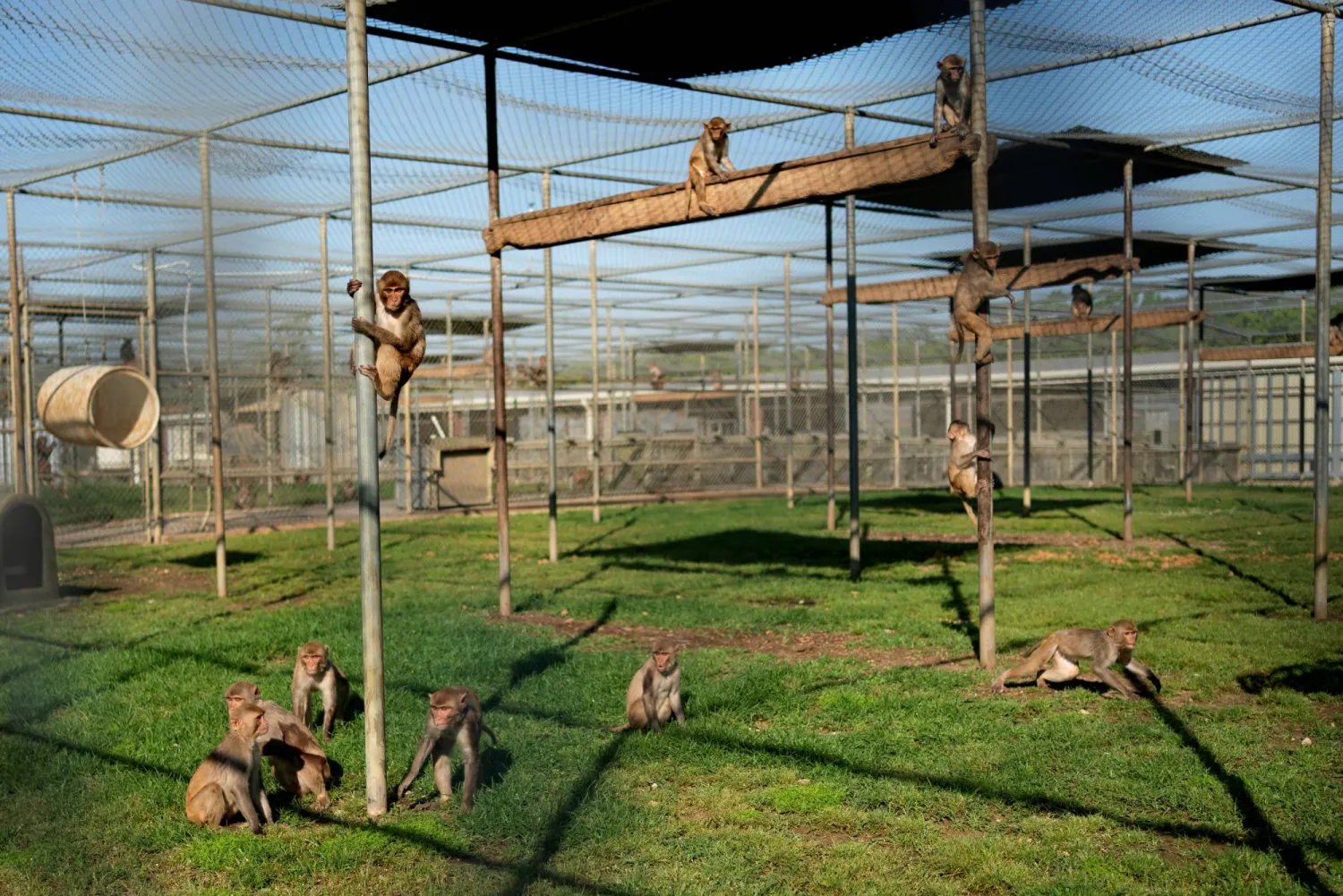
Rhesus macaque monkeys feed at the Tulane National Primate Research Center, where the focus of study has shifted to the coronavirus disease (COVID-19) pandemic, in Covington, Louisiana, US, May 14, 2021. REUTERS/Kathleen Flynn
TT

Monkeys that Escaped US Lab Are Species Used for Human Research Since 1800s

Rhesus macaque monkeys feed at the Tulane National Primate Research Center, where the focus of study has shifted to the coronavirus disease (COVID-19) pandemic, in Covington, Louisiana, US, May 14, 2021. REUTERS/Kathleen Flynn

The 43 rhesus macaque monkeys that escaped a South Carolina medical lab this week are among the most studied animals on the planet. And for more than a century, they have held a mirror to humanity, revealing our strengths and weaknesses through their own clever behaviors, organ systems and genetic code, The Associated Press reported.
The bare-faced primates with expressive eyes have been launched on rockets into space. Their genome has been mapped. They have even been stars of a reality TV show.
Animal rights groups point out that the species has been subjected to studies on vaccines, organ transplants and the impact of separating infants from mothers. At the same time, many in the scientific community will tell you just how vital their research is to fighting AIDS, polio and COVID-19.
In 2003, a nationwide shortage of rhesus macaques threatened to slow down studies and scientists were paying up to $10,000 per animal to continue their work.
“Every large research university in the United States probably has some rhesus macaques hidden somewhere in the basement of its medical school,” according to the 2007 book, “Macachiavellian Intelligence: How Rhesus Macaques and Humans Have Conquered the World."
“The US Army and NASA have rhesus macaques too,” wrote the book's author, Dario Maestripieri, a behavioral scientist at the University of Chicago, “and for years they trained them to play computer video games to see whether the monkeys could learn to pilot planes and launch missiles.”
Research begins in the 1890s Humans have been using the rhesus macaque for scientific research since the late 1800s when the theory of evolution gained more acceptance, according to a 2022 research paper by the journal eLife.
The first study on the species was published in 1893 and described the “anatomy of advanced pregnancy," according to the eLife paper. By 1925, the Carnegie Science Institute had set up a breeding population of the monkeys to study embryology and fertility in a species that was similar to humans.
One reason for the animal's popularity was its abundance. These monkeys have the largest natural range of any non-human primate, stretching from Afghanistan and India to Vietnam and China.
“The other reason is because rhesus macaques, as primates go, are a pretty hardy species,” said Eve Cooper, the eLife research paper's lead author and a biology professor at the University of Colorado-Boulder. “They can live under conditions and they can be bred under conditions that are relatively easy to maintain.”
NASA rockets and the Salk polio vaccine In the 1950s, the monkey's kidneys were used to make the Salk polio vaccine. NASA also used the animals during the space race, according to a brief history of animals in space on the agency's website.
For example, a rhesus monkey named “Miss Sam” was launched in 1960 in a Mercury capsule that attained a velocity of 1,800 mph (1,900 kph) and an altitude of 9 miles (14.5 kilometers) . She was retrieved in overall good condition.
“She was also returned to her training colony until her death on an unknown date,” NASA wrote.
Mapping the human genome In 2007, scientists unraveled the DNA of the rhesus macaque. The species shared about 93% of its DNA with humans, even though macaques branched off from the ape family about 25 million years ago.
In comparison, humans and chimpanzees have evolved separately since splitting from a common ancestor about 6 million years ago, but still have almost 99% of their gene sequences in common.
The mapping of the human genome in 2001 sparked an explosion of work to similarly decipher the DNA of other animals. The rhesus macaque was the third primate genome to be completed.
For those who have studied the behavior of rhesus macaques, the research is just as interesting.
“They share some striking similarities to ourselves in terms of their social intelligence,” said Maestripieri, the University of Chicago professor who wrote a book on the species.
For example, the animals are very family oriented, siding with relatives when fights break out, he told The Associated Press on Friday. But they also recruit allies when they're attacked.
“They're very political,” Maestripieri said. “Most of their daily lives are spent building political alliances with each other. Does that sound familiar?"
Maestripieri was a consultant for a reality show about some rhesus macaques in India called “Monkey Thieves.”
“They basically started following large groups of these rhesus macaques and naming them,” the professor said. “It was beautifully done because these monkeys essentially act like people occasionally. So it’s fascinating to follow their stories.”



Saudi National Center for Wildlife, Soudah Development Company Release Birds of Prey

The release comes as part of reintroduction programs aimed at enhancing ecological balance and restoring biodiversity in one of the Kingdom’s most prominent mountainous environmental zones - SPA
TT

Saudi National Center for Wildlife, Soudah Development Company Release Birds of Prey

The release comes as part of reintroduction programs aimed at enhancing ecological balance and restoring biodiversity in one of the Kingdom’s most prominent mountainous environmental zones - SPA

Saudi Arabia's National Center for Wildlife (NCW), in cooperation with Soudah Development Company, has released a number of birds of prey in Al-Soudah Park, including three griffon vultures, a black kite, an Arabian scops owl, and an Eurasian sparrowhawk, after rehabilitating them at shelter centers.


The release comes as part of reintroduction programs aimed at enhancing ecological balance and restoring biodiversity in one of the Kingdom’s most prominent mountainous environmental zones, SPA reported.

This release followed the completion of rehabilitation and environmental acclimatization stages to ensure the birds’ readiness and ability to adapt to the nature of the area, contributing to the stability of local species and boosting their ecological roles within mountain ecosystems, particularly in regulating food chains and preserving the health of natural habitats.

The NCW noted that this step falls within its ongoing programs to breed and reintroduce threatened wildlife species, rehabilitate ecosystems, and enrich biodiversity across various regions of the Kingdom, in cooperation with national partners and in line with the objectives of the Saudi Green Initiative and the National Environment Strategy, which support the environmental development goals of the Saudi Vision 2030.

Specialized teams will continue to monitor the released birds and track their movements and ecological behavior using dedicated tools and technologies, supporting the evaluation of the program’s success and the improvement of its outcomes in the future in accordance with the best global environmental practices.


Ariane 6 Lifts Off with 2 European Navigation Satellites

The European Space Agency (ESA) Ariane 6 rocket carrying two Galileo satellites for the the EU's Global Navigation Satellite System (GNSS) launches at the Guiana Space Center in Kourou, on the French overseas department of Guiana, on December 17, 2025. (Photo by Ronan LIETAR / AFP)
TT

Ariane 6 Lifts Off with 2 European Navigation Satellites

The European Space Agency (ESA) Ariane 6 rocket carrying two Galileo satellites for the the EU's Global Navigation Satellite System (GNSS) launches at the Guiana Space Center in Kourou, on the French overseas department of Guiana, on December 17, 2025. (Photo by Ronan LIETAR / AFP)

A European Ariane 6 rocket blasted off from France's Kourou space base in French Guiana early Wednesday, carrying two Galileo global navigation satellites, according to an AFP correspondent.

Lift-off was at 2:01 am local time (0501 GMT) for the fourth commercial flight of the Ariane 6 launch system since the expendable rockets came into service last year.

The rocket was carrying two more satellites of the European Union's Galileo program, a global navigation satellite system that aims to make the bloc less dependent on the US's Global Positioning System (GPS).

The two satellites were set to be placed in orbit nearly four hours after lift-off.

They will bring to 34 the number of Galileo satellites in orbit and "will improve the robustness of the Galileo system by adding spares to the constellation to guarantee the system can provide 24/7 navigation to billions of users. The satellites will join the constellation in medium Earth orbit 23, 222 km (14,429 miles) above Earth’s surface," according to the European Space Agency (ESA) which oversees the program.

Previous Galileo satellites were primarily launched by Ariane 5 and Russian Soyuz rockets from Kourou.

After Russia's invasion of Ukraine, Europe halted space cooperation with Moscow.

Before the Ariane 6 rocket entered into service in July 2024, the EU contracted with Elon Musk's SpaceX to launch two Galileo satellites aboard Falcon 9 rockets in September 2024 from the Kennedy Space Center in Florida.


Delhi Restricts Vehicles, Office Attendance in Bid to Curb Pollution

Children ride a bicycle across a field on smoggy winter morning in New Delhi on December 17, 2025. (Photo by Arun SANKAR / AFP)
TT

Delhi Restricts Vehicles, Office Attendance in Bid to Curb Pollution

Children ride a bicycle across a field on smoggy winter morning in New Delhi on December 17, 2025. (Photo by Arun SANKAR / AFP)

Authorities in India's capital Delhi rolled out strict measures on Wednesday in an attempt to curb pollution, including a ban on vehicles not compliant with latest emission control norms and regulating attendance in private and government offices.

The air quality index (AQI) in the Delhi region, home to 30 million people, has been in the 'severe' category for the past few days, often crossing the 450-mark. In addition, shallow fog in parts of the city worsened visibility that impacted flights and trains.

This prompted the Commission for Air Quality Management to invoke stage four, the highest level, of the Graded Response Action Plan for Delhi and surrounding areas on Saturday.

The curbs ban the entry of older diesel trucks into the city, suspend construction, including on public projects, and impose hybrid schooling, Reuters reported.

Kapil Mishra, a minister in the local government, announced on Wednesday that all private and government offices in the city would operate with 50% attendance, with the remaining working from home.

Additionally, all registered construction workers, many of them earning daily wages, will be given compensation of 10,000 rupees ($110) because of the ban, Mishra said at a press conference in Delhi.

On Tuesday, the government enforced strict anti-pollution measures for vehicles in the city, banning vehicles that are not compliant with the latest emission control standards.

"Our government is committed to providing clean air in Delhi. We will take strict steps to ensure this in the coming days," Delhi's Environment Minister Manjinder Singh Sirsa said late on Tuesday.

Pollution is an annual winter problem in Delhi and its suburbs, when cold, dense air traps emissions from vehicles, construction sites and crop burning in neighboring states, pushing pollution levels to among the highest in the world and exposing residents to severe respiratory risks.

The area, home to 30 million people, gets covered in a thick layer of smog with AQI touching high 450-levels. Readings below 50 are considered good.