Monkeys that Escaped US Lab Are Species Used for Human Research Since 1800s

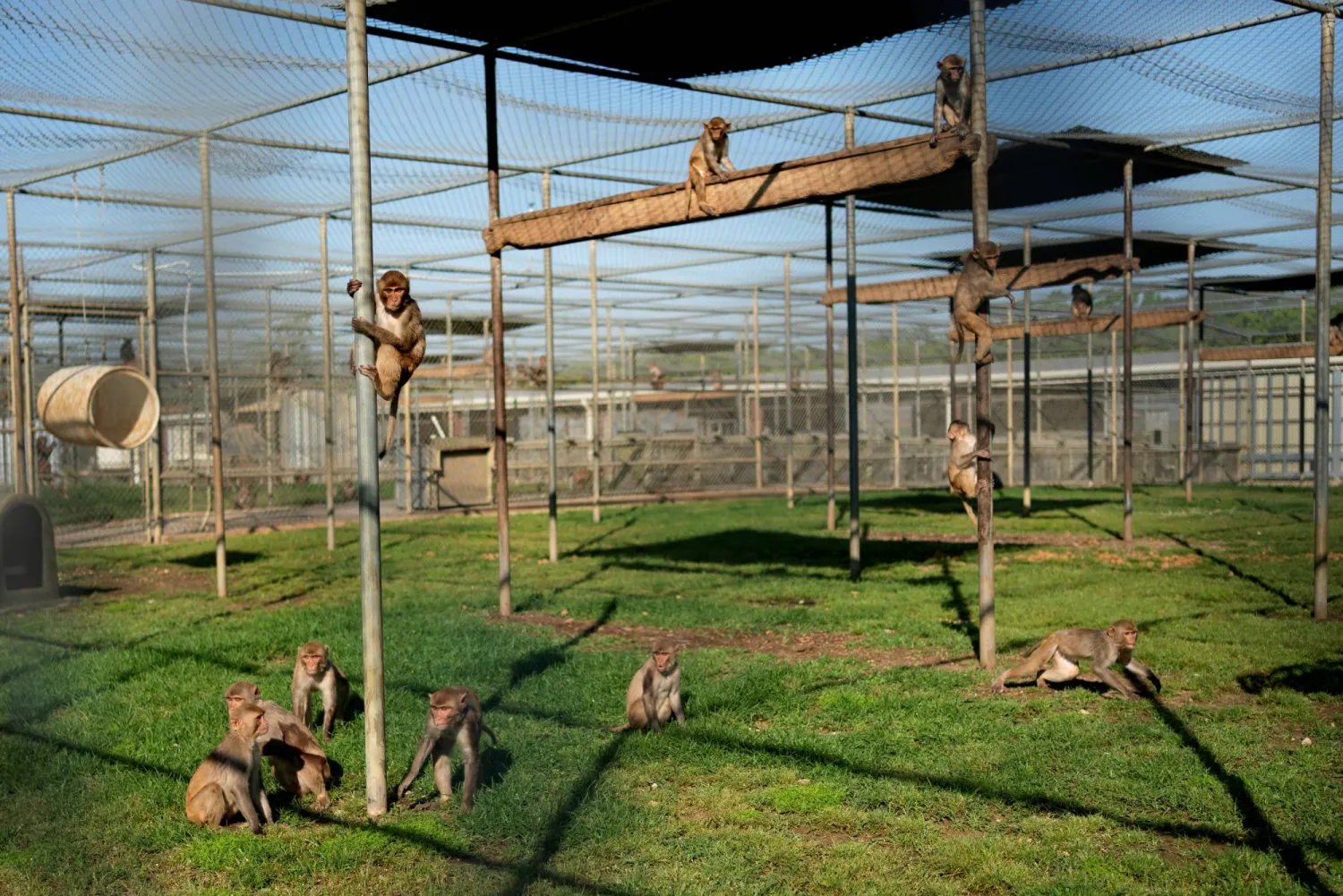
Rhesus macaque monkeys feed at the Tulane National Primate Research Center, where the focus of study has shifted to the coronavirus disease (COVID-19) pandemic, in Covington, Louisiana, US, May 14, 2021. REUTERS/Kathleen Flynn
TT

Monkeys that Escaped US Lab Are Species Used for Human Research Since 1800s

Rhesus macaque monkeys feed at the Tulane National Primate Research Center, where the focus of study has shifted to the coronavirus disease (COVID-19) pandemic, in Covington, Louisiana, US, May 14, 2021. REUTERS/Kathleen Flynn

The 43 rhesus macaque monkeys that escaped a South Carolina medical lab this week are among the most studied animals on the planet. And for more than a century, they have held a mirror to humanity, revealing our strengths and weaknesses through their own clever behaviors, organ systems and genetic code, The Associated Press reported.
The bare-faced primates with expressive eyes have been launched on rockets into space. Their genome has been mapped. They have even been stars of a reality TV show.
Animal rights groups point out that the species has been subjected to studies on vaccines, organ transplants and the impact of separating infants from mothers. At the same time, many in the scientific community will tell you just how vital their research is to fighting AIDS, polio and COVID-19.
In 2003, a nationwide shortage of rhesus macaques threatened to slow down studies and scientists were paying up to $10,000 per animal to continue their work.
“Every large research university in the United States probably has some rhesus macaques hidden somewhere in the basement of its medical school,” according to the 2007 book, “Macachiavellian Intelligence: How Rhesus Macaques and Humans Have Conquered the World."
“The US Army and NASA have rhesus macaques too,” wrote the book's author, Dario Maestripieri, a behavioral scientist at the University of Chicago, “and for years they trained them to play computer video games to see whether the monkeys could learn to pilot planes and launch missiles.”
Research begins in the 1890s Humans have been using the rhesus macaque for scientific research since the late 1800s when the theory of evolution gained more acceptance, according to a 2022 research paper by the journal eLife.
The first study on the species was published in 1893 and described the “anatomy of advanced pregnancy," according to the eLife paper. By 1925, the Carnegie Science Institute had set up a breeding population of the monkeys to study embryology and fertility in a species that was similar to humans.
One reason for the animal's popularity was its abundance. These monkeys have the largest natural range of any non-human primate, stretching from Afghanistan and India to Vietnam and China.
“The other reason is because rhesus macaques, as primates go, are a pretty hardy species,” said Eve Cooper, the eLife research paper's lead author and a biology professor at the University of Colorado-Boulder. “They can live under conditions and they can be bred under conditions that are relatively easy to maintain.”
NASA rockets and the Salk polio vaccine In the 1950s, the monkey's kidneys were used to make the Salk polio vaccine. NASA also used the animals during the space race, according to a brief history of animals in space on the agency's website.
For example, a rhesus monkey named “Miss Sam” was launched in 1960 in a Mercury capsule that attained a velocity of 1,800 mph (1,900 kph) and an altitude of 9 miles (14.5 kilometers) . She was retrieved in overall good condition.
“She was also returned to her training colony until her death on an unknown date,” NASA wrote.
Mapping the human genome In 2007, scientists unraveled the DNA of the rhesus macaque. The species shared about 93% of its DNA with humans, even though macaques branched off from the ape family about 25 million years ago.
In comparison, humans and chimpanzees have evolved separately since splitting from a common ancestor about 6 million years ago, but still have almost 99% of their gene sequences in common.
The mapping of the human genome in 2001 sparked an explosion of work to similarly decipher the DNA of other animals. The rhesus macaque was the third primate genome to be completed.
For those who have studied the behavior of rhesus macaques, the research is just as interesting.
“They share some striking similarities to ourselves in terms of their social intelligence,” said Maestripieri, the University of Chicago professor who wrote a book on the species.
For example, the animals are very family oriented, siding with relatives when fights break out, he told The Associated Press on Friday. But they also recruit allies when they're attacked.
“They're very political,” Maestripieri said. “Most of their daily lives are spent building political alliances with each other. Does that sound familiar?"
Maestripieri was a consultant for a reality show about some rhesus macaques in India called “Monkey Thieves.”
“They basically started following large groups of these rhesus macaques and naming them,” the professor said. “It was beautifully done because these monkeys essentially act like people occasionally. So it’s fascinating to follow their stories.”



British Baker’s Criticism of Mexican ‘Ugly’ Bread Triggers Social Media Outrage

Bolillos, a traditional Mexican bread, sit for sale at a street stand in Mexico City, Thursday, Dec. 18, 2025. (AP Photo/Marco Ugarte)
TT

British Baker’s Criticism of Mexican ‘Ugly’ Bread Triggers Social Media Outrage

Bolillos, a traditional Mexican bread, sit for sale at a street stand in Mexico City, Thursday, Dec. 18, 2025. (AP Photo/Marco Ugarte)

A blunt critique of Mexican bread by a British baker sparked a cascade of social media outrage, ultimately leading to a public apology.

In an interview for a food-themed podcast that resurfaced online, Richard Hart, the co-founder of Green Rhino bakery in Mexico City and a well-known figure in international baking circles, said Mexicans “don’t really have much of a bread culture,” adding that “they make sandwiches on these white, ugly rolls that are pretty cheap and industrially made.”

His comments quickly rippled across Instagram, TikTok and X, with many Mexicans accusing him of being dismissive and insulting of Mexico’s traditional breads.

What began as a dispute over bread soon ignited a national debate over food identity — not only over who defines Mexican culinary traditions, but also over the growing influence of foreigners in a capital already tense from a surge of US expatriates and tourists, according to AP.

Social media was soon flooded with memes, reaction videos, and passionate defenses of Mexican bread.

Users took to social media to praise everyday staples — from the crusty bolillos used for tortas to the iconic conchas found in neighborhood bakeries.

In many cases, these simple street foods act as a uniting factor across social groups and classes, and often cut to the core of the country’s cultural identity.

While wheat bread was introduced to Mexico during the colonial period, the classic food staple evolved into a distinct national tradition, blending European techniques with local tastes and ingredients. Today, small neighborhood bakeries remain central to daily life in cities and towns, serving as social hubs as well as food sources.

The incident prompted many to question why a foreign entrepreneur would publicly disparage a staple so deeply embedded in Mexican life. For many, Hart’s remarks echoed long-standing frustrations over foreign chefs and restaurateurs receiving disproportionate prestige, as well as concerns over gentrification in the capital.

“Don’t mess with the bolillo,” warned one viral post on X.

As criticism mounted, Hart issued a public apology on Instagram, saying his comments were poorly phrased and did not show respect for Mexico and its people. He acknowledged the emotional response and said he didn’t behave as a “guest.”

“I made a mistake,” Hart said in his statement. “I regret it deeply.”


High-speed Passenger Train Kills 7 Elephants in India

Elephants are used to clear logs and debris in a village affected by flooding in Pidie Jaya, Aceh province, Indonesia, Monday, Dec. 8, 2025. (AP Photo/Ahyar Tarmizi)
TT

High-speed Passenger Train Kills 7 Elephants in India

Elephants are used to clear logs and debris in a village affected by flooding in Pidie Jaya, Aceh province, Indonesia, Monday, Dec. 8, 2025. (AP Photo/Ahyar Tarmizi)

Seven wild Asiatic elephants were killed and a calf was injured when a high-speed passenger train collided with a herd crossing the tracks in India's northeastern state of Assam early Saturday, local authorities said.

The train driver spotted the herd of about 100 elephants and used the emergency brakes, but the train still hit some of the animals, Indian Railways spokesman Kapinjal Kishore Sharma told The Associated Press.

Five train coaches and the engine derailed following the impact, but there were no human casualties, Sharma said.

Veterinarians carried out autopsies on the dead elephants, which were to be buried later in the day.

The accident site is a forested area around 125 kilometers southeast of Assam’s capital city of Guwahati. Railway tracks in the state are frequented by elephants, but Indian Railways said in a statement the accident location wasn't a designated elephant corridor.

The Rajdhani Express train, traveling from Sairang in Mizoram state bordering Myanmar, was bound for the national capital of New Delhi with 650 passengers onboard when it hit with elephants.

“We delinked the coaches which were not derailed, and the train resumed its journey for New Delhi. Around 200 passengers who were in the five derailed coaches have been moved to Guwahati in a different train,” Sharma said.

Speeding trains hitting wild elephants is not rare in Assam, which is home to an estimated 7,000 wild Asiatic elephants, one of the highest concentrations of the pachyderm in India. Since 2020, at least a dozen elephants have been killed by speeding trains across the state.

Wild elephants often stray into human habitations this time of year, when rice fields are ready for harvesting.


Winter at Tantora Festival Kicks Off in AlUla

The 2025–2026 season features a diverse array of immersive experiences - SPA
TT

Winter at Tantora Festival Kicks Off in AlUla

The 2025–2026 season features a diverse array of immersive experiences - SPA

The Winter at Tantora Festival launched yesterday in AlUla Governorate and will run until January 10, 2026, marking the beginning of the winter season with a rich program that celebrates the region’s deep-rooted agricultural and historical heritage.

The festival derives its name from the Tantora, a traditional mudbrick sundial located in the heart of AlUla’s Old Town. For centuries, local farmers and residents relied on this stone marker to tell time, manage water distribution rights, and signal the start of the winter planting season, SPA reported.

The 2025–2026 season features a diverse array of immersive experiences. "Old Town Nights" offers an atmospheric evening of heritage storytelling and fine dining at the historic AlUla Fort, while the "AlManshiyah Carnival" creates a festive space for families with traditional games and parades.

Music remains a central pillar of the festival, with performances set against AlUla’s most iconic backdrops. The "Shorfat Tantora" (Tantora Balconies) series brings live music to the rooftops of the AlJadidah Arts District, while major concerts are scheduled at the Maraya mirrored hall and the Thanaya open-air amphitheater.

These events are part of the broader AlUla Moments calendar, supporting the goals of Saudi Vision 2030 to highlight the Kingdom's heritage and establish AlUla as a premier global destination.