New Zealand Mountain Granted Personhood, Recognizing it as Sacred for Māori

FILE - New Zealand's Mount Taranaki, also known as Mount Egmont, has a warm glow lighting the snow peak, June 12, 2011. (AP Photo/David Frampton, File)
TT

New Zealand Mountain Granted Personhood, Recognizing it as Sacred for Māori

FILE - New Zealand's Mount Taranaki, also known as Mount Egmont, has a warm glow lighting the snow peak, June 12, 2011. (AP Photo/David Frampton, File)

A mountain in New Zealand considered an ancestor by Indigenous people was recognized as a legal person on Thursday after a new law granted it all the rights and responsibilities of a human being.
Mount Taranaki — now known as Taranaki Maunga, its Māori name — is the latest natural feature to be granted personhood in New Zealand, which has ruled that a river and a stretch of sacred land are people before. The pristine, snow-capped dormant volcano is the second highest on New Zealand's North Island at 2,518 meters (8,261 feet) and a popular spot for tourism, hiking and snow sports, The Associated Press reported.
The legal recognition acknowledges the mountain’s theft from the Māori of the Taranaki region after New Zealand was colonized. It fulfills an agreement of redress from the country's government to Indigenous people for harms perpetrated against the land since.
How can a mountain be a person? The law passed Thursday gives Taranaki Maunga all the rights, powers, duties, responsibilities and liabilities of a person. Its legal personality has a name: Te Kāhui Tupua, which the law views as “a living and indivisible whole." It includes Taranaki and its surrounding peaks and land, “incorporating all their physical and metaphysical elements.”
A newly created entity will be “the face and voice” of the mountain, the law says, with four members from local Māori iwi, or tribes, and four members appointed by the country's Conservation Minister.
Why is this mountain special? “The mountain has long been an honored ancestor, a source of physical, cultural and spiritual sustenance and a final resting place," Paul Goldsmith, the lawmaker responsible for the settlements between the government and Māori tribes, told Parliament in a speech on Thursday.
But colonizers of New Zealand in the 18th and 19th centuries took first the name of Taranaki and then the mountain itself. In 1770, the British explorer Captain James Cook spotted the peak from his ship and named it Mount Egmont.
In 1840, Māori tribes and representatives of the British crown signed the Treaty of Waitangi — New Zealand's founding document — in which the Crown promised Māori would retain rights to their land and resources. But the Māori and English versions of the treaty differed — and Crown breaches of both began immediately.
In 1865, a vast swathe of Taranaki land, including the mountain, was confiscated to punish Māori for rebelling against the Crown. Over the next century hunting and sports groups had a say in the mountain's management — but Māori did not.
“Traditional Māori practices associated with the mountain were banned while tourism was promoted,” Goldsmith said. But a Māori protest movement of the 1970s and '80s has led to a surge of recognition for the Māori language, culture and rights in New Zealand law.
Redress has included billions of dollars in Treaty of Waitangi settlements — such as the agreement with the eight tribes of Taranaki, signed in 2023.
How will the mountain use its rights? “Today, Taranaki, our maunga, our maunga tupuna, is released from the shackles, the shackles of injustice, of ignorance, of hate," said Debbie Ngarewa-Packer, a co-leader of the political party Te Pāti Māori and a descendant of the Taranaki tribes, using a phrase that means ancestral mountain.
“We grew up knowing there was nothing anyone could do to make us any less connected,” she added.
The mountain's legal rights are intended to uphold its health and wellbeing. They will be employed to stop forced sales, restore its traditional uses and allow conservation work to protect the native wildlife that flourishes there. Public access will remain.



Two Holy Mosques Exhibition Welcomes Visitors for Founding Day Celebrations

The exhibition is open daily from 10:00 a.m. to 1:30 a.m - SPA
TT

Two Holy Mosques Exhibition Welcomes Visitors for Founding Day Celebrations

The exhibition is open daily from 10:00 a.m. to 1:30 a.m - SPA

In celebration of the Kingdom’s Founding Day, the Exhibition of the Two Holy Mosques Architecture in Makkah is welcoming visitors to explore a comprehensive historical journey.

The exhibition presents the evolution of the Two Holy Mosques through rare artifacts, historical photographs, and documentation of successive Saudi expansions, according to SPA.

The halls highlight the Kingdom’s long-standing dedication to serving the Two Holy Mosques. They combine heritage and modern technology to present the architectural development of Islam’s holiest sites.

The exhibition is open daily from 10:00 a.m. to 1:30 a.m.


Photos Show Filming of Ramadan TV Drama Series on the War-scarred Streets of Syria's Aleppo

Extras stand by as a television crew films an episode of the TV series “Al-Souriyoun al-Aada” (“The Syrian Enemies”), based on a novel of the same name that was banned under Bashar Assad, along a transformed street in central Aleppo, Syria, Friday, Feb. 13, 2026. (AP Photo/Ghaith Alsayed)
TT

Photos Show Filming of Ramadan TV Drama Series on the War-scarred Streets of Syria's Aleppo

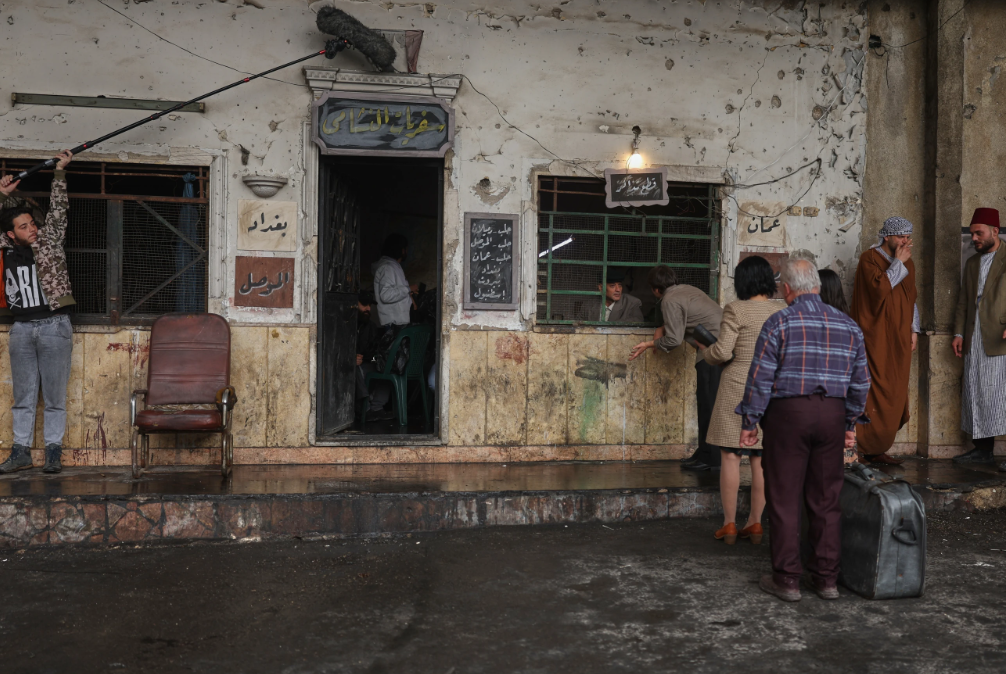
Extras stand by as a television crew films an episode of the TV series “Al-Souriyoun al-Aada” (“The Syrian Enemies”), based on a novel of the same name that was banned under Bashar Assad, along a transformed street in central Aleppo, Syria, Friday, Feb. 13, 2026. (AP Photo/Ghaith Alsayed)

Ramadan in the Arab world is a month of fasting and prayer by day — and television by night. For decades, families have gathered after the iftar, the evening meal that breaks the daytime fast, to follow the season’s highly anticipated drama series, produced specially to air during the Islamic holy month.

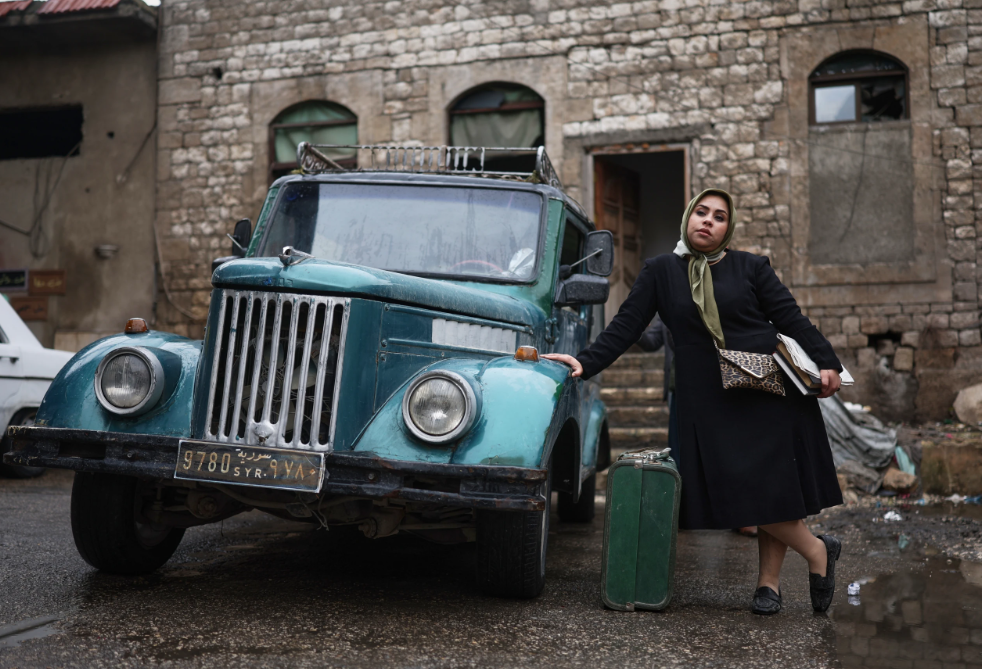
In the week before Ramadan, a television crew in central Aleppo was busy preparing one of those productions, with a battered street in the historic city transformed into a scene from decades past.

Lamees Al-Ali, an extra in the series, poses for a photograph during the filming of an episode of the TV series “Al-Souriyoun al-Aada” (“The Syrian Enemies”), based on a novel of the same name that was banned under Bashar Assad, along a transformed street in central Aleppo, Syria, Friday, Feb. 13, 2026. (AP Photo/Ghaith Alsayed)

Classic 1970s cars lined the curb. A horse-drawn cart rolled through the frame. A vendor in a red tarboush, a brimless cone-shaped hat, stood beside steaming pots of sahlep — a sweet, thickened milk drink flavored with spices and associated with winter evenings.

Just outside the camera’s view stood a stark reminder of Syria's more recent history. Collapsed buildings and damaged facades testified to Aleppo’s role as a major battleground during the country's civil war. However, with costumes, props and careful framing, the production temporarily carried the street back to what it portrays as a more innocent era, according to The AP news.

A television crew films an episode of the TV series “Al-Souriyoun al-Aada” (“The Syrian Enemies”), based on a novel of the same name that was banned under Bashar Assad, along a transformed street in central Aleppo, Syria, Friday, Feb. 13, 2026.(AP Photo/Ghaith Alsayed)

The series being filmed — “Al-Souriyoun al-Aada,” or “The Syrian Enemies” — is based on a novel that was banned during the rule of former President Bashar Assad. The story examines painful chapters of Syria’s past, including the 1982 events in Hama, when government forces crushed an uprising led by the Muslim Brotherhood, killing or disappearing an estimated 10,000 to 40,000 people and leaving the city in ruins.

As filming continues into Ramadan, the production reflects both a cherished seasonal tradition and Syria’s complex, layered history.


How Bomb Cyclones Form and Create Dangerous Conditions 

A man works in a snowstorm, Sunday, Feb. 22, 2026, in New York. (AP)
TT

How Bomb Cyclones Form and Create Dangerous Conditions 

A man works in a snowstorm, Sunday, Feb. 22, 2026, in New York. (AP)

When turbulent weather with whipping winds and heavy snow is in the forecast, meteorologists sometimes warn that a storm could “bomb out” or become a bomb cyclone. But what exactly does this mean?

According to the US National Oceanic and Atmospheric Administration, certain storms undergo bombogenesis, which happens when a storm’s central pressure drops at least 24 millibars in 24 hours. These storms are sometimes called bomb cyclones. Storm intensity is measured by central pressure, so the lower the pressure, the stronger the storm.

Such rapidly strengthening storms are capable of producing heavy rain, blizzard conditions and intense winds that can create dangerous conditions such as downed trees and power outages.

“If you’re watching TV at night and the weather report comes on and you’re hearing ‘bomb cyclone’ being used, that usually means there’s quite a bit of active weather going on,” said Andrew Orrison, a meteorologist with the National Weather Service in College Park, Maryland.

Bomb cyclones can happen in any season, but mainly occur during fall and winter when frigid air from the Arctic can creep south and clash with warmer air masses.

“It’s really the clash of those air masses that really kind of helps to generate the areas of low pressure in the first place,” said Orrison.

Regions in North America that are prone to seeing bomb cyclones include Alaska, the Pacific Northwest and the Great Lakes region.