Apple Changes Gulf of Mexico to Gulf of America on Maps 

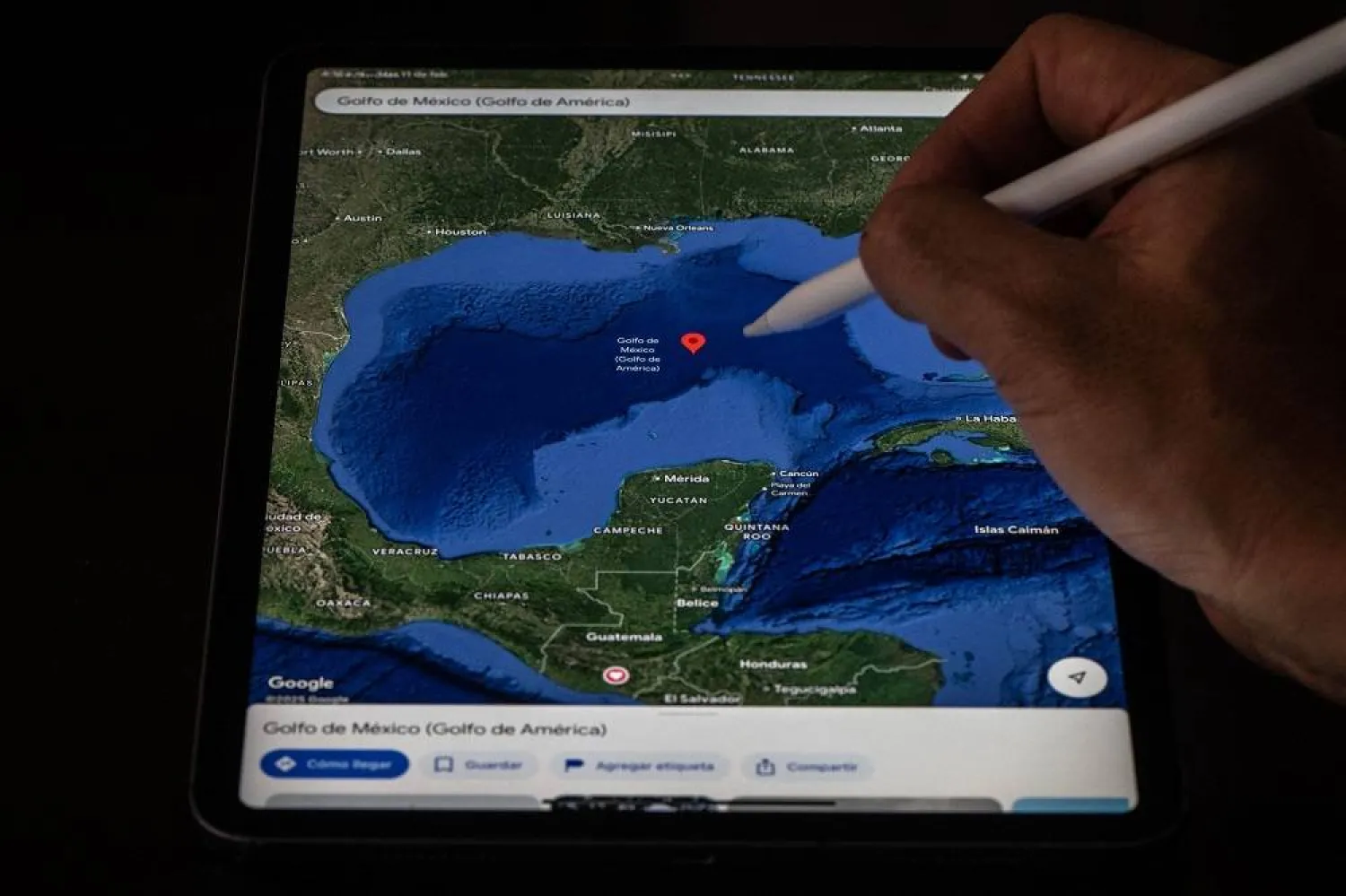
This photo illustration shows the Gulf of Mexico branded as Gulf of America displayed on the Google Maps application on a tablet on February 11, 2025, in Bogota, Colombia. (AFP)
TT

Apple Changes Gulf of Mexico to Gulf of America on Maps 

This photo illustration shows the Gulf of Mexico branded as Gulf of America displayed on the Google Maps application on a tablet on February 11, 2025, in Bogota, Colombia. (AFP)

Apple renamed the Gulf of Mexico to the Gulf of America on its maps Tuesday after an order by President Donald Trump was made official by the US Geographic Names Information System.

The move follows Google, which announced last month that it would make the change once the official listing was updated and wrote in a blog post Sunday that it had begun rolling out the change.

In Google's case, the company said people in the US will see Gulf of America and people in Mexico will see Gulf of Mexico. Everyone else will see both names.

After taking office, Trump ordered that the water bordered by the Southern United States, Mexico and Cuba be renamed.

The US Geographic Names Information System officially updated the name late Sunday. Microsoft has also made the name change on its Bing maps.

The Associated Press, which provides news around the world to multiple audiences, will refer to the Gulf of Mexico by its original name, which it has carried for 400 years, while acknowledging the name Gulf of America.


British Sculptors Achieve Notable Victory in Global Ice Carving Competition

The team sculpted a kraken eating a boat
TT

British Sculptors Achieve Notable Victory in Global Ice Carving Competition

The team sculpted a kraken eating a boat

Two stonemasons have won a snow sculpting prize as part of Team GB's entry to the World Snow Festival in Switzerland, according to BBC.

Sheffield sculptors Lily Marsh and Steve Roche were part of Great Britain's four-person team, which won the public vote and came third in the technical judging at the competition in Grindelwald.

They competed against 10 nations with the Spanish team taking first place in the technical category.

Sculptor Lily Marsh said it was “refreshing” to swap stone for snow. “Normally it's very dusty and it's much quicker to move the materials so I really enjoyed it,” she said.

The team - led by Christine Close, a sculptor based in France - carved a kraken eating a boat as part of the myths and legends theme set by the competition organizers.

They worked with a large block of snow, starting with a small model.

“We used big chisels on the end of broom handles. A bit like gardening hoes.

You use those to stab at it and shave stuff way,” explained Roche.

“And we used a length of chain that had nuts and bolts set in it with two handles at the end like a big chain saw to carve off the really big bits that we needed to get rid of at the start of the design,” he added.

Despite the low temperatures, Roche said the work kept the team warm.

“I was working in a T shirt most days. I was moaning it was too warm. I got sunburned. I had to go to the shop to get sun cream because it was so bright,” he said.

After the judging, sadly the sculptures did not last and were left to melt in the snow, said Marsh.

“It's quite a liberating thing because often you can get precious about the stuff you make or get worried about it not being good enough and actually it's quite a good practice to make something and know that it's definitely going to melt. It releases you from that worry a bit,” he said.


How a Syrian Refugee Chef Met Britain's King Charles

Imad Alarnab, a chef and restaurant owner who fled Syria in 2015, hosted King Charles III at his Soho restaurant. Ben STANSALL / AFP
TT

How a Syrian Refugee Chef Met Britain's King Charles

Imad Alarnab, a chef and restaurant owner who fled Syria in 2015, hosted King Charles III at his Soho restaurant. Ben STANSALL / AFP

Pots clanged and oil sizzled inside the London kitchen of Syrian chef Imad Alarnab, as the former refugee who fled his country's civil war recalled hosting King Charles III.

When the chef left his war-torn homeland in 2015, he never imagined that one day he would watch as cameras flashed and wide-eyed crowds greeted the monarch arriving at his Soho restaurant last year.

Alarnab, 48, said he had asked the king to come to the popular eatery when he met him at Buckingham Palace before an event honoring humanitarian work in 2023.

"I told him 'I would love for you to visit our restaurant one day' and he said: 'I would love to'... I was over the Moon to be honest".

The chef has come a long way since he arrived in London after an arduous journey from Damascus with virtually no money in his pocket.

Fearing for his life, he had escaped Syria after his family was uprooted again and again by fighting.

His culinary empire –- restaurants, cafes, and juice bars peppered across the Syrian capital -- had been destroyed by bombing in just six days in 2013.

Alarnab spent three months crisscrossing Europe in the back of lorries, aboard trains, on foot and even on a bicycle before he reached the UK.

"When I left, I left with nothing," he told AFP, as waiters whirled past carrying steaming plates of traditional Syrian fare.

Starving and exhausted, he spent the last of his money on a train ticket to Doncaster where his sister lived.

'Love letter from Syria'

To make a living, Alarnab initially picked up any odd jobs, such as washing and selling cars, saving enough to bring his wife and three daughters over after seven months.

His love of cooking never left him though. In France, while he was sleeping on the steps of a church, Alarnab had often cooked for hundreds of other refugees.

"I always dreamed of going back to cooking," he said.

So it wasn't long before he found himself back in the kitchen, cooking up a storm across London with his sold-out supper clubs, bustling pop-up cafes, and crowded lunchtime falafel bars.

He now runs two restaurants in the city –- one in Soho's buzzing Kingly Court and another nestled in a corner of the vibrant Somerset House arts center.

"I was looking for a city to love when I found London," Alarnab said, adding it had offered him "space to innovate" and add his own modern twist to classic Syrian dishes.

Far from home, Alarnab said his word-of-mouth success had grown into a "love letter from Syria to the world" that needs no translation.

"You don't really need to speak Arabic or Syrian to know that this is the best falafel ever," he said, pointing to a row of colorful plates.

-'There is hope' -

For Alarnab, spices frying, dough rising and cheese melting inside a kitchen offered an unlikely escape from the real world.

"All my problems, I leave them outside the kitchen and walk in fresh."

When he fled Syria, Alarnab thought going back to Damascus was forever off the table.

Yet he returned for the first time in October, almost a year to the day after longtime leader Bashar al-Assad was toppled in a lightning opposition offensive -- ending almost 14 years of brutal civil war.

He walked the familiar streets of his old home, where his late mother taught him to cook many years ago.

"To return to Damascus and for her not to be there, that was extremely difficult."

Torn between the two cities, Alarnab said he longed to one day rebuild his home in Damascus.

"I wish I could go back and live there. But at the same time, I feel like London is now a part of me. I don't know if I could ever go back and just be in Syria," he said.

Although Syrians still bear the scars of war, Alarnab said he had seen "hope in people's eyes which was missing when I left in 2015".

"The road ahead is still very long, and yes this is only the beginning -- but there is hope."


El Nino May Return in 2026 and Make Planet Even Hotter

FILE -  Villagers fetch water from a makeshift borehole in Mudzi, Zimbabwe, Tuesday, July 2, 2024. (AP Photo/Aaron Ufumeli, File)
FILE - Villagers fetch water from a makeshift borehole in Mudzi, Zimbabwe, Tuesday, July 2, 2024. (AP Photo/Aaron Ufumeli, File)
TT

El Nino May Return in 2026 and Make Planet Even Hotter

FILE -  Villagers fetch water from a makeshift borehole in Mudzi, Zimbabwe, Tuesday, July 2, 2024. (AP Photo/Aaron Ufumeli, File)
FILE - Villagers fetch water from a makeshift borehole in Mudzi, Zimbabwe, Tuesday, July 2, 2024. (AP Photo/Aaron Ufumeli, File)

The warming El Nino weather phenomenon could form later this year, potentially pushing global temperatures to record heights.

There is a 50- to 60-percent chance of El Nino developing during the July-September period and beyond, according to the US National Oceanic and Atmospheric Administration (NOAA).

The World Meteorological Organization will issue an update on El Nino on Tuesday.

Here's what you need to know about El Nino and its cooler sister, La Nina:

- Why the name? –

El Nino and its cooler sister La Nina are two phases of a natural climate pattern across the tropical Pacific known as the El Nino-Southern Oscillation (ENSO).

Peruvian and Ecuadoran fishermen coined the term El Nino ("the boy" or "the Christ Child") in the 19th century for the arrival of an unusually warm ocean current off the coast that reduced their catch just before Christmas.

Scientists chose the name La Nina as the opposite of El Nino. Between the two events, there is a "neutral" phase.

- El Nino -

El Nino can weaken consistent trade winds that blow east to west across the tropical Pacific, influencing weather by affecting the movement of warm water across this vast ocean.

This weakening warms the usually cooler central and eastern sides of the ocean, altering rainfall over the equatorial Pacific and wind patterns around the world.

The extra heat at the surface of the Pacific releases energy into the atmosphere that can temporarily drive up global temperatures, which is why El Nino years are often among the warmest on record.

"All else being equal, a typical El Nino event tends to cause a temporary increase in the global mean temperature on the order of 0.1C-0.2C," Nat Johnson, an NOAA meteorologist, told AFP.

El Nino occurs every two to seven years.

It typically results in drier conditions across southeast Asia, Australia, southern Africa, and northern Brazil, and wetter conditions in the Horn of Africa, the southern United States, Peru and Ecuador.

- Another record? -

The last El Nino occurred in 2023-2024, contributing to making 2023 the second highest year on record and 2024 the all-time high.

Carlo Buontempo, director of the European Union's Copernicus Climate Change Service, told AFP in January that 2026 could be "another record-breaking year" if El Nino appears this year.

However, El Nino's impact would be higher in 2027 than in 2026 if it develops in the second half of this year, said Tido Semmler, a climate scientist at Ireland's National Meteorological Service.

"It takes time for the global atmosphere to react to the El Nino," he said.

"Having said this, there is a risk of 2026 being the warmest year on record even without El Nino, due to the global warming trend," Semmler told AFP.

"2027 would face an increased risk of getting a record warm year if El Nino developed in the second half of 2026," he added.

- La Nina -

The latest La Nina episode was relatively weak and short lived, starting in December 2024 and due to enter a neutral phase during the Februady-April period.

La Nina cools the eastern Pacific Ocean for a period of about one to three years, generating the opposite effects to El Nino on global weather.

It leads to wetter conditions in parts of Australia, southeast Asia, India, southeast Africa and northern Brazil, while causing drier conditions in parts of South America.

La Nina did not stop 2025 from being the third hottest on record.

- New calculation –

The NOAA adopted in February a new way of determining El Nino and El Nino events.

The old Oceanic Nino Index (ONI) compared the three-month average sea surface temperature one region of the Pacific with a 30-year average in the same area.

But as the oceans have been warming rapidly, that old 30-year average can be out of date.

The new method, the Relative Oceanic Nino Index (RONI), compares how warm or cool the east-central Pacific is compared to the rest of the tropics.

The NOAA said RONI is a "clearer, more reliable way" to track El Nino and La Nina in real time.