


World's Glaciers are Losing Record Ice as Global Temperatures Climb, UN Says

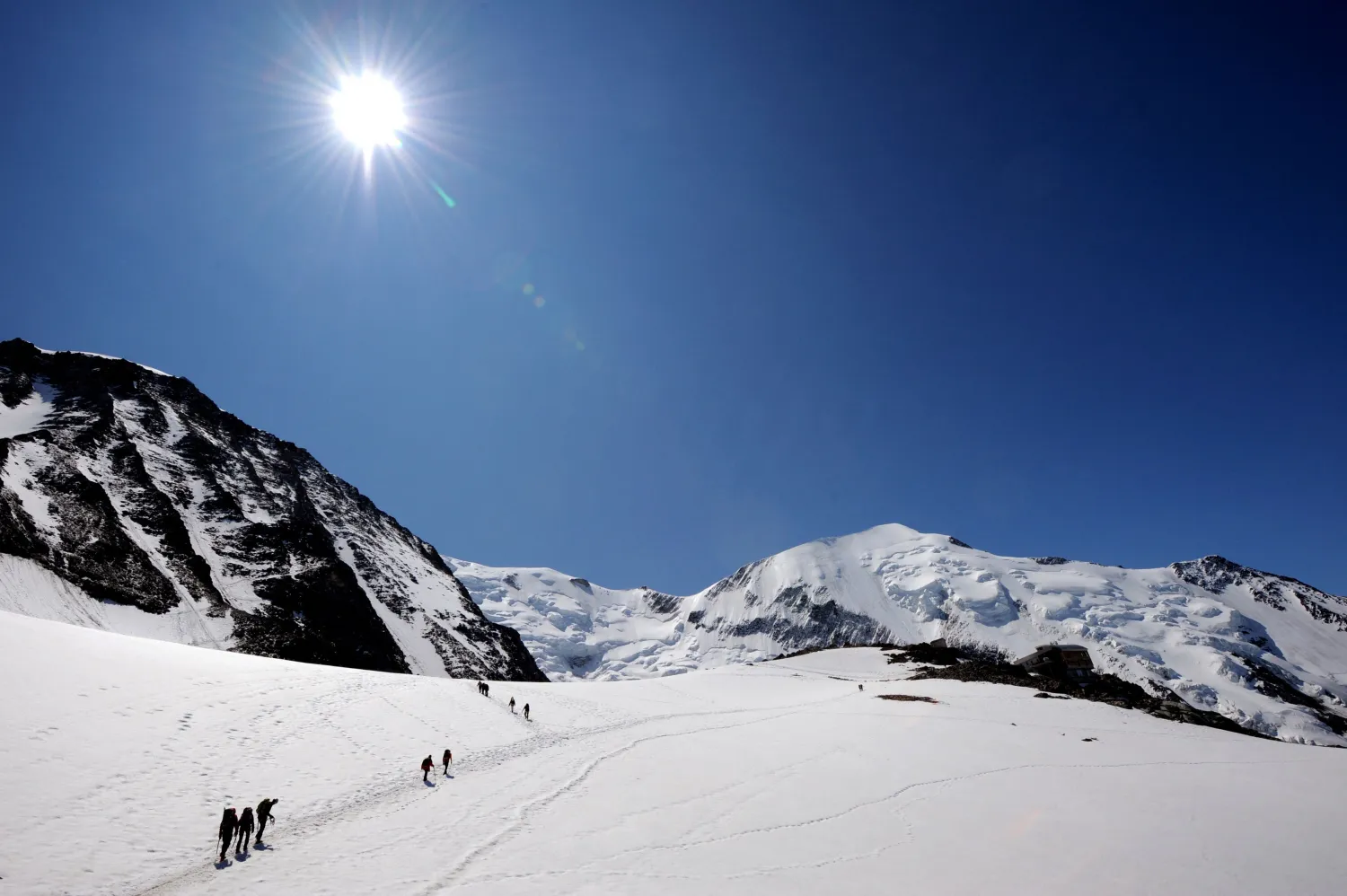
(FILES) Alpinists climb the "Voie royale", way to go to the Mont-Blanc to the top of the glacier of Tete Rousse, a 3.200 meter peak in the French Alps, on June 30, 2011. (Photo by JEAN-PIERRE CLATOT / AFP)
TT

World's Glaciers are Losing Record Ice as Global Temperatures Climb, UN Says

(FILES) Alpinists climb the "Voie royale", way to go to the Mont-Blanc to the top of the glacier of Tete Rousse, a 3.200 meter peak in the French Alps, on June 30, 2011. (Photo by JEAN-PIERRE CLATOT / AFP)

Glaciers around the globe are disappearing faster than ever, with the last three-year period seeing the largest glacial mass loss on record, according to a UNESCO report released on Friday.

The 9,000 gigatons of ice lost from glaciers since 1975 are roughly equivalent to "an ice block the size of Germany with the thickness of 25 meters," Michael Zemp, director of the Switzerland-based World Glacier Monitoring Service, said during a press conference announcing the report at the UN headquarters in Geneva.

The dramatic ice loss, from the Arctic to the Alps, from South America to the Tibetan Plateau, is expected to accelerate as climate change, caused by the burning of fossil fuels, pushes global temperatures higher. This would likely exacerbate economic, environmental and social problems across the world as sea levels rise and these key water sources dwindle.

The report coincides with a UNESCO summit in Paris marking the first World Day for Glaciers, urging global action to protect glaciers around the world, Reuters said.

Zemp said that five of the last six years registered the largest losses, with glaciers losing 450 gigatons of mass in 2024 alone.

The accelerated loss has made mountain glaciers one of the largest contributors to sea level rise, putting millions at risk of devastating floods and damaging water routes that billions of people depend on for hydroelectric energy and agriculture.

Stefan Uhlenbrook, the director of water and cryosphere at the World Meteorological Organization (WMO), said that about 275,000 glaciers remain globally which, along with the Antarctic and Greenland ice sheets, comprise about 70% of the world's freshwater.

"We need to advance our scientific knowledge, we need to advance through better observing systems, through better forecasts and better early warning systems for the planet and the people," Uhlenbrook said.

DANGERS AND DEITIES

About 1.1 billion people live in mountain communities, which suffer the most immediate impacts of glacier loss, due to the increasing risks with natural hazards and unreliable water sources. The remote locations and difficult terrains also make cheap fixes difficult to come by.

Rising temperatures are expected to worsen droughts in areas that rely on snowpack for freshwater, while increasing both the severity and frequency of hazards like avalanches, landslides, flash floods and glacial lake outburst floods (GLOFs).

One Peruvian farmer living downstream of a retreating glacier has taken the issue to court, suing German energy giant RWE for a portion of the glacial lake's flood defenses proportionate to its historic global emissions.

"The changes we see in the field are literally heartbreaking," glaciologist Heidi Sevestre, secretariat at the Arctic Monitoring and Assessment Program, told Reuters outside the UNESCO headquarters in Paris on Wednesday.

"Things in certain regions are happening actually much faster than we anticipated," Sevestre added, noting a recent trip to the Rwenzori Mountains, located in Uganda and the Democratic Republic of the Congo in East Africa, where glaciers are now expected to disappear by 2030.

Sevestre has worked with the region's indigenous Bakonzo communities who believe a deity called Kitasamba lives in the glaciers.

"Can you imagine the deep spiritual connection, this strong attachment they have towards the glaciers and what it might mean for them that their glaciers are disappearing?" Sevestre said.

Glacial melt in East Africa has led to increased local conflicts over water, according to the new UNESCO report, and while the impact on a global scale is minimal, the trickle of melting glaciers around the world is having a compounding impact.

Between 2000 and 2023, melting mountain glaciers have caused 18 millimeters of global sea level rise, about 1 mm per year. Every millimeter can expose up to 300,000 people to annual flooding, according to the World Glacier Monitoring Service.

"Billions of people are connected to glaciers, whether they know it or not, and that will require billions of people to protect them," Sevestre said.



'Secret Highway' to Mars Could Cut Journey Time to 153 Days

Chance may lead us to the shortest paths in space as well. (Shutterstock)
TT

'Secret Highway' to Mars Could Cut Journey Time to 153 Days

Chance may lead us to the shortest paths in space as well. (Shutterstock)

Astronomers have identified a new space corridor that could cut hundreds of days from the journey to Mars by taking advantage of a natural route followed by some asteroids as they travel between planets.

The distance between Earth and Mars constantly changes depending on their positions and orbital speeds around the Sun. It reaches its shortest point when Earth lies directly between the Sun and the Red Planet, a phenomenon known as “Mars opposition,” which occurs roughly every 26 months.

Even so, reaching Mars currently takes between seven and 10 months, even using the fastest spacecraft available. But the newly identified space corridor, which opens during periods when the two planets are relatively close, could reduce the total mission time to just 153 days.

Space agencies typically plan planetary missions by analyzing planetary orbital data to determine optimal flight paths and fuel requirements. However, this newly identified corridor was discovered through the study of asteroid orbital data instead.

Astronomers explored whether asteroid trajectories could reveal hidden shortcuts through space, focusing on asteroid 2001 CA21, which is believed to cross the orbital paths of both Earth and Mars.

Researchers analyzed the asteroid’s close approaches to Mars, a trajectory that could allow spacecraft to follow a more direct route to the Red Planet. They also examined Mars opposition windows in 2027, 2029, and 2031 to determine which offered the best conditions for a shorter journey.

The study found that 2031 is the only year in which the geometry of Earth and Mars aligns favorably with the asteroid’s orbital plane, making the rapid route possible.

The researchers said in the study, published in Acta Astronautica and cited by The Independent: “The 2031 Mars opposition supports two complete round-trip missions in less than one year while aligning with the orbital plane associated with asteroid CA21, demonstrating how small-body orbital data can help identify rapid interplanetary transfer opportunities at an early stage.”

They added: “This study presents an innovative engineering methodology for designing rapid interplanetary missions.”

The research team hopes future studies into the orbital dynamics of near-Earth asteroids will contribute to developing faster and more efficient designs for interplanetary space travel.


Study Shows How Potato-based Diet Changed Genetics of Andean People

FILE PHOTO: A woman sells potatoes at La Parada market in La Victoria district of Lima, Peru, June 14, 2017. REUTERS/Mariana Bazo/File Photo
TT

Study Shows How Potato-based Diet Changed Genetics of Andean People

FILE PHOTO: A woman sells potatoes at La Parada market in La Victoria district of Lima, Peru, June 14, 2017. REUTERS/Mariana Bazo/File Photo

Indigenous people in the Andes domesticated the potato - a great source of starch, vitamins, minerals and fiber - 6,000 to 10,000 years ago, making this tuber a central part of their diet.

These people then experienced genetic adaptations beneficial for such a diet that are still seen in their descendants living in Peru.

New genomic research documents how these descendants - speakers of the Quechua language of the once-great Inca Empire - underwent fortification involving a gene called AMY1 that is involved in starch digestion, a function useful for people with a potato-centric diet.

The study found that these people possess an average of 10 copies of AMY1 - two to four more than most people. No other known population globally exceeds that number. According to Reuters, the study also showed that the onset of these genetic changes in this population coincided with the advent of potato domestication.

"It is a wonderful case of culture shaping biology," said evolutionary and anthropological geneticist Omer Gokcumen of the University at Buffalo, one of the senior ⁠authors of the ⁠research published this week in the journal Nature Communications.

"This highlights the importance of dietary adaptation in human evolutionary history, with implications for metabolism, health and the impact of domestication events on human biology," said UCLA anthropological geneticist Abigail Bigham, also one of the study's senior authors.

At the molecular level, AMY1 governs an enzyme called amylase that is present in saliva and is responsible for breaking down starch in the mouth when a person eats starchy foods. A person with more copies of the gene may produce more of the enzyme.

This greater dosage, the researchers said, may facilitate better metabolism of ⁠high-starch diets. Amylase may also be involved in regulating the microbiome - the body's natural collection of microbes - which can shift with dietary change.

Lactose tolerance is another example of diet-driven evolutionary adaptation, involving a gene related to an enzyme that breaks down lactose in milk.

In the new study, the researchers analyzed genomic data spanning more than 3,700 people across 85 populations in the Americas, Europe, Africa and Asia, including 81 native Quechua speakers of Andean ancestry in Peru.

The researchers said it appears that over time evolutionary forces favored extra copies of AMY1 in the ancient Andeans.

In order to become widespread, a genetic variant may provide some advantage.

"Therefore, one hypothesis is that people with more copies of AMY1 may have been better able to process starch-rich foods, including potatoes," University at Buffalo doctoral student and study co-lead author Luane Landau said.

"Individuals who were born with the higher copies of AMY1 may have had an ⁠advantage as compared to ⁠individuals who did not have it, and left more descendants over generations.

Over time, this could explain why the genetic version linked to high AMY1 copy number became more common in Andean populations today," Landau said.

Potatoes represented a reliable food source - a crop that thrived at the high altitudes these people inhabited.

"They were one of the main sources for calories in the ancient Andean diet," University at Buffalo doctoral student and study co-lead author Kendra Scheer said.

Potatoes were at the heart of the Inca food supply. They were brought to Europe and the rest of the world following the Spanish conquest of the Inca Empire in the 16th century.

"Their global culinary spread is a testament to their broad likeability," Bigham said.

At markets in the Andean highlands and elsewhere in Peru, Quechua speakers sell a wide variety of potatoes, with flesh of various colors including purple, blue, red, gold, white and even black.

"In Peru, there are about 3,000 to 4,000 different kinds of potato, but the majority of the world has access to only a select few strains. Therefore, there is a whole world of different types of French fries that are possible," Scheer said.


Court Rules in ‘Sunbed War,’ Towels Lose

A pool with sunbeds at a luxury resort (Shutterstock)
TT

Court Rules in ‘Sunbed War,’ Towels Lose

A pool with sunbeds at a luxury resort (Shutterstock)

A German tourist has won a payout of more than €900 (£850) after he was unable to secure a sun lounger due to other guests reserving them with towels, according to BBC.

The man, who has not been identified, was on holiday in Greece with his family in 2024, and said he spent 20 minutes a day trying to find a sun lounger, despite waking up at 06:00.

He then sued his tour operator for allowing the reservation system, arguing the sunbeds were reserved so often, they were unusable.

Judges at a district court in Hanover ruled in his favor, and said the family of four were entitled to a larger refund on their package holiday as it had been “defective.”

The man had initially paid €7,186 (£6,211) to take his wife and their two children on the package holiday to Kos, an island in Greece.

In his arguments to court, he said that his tour operator had failed to enforce the resort's ban on towel reserving, and did not confront guests who were engaging in the practice.

He added that even when his family rose at 06:00, loungers were unavailable, and his children were forced to lie on the floor.

Though the tour operator had initially paid out a refund of €350 (£302), judges in Hanover ruled the family was entitled to a refund of €986.70 (£852.89).

They said that although the travel company did not run the hotel and could not ensure every customer could access a sunbed at any given time, the operator did have an obligation to make sure there was an organizational structure that would guarantee a “reasonable” ratio of sunbeds to guests.

Many tourists will have encountered “sunbed wars” or “dawn dash” on holiday, which is the practice of reserving loungers with towels.