

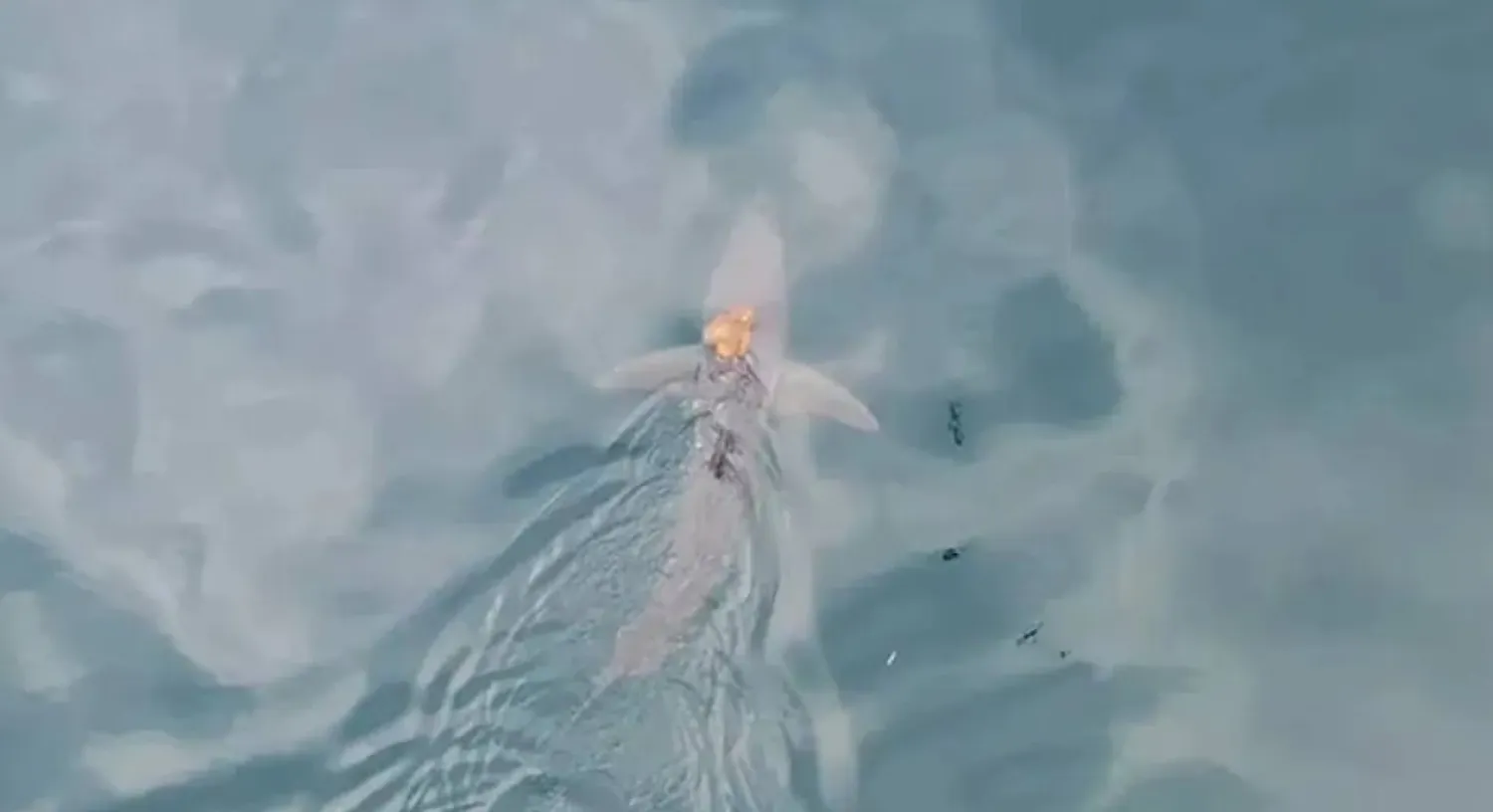

Octopus Riding a Shark Caught on Camera

Researchers with the University of Auckland captured the rare sighting in the Hauraki Gulf near Kawau Island in New Zealand. (Credit: University of Auckland)
TT

Octopus Riding a Shark Caught on Camera

Researchers with the University of Auckland captured the rare sighting in the Hauraki Gulf near Kawau Island in New Zealand. (Credit: University of Auckland)

A rare sighting, captured on video off the coast of New Zealand and shared by scientists affiliated with the University of Auckland, shows a Maori octopus riding on top of a mako shark, Fox News reported.

The university said the December 2023 encounter "was one of the strangest things University of Auckland marine scientists had ever seen. It was a mysterious sight indeed... octopus are mostly on the seabed while short-fin mako sharks don’t [favor] the deep."

The university researchers had been looking for shark feeding frenzies in the Hauraki Gulf near Kawau Island when a mako shark with an "orange patch" on its head was discovered, the report said.

The researchers launched a drone and put a GoPro camera in the water and "saw something unforgettable: an octopus perched atop the shark’s head, clinging on with its tentacles," University of Auckland Professor Rochelle Constantine wrote in a piece for the university last week.

Constantine added that the researchers moved on after 10 minutes, so they weren’t sure what happened to the "sharktopus" next, but the "octopus may have been in for quite the experience, since the world’s fastest shark species can reach [30 mph]."



Australian Bushfires Raze Homes, Cut Power to Tens of Thousands

Smoke billows from the Longwood bushfire along the Goulburn Highway in Victoria, Australia, 09 January 2026. (EPA)
TT

Australian Bushfires Raze Homes, Cut Power to Tens of Thousands

Smoke billows from the Longwood bushfire along the Goulburn Highway in Victoria, Australia, 09 January 2026. (EPA)

Thousands of firefighters battled bushfires in Australia's southeast on Saturday that have razed homes, cut power to thousands of homes and burned swathes of bushland.

The blazes have torn through more than 300,000 hectares (741,316 acres) of bushland amid a heatwave in Victoria state since the middle of the week, authorities said on Saturday, and 10 major fires were still burning statewide.

In neighboring New South ‌Wales state, several ‌fires close to the Victorian border were ‌burning ⁠at emergency level, ‌the highest danger rating, the Rural Fire Service said, as temperatures hit the mid-40s Celsius (111 degrees Fahrenheit).

More than 130 structures, including homes, have been destroyed and around 38,000 homes and businesses were without power due to the fires in Victoria, authorities said.

The fires were the worst to hit the state since the Black Summer blazes of 2019-2020 that destroyed an area ⁠the size of Türkiye and killed 33 people.

"Where we can fires will be being brought ‌under control," Victoria Premier Jacinta Allan told ‍reporters, adding thousands of firefighters were ‍in the field.

Prime Minister Anthony Albanese said the nation faced a ‍day of "extreme and dangerous" fire weather, especially in Victoria, where much of the state has been declared a disaster zone.

"My thoughts are with Australians in these regional communities at this very difficult time," Albanese said in televised remarks from Canberra.

One of the largest fires, near the town of Longwood, about 112 km (70 miles) north of Melbourne, has burned ⁠130,000 hectares (320,000 acres) of bushland, destroying 30 structures, vineyards and agricultural land, authorities said.

Dozens of communities near the fires have been evacuated and many of the state's parks and campgrounds were closed.

A heatwave warning on Saturday was in place for large parts of Victoria, while a fire weather warning was active for large areas of the country including New South Wales, the nation's weather forecaster said.

In New South Wales capital Sydney, the temperature climbed to 42.2 C, more than 17 degrees above the average maximum for January, according to data from the nation's weather forecaster.

It predicted ‌conditions to ease over the weekend as a southerly change brought milder temperatures to the state.


Britain’s Princess Catherine ‘Deeply Grateful’ After Year in Cancer Remission

Britain's Catherine, Princess of Wales reacts as she speaks to a patient next to Prince William, Prince of Wales, during an arts workshop at Charing Cross Hospital, in London, Britain, January 8, 2026. (Reuters)
TT

Britain’s Princess Catherine ‘Deeply Grateful’ After Year in Cancer Remission

Britain's Catherine, Princess of Wales reacts as she speaks to a patient next to Prince William, Prince of Wales, during an arts workshop at Charing Cross Hospital, in London, Britain, January 8, 2026. (Reuters)

Britain's future queen, Princess Catherine, marked her 44th birthday Friday with a video about the healing power of nature, almost a year since she revealed she was in remission from cancer.

Mother-of-three Catherine, who is married to heir-to-the-throne Prince William, released "Winter", the final instalment of her year-long "Mother Nature" video series, on her official Instagram and X.

"Even in the coldest, darkest season, winter has a way of bringing us stillness, patience and quiet consideration," Catherine, also known as Kate, says in the video's voiceover.

"I find myself reflecting on how deeply grateful I am... Fears washed away.

"Come to peace with our tears and discover what it means to be alive. To be at one with nature, a quiet teacher and a soft voice that guides, in memory, helping us to heal," she added.

Catherine is shown walking through wintry English countryside, interspersed with clips of other UK landscapes.

The nearly two-minute-long video posted on social media comes two years after the start of Catherine's health problems.

In January 2024, her Kensington Palace office announced she was facing weeks in hospital after successful abdominal surgery.

The surgery was for a non-cancer-related health issue, the palace said.

Weeks later, however, on March 22 an emotional Kate revealed in a video message that she had been diagnosed with an unspecified cancer and had begun preventative chemotherapy.

Her diagnosis coincided with King Charles III, her father-in-law, also being diagnosed with cancer, which was revealed by Buckingham Palace on February 5, 2024.

Charles, 77, said last month that his own treatment was expected to be pared back this year.


Experts Say Oceans Soaked up Record Heat Levels in 2025

People exercise along Sydney Harbour, Australia, 08 January 2026. (EPA)
TT

Experts Say Oceans Soaked up Record Heat Levels in 2025

People exercise along Sydney Harbour, Australia, 08 January 2026. (EPA)

The world's oceans absorbed a record amount of heat in 2025, an international team of scientists said Friday, further priming conditions for sea level rise, violent storms, and coral death.

The heat that has accumulated in the oceans last year increased by approximately 23 zettajoules -- an amount equivalent to nearly four decades of global primary energy consumption.

This finding -- published in the journal Advances in Atmospheric Sciences -- was the highest reading of any year since modern record keeping began in the early 1950s, researchers said.

To derive these calculations, more than 50 scientists from 31 research institutions used multiple sources including a thousands-strong fleet of floating robots that track ocean changes to depths of 2,000 meters.

Peering into the depths, rather than fluctuations at the surface, provides a better indicator of how oceans are responding to "sustained pressure" from humanity's emissions, said study co-author Karina von Schuckmann.

"The picture is clear: results for 2025 confirm that the ocean continues to warm," von Schuckmann, an oceanographer from French research institute Mercator Ocean International, told AFP.

Oceans are a key regulator of Earth's climate because they soak up 90 percent of the excess heat in the atmosphere caused by humanity's release of greenhouse gases like carbon dioxide.

All that additional energy has a powerful knock-on effect. Warmer oceans increase moisture in the atmosphere, providing fuel for tropical cyclones and destructive rainfall.

Hotter seas also directly contribute to sea level rise -- water expands when it warms up -- and make conditions unbearable for tropical reefs, whose corals perish during prolonged marine heatwaves.

"As long as the Earth continues to accumulate heat, ocean heat content will keep rising, sea level will rise and new records will be set," said von Schuckmann.

- Humanity's choice -

Ocean warming is not uniform, with some areas warming faster than others.

The tropical oceans, the South Atlantic, the Mediterranean, the northern Indian Ocean, and the Southern Ocean were among waters that absorbed record amounts of heat in 2025.

This occurred even as average sea surface temperatures decreased slightly in 2025 -- yet still remained the third-highest value ever measured.

This decrease is explained by the shift from a powerful, warming El Nino event in 2023-2024 to La Nina-type conditions generally associated with a temporary cooling of the ocean surface.

In the long term, the rate of ocean warming is accelerating due to a sustained increase in greenhouse gas concentrations in the atmosphere caused mainly by burning fossil fuels.

As long as global warming is not addressed and the amount of heat trapped in the atmosphere keeps rising, oceans will keep breaking records, the researchers said.

"The greatest uncertainty in the climate system is no longer the physics, but the choices humanity makes," said von Schuckmann.

"Rapid emission reductions can still limit future impacts and help safeguard a climate in which societies and ecosystems can thrive."