


10 Native Spring Ephemerals that Bring Early Color to the Garden

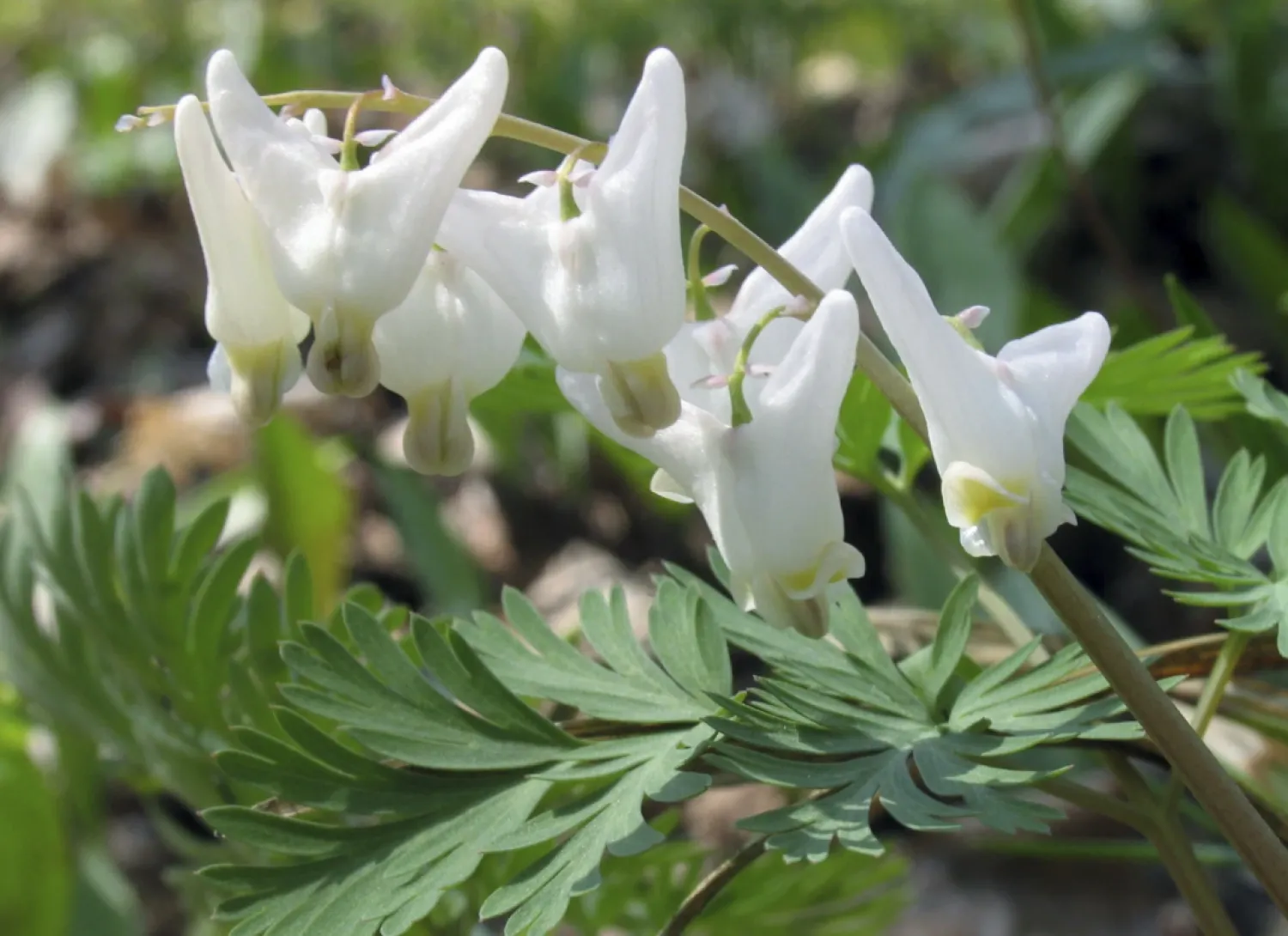
This July 12, 2005, image provided by Bugwood.org shows dutchman's breeches (Dicentra cucullaria). (Joseph OBrien/USDA Forest Service/Bugwood.org via AP)
TT

10 Native Spring Ephemerals that Bring Early Color to the Garden

This July 12, 2005, image provided by Bugwood.org shows dutchman's breeches (Dicentra cucullaria). (Joseph OBrien/USDA Forest Service/Bugwood.org via AP)

Spring brings the return of color to the garden as bulbs bloom, perennials re-emerge, and new annuals settle in. But there’s a less common category of plants that’s also worth knowing: native spring ephemerals.

Compared to most garden plants, ephemerals are fleeting, but their role in bridging the gap between winter and spring is invaluable.

Ephemerals come to life in very early spring to take advantage of the season’s increased soil moisture, early spring rains and the availability of sunlight under leafless trees.

They poke up, grow quickly, put on a colorful show and then go dormant all within 6 to 8 weeks, typically from when the last snow melts to when the trees leaf out. And unlike plants that leave fading foliage behind, ephemerals retreat without a trace — or nearly so — allowing you to take advantage of the precious real estate left behind for later-season, shade-loving perennials, The AP news reported.

Early food for insects, and a sight for sore eyes Native ephemerals' role in nature is to feed starving insects that emerge from dormancy at a time when other food is scarce. But they also provide flowery accents for garden-starved humans at a time when landscape color is scarce.

Plant potted ephemerals or their corms or rhizomes in either spring or early fall. If sowing seeds, do so in late summer or early fall to allow time for growth and root establishment before winter. Either way, select a spot under deciduous trees that receives temporary spring sunlight and has well-draining, acidic soil (exceptions are noted below).

A generous helping of compost, mixed into the soil, will provide nutrients, and a 2-inch layer of mulch will insulate and protect roots while dormant.

Fertilizer isn’t absolutely necessary, but a dose provided when buds begin to form in spring will boost flower size.

In fall, dig up and divide overgrown ephemerals, if necessary, and give the area a good watering to help prepare them for winter. Because the plants will likely disappear underground by mid-summer, marking their spots with popsicle sticks in spring will make finding them easier.

Here are 10 native spring ephemerals to consider: Azure bluet (Houstonia caerulea) — Small, pale-blue flower with yellow center and rosette leaves. Sow seeds just below the soil surface. Grow in rock gardens or in the lawn, but don’t mow until plants have set seed for the following year. Grows 8 inches tall.

Bloodroot (Sanguinaria canadensis) — One large, broad leaf and one orange-centered white flower per plant, each on its own stem. Spreads quickly to form a ground cover. Grows 12-14 inches tall.

Calypso orchid, fairy slipper (Calypso bulbosa) — A single, dainty, purple-magenta-yellow-white blossom atop a slender stem with a single leaf. Thrives best in shade or part shade and can handle alkaline soil. Grows 2-8 inches tall.

Dutchman’s breeches (Dicentra cucullaria) — Deep-cut, feathery foliage, slender stems and drooping, fragrant white flowers. Note to parents and pet owners: All of its parts are toxic, but only if consumed in large quantities; causes minor skin irritation when touched. Beneficial to bumblebees. Grows 10 inches tall.

Fringed bleeding hearts (Dicentra eximia) — Not to be confused with the Asian bleeding heart (Lamprocapnos spectabilis), this US native has light-green, fernlike foliage and clusters of drooping, heart-shaped pink flowers on mounding plants. Thrives in moist, rocky soil and prefers part-shade to shade. Attracts birds. Grows 1-2 feet tall.

Great white trillium (Trillium grandiflorum) — A triplet of oval leaves surrounds a solitary large white flower that turns pink as it matures. Berries and roots have a low toxicity, but only if eaten. Thrives in sun to shade. Grows 1-3 feet tall.

Virginia bluebells (Mertensia virginica) — Pink, but opens to reveal blue flowers on arching, branched stems. Prefers part shade or shade, and moist, rocky soil. A colonizing, rapid spreader. Grows 1-3 feet tall.

Rue anemone (Thalictrum thalictroides) — Pink or white flowers on maroon stems with whorled leaves. Prefers partly shady conditions. Note to parents and pet owners: All parts of this plant are toxic, but only if eaten in large quantities; contact with sap will cause irritation. Grows 9 inches tall.

Trout lily (Erythronium americanum) — Blotchy leaves and red-tinged, nodding yellow flowers with curled-back petals. Will perform best in full sun but can handle part shade. Does not transplant well, so leave it in place once planted. Grows 8 inches tall.

Twinleaf (Jeffersonia diphylla) — Each leaf is divided into two lung-shaped leaflets, with white, star-shaped flowers atop leafless flower stalks. Petals are delicate and can be blown off by wind. Grows 1-3 feet tall.



Mohammad Bakri, Renowned and Controversial Palestinian Actor and Filmmaker, Dies at 72

Palestinian actor Mohammed Bakri poses during the photocall for the film “Wajib” at the 70th Locarno International Film Festival in Locarno, Switzerland, on Aug. 5, 2017. (Urs Flueeler/Keystone via AP, File)
TT

Mohammad Bakri, Renowned and Controversial Palestinian Actor and Filmmaker, Dies at 72

Palestinian actor Mohammed Bakri poses during the photocall for the film “Wajib” at the 70th Locarno International Film Festival in Locarno, Switzerland, on Aug. 5, 2017. (Urs Flueeler/Keystone via AP, File)

Mohammad Bakri, a Palestinian director and actor who sought to share the complexities of Palestinian identity and culture through a variety of works in both Arabic and Hebrew, has died, his family announced. He was 72.

Bakri was best known for “Jenin, Jenin,” a 2003 documentary he directed about an Israeli military operation in the northern West Bank city the previous year during the second Palestinian intifada, or uprising. The film, focusing on the heavy destruction and heartbreak of its Palestinian residents, was banned by Israel, The AP news reported.

Bakri also acted in the 2025 film “ All That’s Left of You,” a drama about a Palestinian family through more than 76 years, alongside his sons, Adam and Saleh Bakri, who are also actors. The film has been shortlisted by the Academy Awards for the best international feature film.

Over the years, he made several films that spanned the spectrum of Palestinian experiences. He also acted in Hebrew, including at Israel’s national theater in Tel Aviv, and appeared in a number of famous Israeli films in the 1980s and 1990s. He studied at Tel Aviv University.

Bakri, who was born in northern Israel and held Israeli citizenship, dabbled in both film and theater. His best-known one-man-show from 1986, “The Pessoptimist,” based on the writings of Palestinian author Emile Habiby, focused on the intricacies and emotions of someone who has both Israeli and Palestinian identities.

During the 1980s, Bakri played characters in mainstream Israeli films that humanized the Palestinian identity, including “Beyond the Walls,” a seminal film about incarcerated Israelis and Palestinians, said Raya Morag, a professor at the Hebrew University of Jerusalem who specializes in cinema and trauma.

“He broke stereotypes about how Israelis looked at Palestinians, and allowing someone Palestinian to be regarded as a hero in Israeli society,” she said.

“He was a very brave person, and he was brave by standing to his ideals, choosing not to be conformist in any way, and paying the price in both societies,” said Morag.

Bakri faced some pushback within Palestinian society for his cooperation with Israelis. After “Jenin, Jenin,” he was plagued by almost two decades of court cases in Israel, where the film was seen as unbalanced and inciting.

In 2022, Israel's Supreme Court upheld a ban on the documentary, saying it defamed Israeli soldiers, and ordered Bakri to pay tens of thousands of dollars in damages to an Israeli military officer for defamation.

“Jenin, Jenin” was a turning point in Bakri’s career. In Israel, he became a polarizing figure and he never worked with mainstream Israeli cinema again, Morag said. “He was loyal to himself despite all the pressures from inside and outside,” she added. “He was a firm voice that did not change during the years.”

Local media quoted Bakri's family as saying he died Wednesday after suffering from heart and lung problems. His cousin, Rafic, told the Arabic news site Al-Jarmaq that Bakri was a tenacious advocate of the Palestinians who used his works to express support for his people.

“I am certain that Abu Saleh will remain in the memory of Palestinian people everywhere and all people of the free world,” he said, using Mohammed Bakri's nickname.


Over 60 Endangered Species Released into King Khalid Royal Reserve

These efforts align with the National Environment Strategy and Saudi Vision 2030 - SPA
TT

Over 60 Endangered Species Released into King Khalid Royal Reserve

These efforts align with the National Environment Strategy and Saudi Vision 2030 - SPA

In collaboration with the National Center for Wildlife (NCW), the Imam Abdulaziz bin Mohammed Royal Reserve Development Authority has released over 60 endangered species into the King Khalid Royal Reserve. This initiative supports a national program to reintroduce wildlife into their natural habitats.

CEO of the authority Dr. Talal Al-Harigi stated that the release aims to enhance biodiversity and restore natural habitats. He emphasized that the project fosters a stable environment for wildlife adaptation, SPA reported.

These efforts align with the National Environment Strategy and Saudi Vision 2030, which seek to improve the quality of life and promote sustainability. Dr. Al-Harigi noted that the partnership with NCW exemplifies institutional integration and the use of global best practices for successful reintroduction.

The release included species such as Arabian sand gazelles, Arabian oryx, wild hares, and mountain gazelles, contributing to biodiversity, ecological balance, and eco-tourism in the region.


'The Best Gift Ever': Baby is Born after the Rarest of Pregnancies, Defying All Odds

This photo provided by the family shows Ryu Lopez in California in October 2025. (Lopez family via AP)
TT

'The Best Gift Ever': Baby is Born after the Rarest of Pregnancies, Defying All Odds

This photo provided by the family shows Ryu Lopez in California in October 2025. (Lopez family via AP)

Suze Lopez holds her baby boy on her lap and marvels at the remarkable way he came into the world.

Before little Ryu was born, he developed outside his mom’s womb, hidden by a basketball-sized ovarian cyst — a dangerous situation so rare that his doctors plan to write about the case for a medical journal, The AP news reported.

Just 1 in 30,000 pregnancies occur in the abdomen instead of the uterus, and those that make it to full term “are essentially unheard of — far, far less than 1 in a million,” said Dr. John Ozimek, medical director of labor and delivery at Cedars-Sinai in Los Angeles, where Ryu was born. “I mean, this is really insane.”

Lopez, a 41-year-old nurse who lives in Bakersfield, California, didn’t know she was pregnant with her second child until days before giving birth.

When her belly began to grow earlier this year, she thought it was her ovarian cyst getting bigger. Doctors had been monitoring the mass since her 20s, leaving it in place after removing her right ovary and another cyst.

Lopez experienced none of the usual pregnancy symptoms, such as morning sickness, and never felt kicks. Though she didn’t have a period, her cycle is irregular and she sometimes goes years without one.

For months, she and her husband, Andrew Lopez, went about their lives and traveled abroad.

But gradually, the pain and pressure in her abdomen got worse, and Lopez figured it was finally time to get the 22-pound (10-kilogram) cyst removed. She needed a CT scan, which required a pregnancy test first because of the radiation exposure. To her great surprise, the test came back positive.

Lopez shared the news with her husband at a Dodgers baseball game in August, handing him a package with a note and a onesie.

“I just saw her face,” he recalled, “and she just looked like she wanted to weep and smile and cry at the same time.”

Shortly after the game, Lopez began feeling unwell and sought help at Cedars-Sinai. It turned out she had dangerously high blood pressure, which the medical team stabilized. They also did blood work and gave her an ultrasound and an MRI. The scans found that her uterus was empty, but a nearly full-term fetus in an amniotic sac was hiding in a small space in her abdomen, near her liver.

“It did not look like it was directly invading any organs,” Ozimek said. “It looked like it was mostly implanted on the sidewall of the pelvis, which is also very dangerous but more manageable than being implanted in the liver.”

Dr. Cara Heuser, a maternal-fetal specialist in Utah not involved with the case, said almost all pregnancies that implant outside the uterus — called ectopic pregnancies — go on to rupture and hemorrhage if not removed. Most commonly, they occur in the fallopian tubes.

A 2023 medical journal article by doctors in Ethiopia described another abdominal pregnancy in which the mother and baby survived, pointing out that fetal mortality can be as high as 90% in such cases and birth defects are seen in about 1 in 5 surviving babies.

But Lopez and her son beat all the odds.

On Aug. 18, a medical team delivered the 8-pound (3.6-kilogram) baby while she was under full anesthesia, removing the cyst during the same surgery. She lost nearly all of her blood, Ozimek said, but the team got the bleeding under control and gave her transfusions.

Doctors continually updated her husband about what was happening.

“The whole time, I might have seemed calm on the outside, but I was doing nothing but praying on the inside,” Andrew Lopez said. “It was just something that scared me half to death, knowing that at any point I could lose my wife or my child.”

Instead, they both recovered well.

“It was really, really remarkable,” Ozimek said.

Since then, Ryu — named after a baseball player and a character in the Street Fighter video game series — has been healthy and thriving. His parents love watching him interact with his 18-year-old sister, Kaila, and say he completes their family.

With Ryu’s first Christmas approaching, Lopez describes feeling blessed beyond measure.

“I do believe in miracles,” she said, looking down at her baby. “God gave us this gift — the best gift ever.”